
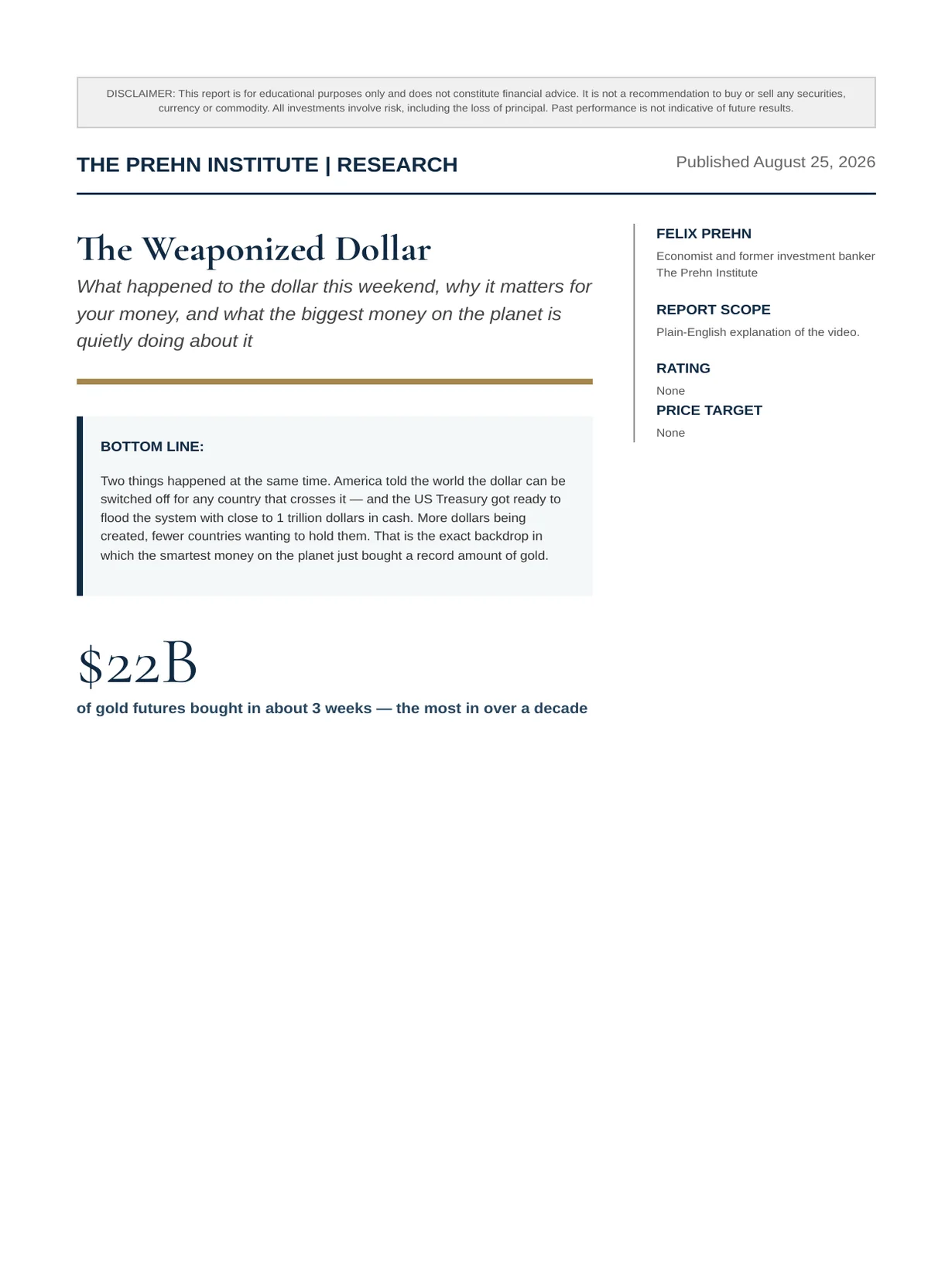
The Weaponized Dollar
What happened to the dollar this weekend, why it matters for your money, and what the biggest money on the planet is quietly doing about it
Felix Nikolas Prehn · 25 August 2026 · 14 pages
Bottom line
Two things happened at the same time. America told the world the dollar can be switched off for any country that crosses it — and the US Treasury got ready to flood the system with close to 1 trillion dollars in cash. More dollars being created, fewer countries wanting to hold them. That is the exact backdrop in which the smartest money on the planet just bought a record amount of gold.
$22Bof gold futures bought in about 3 weeks — the most in over a decade
Bottom Line
One setup, two moves
MOVE 1
The dollar became a weapon. Over one weekend the US Treasury Secretary said any country helping Iran would be "removed from the US dollar system," launched something called Operation Economic Outcast, and called it an "economic D-Day." The message to the rest of the world was simple: the dollar can be switched off.
MOVE 2
The money machine got switched on. At the same time, the Treasury is sitting on close to 1 trillion dollars in cash and just doubled a program to buy back its own government debt, starting September 9. In plain English: more dollars are about to be pushed into the system.
THE COMBINATION
More dollars, fewer buyers. When you create more of something while making the rest of the world less keen to hold it, its value tends to fall. That is the setup. And it is already moving.
THE TELL
Follow the money, not the mood. While the news showed tankers and sanctions, central banks and the biggest clients at the biggest banks bought a record amount of gold — about 22 billion dollars of it in roughly 3 weeks, the most in over a decade.
Key idea.
The Iran story and the Treasury story are not 2 separate headlines. They are 1 story about the dollar — and the people who move billions are treating it that way.
The Weekend They Weaponized the Dollar
"We are now entering the endgame"
Mainstream coverage of the weekend sanctions announcement. Source: CBS News, August 24, 2026.
WHAT WAS ANNOUNCED
Operation Economic Outcast. The Treasury targeted close to 60 companies and ships overnight, across 5 sectors — including gold. Officials described it as an "economic D-Day" and said any country helping Iran could be "removed from the US dollar system."
WHY IT IS BIGGER THAN IRAN
It is a demonstration. Because almost all global trade runs through dollars, cutting a country off from dollars is close to cutting it off from the world economy. The rest of the world just watched that power used in public.
WHAT IT DOES TO IRAN
The pain shows up in prices. Iran's currency, the rial, hit a record low. Reported food prices jumped — rice up around 60%, beef up around 150% — and the IMF pointed to a roughly 5% hit to the economy. That is what a currency losing trust looks like from the inside.
THE QUIET CONSEQUENCE
Every other country is taking notes. If the dollar can be switched off for one country, a cautious government elsewhere starts asking a simple question: what do we hold instead, just in case? Historically, the answer has been gold.
The Trillion-dollar Money Machine
Close to $1 trillion, ready to go
Source: CNBC, August 24, 2026. The Treasury General Account is, in plain English, the government's own checking account.
THE CASH PILE
A government checking account near 1 trillion dollars. The Treasury General Account is the government's own cash balance at the Fed. It has been built up to close to 1 trillion dollars — a huge amount of money that can be spent back into the system.
THE BUYBACK
Buying back its own debt — at double the size. The Treasury doubled the size of a program that buys back its own government bonds, from about 2 billion to at least 4 billion per operation, starting September 9. When the government buys bonds back, it hands cash to the sellers. That is money going into the system.
WHY NOW
Borrowing got expensive. The 30-year government borrowing rate has been sitting around 5.25%. Pushing cash in and buying back bonds is one way to try to hold those rates down — but it also means more dollars in circulation.
THE PLAIN-ENGLISH VERSION
They are doing both at once. Telling the world the dollar can be switched off, while quietly getting ready to make a lot more of them. That is the combination that matters.
Why This Reaches Your Bank Account
More dollars, fewer buyers
Dollar used as a weapon
→
World trusts the dollar a little less
→
Treasury pushes more dollars into the system
→
Each dollar is worth a little less over time
THE HONEST PART
This is slow, not a crash. Nobody is saying the dollar disappears next week. The risk is quieter than that: the cash in your account slowly buys less, while the world gradually moves some of its savings out of dollars and into things that cannot be printed.
WHY THE NEWS MISSES IT
Headlines are about the war. Most people this week will watch the tankers and the sanctions, feel a bit anxious, and completely miss the real move — their own cash losing value while the rest of the world quietly gets off the dollar.
WHO ALREADY KNOWS
The biggest money on the planet. Central banks and the largest clients at the largest banks do not wait for a headline to tell them. They act early and quietly. On the next page, look at exactly what they just did.
THE QUESTION
Do they know something you don't? That is the only question that matters here. And their behaviour — not their words — is the clearest answer you will get.
What the Smart Money Is Doing
A record bet on the oldest money there
is
$22B
of gold futures bought in about 3 weeks
- the most in over 10 years
- 89%
- of central-bank reserve managers expect to add gold
- 2023
- China buying gold at its fastest pace since then
THE RECORD BUYING
About 22 billion dollars, in roughly 3 weeks. Speculators bought a record amount of gold futures — the largest such position in over a decade. This is not retail investors nibbling. It is big, professional money moving fast.
THE CENTRAL BANKS
The buyers with the longest memory. Central banks have been stacking gold, with China buying at its fastest pace since 2023. In a recent survey, 89% of the reserve managers who run these national savings said they expect to add more gold. They are the ones most worried about a weaponized dollar — because they hold the most dollars.
THE CHART MOMENT
Gold climbed back above its 200-day line. The 200-day moving average is just the average price over the last 200 days
- a simple line traders use to tell an uptrend from a downtrend. Gold crossed back above it for the first time since 2023 and is up roughly 15% into the $4,600–4,700 area.
WHY IT MATTERS
Behaviour beats opinion. You do not have to guess what the big money thinks. You can see what it is buying. And right now, it is buying the one form of money that no government can print.
The Gold and Silver Forecasts
$4,900 gold — and 1 desk's bet on $90
silver
THE GOLD TARGET
A major Wall Street bank sees $4,900 by year-end. Goldman Sachs put a year-end 2026 gold target of 4,900 dollars on the table and flagged "significant upside risk" beyond it. That is one forecast, not a promise — but it tells you how a major desk is thinking.
THE AMPLIFIER
Options can push the price further. The same desk described a surge in demand for call options — contracts that pay off if the price rises — as a "mechanical price amplifier." In plain English: the way people are betting can add fuel to a move once it starts.
THE SILVER BET
90 dollars silver, in 3 months. One trading desk placed a bet, through options, that silver — the boring one — reaches 90 dollars within about 3 months. Frame it correctly: this is 1 desk's aggressive bet, not a consensus forecast. But it is a real position, with real money behind it.
HOW TO HOLD THESE NUMBERS
As signals, not guarantees. Nobody knows the exact path or price. The point is direction and conviction: serious institutions are putting serious money behind higher, not lower.
Important.
This report contains no rating and no price target of its own. The figures above are other institutions' published views, repeated here to explain the video. Forecasts can be wrong. Do your own research.
Why Cash Is the Guaranteed Loser
$1 in 1971 buys about 12 cents today
The image.
Cash is an ice cube on a warm counter. It looks unchanged at first, but its purchasing power melts over time. This does not mean "hold no cash." It means don't confuse short-term safety with long-term wealth storage.
- 1971
- The year the dollar came off gold. Until 1971 the dollar was tied to gold. Once that link was cut, governments could create dollars far more freely — and they did.
THE RESULT
A slow, steady loss. By the standard inflation measures, a 1971 dollar has lost the vast majority of its purchasing power — roughly 88% of it. In other words, 1 dollar back then buys you about 12 cents' worth of goods today.
WHY GOLD HOLDS UP
You cannot print it. Gold's whole appeal is that its supply grows slowly and no government controls it. When confidence in paper money is under pressure, that scarcity is exactly what people want.
THE TAKEAWAY
Sitting entirely in cash is a decision, too. It feels safe, but over long stretches it has been a guaranteed slow loss of buying power. That is the trade-off to understand before you "do nothing."
What This Means for You
A plan matters most when the headlines feel loud
THE BIGGER RISK BEHIND ALL THIS
The AI bubble sits on top of it. All of this — a weaponized dollar and a trillion-dollar money machine — is landing on top of the biggest speculative bubble since the year 2000. Big tech is set to spend around 700 billion dollars on AI this year alone.
THE HISTORY THAT SHOULD WORRY YOU
The internet was real, and it still crashed. The internet was arguably the greatest invention of our lifetime — and the NASDAQ still fell 78% after 2000, and took 15 years to climb back. The technology being real does not stop the bubble from bursting.
MAKE IT PERSONAL
Picture a 55-year-old with $100,000. That is roughly the average retirement pot in your 50s. A 78% drop, like the NASDAQ's, turns 100,000 dollars into 22,000 — and history says it might not recover until you're 70. This already happened to millions of people once.
THE RESPONSE
Don't panic — get a system. Gold and silver may be a big part of the answer. But the real fix is having a simple, calm plan for your 401k, your pension and your retirement — so a crash becomes something you prepared for, not something that happens to you.
Turn Understanding into a Plan
Five questions to ask before the next
headline
Free live session — Survive The Bubble
survivethebubble.com
Felix walks you through how to protect your 401k, pension and retirement from the kind of crash history says is coming. It has to be live so you can ask
Do I have 3 to 6 months of expenses set aside without having to sell investments?
✓
How much of my long-term savings is sitting in cash that quietly loses value every year?
✓
Do I own anything that a government cannot print — like gold or silver?
✓
Am I overexposed to one crowded theme, like big-tech AI, without realising it?
✓
If the market fell 50–78% like it did after 2000, do I have a plan — or would I panic?
✓
Disclaimer
This report is for educational and informational purposes only and does not constitute financial, investment, legal, tax or accounting advice. It is not a recommendation, solicitation or offer to buy or sell any security, currency, commodity or financial product. No buy/sell rating or price target is provided. All investments involve risk, including the possible loss of principal. Forecasts and price targets described here are the published views of third parties, may be wrong, and may not repeat. Historical comparisons are illustrative and simplify complex events. Readers should do their own research and consult appropriately qualified professionals before making financial decisions. Past performance is not indicative of future results. The Prehn Institute makes no guarantee regarding outcomes.