
The Two Wall Streets
Wall Street is cheering AI louder than anything since the dot-com days — so why are the stocks falling? A plain-English look at the gap between what the big banks say and what they do.
Felix Nikolas Prehn · 15 July 2026 · 23 pages
Bottom line
You are probably already in this trade. You may not own a single share of any AI stock on purpose. But if you hold a workplace retirement account, an IRA, or a broad index fund, a handful of AI-linked companies have grown so large that they now make up a big slice of the whole market. When they move, your “safe, boring, diversified” fund moves with them. You were, in effect, signed up without a signature.
Overview
- How To Read Any Research Report Like An Insider
- The Language Of Hype
- A Beginner's Glossary
- Frequently Asked Questions
- The Psychology Of A Bubble
About Felix Prehn & The Prehn Institute · Sources · Disclaimer
The Two Wall Streets
Bottom Line:
2. WHY THIS REPORT MATTERS TO YOU
You are probably already in this trade. You may not own a single share of any AI stock on purpose. But if you hold a workplace retirement account, an IRA, or a broad index fund, a handful of AI-linked companies have grown so large that they now make up a big slice of the whole market. When they move, your “safe, boring, diversified” fund moves with them. You were, in effect, signed up without a signature.
Our goal is understanding, not prediction. We are not going to tell you the market will crash on a certain date. Nobody knows that, and anyone who claims to is selling something. What we can do is show you how the machine works, so that when you hear an analyst on television promise the sky, you know which questions to ask.
Plain English, on purpose. Every technical term is explained the first time it appears. If a sentence needs a finance degree to follow, we consider that our mistake, not yours.
3.
THE
SETUP:
WHAT
“PUMPING A
STOCK” MEANS
The core conflict. Big banks earn enormous fees arranging deals — helping companies sell shares and bonds. The same banks also employ analysts who publish research telling the public what to buy. In theory those two jobs are kept separate. In practice, a bank that wants a company's next fee has an incentive to keep that company happy — and an analyst who publishes a harsh view may not get invited back. When the cheering is loudest, it is worth asking who gets paid when you buy.
Two Wall Streets. There is the Wall Street you see: the research notes, the confident guest in a good suit, the eye-watering valuations. And there is the Wall Street you don't see: the trading desk and the bond desk, where the firm bets its own money on what it actually believes. Same logo. Same building. Frequently, the opposite message. This report is about learning to tell which one you are listening to.
Our time window. This is a snapshot of the last three months, built around events reported during that window and the numbers behind them.
The Two Wall Streets · July 15, 2026
4. The Spacex Case: Every Force Up, Still Falling
A textbook set-up for a rising price. Recently one of the most-hyped names on the planet joined a major stock index on fast-track rules that cut the required trading history to just fifteen days. Index inclusion forces buying: every fund that tracks the index has to buy the stock, regardless of quality. On top of that, eighteen of nineteen analysts stamped it a “buy.” Forced buying plus a wall of buy ratings is about as much upward pressure as a stock can get.
And it fell anyway. It dropped on the day it was included, more over the following week, and a great deal from its peak — leaving ordinary buyers underwater. When a stock cannot rise even with every possible tailwind, that tells you something the ratings do not.
Why forced buying can be a trap. Index inclusion sounds like a stamp of approval, but the funds buying are not judging quality — they are simply obeying a rule. That creates a wave of purchases that has nothing to do with whether the business is any good. When that mechanical wave passes and the price still cannot hold, the only buyers left are the ones who actually studied the company — and if they are not showing up, the message is loud.
EXHIBIT 1 — EVERY FORCE PUSHED IT UP, AND IT FELL ANYWAY
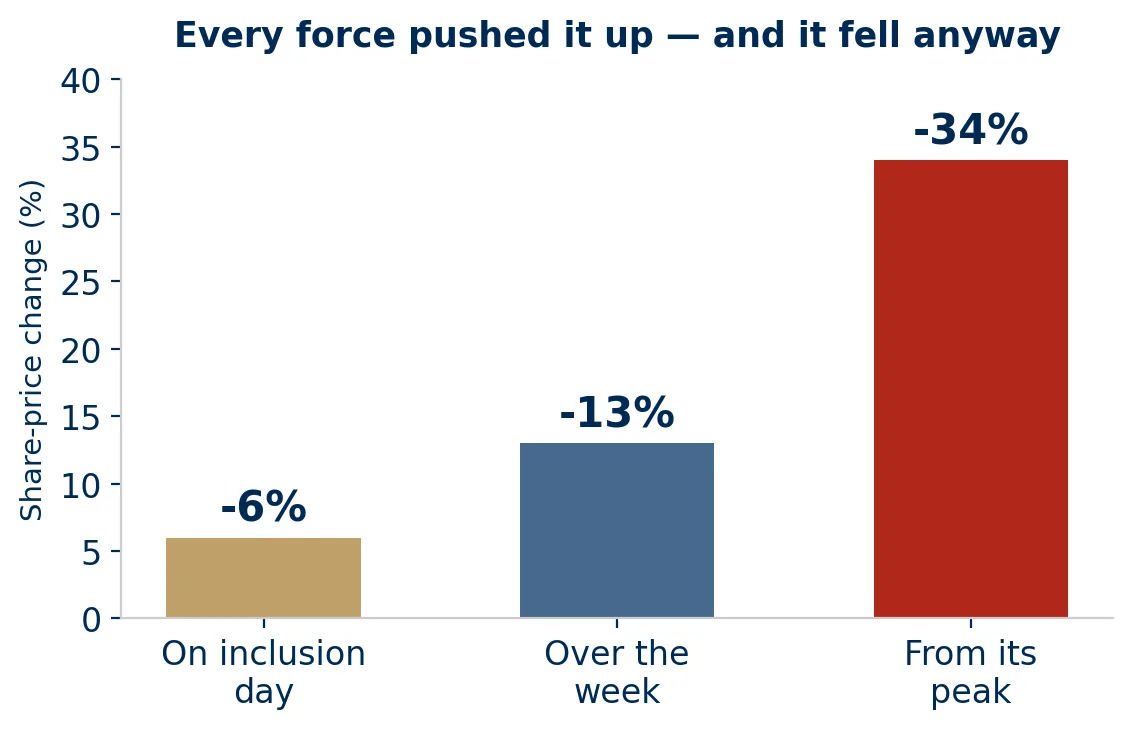
Source: Winston app. Percentages, not prices; figures approximate.
The valuation tell. Some banks assigned this company a value equivalent to more than 500 times its yearly
sales. For context, almost nothing on Earth trades above roughly 100 times sales, and even that is reserved for a red-hot software company on a very good day. This name is also reportedly burning through billions of dollars every quarter. A very high multiple on a business that is losing cash is a fragile combination.
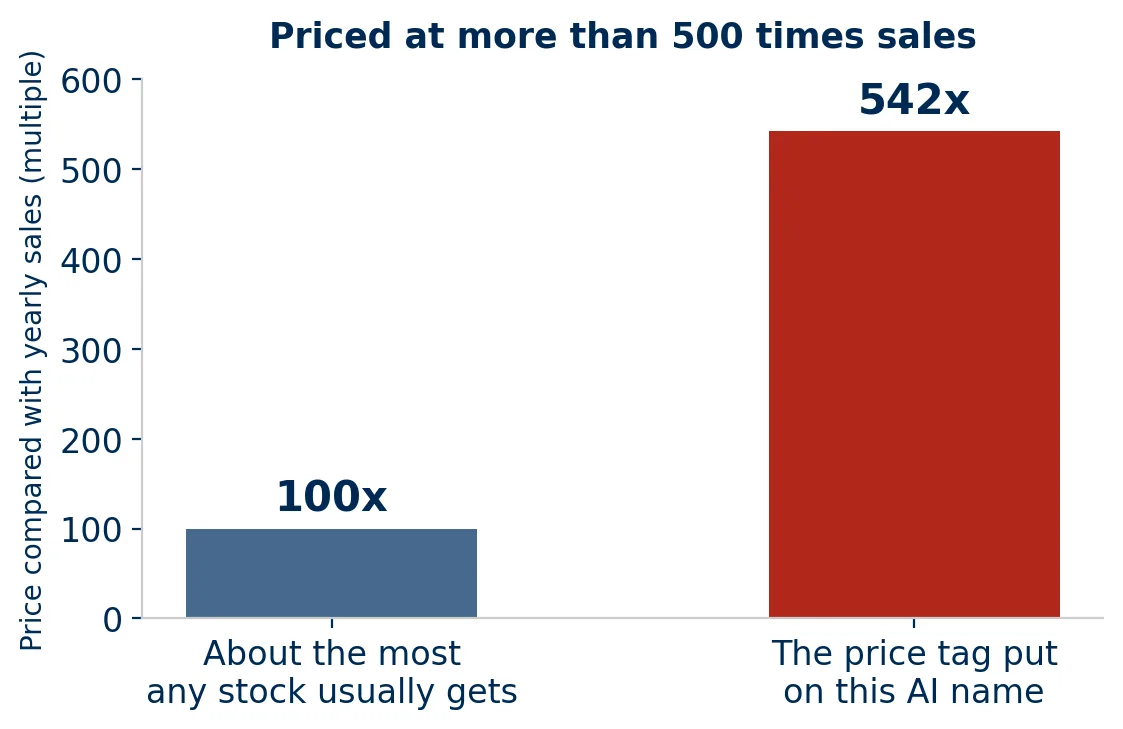
Source: Winston app. “Multiple” = company value divided by yearly sales. Figures approximate.
5. FOLLOW THE FEES
Why serious people sign eye-watering numbers. A company like this may need to raise on the order of $235
billion in the coming years to fund its ambitions. The banks that arrange financing of that size earn roughly
KEY IDEA When a research note starts reading like a movie trailer — “the apex of civilizational ambition,” “the final frontier” — treat it as marketing until proven otherwise. Banks do not write poetry about boring, profitable companies. Breathless language is a signal to ask who is getting paid.
6. COMPANY IN FOCUS: IBM (IBM)
The twist of the whole story. IBM is not a hot AI start- up. It is a 115-year-old company that survived the Great Depression, two world wars, the mainframe era, the personal-computer era and the internet. And in the middle of the greatest technology boom of our lifetimes, it just printed the worst single trading day of its entire existence.
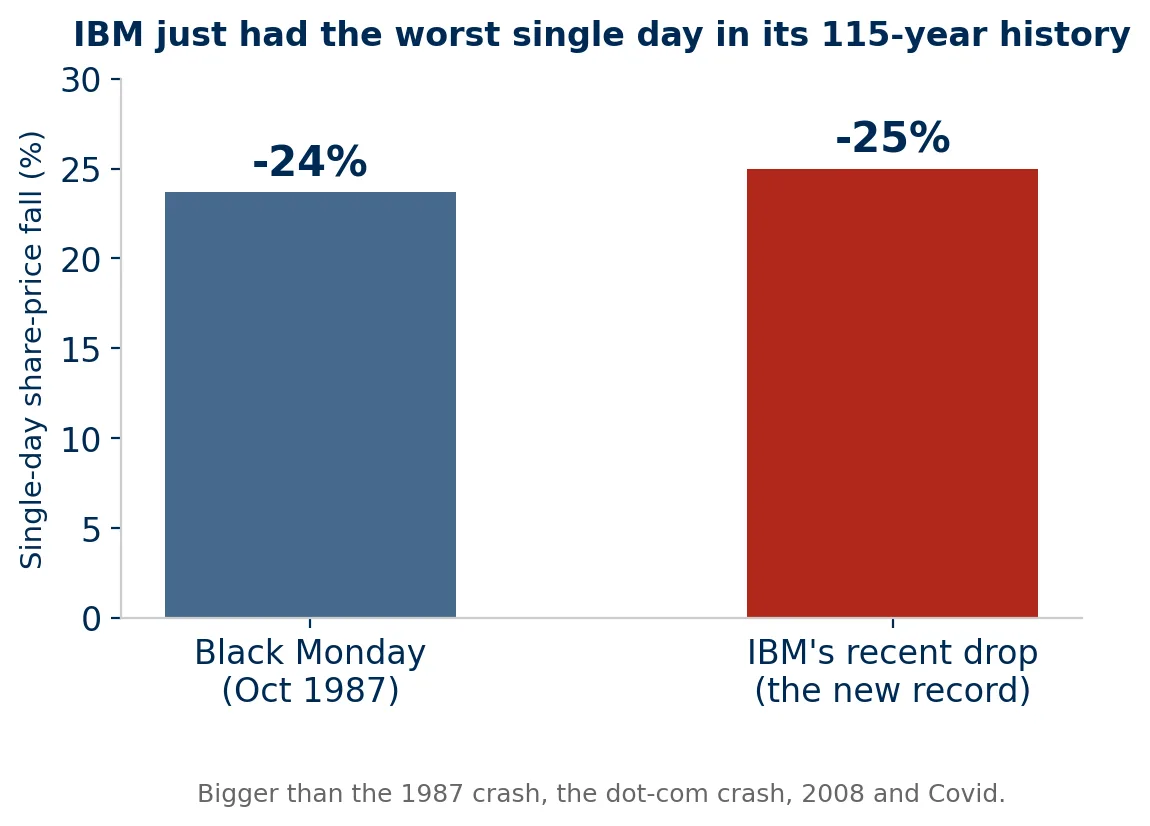
Source: Winston app. Single-day percentage moves; figures approximate.
The obvious guess is wrong. You might assume the old dinosaur simply got left behind by AI. It's the opposite. IBM did not fall despite the AI boom. It fell because of it — and that is what makes this the most important case study in the report.
7. WHY IBM FELL BECAUSE OF AI
“Capex reprioritization” in plain English. Management explained that big corporate customers took budgets they would normally spend on IBM's software and mainframes and redirected that money toward AI infrastructure — the chips and data centres everyone is excited about. Translated from corporate- speak: customers robbed IBM's budget to feed the AI machine.
IN ONE SENTENCE Money is not gently flowing into the whole tech sector and lifting every boat. It is being ripped out of one part of technology and shovelled into another. That is one boat sinking three others to stay afloat.
Why that is scarier than a hot stock falling. When a boom has to eat healthy, century-old, profitable companies to keep feeding itself, that is not the beginning of something. It is a sign of the late stage of something.
8. THE CONTAGION: SOFTWARE PEERS
It did not stop at IBM. On the same day, the fear jumped to other big, established software names — Microsoft, Salesforce and ServiceNow among them — which fell in sympathy. The market suddenly saw the risk: if companies are starving their normal software spending to fund AI, that threatens a whole set of stocks that investors think of as “safe.”
Why we mention these peers. They are the closest comparable businesses to the IBM story — large enterprise-software providers whose customers are making the same budget choice. We name them to show how one company's problem became a sector-wide question, not to make any call on their shares.
The lesson for a portfolio. "Safe" is not a permanent label. Companies people file under "steady, boring, reliable" can be quietly exposed to the very trend everyone is chasing elsewhere. The only way to know is to look inside a business and ask where its customers' money is really going — not to trust the label it wore last year.
9. THE BORROWING MACHINE
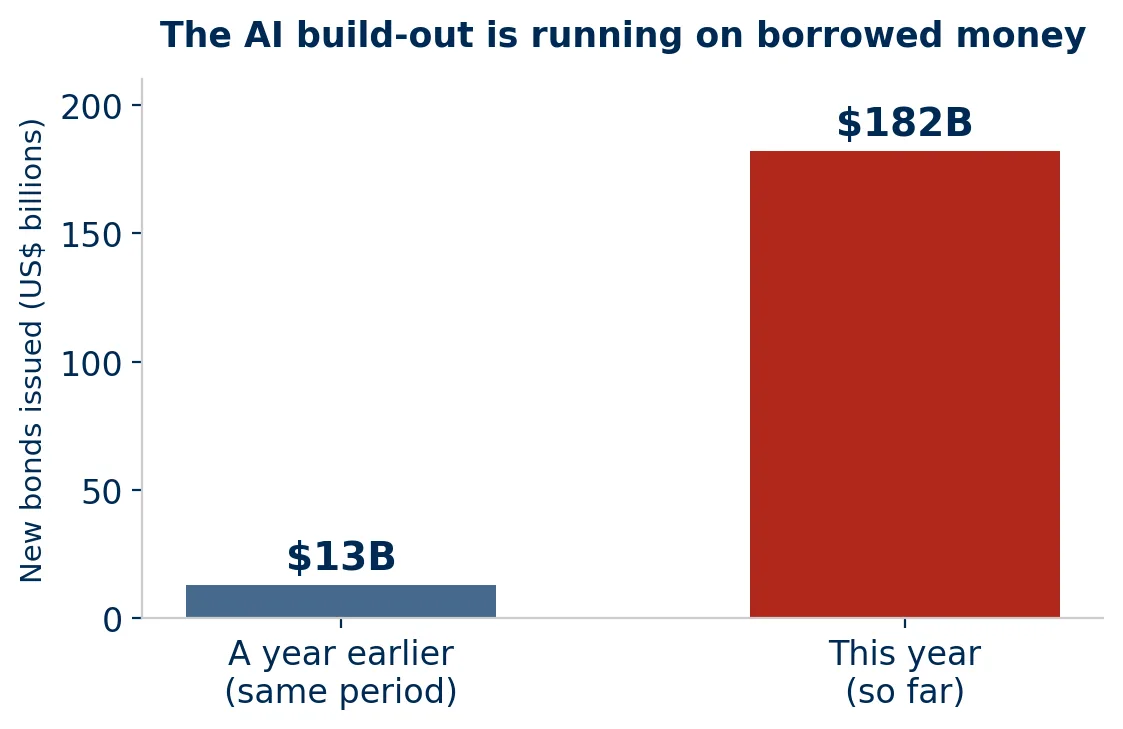
The boom runs on debt. The AI build-out — the data centres, the chips — is not being paid for out of profits. It is being paid for with borrowed money. In a matter of months, a small group of firms issued roughly $182
billion of brand-new bonds, a huge jump on the same period a year earlier.
Source: Winston app. Figures approximate.
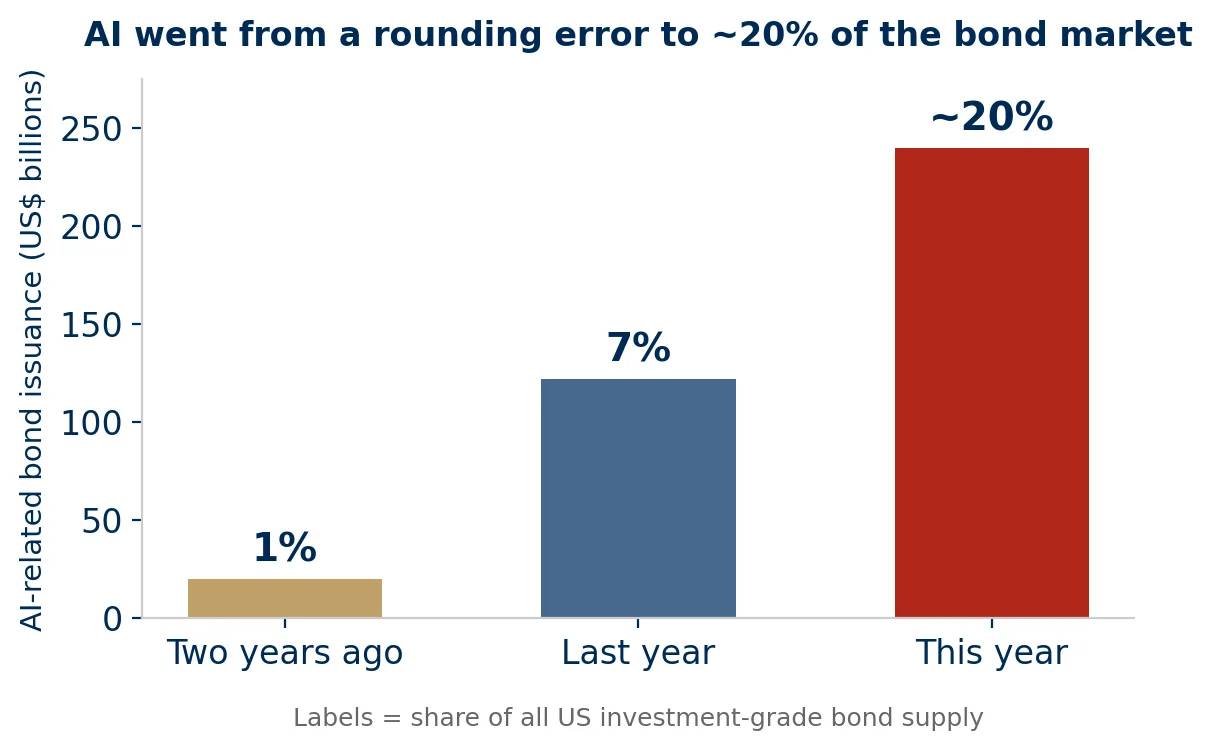
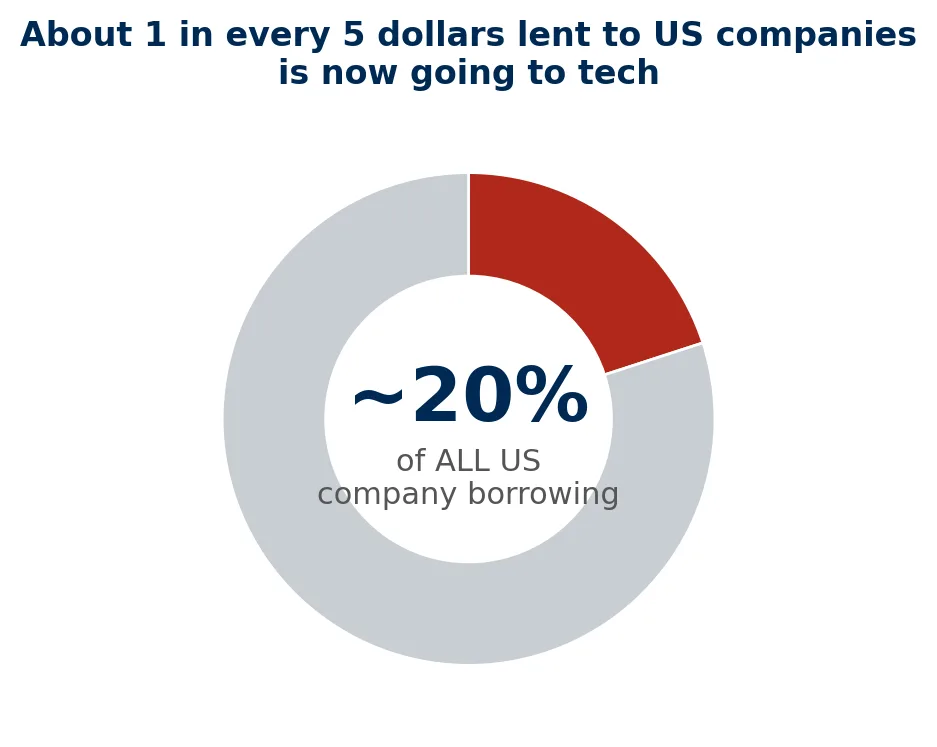
One trade, a fifth of the market. At one point AI-related borrowing was close to 20% of the entire investment- grade corporate bond market — one theme accounting for roughly one in every five dollars lent to US companies. And leverage — debt compared with what these companies actually earn — has on some of the biggest players roughly doubled.
EXHIBIT 5 — AI WENT FROM A ROUNDING ERROR TO ABOUT A FIFTH OF THE MARKET
Source: Winston app. Figures approximate.
EXHIBIT 6 — ONE IN FIVE DOLLARS LENT TO US COMPANIES IS GOING TO TECH
Source: Winston app. Figures approximate.
10. THE CIRCULAR FINANCING TRICK
Watch the same dollar do a lap. Here is how the growth can look bigger than it really is. A giant chip maker invests billions into an AI start-up. The start-up then uses that same money to buy chips — from the chip maker that just funded it. The chip maker books the purchase as revenue. Revenue looks like it's booming, the stock rises, everyone cheers.
EXHIBIT 7 — THE MONEY-IN-A-CIRCLE TRICK
Chip maker invests $1 into an AI start-up
↓
Start-up spends that $1 buying chips…
↓
…from the same chip maker, booked as REVENUE
↻
Why it matters. Follow the actual dollar: it left the chip maker, went to the start-up, and came right back as “sales.” A chunk of what looks like roaring demand can be one dollar in a circle wearing different hats. Real, external demand is durable. Circular demand vanishes the moment the investing stops.
11.
THE
GREAT
ROTATION
INTO
LEVERAGE
The thrill-seeking money moved. A year ago the exciting thing was crypto. Bitcoin has since roughly halved from its peak, and trillions in crypto value evaporated. That appetite for a thrill did not disappear — it rotated, straight into AI stocks, and increasingly into leveraged bets on them.
Amplified bets.200 Amplified bets. In roughly six months, more than 200 leveraged exchange-traded funds launched — products that magnify a bet, so you win more when you are right and get wiped out faster when you are wrong. They are now worth more than $150 billion. That is the same casino energy as the crypto mania, just pointed at chip names now.
Enormous corporate debt, propping up partly circular revenue, supporting very high valuations, increasingly bought with borrowed, leveraged money by investors who just got burned in crypto. Pull any one card out of that tower and you understand why the trading desks are nervous.
The Two Wall Streets · July 15, 2026
12. Felix's Rules: How to Pick Great
STOCKS
Quality first. Felix's approach does not chase “value” or “growth” for their own sake — it looks for quality. The checklist below is the lens we use throughout this report. It is a way of thinking, not a recommendation about any single stock.
IS THE BUSINESS PROFITABLE?
Gross Margin Indicates the size of the moat. Reveals core efficiency and the ability to absorb shocks.
Operating Margin Reveals profitability after all operational costs. A good measure of cost control.
ROCE Return to all financial stakeholders (equity and debt). A good measure of management effectiveness.
IS IT GENERATING CASH?
Cash Conversion Ability to turn profits into cash. A good measure of efficiency and flexibility.
| Levered Free Cash Flow Margin | Reveals what portion of sales ends up as cash. |
|---|---|
| IS IT FINANCIALLY STABLE? | |
| Leverage | A measure of financial risk. Tells a story about the volatility of returns. |
| Interest Cover | Degree of financial comfort regarding debt. A high ratio suggests stability and flexibility. |
| VALUATION | |
| P/E + Forward P/E | A short-term valuation snapshot plus a forward-looking view. This is the least important of our metrics. |
| Consistent earnings growth? | Shows whether the business is reliable or cyclical. |
| Rising EPS? | Reveals whether shareholder value is increasing or being diluted. |
| MOAT (COMPETITIVE ADVANTAGE) | |
| Sources of a moat | Cost advantage; size advantage (economies of scale); high switching costs; patents, brand or government licences. |
13. THE RULES FOR GROWTH STOCKS
Different data, more risk. Younger growth companies lack the long track record quality investors prefer, so they are harder — and riskier — to judge. Felix uses a separate checklist that leans on the data that is available and demands a longer time horizon. cash position to survive a crash.
Large target market A total addressable market at least ~25x current size.
Brand & technology leadership A strong, clean brand; genuine tech leadership; high R&D spend to build a moat.
CEO / founder heavily invested Skin in the game (e.g. Tesla, Square, Spotify, MercadoLibre, AMD).
Fully understand the business Can you write down three reasons this company is better than its competitors?
The Two Wall Streets · July 15, 2026
14. A Worked Example Through the Quality Lens
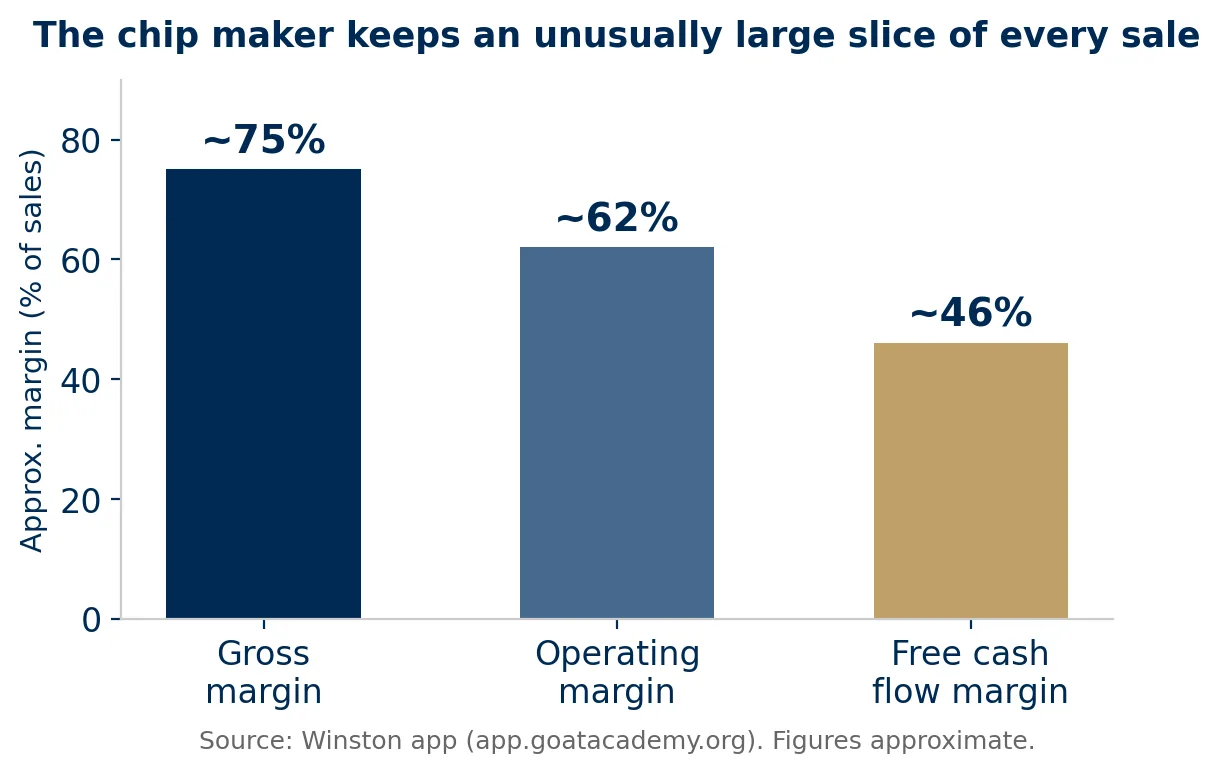
Applying the checklist. To show the lens in action, consider the chip maker at the centre of the circular- financing story. On the profitability tests it screens as unusually strong: it keeps a very large slice of every sale as gross profit, and a healthy portion drops all the way to cash.
EXHIBIT 8 — A VERY PROFITABLE BUSINESS, ON THE NUMBERS
Source: Winston app. Figures approximate.
The point of the exercise. A business can pass the quality tests and still sit inside a risky trade. Strong margins do not protect you from a rich valuation, from circular revenue, or from a whole sector funded by debt. Quality and safety are not the same thing — and that distinction is the heart of this report.
Free cash flow margin Share of sales that ends up as cash ~46% — strong
Leverage Financial risk from debt Low at the company level; see live figures in the
Winston app
Interest cover Comfort in servicing debt Comfortable; see live figures in the Winston app
Cash conversion Turning profit into cash Strong; see live figures in the Winston app
F R E E L I V E T R A I N I N G
Protect your money before the AI trade turns
15. THE GOLDMAN TIMELINE: TWO WALL
STREETS IN 48 HOURS
Both Wall Streets, caught at once. Here is the clearest recent example of the gap between what a bank says and what it does, all inside roughly two days.
Step one — privately. A respected financial newspaper reported that banks were quietly trying to offload the AI- infrastructure debt they had been holding — to move the risk off their own books onto someone slower.
Step two — publicly. About forty-eight hours later, a bulge-bracket bank published a big, loud, optimistic report on the AI trade — the kind that reassures nervous investors to keep holding.
Step three — on their own desk. Around that same window, that bank's own traders — the people moving real money in these exact bonds — reportedly described what was happening with one word: “carnage.”
THE PATTERN Sell the beautiful story to the public; move the ugly risk to someone else. It is the same shape as the hot-stock underwriting story at the top of this report — the roles of “talk” and “trade” simply swap costumes.
16. RISK FACTORS
DEBT & REFINANCING RISK A build-out funded by borrowing depends on cheap, available credit. If lenders demand higher rates or step back, the spending that relies on new loans can slow quickly.
CIRCULAR-REVENUE RISK Where revenue is partly the same money circulating between firms that own pieces of each other, reported growth can overstate real, external demand — and can reverse when the investing stops.
CONCENTRATION RISK A small number of AI-linked names have grown into a large share of the whole market. When they fall, they can drag broad index funds down with them — including retirement accounts that never chose the trade.
Research is produced by firms that also earn fees from the companies they cover. A rule that once separated the two was recently rolled back (see Section 19), removing a guardrail just as the hype peaks.
VALUATION RISK Very high multiples on businesses that are burning cash leave little room for disappointment. Small changes in expectations can cause large price moves.
LEVERAGE & PRODUCT RISK Leveraged ETFs and other amplified products magnify losses as well as gains. In a fast, sharp fall they can lose value far quicker than the stocks they track — and some never recover even if the underlying shares later bounce back.
SENTIMENT & CROWDING RISK When one trade becomes "the only game in town," a huge crowd is standing on the same side of the boat. If sentiment turns, everyone tries to leave at once, and the exits are narrow. Crowded trades tend to unwind faster than they built up.
17. OPPORTUNITIES
Genuine demand is real. None of this means AI is fake. Real computing demand, real efficiency gains and genuinely profitable enablers exist inside the theme. The task is separating durable, cash-generating businesses from stories propped up by debt and circular revenue.
Quality at the core. Companies that keep a large slice of every sale, convert profit into cash and carry modest debt are better placed to survive a shake-out — and to buy up weaker rivals when the cycle turns.
Patience is an edge. The investors who do best in a bubble are rarely the ones who guess the exact top. They are the ones who understand what they own, avoid the most-leveraged corner, and keep some dry powder for when good businesses go on sale.
Shake-outs create winners. Every past technology boom, even the ones that ended in tears, left behind a handful of genuinely great businesses that grew for decades afterwards. The internet was real even though most dot-coms failed. The opportunity is not to avoid the theme entirely — it is to own the survivors, not the stories.
The Two Wall Streets · July 15, 2026
18. Lower-risk Exposure: Sector & Industry ETFs
Why an ETF can lower single-stock risk. An exchange-traded fund (ETF) holds a basket of many companies, so one company's bad day hurts less than if you owned it alone. It does not remove market risk — if the whole theme falls, a themed ETF falls too — but it spreads company-specific risk. We select broad, well- known funds below; this is education, not a recommendation to buy any of them.
Mind the overlap. Owning several tech ETFs can feel diversified while secretly betting on the same few giants over and over — because the biggest companies show up in most of them. Before adding a fund, look at its top holdings and ask whether you are truly spreading risk or just buying the same names twice.
Mind the fees. Every ETF charges a small yearly fee, called the expense ratio. Broad, plain-vanilla funds tend to be cheap; narrow, exotic or leveraged ones tend to cost more. Over many years, a lower fee quietly compounds in your favour. Cheaper and broader is usually the calmer choice.
VGT Broad US information-technology sector Wider tech basket, including mid-sized names.
IGV US software companies Focuses on the software peers discussed in the IBM contagion.
SOXX / SMH Semiconductor (chip) companies Diversifies across the chip makers at the centre of the AI trade.
QQQ Large non-financial companies on a major growth index Very broad; dilutes any single AI name across a big basket.
The Two Wall Streets · July 15, 2026
19. History Rhymes: The Dot-com Analyst Wall
We have seen this movie. In the late 1990s a star analyst publicly told the country that certain internet stocks were must-buys. When investigators later pulled the emails, he had privately called some of those same stocks junk. One internal message admitted, in plain words, that ordinary savers were losing their retirement so a bank would not upset a client.
The wall that was built. In the wreckage, regulators built rules to stop it happening again — new corporate- accountability law in 2002, and in 2003 a landmark settlement that legally separated the research department from the deal-making department. They were not even allowed to coordinate freely.
The wall that came down. That settlement was recently terminated. A former chairman of the market regulator warned, in a newspaper opinion piece, that the move risked making Wall Street analysts conflicted again — just as the biggest hype cycle since the dot-com era peaks. The referee walked off the field mid-game.
20. WHAT SMART INVESTORS DO NOW
Don't panic-sell either. The goal is not to dump everything and hide in cash. People who did that after past crashes often missed the recovery and did themselves lasting harm. Fear sells just as well as greed.
Know what you own. Look inside your funds. Understand how much of your “safe” index exposure is really a bet on a handful of AI names. Awareness is the first protection.
Favour quality and modest debt. Lean toward businesses that generate real cash and do not depend on constant new borrowing. Avoid the most-leveraged corner of the trade.
Have a plan before the crowd. Decide in advance what you would do if prices fell sharply. A calm plan made in daylight beats a panicked decision made in the dark.
Size your bets so you can sleep. The most-hyped corner of a boom is not where you put money you need next year. If a position is big enough to keep you awake at night, it is big enough to make you sell at the worst possible moment. Owning a little of something you understand beats owning a lot of something you do not.
Let time do the heavy lifting. Ordinary investors have one advantage professionals envy: they are not judged every ninety days. You can afford to wait for good businesses to get cheap and then hold them for years. Patience is not a consolation prize; it is the edge.
21. THREE QUESTIONS & BOTTOM LINE
Before you put a dollar into any AI stock, ask three questions:
Making or borrowing? Is the company actually making money, or borrowing to look like it is growing?
Real or circular? Is the revenue from real, outside customers, or the same dollar circling between firms that own pieces of each other?
Who is selling? If the insiders who built the trade are quietly heading for the exit while telling you to buy, you already know which Wall Street to believe.
Wall Street is cheering AI harder than anything since the dot-com days, and several of the loudest-hyped names are falling anyway. That is not a contradiction — it is the tell. The loudest cheering tends to happen right next to the quietest exit. Your job as an ordinary investor is to work out which one you are standing next to, stay calm, and stay educated.
The Two Wall Streets · July 15, 2026
22. How to Read Any Research Report Like an Insider
Start at the back. The most honest part of any research report is usually the fine print: the disclosures. That is where a firm has to admit if it has done paid work for the company, owns its shares, or hopes to win its next deal. Read that first, then read the cheerful headline. The two together tell you far more than either one alone.
Separate fact from forecast. A report mixes two very different things: what already happened (facts) and what someone guesses will happen next (forecasts). Facts are checkable. Forecasts are opinions dressed in numbers. When you catch yourself feeling excited, ask: is this a fact, or is this a hope with a decimal point?
Watch the adjectives. Solid analysis leans on nouns and numbers — margins, cash, debt. Marketing leans on adjectives — "transformational," "unprecedented," "generational." The more a page reaches for dramatic words, the less it is usually saying with data.
Find the assumption doing all the work. Almost every rosy projection rests on one big "if": if growth stays this fast, if borrowing stays this cheap, if demand is real and not circular. Locate that single assumption and ask how likely it truly is. If the whole story collapses when one "if" fails, that is a fragile story.
INSIDER HABIT Professionals do not ask "is this a good company?" They ask "what has to be true for this price to make sense — and do I believe it?" That single reframing protects you from most hype.
The Two Wall Streets · July 15, 2026
23. The Language of Hype
Words are a tell. Over the last three months the loudest AI coverage has leaned on a familiar vocabulary. None of these phrases is proof of anything on its own — but when a report is stuffed with them and thin on cash-flow numbers, treat it as marketing until the data catches up. The table below translates a few favourites into plain English.
| WHAT THEY SAY → WHAT IT CAN REALLY MEAN | |
|---|---|
| "Generational opportunity" | Please do not ask about this year's cash flow. |
| "The apex of civilizational ambition" | A rocket/AI story being sold with poetry instead of profits. |
| "Total addressable market of $X trillion" | A giant number the company does not actually earn — yet, or maybe ever. |
| "Priced for perfection" | Everything must go right or the stock falls; there is no margin for error. |
| "Strategic investment in a partner" | Watch for money that may loop back as the investor's own revenue. |
| "Capex reprioritization" | Customers are moving budget away from us toward something else. |
| "Non-GAAP, adjusted, ex-items" | Profit after removing the inconvenient costs; find the plain number too. |
| "Constructive on the name" | We like it, but want deniability if it drops. |
24. A BEGINNER'S GLOSSARY
Every term, in plain English. This report promised that no sentence would need a finance degree. Here is the whole vocabulary in one place, so you can look anything up. Nothing here is advice — these are definitions. ownership.
Investment-grade Bonds from borrowers rated relatively safe. "Junk" is the riskier tier below it.
Index A basket that measures a market, like the S&P 500. Many funds simply copy an index.
| ETF | Exchange-traded fund — a single ticker that holds many stocks or bonds at once, spreading risk. |
|---|---|
| MONEY THE COMPANY MAKES | |
| Revenue (sales) | The total money coming in the door before any costs are paid. |
| Gross margin | The slice of each sale left after the direct cost of making the product. High = a strong moat. |
| Operating margin | Profit left after the day-to-day running costs of the business. |
| Free cash flow (FCF) | The real cash left over after paying to run and grow the business. Cash you cannot fake easily. |
| Cash conversion | How much reported profit actually turns into real cash. Low conversion is a warning sign. |
Figure F — Glossary, part 2 of 2.
| RISK & VALUATION | |
|---|---|
| Leverage | How much debt a company carries versus what it earns. More leverage = more risk if things wobble. |
| Concentration risk | When a few big names dominate an index, a fall in them drags the whole "diversified" fund down. |
|---|---|
| THE TRICKS & THE PLAYERS | |
| Circular financing | Company A funds Company B, which spends it buying from Company A — the same dollar looping as "sales." |
| Underwriting | Banks arranging and selling a company's new shares or bonds — the source of enormous fees. |
| Bulge-bracket bank | One of the largest global investment banks. Big deals, big research desks, big trading floors. |
| Leveraged ETF | A fund that magnifies a bet. Bigger wins when right; faster wipe-out when wrong. |
| Index inclusion | When a stock is added to a major index, forcing index funds to buy it regardless of quality. |
25. FREQUENTLY ASKED QUESTIONS
"Is this report telling me AI is a scam?" No. AI is real and some of its enablers are genuinely profitable. The report is about the gap between the loudest hype and the quiet behaviour of the people who trade for a living
- and about not overpaying for a story funded by debt.
"Should I sell everything?" This report gives no buy or sell advice. History shows that panic-selling after a scare often does more harm than the scare itself. The aim is to understand what you own, not to make a snap decision.
"I only own index funds — am I safe?" You are diversified, which helps, but a handful of AI-linked giants now make up a large share of the main indexes. So even a "boring" index fund carries more of this one trade than most people realise. Knowing that is the point.
ONE LAST THOUGHT The single most valuable habit in investing is slowing down. Hype is designed to make you act fast. Understanding is what lets you act calmly. That is the whole purpose of this report.
The Two Wall Streets · July 15, 2026
26. The Psychology of a Bubble
Why smart people get caught. Bubbles are not a failure of intelligence — plenty of brilliant people bought internet stocks in 1999 and houses in 2007. They are a failure of patience under social pressure. When your neighbour, your barber and a stranger on television are all getting rich on the same thing, doing nothing feels like losing. That feeling, not stupidity, is what pulls people in at the top.
Fear of missing out. The most expensive four words in investing are "I'll miss the boat." Hype machines are built to trigger exactly that fear, because a nervous buyer in a hurry does not stop to check the cash flow. Noticing the feeling is half the battle; the other half is refusing to act on it.
The story beats the spreadsheet. Humans are wired for stories, not tables. "This will change the world" is a far stronger pull than "this trades at 500 times sales and burns cash." A bubble is what happens when a great story outruns the boring numbers for long enough that people stop checking the numbers at all.
The antidote. Write down, in advance and in daylight, why you own something and what would make you change your mind. When the noise gets loud, you re- read your own calm words instead of reacting to the crowd. Rules made before the storm are the cheapest insurance in investing.
REMEMBER You do not have to catch every wave. You only have to avoid drowning in the ones that break. Missing a rally costs you a gain; riding a bubble down can cost you years.
| The signal | What we saw | What it may mean for you |
|---|---|---|
| The pump that failed | A most-hyped name got forced buying and near- unanimous "buy" ratings — and still fell. | Ratings and hype are not the same as value. Forced buying can hide a weak business. |
| The boom eating its own | A 115-year-old blue chip had its worst day ever | |
| because customers moved budgets to AI. | ||
| Money is being pulled out of parts of tech, not gently | ||
| lifting all of it. | ||
| The debt machine | Roughly $182B of new bonds; AI near one-fifth of | |
| investment-grade supply; leverage roughly doubled. | ||
| The build-out runs on borrowed money, which | ||
| depends on cheap, available credit. | ||
| The circle | A chip maker funds a start-up that buys its chips, | |
| booked as revenue. | ||
| Some "demand" can be the same dollar going in a | ||
| loop; it vanishes if the funding stops. | ||
| The rotation | Crypto thrill-money moved into 200+ leveraged ETFs | |
| worth over $150B. | ||
| Casino energy amplifies both the upside and the | ||
| wipe-out. | ||
| Two Wall Streets | Banks reportedly offloaded AI debt, then published a | |
| loud bullish note; a trading desk said "carnage." | ||
| Notice whether you are hearing the sales desk or | ||
| watching the trading desk. | ||
| History rhymes | The 2003 wall between research and deal-making | |
| was recently torn down. | ||
| A guardrail came off just as the hype peaked — read | ||
| research more sceptically. |