
The $1 Trillion, 40-Minute Warning
How the yen carry trade connects the US–Japan intervention, Korea's historic sell-off, US debt and Wall Street
Felix Nikolas Prehn · 2 August 2026 · 26 pages
Bottom line
The approved video script describes four events that appear separate but share one transmission mechanism: cheap yen-funded leverage. When the yen strengthens, the cost of repaying yen debt rises, leveraged investors sell liquid assets, and stress can move quickly from currencies into stocks and bonds. minutes in which the script says nearly $1 trillion was erased from US stocks
Overview
Contents
Bottom line: one machine
4–5
The intervention and the notepad
6–7
The 40-minute shock
8–9
Carry trade, explained simply
10–12
Why the US stepped in
13–14
Korea: the canary
15–16
What it means for investors
Three-step framework
18–20
Action checklist & free seminar
Sources, methodology & disclosures
How to use this report.
Read it beside the video. The sections follow the script's information and order. The goal is not to predict the next market move. It is to explain the plumbing that can make apparently unrelated events move together.
Bottom Line
One machine, four warning lights
BOTTOM LINE:
Japan's record currency intervention, the US Treasury's participation, a violent US stock reversal and Korea's historic monthly decline are presented in the script as connected symptoms of leveraged money being forced to move.
Japan and the US buy yen
→
Yen-funded loans become costlier
→
Leveraged investors sell liquid assets
THE TRIGGER
A stronger yen. The carry trade works while investors can borrow cheaply in yen, convert the funds and invest elsewhere. The script's central warning is that a stronger yen reverses that comfort.
THE TRANSMISSION
Margin calls turn theory into selling. When the repayment currency rises, the loan becomes more expensive. Investors may need cash quickly, and liquid US stocks can be among the fastest assets to sell.
THE WIDER SYSTEM
Stocks, currencies and government debt are linked. Japan's position as the largest foreign holder of US Treasuries means defending the yen can also matter for US interest rates and America's debt burden.
THE LESSON
Do not confuse plumbing with company quality. A sudden stock decline can reflect forced selling and liquidity stress rather than a new verdict on every underlying business.
The First Warning Light
The biggest intervention described in the script
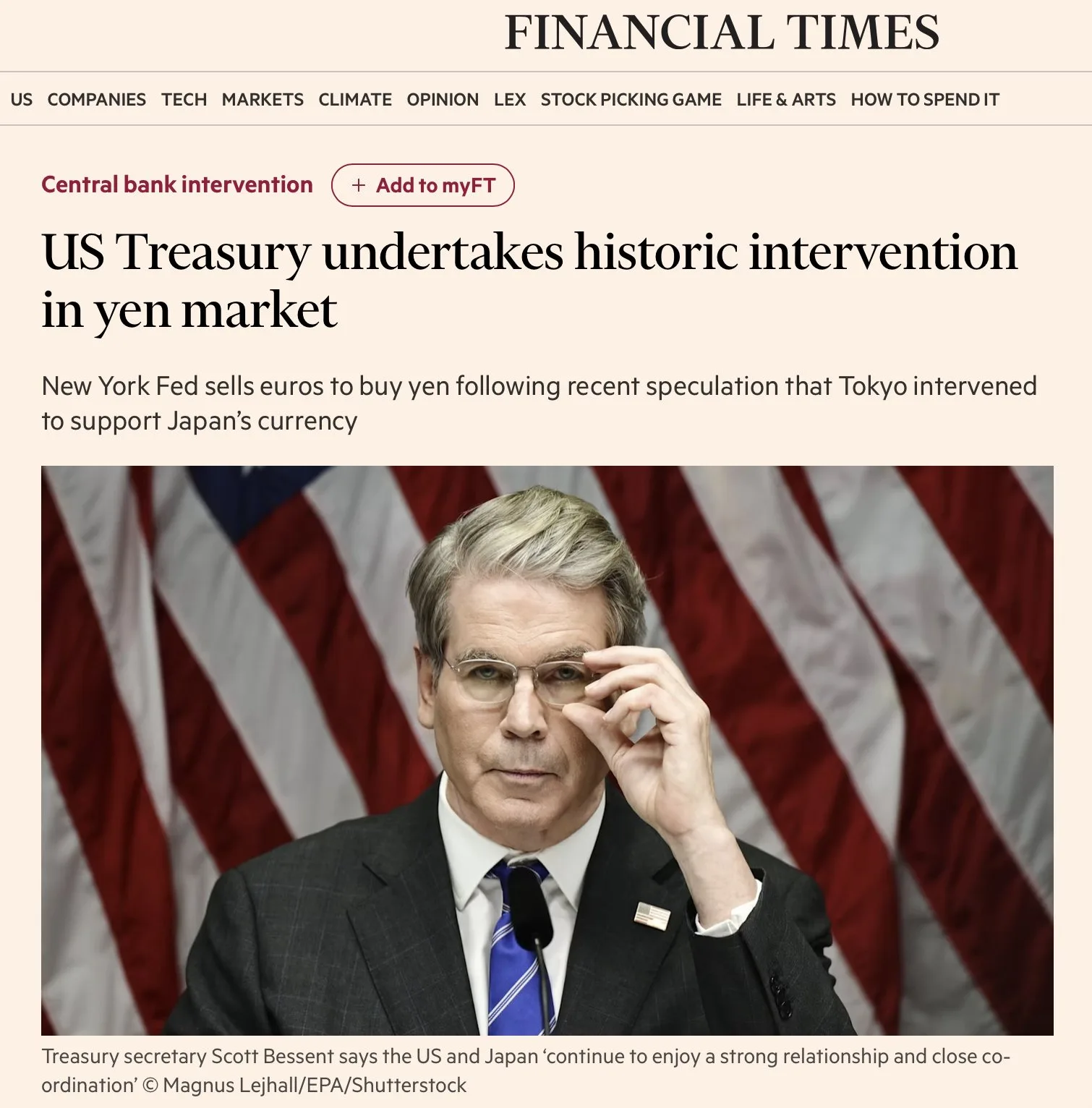
Illustrative source image supplied with the video materials. The approved script describes Japan using about ¥8.45T, or roughly $53B, in one day, followed by US participation.
WHY INTERVENTION MATTERS
It is not routine. The script emphasizes that America buying yen alongside Japan breaks with roughly three decades of normal practice. That makes the action a signal, not merely a transaction.
WHAT CHANGED
Two large public-sector balance sheets acted together. Japan bought its own currency. The New York Fed, acting for the US Treasury, sold euros and bought yen.
WHAT IT DOES NOT PROVE
Intervention is not a complete forecast. It tells us policymakers saw enough risk to act. It does not tell us the exact path, speed or endpoint of the yen or stock market.
The Second Warning Light
“Buy Japanese Yen — $5–10 billion”
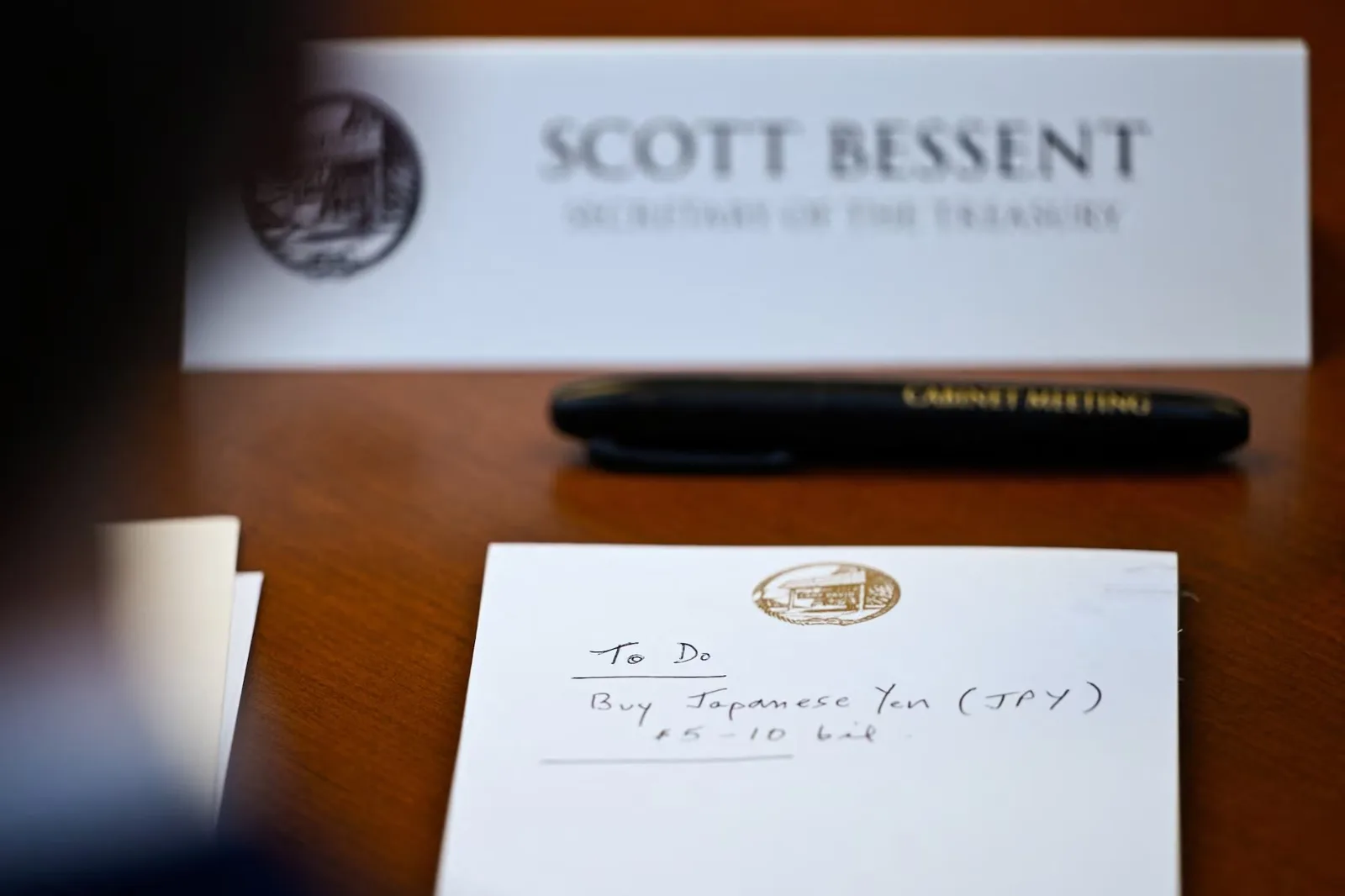
The Bessent notepad photograph supplied with the video materials. The script uses this image as direct visual evidence that buying yen was on the Treasury Secretary's agenda.
Why this image matters.
It compresses an abstract policy story into one concrete instruction. The report does not add a theory beyond the script: the point is that the plan to buy yen was visible, handwritten and photographed before the market fully absorbed the action.
The Third Warning Light
From +0.70% to −1.20%
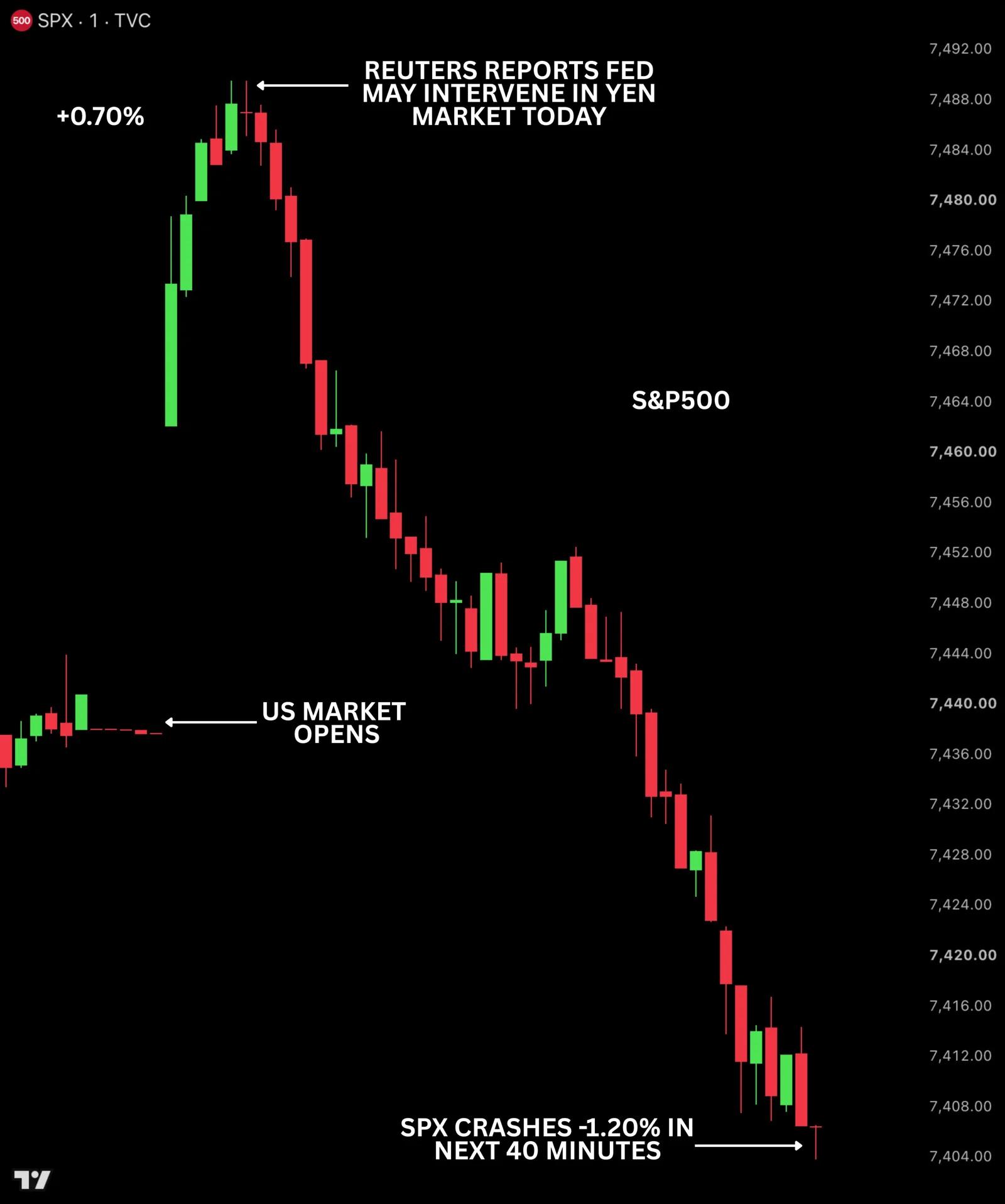
- +0.70%
- earlier S&P move described in the script
40 min
time for the reversal
- −1.20%
- later move described in the script
Why Currency News Hit Stocks
The market was repricing a loan, not every
company
Reuters reports US yen-market action
Investors anticipate a stronger yen
Yen-funded trades become less comfortable
Liquid US assets are sold to raise cash
THE TELL
Japan-related currency news moved US stocks. The script treats that cross-market reaction as evidence of a financing link.
THE DISTINCTION
Price pressure is not always fundamental deterioration. Forced selling can hit many securities at once, even when their individual business outlooks have not changed in 40 minutes.
PRACTICAL USE
Separate “what is being sold” from “why it is being sold.” The reason can be leverage, collateral or liquidity rather than a fresh judgment on every company's moat.
→
→
→
Explained Simply
Borrow cheaply. Invest elsewhere. Keep the
difference.
- Borrow yen near zero
→
- Swap yen for dollars
→
- Buy assets that pay more
BOTTOM LINE:
The carry trade is a financing strategy. Its attraction comes from the gap between the low cost of borrowing yen and the higher expected return on assets purchased with the converted funds.
THE APPEAL
The spread feels like free money. Borrowing at almost zero and investing at a higher return creates a profit opportunity while the exchange rate remains friendly.
THE HIDDEN ASSUMPTION
The yen must stay weak. The investor borrowed yen and must eventually repay yen. Currency direction can overwhelm the apparent interest-rate advantage.
THE SCALE
Many investors can rely on the same assumption. That is why a reversal can become crowded: the same financing idea is embedded in many portfolios.
The Catch
The repayment currency suddenly gets stronger
The yen rises
The yen loan costs more in dollar terms
Collateral pressure and margin calls increase
Investors sell what they can sell quickly
Simple analogy.
Imagine borrowing ten bags of rice when rice is cheap. You spend the proceeds elsewhere. Before repayment, rice becomes much more expensive. You still owe ten bags, but buying them back now consumes far more of your money.
→
→
→
Small Currency Move, Large Market Reaction
Why the exit can become a stampede
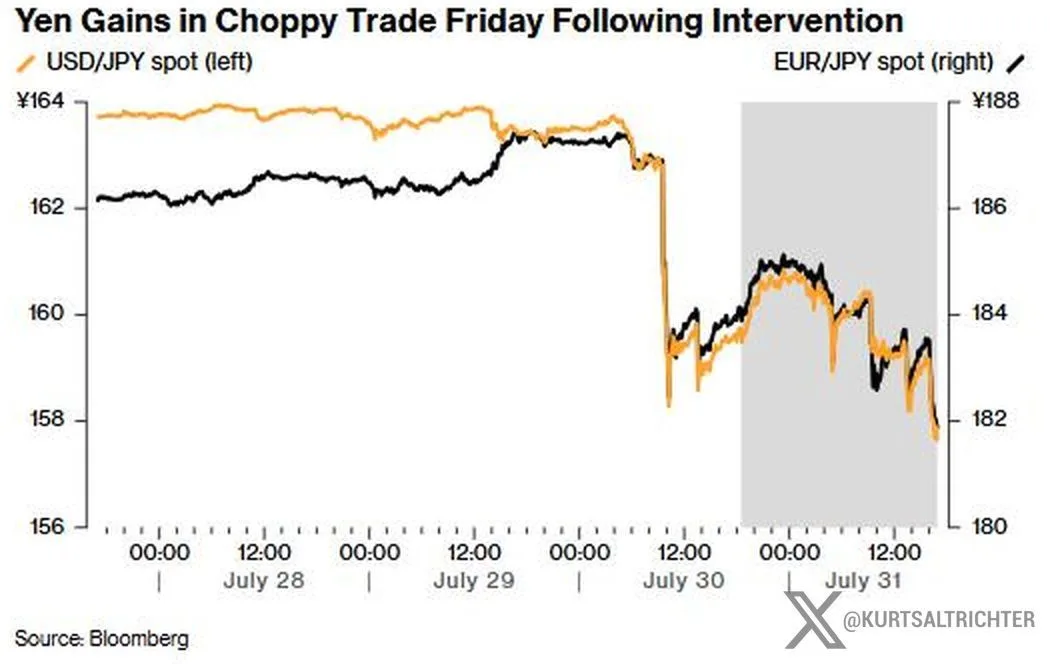
Illustrative currency chart supplied with the video materials. It shows the yen strengthening after the intervention.
CROWDING
Many funds can share the same trade. The script cites roughly $9.5B of hedge-fund bets against the yen. When the direction changes, the exits can become crowded.
LIQUIDITY
The easiest asset to sell may be sold first. Investors facing repayment pressure do not always sell what they dislike most. They sell what can raise cash fastest.
NON-LINEARITY
A small trigger can cause a large reaction. Leverage turns modest price changes into urgent balance-sheet decisions.
The Treasury Link
Japan is central to America's bond market
BOTTOM LINE:
The script argues that US participation was self-protection, not charity. Japan is described as the largest foreign holder of US government debt. A disorderly yen defence could therefore affect US Treasury prices and US interest rates.
Actor Pressure Potential response Why America cares
Japan Weak yen Buy yen, potentially fund action by selling reserves Japan owns a large amount of US Treasuries
US Treasury Risk of higher long-term rates
Join yen purchases Higher rates increase the burden of servicing
US debt
Leveraged investors
Stronger yen Close carry trades Forced selling can hit US stocks and bonds
Rounded debt figure.
The script uses approximately $40T for US debt as a simple, human-scale figure. This report repeats that rounded script figure and does not refresh it with outside research.
One Chain
Yen defence can feed back into US rates
Japan needs resources to support the yen
US Treasuries may be sold
Treasury prices fall; yields rise
US borrowing costs increase
BOND MECHANICS
Price and yield move in opposite directions. If a large holder sells Treasuries, prices can face pressure and yields can rise.
DEBT MECHANICS
Higher rates make refinancing more expensive. The script connects this to America's roughly $40T debt burden.
POLICY MOTIVE
Prevent a destabilising loop. Supporting the yen may reduce the pressure that could otherwise lead Japan to sell more US debt.
→
→
→
The Canary in the Coal Mine
The Kospi's worst month in history
30%+
Kospi monthly decline described in the script
- 27%
- 1997 Asian crisis comparison
- 23%
- 2008 global financial crisis comparison
BOTTOM LINE:
The script presents Korea as a smaller, faster market that showed what a leveraged unwind can look like before similar pressure reaches larger markets.
SEVERITY
The comparison matters more than a precise point estimate. The script's consistent claim is that the month was worse than both 1997 and 2008 comparisons.
MARKET BRAKES
Circuit breakers fired on consecutive days. The script uses this as evidence that selling pressure became exceptional.
Chips, AI and Borrowed Money
The same pattern in a different market
Cheap borrowed money crowds into hot AI and chip trades
→
The trade wobbles
→
Borrowed money rushes for the exit
THE SCRIPT'S FRAMING
The details differ; the structure rhymes. Korea's sell-off involved chips, AI expectations and leverage. The carry-trade story involves yen funding. Both become dangerous when many investors use borrowed money to own the same popular assets.
THE LEVERAGE LESSON
Leverage removes patience. An unleveraged investor can choose to wait. A leveraged investor may be forced to sell because a lender demands cash.
THE CANARY LESSON
Stress often appears first where liquidity is thinner. The script uses Korea as the early warning, not as proof that every market must follow the same path.
What This Means for You
A plan matters most when headlines feel
overwhelming
panic-sell at the bottom freeze while bargains pass follow a prepared framework
THE BEHAVIOURAL RISK
Confusion creates bad timing. The script says regular investors often either sell after the fall or do nothing while informed buyers act.
THE ANALYTICAL RISK
A market shock can blur company quality. If forced selling hits a broad group of stocks, investors still need to distinguish strong businesses from weak ones.
THE RESPONSE
Use a simple framework. The script proposes three ideas: do not over-hold cash, own assets that can cope with paper-money stress, and own the financial plumbing.
CASH
Keep an emergency fund — but understand the trade-off
BOTTOM LINE:
The script recommends three to six months of expenses as an emergency fund, while warning that excessive long-term cash exposure can lose purchasing power through inflation.
Emergency cash
→
Stability and flexibility
→
Beyond the buffer, inflation matters
The script's image.
Cash is an ice cube on a warm counter. It looks unchanged at first, but purchasing power can melt over time. This does not mean “hold no cash.” It means separate short-term safety from long-term wealth storage.
Use of cash Purpose Main risk
Emergency buffer Unexpected expenses and flexibility Too little creates forced selling
Long-term excess Optionality Purchasing power can erode
Assets Under Paper-money Stress
Hard assets and companies with pricing power
HARD ASSETS
The script names real estate and gold. The intended role is to own things that may retain value when confidence in paper currencies is under pressure.
PRICING POWER
Strong businesses can raise prices without losing
customers. That ability can help protect margins when input costs and inflation rise.
WINSTON'S MOAT
Competitive advantage is central. The script points to the Winston app's moat score as a way to think about durable pricing power. Stock-related analytical source:
QUALITY RULES
Profitability, cash generation and stability matter. Felix's framework looks for quality rather than forcing a value-versus- growth label.
Question What it reveals Why it matters here
Can the company raise prices? Customer loyalty and competitive advantage Potential inflation resilience
Does profit turn into cash? Business quality and flexibility Helps survive market stress
Is debt manageable? Financial stability Reduces forced-action risk
Financial Infrastructure
Own the plumbing, not only the passengers
BOTTOM LINE:
When money moves violently between currencies, stocks and bonds, the infrastructure that processes, settles, holds and routes those transactions remains essential.
More volatility
→
More money movement
→
Exchanges, custody and payment rails stay central
THE PICKAXE IDEA
In a gold rush, sell pickaxes. The script prefers thinking about the systems enabling financial activity, not only the assets experiencing the rush.
WHAT THIS IS NOT
It is not a stock recommendation. The script does not name a security to buy, and this report provides no rating or price target.
THE TEST
Explain it to a 12-year-old. If you cannot explain what the business does and why customers pay it, you may not understand the risk well enough.
Turn Understanding into Process
Five questions before the next warning shot
Free live beginners seminar
fasttrackforbeginners.com
Saturday · 9am Eastern Time · No credit card
Do I have three to six months of expenses available without selling investments?
✓
Am I overexposed to one crowded theme or one source of leverage?
✓
Can I explain why each business I own makes money?
✓
Do the businesses I own have pricing power, cash generation and manageable debt?
✓
Would a broad market sell-off force me to act, or give me choices?
✓
Disclaimer
This report is for educational and informational purposes only and does not constitute financial, investment, legal, tax or accounting advice. It is not a recommendation, solicitation or offer to buy or sell any security, currency, commodity or financial product. No buy/sell rating or price target is provided. All investments involve risk, including the possible loss of principal. Market events, relationships and historical comparisons described here may not repeat. Illustrations simplify complex systems and may omit factors. Readers should conduct their own research and consult appropriately qualified professionals before making financial decisions. Past performance is not indicative of future results. The Prehn Institute makes no guarantee regarding outcomes.