
The Sacrifice
How the debt gets paid with your money
Felix Nikolas Prehn · 4 October 2026 · 13 pages
Bottom line
In an interview published on 1 October 2026, the president said that "certain levels of inflation will also pay off that debt very rapidly". Federal debt now exceeds $40 trillion. This report sets out the mechanism economists call financial repression, why it is not working at present, who bears the cost if it is made to work, and what it would mean for the dollar's place in the world.
$40tnUS federal debt, passed in mid-August 2026
Section 1
The president said it on the record
The quotation
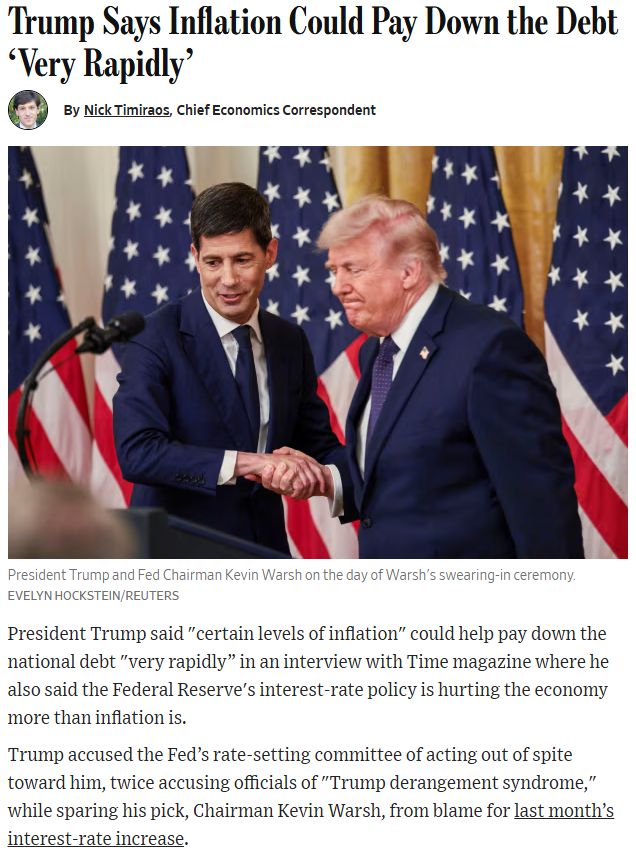
"You know, inflation." TIME told the president that the national debt had grown by about $11 trillion over his five years in office. He replied: "Certain levels of inflation will also pay off that debt very rapidly. Very rapidly." He then said: "I don't want to tell you what those means are, but you can pay off the debt through other means."
What he did not say
No level, no list. He did not say what level of inflation he had in mind, or whether he wants the Federal Reserve to tolerate more of it.
The rate context
Rates are rising, not falling. On 16 September 2026 the Federal Reserve raised its policy rate by a quarter of a point, to a range of 3.75 to 4 per cent. It was the first rise since July 2023. The president has called for rates of 1 per cent "or less".
Section 2
The same idea, ten years apart
| Date | Speaker | Statement |
|---|---|---|
| April 2016 | Donald Trump, to the Washington Post | He could eliminate what was then a $19 trillion debt "over a period of eight years" |
| May 2016 | Donald Trump, on CNN | "You never have to default because you print the money, I hate to tell you, OK?" |
| June 2025 | Scott Bessent, Treasury Secretary, on CBS | "Everything has been alarmist" on inflation |
| August 2026 | Scott Bessent, on CNBC, the day after the $40 trillion milestone | "Nothing magic" about the number; "we can grow our way out of that" |
| October 2026 | Donald Trump, to TIME | "Certain levels of inflation will also pay off that debt very rapidly" |
- $19tn
- federal debt when the 2016 claim was made
- $40tn+
- federal debt in August 2026
- $11tn
- increase over five years, as put to the president by TIME
Section 3
Financial repression
- Hold interest rates below inflation
- The gap moves money from savers to the Treasury
- The debt shrinks in real terms
Definition. Financial repression is the practice of keeping the interest rate a government pays on its debt below the rate of inflation. The difference is a transfer from the holders of the debt to the issuer. It is not announced, it is not legislated as a tax, and it compounds year after year.
A worked example
9 per cent inflation, 4 per cent interest. The real return is minus 5 per cent. On $20,000 held in an account, the balance grows on paper but loses about $1,000 of purchasing power in the first year, and roughly a quarter of its real value over five years.
The historical record
BIS Working Paper 363. "The Liquidation of Government Debt" (Reinhart and Sbrancia, 2011) estimates that negative real rates reduced the debt of the United States and the United Kingdom by 2 to 3 per cent of GDP a year in the decades after the Second World War. The paper finds that repression is most successful "when accompanied by a steady dose of inflation".
The conditions then
Today's setting is different. The post-war episode relied on interest-rate caps, captive domestic buyers of government debt and capital controls. Whether comparable conditions exist today is doubtful.
Section 4
Why this tool, and not another
| Option | What it requires | Obstacle |
|---|---|---|
| Raise taxes | Enough revenue to pay the debt down | Politically unattainable at this scale |
| Cut spending | Enough savings to pay the debt down | Cuts fall on programmes that voters use |
| Default | Open refusal to pay | Would damage the financial system and every pension that holds Treasuries |
| Reduce the real value of the debt | Inflation above the interest rate paid | Borrowing costs must stay below inflation |
Section 5
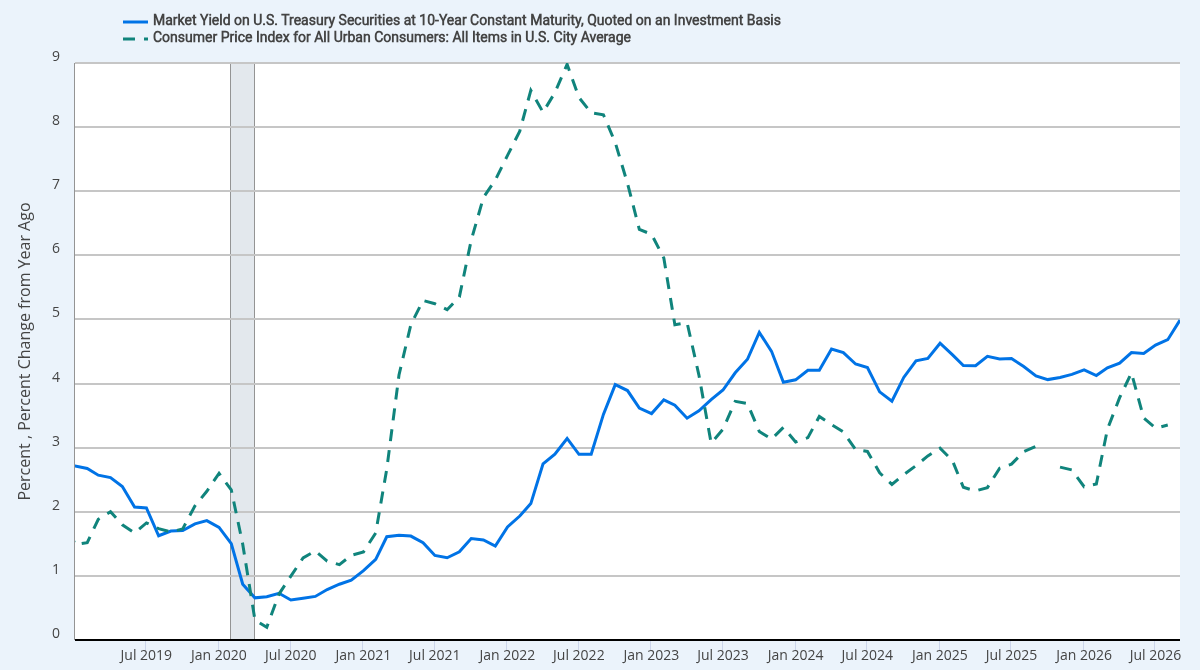
The catch: the yield is above inflation
- 5.24%
- 10-year Treasury yield, 1 October 2026
- 3.35%
- consumer prices, 12 months to August 2026
- 1.9
- percentage points of positive real yield
The reading
The wrong way round. Repression needs a negative real yield. The real yield on 10-year debt is positive by nearly two points. The 10-year yield touched 5.34 per cent on the day the interview was published, its highest since 2002.
Section 6
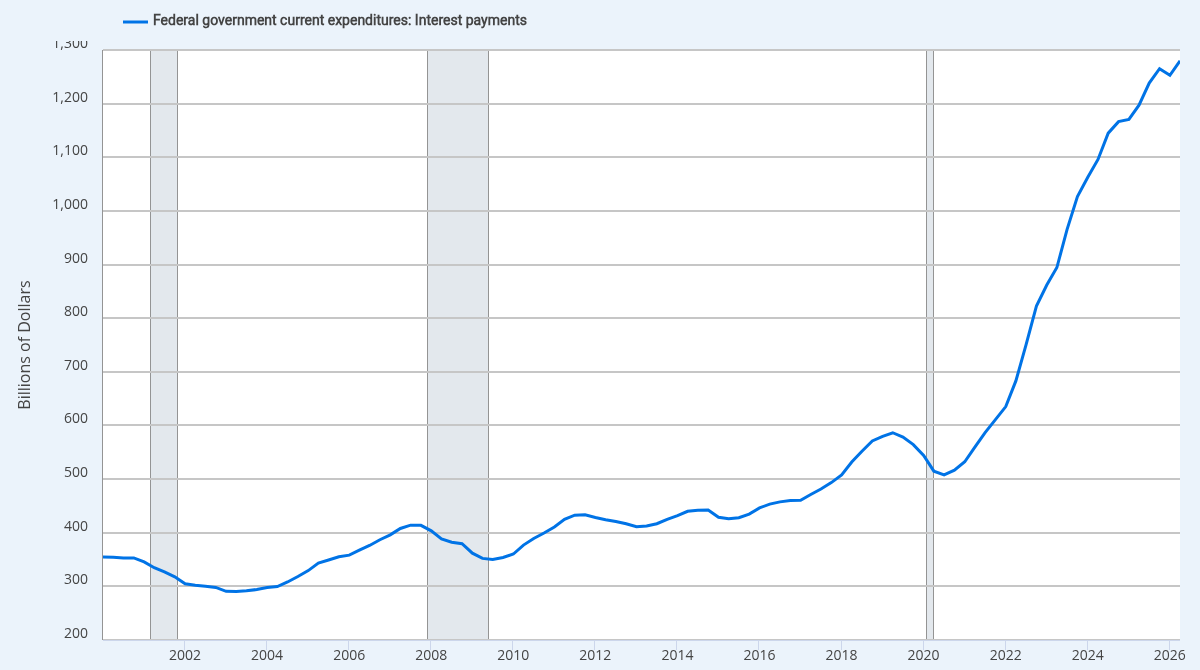
Interest above $1 trillion a year
The rollover
Old debt is re-signed at new rates. Debt borrowed when rates were 1 to 2 per cent is refinanced as it matures. At 4 to 5 per cent, each extra percentage point on tens of trillions of dollars adds hundreds of billions of dollars a year in interest.
The deadline
Waiting makes it worse. Left alone, the interest bill rises as cheap debt matures. For repression to work, borrowing costs would have to be forced below inflation and held there. That would take a Federal Reserve willing to cut into rising prices, which is the position behind the president's call for rates of 1 per cent "or less".
Section 7
The K-shaped economy
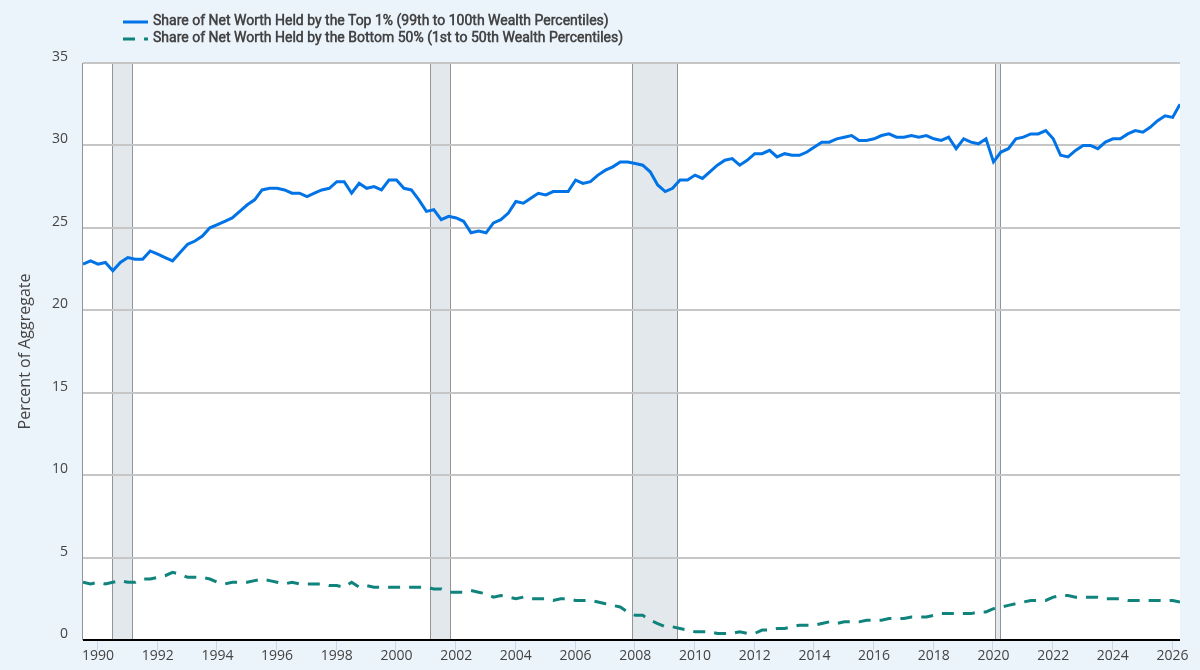
- 32.5%
- of net worth held by the top 1%, Q2 2026 (22.8% in Q3 1989)
- 2.3%
- of net worth held by the bottom 50%, Q2 2026 (3.5% in Q3 1989)
The channel
Assets are priced in dollars. When the dollar loses value, the price of shares, property and gold tends to rise. Households that own them gain. Households that hold wages and cash fall behind, because their pay and savings buy less each year.
Section 8
341 hours, against 100 in 2000
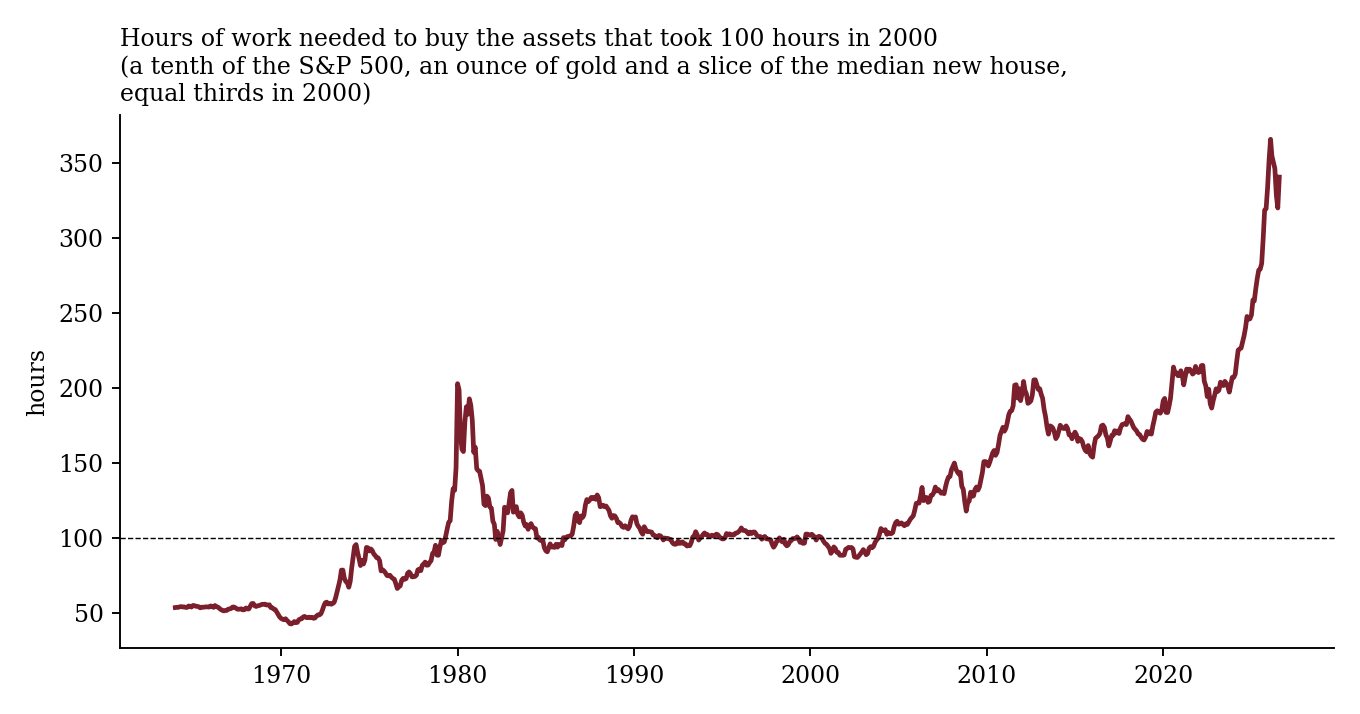
- 341
- index, August 2026 (2000 = 100)
- 137
- hours of work per ounce of gold, against 20 in 2000
- 6.3
- years of income to buy a house, against 6.0 in 2000
What the index measures
Hours, not dollars. It asks how many hours an average American worker must work to buy stocks, gold and a house. The index was up 20.3 per cent over twelve months to August 2026, and reached a record 366.1 in February 2026.
Reading the house figure
Housing is near its long-run level. At 6.3 years the house measure is close to its 2000 level of 6.0 years, and below its April 2022 peak of 8.0 years. The large rises are in stocks and gold, the assets that rise when the dollar is made smaller.
Section 9
Sacrificing the dollar
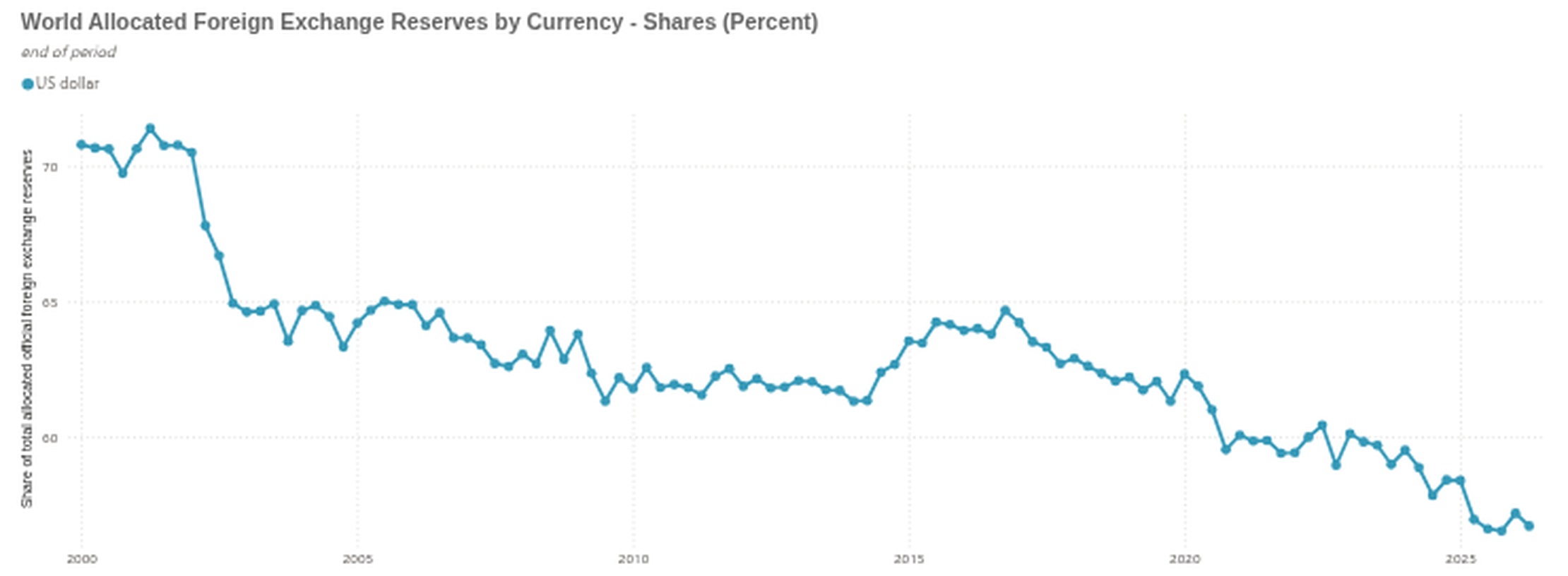
The cost of negative real rates
Foreign holders are paid less than inflation. A government that pays less than inflation to hold its debt gives foreign investors a reason to hold less of it. A weaker dollar is the price of a lighter debt.
The reserve record
A slow decline. The dollar accounted for about 57 per cent of allocated reserves in the first quarter of 2026. The euro accounted for about 20 per cent and the renminbi about 2 per cent. There has been no collapse. The movement is gradual, which is how a policy of this kind would be expected to look.
The warning
Controlled burns can spread. Simon White of Bloomberg argued in April 2025 that a weaker dollar and higher inflation are consistent with a falling debt burden, as in Britain's post-war "beautiful deleveraging". He warned that erratic policy could damage trust in the dollar system, spark capital flight and add to the debt instead.
Conclusion
Debase the denominator
Conclusion. Public statements from the president and the Treasury Secretary describe a debt to be shrunk by growth and inflation, not by cuts or taxes. History shows that the method works only when rates are held below inflation. Today they are not. The path the administration would need to follow is therefore to bring borrowing costs down, accept a weaker dollar, and let the cost fall on households that hold cash and wages.
| Question | Evidence |
|---|---|
| Has the president said inflation will reduce the debt? | Yes, in a TIME interview published on 1 October 2026 |
| Is the mechanism working now? | No. The 10-year yield is about 1.9 points above inflation |
| Who bears the cost if it is made to work? | Holders of wages and cash; the bottom 50 per cent hold 2.3 per cent of net worth |
| What is at risk? | The dollar's share of world reserves, now about 57 per cent |
Disclaimer
The Prehn Institute provides education only. Nothing in this report is financial, investment or tax advice, and no return or income is promised or implied. Investment carries risk, including the loss of capital. Results vary with each individual's circumstances and with market conditions. Past performance is not a guide to future results.