
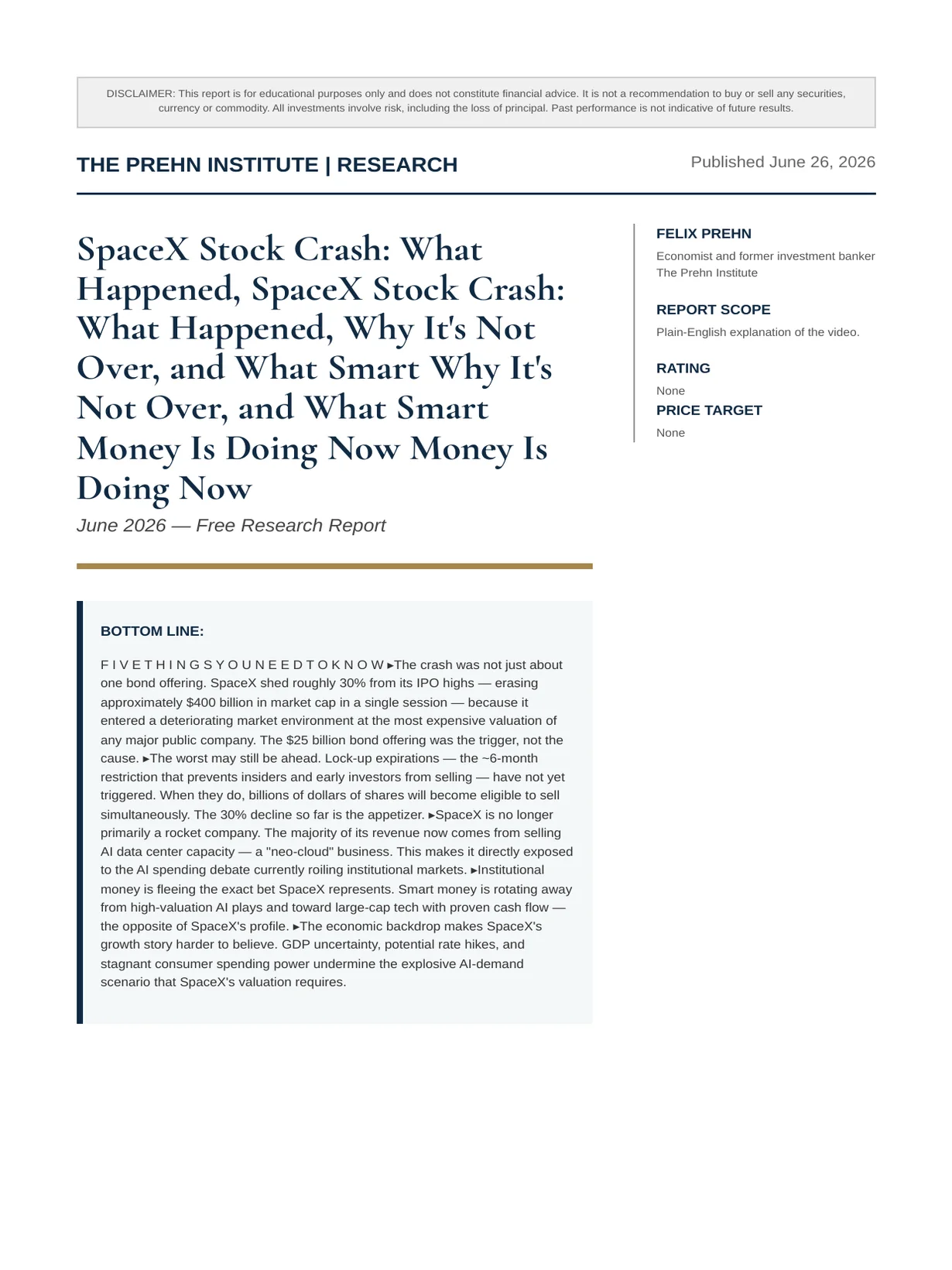
SpaceX Stock Crash: What Happened, SpaceX Stock Crash: What Happened, Why It's Not Over, and What Smart Why It's Not Over, and What Smart Money Is Doing Now Money Is Doing Now
June 2026 — Free Research Report
Felix Nikolas Prehn · 26 June 2026 · 19 pages
Bottom line
F I V E T H I N G S Y O U N E E D T O K N O W ▸The crash was not just about one bond offering. SpaceX shed roughly 30% from its IPO highs — erasing approximately $400 billion in market cap in a single session — because it entered a deteriorating market environment at the most expensive valuation of any major public company. The $25 billion bond offering was the trigger, not the cause. ▸The worst may still be ahead. Lock-up expirations — the ~6-month restriction that prevents insiders and early investors from selling — have not yet triggered. When they do, billions of dollars of shares will become eligible to sell simultaneously. The 30% decline so far is the appetizer. ▸SpaceX is no longer primarily a rocket company. The majority of its revenue now comes from selling AI data center capacity — a "neo-cloud" business. This makes it directly exposed to the AI spending debate currently roiling institutional markets. ▸Institutional money is fleeing the exact bet SpaceX represents. Smart money is rotating away from high-valuation AI plays and toward large-cap tech with proven cash flow — the opposite of SpaceX's profile. ▸The economic backdrop makes SpaceX's growth story harder to believe. GDP uncertainty, potential rate hikes, and stagnant consumer spending power undermine the explosive AI-demand scenario that SpaceX's valuation requires.
Overview
© 2026 The Prehn Institute. Educational purposes only. Not financial advice.
Executive Summary
F I V E T H I N G S Y O U N E E D T O K N O W ▸The crash was not just about one bond offering. SpaceX shed roughly 30% from its IPO highs — erasing approximately $400 billion in market cap in a single session — because it entered a deteriorating market environment at the most expensive valuation of any major public company. The $25 billion bond offering was the trigger, not the cause. ▸The worst may still be ahead. Lock-up expirations — the ~6-month restriction that prevents insiders and early investors from selling — have not yet triggered. When they do, billions of dollars of shares will become eligible to sell simultaneously. The 30% decline so far is the appetizer. ▸SpaceX is no longer primarily a rocket company. The majority of its revenue now comes from selling AI data center capacity — a "neo-cloud" business. This makes it directly exposed to the AI spending debate currently roiling institutional markets. ▸Institutional money is fleeing the exact bet SpaceX represents. Smart money is rotating away from high-valuation AI plays and toward large-cap tech with proven cash flow — the opposite of SpaceX's profile. ▸The economic backdrop makes SpaceX's growth story harder to believe. GDP uncertainty, potential rate hikes, and stagnant consumer spending power undermine the explosive AI-demand scenario that SpaceX's valuation requires.
A B O U T F E L I X P R E H N & G O AT A C A D E M Y Felix Prehn is an ex-investment banker and founder of The Prehn Institute, where he and retired Wall Street mentors have taught institutional investing strategies to over 20,000 students across six years. He is also co-founder of Tradevision.io. This report is for educational purposes only. It does not constitute financial advice. Past performance does not guarantee future results.
© 2026 The Prehn Institute. Educational purposes only. Not financial advice.
The SpaceX Crash — What Actually Happened
The SpaceX crash of 2026 will be studied in business schools for years. It is not simply the story of an overpriced stock correcting. It is a masterclass in how IPO mechanics, market timing, capital allocation decisions, and macroeconomic forces can converge to destroy value at extraordinary speed — and why most retail investors never see it coming until it is too late.
The Rise, the Trigger, and the Scale of the Fall
When SpaceX went public, the stock surged nearly 30% on its first day of trading. Social media celebrated. Retail investors who had waited years to own a piece of the iconic rocket company rushed to buy. In the weeks that followed, the stock climbed even higher. Buyers felt like geniuses.
- +30%
- DAY-1 IPO SURGE — EXACTLY AS PREDICTED
- −30%
- SUBSEQUENT DECLINE FROM ALL- TIME HIGHS
~$400B
MARKET CAP ERASED IN A SINGLE TRADING SESSION
That single-session wipeout — approximately $400 billion in market capitalization — was the second-largest one-day destruction of value in stock market history. But the move that actually triggered it was a capital raise. Shortly after going public, SpaceX raised approximately $85 billion in equity. Then, within the same period, it issued a $25 billion bond offering. In total: roughly $110 billion raised right after the IPO.
T H E R E D F L A G I N V E S T O R S M I S S E D When a company raises $110 billion immediately after going public, it signals one thing above all else: the business cannot fund its own growth from internal cash flows. It needs external capital to survive. That is not the profile of a company priced at 100 times revenue. The market eventually connected those two facts. When it did, the selloff was brutal and fast.
IPO +30% Day 1
→
$85B Equity Raise
→
$25B Bond Offering
→
Market Panic: "They need capital"
→
−30% from ATH · $400B gone
The Lock-Up Time Bomb — The Main Course Is Still Coming
Here is the piece of the SpaceX story that most media coverage glosses over: the decline so far has happened entirely without insider selling pressure. That is because of something called an IPO lock-up period.
© 2026 The Prehn Institute. Educational purposes only. Not financial advice.
When a company goes public, insiders — founders, early investors, employees, and venture capital firms — are legally prevented from selling their shares for a defined period, typically around six months. This is designed to prevent a sudden flood of selling the moment the stock lists. When the lock- up expires, billions of dollars of shares can legally enter the market simultaneously. If insiders want to exit — and after years of holding through a company's private phase, many do — the resulting selling pressure can be enormous.
SpaceX's lock-up expirations have not yet occurred. Every percentage point of the decline witnessed so far has been driven by market forces, valuation concerns, and the bond offering reaction — not a single insider sale. When the lock expires and thousands of employees, early investors, and venture capital firms gain the ability to sell shares they have held for years, the selling dynamic could intensify dramatically.
~6 mo.
STANDARD IPO LOCK-UP PERIOD BEFORE INSIDERS CAN SELL
- $0
- VALUE OF INSIDER SELLING THAT CAUSED THE
INITIAL 30% CRASH — NONE YET
There is one modest offset on the horizon: SpaceX is expected to be included in the Nasdaq 100 index. Index inclusion typically triggers automatic buying from passive ETFs and index funds tracking that benchmark — in SpaceX's case, this could amount to approximately $8 billion in passive inflows. That creates a temporary demand bump. But $8 billion in passive buying does not reverse the economics of a stock trading at 100 times revenue, nor does it stop determined insiders from selling when the lock expires. It provides a window
- not a solution.
© 2026 The Prehn Institute. Educational purposes only. Not financial advice.
The Market Environment — SpaceX Crashed Into a Burning Building
To understand why the SpaceX crash was so severe, you have to understand the environment it landed in. The bond offering was the match. The building was already soaked in gasoline. A global technology selloff was underway before SpaceX's capital raise spooked the market — and SpaceX, as the most expensive stock in the sector, caught the most intense heat.
The Breadth of the Selloff
The Nasdaq 100 dropped roughly 4% in a single week — a move that sounds modest until you translate it into dollar terms on a market of this scale. That represented more than a trillion dollars evaporating in just two trading days. Semiconductor companies were hit even harder: the broad Philadelphia Semiconductor Index fell approximately 8% in a single session.
Table 1 Sector-Wide Percentage Declines During the Selloff (Source: — Winston)
| Asset / Sector | Approximate Decline | Context |
|---|---|---|
| SpaceX | ↓ ~30% from ATH | Most exposed — highest valuation in sector |
| Semiconductor Index (broad) | ↓ ~8% (single day) | Worst single-day sector decline |
| TSMC / Broadcom | ↓ ~8% | Supply-chain bellwethers hit hard |
| Nvidia | ↓ ~5.5% | AI infrastructure leader repriced |
| AMD | ↓ ~5% | Chip competitor caught in same wave |
| Amazon | ↓ ~3% | Cloud exposure, moderate selloff |
| Meta / Microsoft | ↓ ~2% | Consumer/enterprise mix provided partial buffer |
| KOSPI (South Korea) | ↓ ~10% from highs | Global tech contagion — this is a worldwide story |
This was not a U.S.-only event. South Korea's KOSPI index fell roughly 10% from near-record highs. Asian tech markets broadly declined. What began as uncertainty about AI return-on-investment in the United States became a global repricing of the technology trade. SpaceX, sitting at roughly 100 times last year's revenue, was the most expensive target in the sector. When sentiment turns, the most expensive stocks absorb the most damage.
© 2026 The Prehn Institute. Educational purposes only. Not financial advice.
The Google Signal That Connected Directly to SpaceX
Inside the broader selloff, one event connected uniquely to SpaceX and received almost no mainstream coverage. Two of the world's top AI researchers — widely considered among the top ten in their field globally — departed Google DeepMind. In doing so, they publicly suggested that Google's organizational structure would prevent it from reaching the next major AI breakthrough. They joined competitors OpenAI and Anthropic.
There are perhaps only 100 people on the planet who can genuinely advance the frontier of AI research. When two of them publicly signal that the incumbent AI leader is structurally compromised, the AI investment narrative cracks. This matters directly for SpaceX because the majority of SpaceX's revenue now comes from selling data center capacity to AI companies — including Google and Anthropic. If the AI narrative weakens, SpaceX's entire new business model comes under pressure simultaneously.
T H E S PA C E X – A I C O N N E C T I O N M O S T I N V E S T O R S M I S S E D SpaceX is not just a company that benefited from AI hype. Its primary revenue stream — the "neo-cloud" business — depends on AI companies continuing to spend aggressively on computing capacity. Any crack in the AI narrative is simultaneously a crack in SpaceX's revenue forecast. The tech selloff was not background noise for SpaceX — it was a direct threat to its core business model.
© 2026 The Prehn Institute. Educational purposes only. Not financial advice.
SpaceX Valuation Deep Dive — Why the Math Doesn't
Work
Strip away the excitement of rockets, satellites, and AI data centers in orbit, and you are left with a fundamental valuation question that SpaceX cannot currently answer. Understanding this question — and why the market is now asking it loudly — is essential context for any investor deciding what to do with exposure to SpaceX or similar high-valuation tech plays.
The 100× Revenue Problem
At its peak, SpaceX was trading at approximately 100 times its most recent annual revenue. Not earnings — revenue. This is an extraordinary multiple that demands extraordinarily clear thinking.
T H E L E M O N A D E S TA N D I L L U S T R AT I O N Imagine a lemonade stand that earns $1,000 in revenue in a year — before any costs. A 100× revenue valuation means someone is paying $100,000 for that lemonade stand before knowing whether it makes any profit at all. To justify that price, the lemonade stand would need to grow its revenue to something like $5,000–$10,000 per year just to approach a reasonable valuation. SpaceX's situation is identical in structure, just with many more zeroes. The question is not whether SpaceX is an exciting company. It is whether the growth required to justify 100× revenue is realistic in the current environment.
For context: established, profitable tech companies with proven cash flows typically trade at 5–20 times revenue. A 100× multiple implies that every piece of the bull case — continued AI spending explosion, successful data center buildout, smooth lock-up expiration, favorable interest rates — must go perfectly. In real markets, things rarely go perfectly.
The Business Nobody Understands — SpaceX's Revenue Transformation
What makes the SpaceX story particularly complex — and particularly risky for investors who bought on the IPO narrative — is that SpaceX is no longer the company most people thought they were buying. Its revenue mix has undergone a fundamental transformation in a remarkably short period.
Table 2 SpaceX Revenue Mix — Historical vs. Current (Source: — Winston)
| Revenue Source | Historical Mix | Current Mix | Trajectory |
|---|---|---|---|
| Starlink (satellite internet) | Majority | Declining share | Stable but no longer dominant |
| Space exploration / gov't contracts | Minority | Minority | Flat |
© 2026 The Prehn Institute. Educational purposes only. Not financial advice.
| Neo-Cloud (AI data center capacity) | Negligible | Growing majority | Rapidly expanding — capital- intensive |
|---|---|---|---|
| Space-based data centers (planned) | — | Zero (future) | Ambitious; requires massive capital |
SpaceX has become, in effect, a cloud computing infrastructure provider. It sells data center capacity to AI companies — most notably Anthropic and Google — competing directly with Amazon Web Services, Microsoft Azure, and Google Cloud. This is a credible business. The contracts are real. The customers are real. But the business is ferociously capital-intensive: SpaceX needs enormous ongoing investment to build out sufficient data center infrastructure, and the ambition extends to physically launching data centers into orbit.
This transformation creates a critical question that the market is struggling to price: is SpaceX a rocket company, a satellite internet company, or a cloud infrastructure company? Each of those businesses has a different valuation framework, different risk profile, and different sensitivity to AI spending trends. Most retail investors who bought the SpaceX IPO thought they were buying a rocket company. They may have bought an early-stage cloud provider betting everything on the AI boom.
F E L I X ' S I P O R E D F L A G C H E C K L I S T — A P P L I E D TO S PA C E X
Profitable or raising capital? SpaceX raised ~$110B immediately after its IPO. Cannot fund its own growth from operations. ❌ Red flag. Lock-up expiration risk? Lock-ups have not yet expired. Billions of dollars of insider shares are waiting to be sold. ❌ Red flag. Valuation based on today's reality or tomorrow's dream? ~100× revenue requires near-perfect execution of a future growth scenario that has not yet been proven. ❌ Red flag.
© 2026 The Prehn Institute. Educational purposes only. Not financial advice.
AI Spending & Institutional Pullback — Why Smart Money Is Fleeing SpaceX
SpaceX's valuation problem does not exist in isolation. It is part of a broader philosophical war being fought inside institutional money right now — a war between those who believe AI spending will deliver transformative returns, and those who believe the industry is burning capital on promises that may never materialize. SpaceX sits at the most exposed position in this debate.
The War Inside Wall Street
BEAR CAMP — "AI SPENDING IS TOO MUCH"
BULL CAMP — "WE'RE STILL EARLY"
The market's response to this debate is deeply contradictory — and that contradiction is precisely where sophisticated investors find opportunity. Large-cap AI companies like Microsoft, Nvidia, and Micron are being priced as if AI is peaking. Their price-to-earnings ratios have compressed to historically low levels relative to their growth rates, implying the market believes the AI cycle is rolling over. Meanwhile, smaller, more speculative AI plays — optical networking companies, emerging chip designers, early-stage AI infrastructure names — are priced as if the AI boom runs uninterrupted through 2030 and beyond.
Both of these stories cannot simultaneously be true. Either AI investment is generating returns (in which case large-cap names are undervalued) or it is not (in which case small AI plays are dangerously overvalued). And then there is SpaceX — priced as if AI will conquer the world and SpaceX will be the primary infrastructure provider for that conquest. It sits at the most aggressive end of the AI bull case while institutional money is increasingly retreating to the AI bear camp.
What Institutional Money Is Actually Doing
The funds managing billions are not running away from AI. They are running away from overpaying for AI. There is a crucial distinction. Institutional investors are rotating from SpaceX-style speculative AI infrastructure plays toward large-cap technology companies with established cash flows, proven AI revenue, and depressed valuations. Companies that can make a concrete statement — "we have already sold this data center capacity, we know the cost, we know the margin, we know the return" — are being preferred over companies making ambitious growth projections.
Returns on AI investment remain unproven ▸ Hundreds of billions in capex with no ROI timeline ▸ Rotating OUT of Microsoft, Nvidia, SpaceX ▸ Large-cap valuations priced for AI cycle peak ▸ AI will reshape the entire global economy ▸ Infrastructure built today = dominance in a decade ▸ Buying large-cap AI names at compressed multiples ▸ Smaller AI plays priced for boom through 2030 ▸
© 2026 The Prehn Institute. Educational purposes only. Not financial advice.
Smart money isn't running from AI. It's running from overpaying for AI. A company like Microsoft or Nvidia at historically low P/E ratios — with proven cash flow and committed AI revenue — is a very different bet from SpaceX at 100× revenue requiring the entire AI bull case to play out perfectly. The discipline of institutional investing is knowing the difference.
The Macro Wild Card — Why SpaceX Is Most Exposed
One additional macro variable makes the SpaceX thesis particularly dangerous in the current environment: the potential for interest rate increases. The chain of causation is straightforward:
Geopolitical Tension
→
Oil Price Spike
→
Inflation Rises
→
Rate Hikes
→
Future Earnings Worth Less Today
→
SpaceX: Most Exposed
Higher interest rates reduce the present value of future earnings — which is precisely how high-growth, high-valuation stocks derive most of their worth. The higher the valuation and the further away the projected returns, the more damaging a rate increase becomes. SpaceX, trading at roughly 100 times revenue with returns projected far into the future, is the most rate-sensitive large stock in the market. If rate expectations shift even modestly upward, the theoretical fair value of SpaceX compresses dramatically — before any operational news even enters the picture.
© 2026 The Prehn Institute. Educational purposes only. Not financial advice.
Macro Economic Backdrop — Why SpaceX's Timing Couldn't Be Worse
SpaceX's growth story rests on a specific economic foundation: explosive AI demand, massive corporate spending on computing infrastructure, and a booming growth environment that justifies extraordinary capital investment. The minimum wage data — and what it reveals about the real state of the American economy — tells a different story entirely.
The Minimum Wage Natural Experiment
This may seem unrelated to SpaceX. It is not. The state of consumer spending power, business margins, and the labor market directly determines whether the economic conditions SpaceX needs — to grow into its valuation — actually exist. The minimum wage data is the most granular, long-running window into the real economy that we have.
The U.S. federal minimum wage has not changed in over 17 years. It remains at $7.25 per hour — a floor so low that it barely functions as a wage floor at all. Very few workers actually earn it. While Washington was gridlocked, 30 states took independent action, raising their own minimums to an average of approximately $14 per hour. Twenty states stayed at the federal floor. Economists recognized this as a rare natural experiment: the same country, same economy, same time period — with two distinct wage regimes running in parallel.
Table 3 The U.S. Minimum Wage Natural Experiment (Source: — Winston)
| Metric | 30 States (Raised Wages) | 20 States (Federal Floor) |
|---|---|---|
| Average minimum wage | ~$14/hour | $7.25/hour |
| Restaurant worker wages vs. control | +8–9% higher | Baseline |
| Restaurant employment per capita | Virtually identical | Virtually identical |
| Broad cost-of-living impact | Not visibly affected | — |
| Neighboring-county comparisons | Higher pay, same jobs | Lower pay, same jobs |
The research focused on restaurants — the sector with the highest concentration of minimum-wage workers and the most to lose if wage increases destroyed employment. After 15 years of real-world data, the findings upended the most common argument against minimum wage increases: restaurant employment per capita was virtually identical across states that raised wages versus those that did not. Wage growth of 8–9% on the higher-wage side, zero measurable job destruction. Neighboring counties on opposite sides of state borders showed the same pattern.
© 2026 The Prehn Institute. Educational purposes only. Not financial advice.
The 3 P's — How the Economy Actually Absorbs Higher Wages
P
Productivity Higher pay reduces turnover and increases worker retention. Lower training costs and greater experience partially offset the wage increase without reducing headcount.
P
Profits Some wage cost is absorbed through thinner business margins. For most sectors, the impact is manageable — a modest compression, not a crisis.
P
Prices Select items cost slightly more. Fifteen years of data shows this is targeted — not broad inflation. Cost of living in higher- wage states was not visibly affected overall.
What This Tells Us About SpaceX's Growth Problem
The minimum wage data reveals something important: the real economy is more fragile and more stagnant than the headline numbers suggest. The federal wage floor has not moved in 17 years. Consumer spending power — particularly for the majority of Americans who are not high earners in the technology sector — is under steady pressure. The economic foundation that SpaceX requires for its growth story is not what the bull narrative assumes.
SpaceX's valuation is fundamentally a bet on explosive, sustained growth in AI infrastructure demand. That demand is corporate — it comes from large technology companies spending aggressively on computing capacity. But corporate spending decisions do not exist in a vacuum. They are shaped by the economic environment, consumer demand trends, and the broader return-on-investment calculations that determine whether AI budgets grow or shrink. A stagnant real economy, with stagnant consumer wages and rising macro uncertainty, is not the fertile ground that a 100× revenue valuation requires.
T H E D ATA W I L L S E T Y O U F R E E The minimum wage research teaches the most important investing lesson in this entire report: do not accept a narrative without checking the data. The narrative that "minimum wage increases destroy jobs" has been loudly repeated for decades and is directly contradicted by 15 years of real-world evidence from 30 states. The same critical discipline applies to SpaceX. "SpaceX is going to the moon" is a narrative. The data — 100× revenue, $110B in capital raises, lock-ups pending, AI demand uncertain — tells a different story.
© 2026 The Prehn Institute. Educational purposes only. Not financial advice.
The 3-Question Framework — Buy, Hold, or Sell?
Data without a decision framework is just entertainment. Institutional investors do not navigate markets by reacting to headlines — they apply structured, repeatable processes that work regardless of the news cycle or the emotional temperature of the market. The following three-question framework is a simplified version of how professional portfolio managers evaluate any market event. In the table below, it is applied directly to SpaceX.
T H E 3 - Q U E S T I O N F R A M E W O R K — A P P L I E D TO S PA C E X A N D T H I S M A R K E T
Q1 Is the volatility structural or temporary?
Structural volatility means something fundamentally broken — fraud, obsolescence, or an irreparable business model failure. Temporary volatility means a fear-driven repricing of a still-healthy business. For the broader tech sector, current volatility is largely temporary: AI revenue is growing, businesses are profitable, the underlying technology is real. For SpaceX specifically, however, there are structural concerns that go beyond temporary repricing. The company cannot fund its own growth, is transforming its entire business model mid-flight, and carries a valuation that assumes near-perfect execution of a future scenario that has not been proven. Be honest about the distinction. SpaceX is not just experiencing a market tantrum.
Q2 Where is the market being inconsistent?
The market is simultaneously pricing large-cap AI infrastructure (Microsoft, Nvidia) as if AI is failing, while pricing small AI speculative plays as if AI succeeds through 2030. SpaceX is priced as if AI will conquer the entire world and SpaceX will be its primary landlord. These three stories are mutually inconsistent. The disciplined investor who can identify which inconsistency to exploit — and picks the most defensible valuation argument — gains an edge. Right now, the inconsistency that makes most sense to act on is large-cap AI names with proven cash flow at depressed valuations — not speculative infrastructure plays at 100× revenue.
Q3 What is my macro exposure?
You do not need to predict interest rates, geopolitics, or oil prices perfectly. You need to know your portfolio's sensitivity to each scenario. SpaceX holders carry maximum macro exposure: their investment is most sensitive to rate increases (future earnings compression), to an AI spending slowdown (direct revenue risk), and to a deteriorating economic backdrop (SpaceX's growth story requires an accelerating, not decelerating, economy). If you hold SpaceX, you are making an implicit bet on the most optimistic version of every macro variable simultaneously. That is a bet worth understanding before you make it — not after.
Table 4 3-Question Framework — SpaceX Scorecard (Source: — Winston)
Question Assessment for SpaceX Signal
© 2026 The Prehn Institute. Educational purposes only. Not financial advice.
| Q1: Structural or Temporary? | Mix of both. Structural concerns: capital dependency, business model transition, 100× revenue valuation. Temporary: broader AI sentiment. | Caution — not pure dip-buy |
|---|---|---|
| Q2: Where Is the Inconsistency? | SpaceX priced for AI domination while large-cap AI priced for failure. Better inconsistency to exploit: large-cap AI with proven cash flow at depressed P/E. | Rotate to proven cash flow |
| Q3: Macro Exposure? | Maximum. Rate-sensitive, AI-demand sensitive, growth-macro sensitive. All major macro risks amplify SpaceX's downside. | Audit overweight positions |
© 2026 The Prehn Institute. Educational purposes only. Not financial advice.
What This Means For You
If you are relatively new to investing, the volume of information in this report can feel overwhelming. That feeling is normal — and it is exactly what Wall Street counts on. When retail investors feel confused, they either panic-sell at the bottom, or they freeze while institutional money scoops up discounts. Here is what to anchor on.
F O U R P R I N C I P L E S TO N AV I G AT E T H I S E N V I R O N M E N T
Excitement is not the same as value. SpaceX is one of the most genuinely exciting companies in history. But "exciting company" does not equal "good investment at any valuation." The IPO lesson is simple: when everyone is celebrating, ask what you are actually paying for.
Timing matters as much as company quality. Even great companies at the wrong price, in the wrong market environment, at the wrong stage of their capital cycle can destroy wealth. SpaceX may build extraordinary businesses. That does not mean the stock at 100× revenue — with lock-ups pending and rates potentially rising — is a safe bet today.
The data will always beat the narrative. The minimum wage research showed us that "everybody knows" is often wrong. The same applies to SpaceX. "Everybody knows" SpaceX is the future. Maybe it is. But the data on valuation, capital structure, and market environment does not yet support the price. Always check the data.
Have a plan before the next crash, not during it. The investors who build wealth over time are almost never the ones who picked the right stock at the right moment by accident. They are the ones who had a framework ready before volatility hit. The 3-Question Framework in this report is a starting structure. Write down your answers before the next wave arrives.
T H E O P P O R T U N I T Y I N S I D E T H E C H A O S The SpaceX crash — and the broader tech selloff — has created genuine discounts in large-cap technology companies with real revenue, real profitability, and committed AI infrastructure contracts. The smart money is not running from AI. It is running from overpaying for AI. Understanding the difference between a 100× revenue speculative play and a historically cheap cash-flow compounder is the foundation of institutional investing. That distinction is available to every retail investor who takes the time to learn it.
Data Sources: All stock percentage data referenced via the Winston research tool at Minimum wage research data sourced from U.S. Department of Labor and Economic Policy Institute; academic methodology from UMass Amherst (Arin Dube). GDP scenario data from Federal Reserve economic projections and D.A. Davidson Technology Research. All figures expressed as percentages only — no specific stock prices — to maintain evergreen accuracy. This report is for educational purposes only. It does not constitute financial advice or a solicitation to buy or sell any security. Past market events do not guarantee future results. Always conduct your own research before making investment decisions.
© 2026 The Prehn Institute. Educational purposes only. Not financial advice.

F R E E L I V E T E A C H I N G S E S S I O N — R E G I S T E R N O W
Why Your Portfolio Is Broken (And You Won't Know Until End of July)
Felix has taken everything in this report — the SpaceX crash anatomy, the AI spending debate, the institutional rotation playbook, the macro risk framework, and the 3-Question process — and turned it into a concrete, step-by-step action plan for the rest of 2026.
F R E E L I V E S E S S I O N — N O C R E D I T C A R D R E Q U I R E D
mygreatportfolio.com
- Felix Prehn, Founder of The Prehn Institute
© 2026 The Prehn Institute. This report is for educational purposes only and does not constitute financial advice or a solicitation to buy or sell any security. All percentage figures are approximations drawn from publicly available market data. Past performance does not guarantee future results. The Prehn Institute and Felix Prehn make no claims about individual trading performance.