
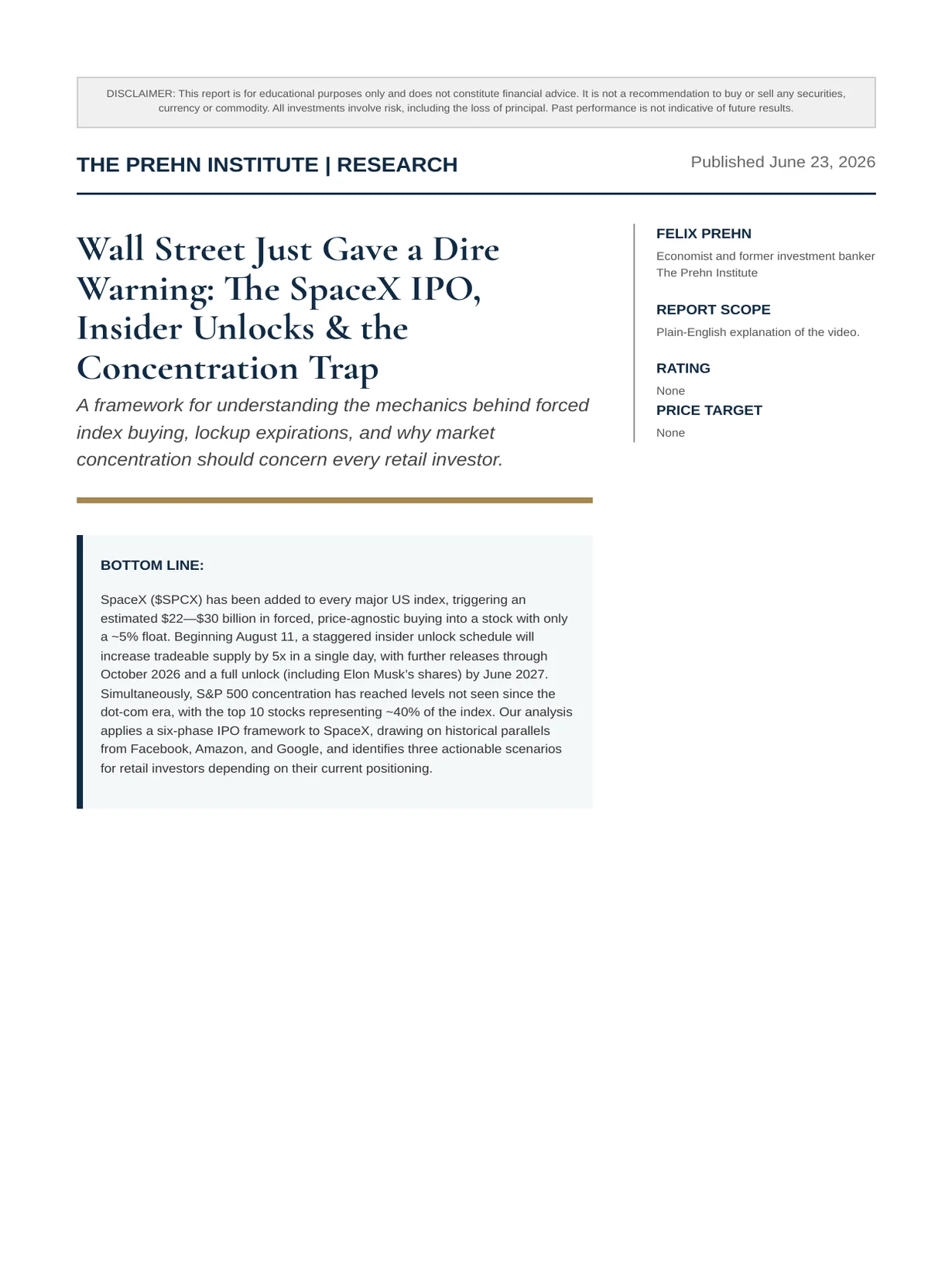
Wall Street Just Gave a Dire Warning: The SpaceX IPO, Insider Unlocks & the Concentration Trap
A framework for understanding the mechanics behind forced index buying, lockup expirations, and why market concentration should concern every retail investor.
Felix Nikolas Prehn · 23 June 2026 · 14 pages
Bottom line
SpaceX ($SPCX) has been added to every major US index, triggering an estimated $22—$30 billion in forced, price-agnostic buying into a stock with only a ~5% float. Beginning August 11, a staggered insider unlock schedule will increase tradeable supply by 5x in a single day, with further releases through October 2026 and a full unlock (including Elon Musk’s shares) by June 2027. Simultaneously, S&P 500 concentration has reached levels not seen since the dot-com era, with the top 10 stocks representing ~40% of the index. Our analysis applies a six-phase IPO framework to SpaceX, drawing on historical parallels from Facebook, Amazon, and Google, and identifies three actionable scenarios for retail investors depending on their current positioning.
Overview
- The Forced Buying Mechanism
. Index Inclusion Calendar
. August 11: The Insider Unlock Schedule
. Case Study — Facebook IPO Lockup Parallel
. The Concentration Problem
- Historical Concentration Collapses
- The Six-Phase IPO Playbook
- What To Do Now — Three Scenarios
- Sources & Citations
- About Felix Prehn and The Prehn Institute
1. The Forced Buying Mechanism
What Is a Float? A stock’s “float” is the portion of shares available for regular investors to buy and sell on the open market. SpaceX currently has a float of approximately 5%. To put this simply: if the company were a pizza with 100 slices, only 5 slices are sitting on the counter. The other 95 are locked in a vault.
How Index Inclusion Works. When a stock is added to a major index, every fund that tracks that index must purchase shares. This is not optional. The fund manager does not evaluate whether the stock is a good buy. The rules require ownership. The buying is mechanical, automatic, and price-agnostic. Our analysis estimates this will generate $22-$30 billion in forced buying demand.
The Supply-Demand Imbalance. We characterise this as “a firehose pointed at a kiddie pool.” Massive demand is being directed at a tiny supply of available shares. This almost certainly causes a significant short-term rally. Investors currently holding SpaceX may feel vindicated. However, this rally is manufactured by scarcity mechanics, not fundamental revaluation.
2. Index Inclusion Calendar
SpaceX has been fast-tracked into every major US equity index. The following table summarises the inclusion schedule.
CRSP (Vanguard) VTI, VTSAX ~June 19, 2026
FTSE Russell Russell 1000, IWB ~June 26, 2026
MSCI MSCI USA, ACWI ~June 29, 2026
Nasdaq-100 QQQ, QQQM ~July 6, 2026
S&P 500 VOO, SPY, IVV Not yet included
Each inclusion event triggers a wave of forced buying. The cumulative effect concentrates enormous demand into a compressed timeline. Crucially, S&P 500 has rejected its fast-track provision, meaning a potential future inclusion event remains ahead.
3. August 11: The Insider Unlock Schedule
What Are Lockup Periods? When a company goes public, insiders—founders, early employees, venture capital investors—cannot sell their shares immediately. They are “locked up” for a set period. Without this mechanism, insiders would sell on Day One, crashing the price and destroying confidence in the IPO process. SpaceX uses a staggered unlock system: a series of release valves, each allowing more shares to flow into the market.
| Current Float: ~5% of total shares available to trade
August 11, 2026: Float jumps to ~25% — a 5x increase in a single day
| August 21: ~32% * September 10: ~39% + September 25: ~46%
October 10: ~53% * October 25: ~60%
June 13, 2027: 100% unlocked (Elon Musk’s shares: 366-day restriction)
Who Is Selling? Insiders who acquired shares at much lower valuations years ago. Their motivations include diversification, tax obligations, and profit-taking. This is rational behaviour. However, the buyers on the other side are retail investors whose index funds just purchased SpaceX automatically—often without the investor’s knowledge.
Key Insight: Wall Street creates the demand via index inclusion. Insiders sell directly into that demand. This is not a conspiracy. It is not illegal. It is the standard mechanism by which IPO liquidity events function.
- CASE STUDY: FACEBOOK IPO LOCKUP PARALLEL
The Precedent. Facebook had its IPO in May 2012. When the first lockup expired three months later, 271 million insider shares entered the market. The stock fell from its IPO price to $19.69—a decline of nearly 50%.
Facebook’s business was not deteriorating. Mobile advertising was accelerating. Revenue was growing. The decline was caused entirely by supply mechanics: more shares entered the market than buyers could absorb. The parallel to SpaceX’s current situation—tiny float, massive forced demand, followed by a staggered supply explosion—is structurally significant.
IPO Date May 18, 2012
First Lockup Expiration August 2012
Insider Shares Released 271 million
Decline from IPO Price ~50%
Recovery to IPO Price July 2013 (~14 months)
5-Year Return from Bottom +1,500%
5. The Concentration Problem
The Data. The top 10 stocks in the S&P 500—predominantly Al and technology companies— currently represent approximately 36-40% of the entire index. Between 1990 and 2015, this figure hovered between 18-23%. The current level is nearly double the 25-year historical norm.
The Implication. An investor who believes they are “diversified” across 500 companies via an S&P 500 index fund is, in reality, making a concentrated bet on approximately 10 names. Four out of every ten dollars is sitting in the same small cluster of Al and technology stocks. SpaceX’s addition to the major indexes compounds this concentration further.
- HISTORICAL CONCENTRATION COLLAPSES
Every period of extreme market concentration in modern history has ended in significant correction. The technology changes. The companies change. The human psychology—the greed, the fear, the cycle—never does.
1870s __—_ Railroads 63% of US market Crash devastated a generation
1972 Nifty Fifty (Blue Chips) ~40%, avg P/E 42x Dow fell -45%
1989 Japan equities Peak concentration 30+ years to recover
2000 Dot-com / Tech Peak tech weighting Nasdaq —78%, 15 yrs to recover
2026 Al / Mega-cap Tech ~40% in top 10 Current period
The Nifty Fifty Warning. The Nifty Fifty were approximately 50 blue-chip stocks—Coca-Cola, Disney, McDonald’s, Polaroid, Xerox—considered the safest investments in America. They traded at an average P/E of 42x, with favourites above 80x. When inflation spiked and recession set in during 1973, the Dow fell 45%. Individual declines were devastating:
Polaroid -91% Eventually went bankrupt
Disney -87%
Avon 86%
Xerox -71%
McDonald’s -70%+
These were not speculative companies. They were the most trusted names in American business. Great companies. Ruinous prices.
- THE SIX-PHASE IPO PLAYBOOK
Our analysis of historical IPOs reveals a consistent six-phase lifecycle. Understanding where a stock sits within this cycle is, in our view, more valuable than any individual data point.
Phase 1 — Excitement: Stock pops on Day One. Media coverage is everywhere. Early buyers feel like geniuses. The tiny float manufactures urgency.
Phase 2 — FOMO: Retail investors pile in at elevated prices. Euphoria replaces analysis. The price going up becomes the thesis.
Phase 3 — The Drop: Lockup expirations hit. Supply floods the market. Fear replaces greed. The narrative flips from “generational” to “overvalued.”
Phase 4 — Sideways (12-24 months): Boring, flat price action. Headlines move on. Weak hands exit. Strong hands accumulate. Fundamentals quietly compound.
Phase 5 — Institutional Entry: Smart money buys after the hype, not during it. Patient capital creates a price floor.
Phase 6 — Re-Rating: The stock re-prices on fundamentals. New base. New multiples. New narrative. The next leg begins.
Key Insight: Our analysis suggests SpaceX currently sits between Phase 1 and Phase 2. The optimal historical entry point has consistently been Phase 4—when the stock is boring, overlooked, and trading on fundamentals rather than hype. Boring is where fortunes are made.
The Historical Proof. This playbook is not theoretical. The following companies followed this exact pattern:
Facebook Nearly -50% +1,500% over 5 years
Amazon —95% after dot-com One of the most valuable companies on Earth
Google —20% in early trading +5,000% returns The playbook has not changed in 30 years. The only variable is which retail investors learn the lesson.
8. What to Do Now — Three Scenarios
Scenario A: You Own SpaceX Directly.
- Know the unlock schedule. Print it. August 11 is the first major event.
- Assess concentration. If SpaceX is more than 5—10% of your portfolio, that is a concentrated bet, not a diversified investment.
- Consider trimming into strength before August 11. You can re-enter at Phase 4 at potentially lower prices.
Scenario B: You Own Index Funds (VTI, VOO, QQQ).
- You now own SpaceX whether you chose to or not. Your fund bought it automatically.
- Your “diversified” fund is already ~40% concentrated in 10 stocks. SpaceX adds to this.
- Consider adding diversification outside US large-cap tech: international funds, small- cap value, bonds, real assets.
Scenario C: You Are on the Sidelines.
- Be patient. The optimal entry is Phase 4, not now.
- Use this time to study the IPO playbook and understand lockup mechanics.
- When Phase 4 arrives (est. 12-18 months), act with conviction, not emotion.
The Evergreen Principle: This framework works for every major IPO, every bubble, and every concentration cycle. It is not about memorising one stock. It is about understanding how markets actually work—the machinery behind the curtain—so you are never surprised again.