
They're About to Reset Stocks, Gold and Silver
The companion guide to the video. Plain English, written for somebody starting from zero, and built to be kept by your side.
Felix Nikolas Prehn · 24 November 2026 · 17 pages
Bottom line
On one day in late November 2026, three things happened at once. A single company put on nearly $1 trillion in value. A Federal Reserve official started talking inflation down, and the dollar jumped. And the main exchange made it more expensive to hold gold and silver. Separately, each is a headline. Together, they point one way. The people who set the rules are protecting the system as it stands. This guide walks you through all three, with the real figures, and shows you the simple habit that keeps you a step ahead.
Start Here
Three changes, one day
Most days the news is noise. Now and then it is a signal. The trick is telling them apart.
On one day in late November 2026, three big things landed together. On their own, each looked like its own story. Read together, on the same day, they rhyme.
The three
First, one company, Nvidia, put on nearly $1 trillion in a single day. That is the biggest one-day gain any US stock has ever had.
Second, a Federal Reserve official came out and started talking inflation down for 2027. On the same day, the US dollar pushed up to its highest level in well over a year.
Third, the main exchange raised the deposit you must put down to hold gold and silver with borrowed money. More on what that means on page 9.
Why bother lining them up
Because a headline tells you about something that already happened. A rule change tells you about something that is about to happen. These three are rule changes.
A small group of people watch the rule changes while everybody else reads the headlines. They are not smarter than you. They just look in a different place. By the end of this guide, so will you.
Signal 1 of 3
A trillion dollars on one man's job
The size of the move is the whole point. This is not a normal market doing normal things.
Nvidia rose about 31% in a single day. In money, that is roughly $954 billion added to one company in one day. The old record was Microsoft, at about $450 billion.
So the new record is not a bit bigger than the old one. It is about double it.
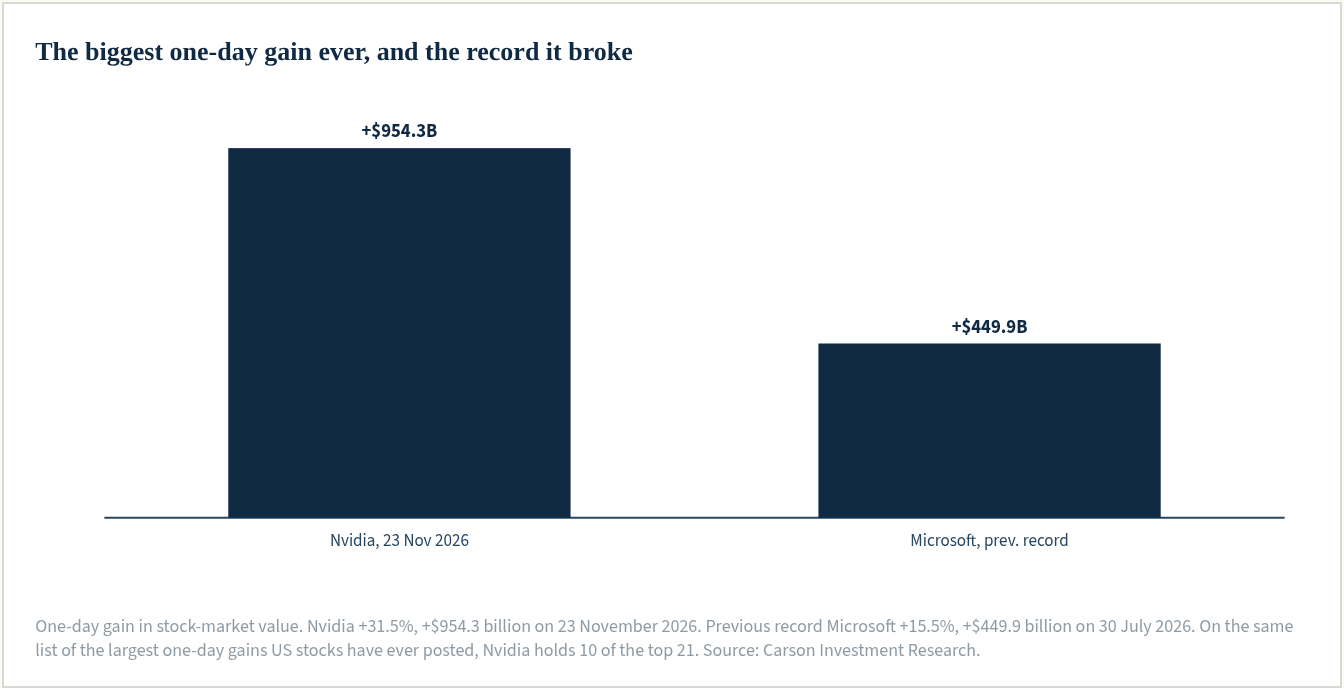
One company sits on about half of the biggest one-day jumps in the whole history of the market. That is not spread out across the economy. It is concentrated in one name.
And the trigger was a boardroom decision. The board brought back Jensen Huang, the co-founder, and handed him the keys. The price turned on it, in a day.
Signal 1 of 3
What "a backstop" really means
Why did the board actually bring him back? Strip away the nice words. The share price had fallen hard over the preceding days, and a lot of paper wealth had gone up in smoke. When it is your own money bleeding out like that, you act. They brought him back to put a floor under the price. It worked.
Then this note from Evercore crossed the screen. Evercore is about as establishment as research gets, so when they write something like this, you sit up.
A backstop just means someone standing behind you, promising to catch you if you fall. Once there is a backstop under a whole industry, the price stops being about profits. It starts being about who is getting caught.
We have seen this film before. In 2008 it was the big banks, "too big to fail". When the state steps in to catch one industry, the share price stops telling you how good the business is. It starts telling you how safe the rescue is.
Why this reaches your savings
Here is the uncomfortable part. If one man's job can swing a company by a trillion dollars in a day, then how much of your pension now moves on a boardroom vote?
Nvidia is not a side bet any more. It is one of the biggest single weights in the whole S&P 500, the index of 500 large US companies that most pensions track. So it sits in almost everyone's retirement account, whether they chose it or not.
Signal 2 of 3
The Fed blinks
This is not advice. It is simply what they said, and what that kind of language usually means.
On the same day, a Federal Reserve official, John Williams, came out with a clear change of tone. Here is the wire, word for word.
"Unusual factors" is central-bank language for "not our fault, and it will pass". It tends to be the sort of thing they say right before they change course.
The Fed has looked boxed in for a while. A lot of the recent price pressure came off oil and energy, and that is not the sort of inflation you can do much about by moving interest rates. So when the same Fed suddenly talks inflation down and hints the hard part is over, it is fair to ask: why now?
Think about the timing. On the very same day the state stepped in behind the AI industry, the Fed started talking inflation down. Maybe that is a coincidence. Or maybe it is one system looking after itself, keeping money cheap and the mood calm while the big things get propped up.
Signal 2 of 3
And the dollar jumps
Here is the part that ties straight into metals. On the same day, the US dollar pushed up to its highest level since early 2025.
- Highest
- level for the US dollar index since early 2025
- Two ways
- a strong dollar presses on what you own
The dollar index simply measures the dollar against a basket of other big currencies. When it rises, the dollar is strong.
And a strong dollar leans on two things people own without thinking about them. First, gold. Gold is priced in dollars, so when the dollar gets stronger, it usually pushes the gold price down. Second, big US companies that earn abroad. They bring home less when they convert foreign sales back into dollars.
Do not hang the story on one week
I will be straight with you. The dollar could easily turn again. If the Fed softens for real and starts cutting rates, the dollar can roll back over, and this flips. One week's chart is not the whole story, and you should not treat it as one.
What tends to stand up through all of it is the dull kind of business that makes money whether it is rescued or not. Something that sells things people have to buy every week, and does not need a bailout to survive. That is the sort of thing still standing when the props come out.
Signal 3 of 3
The gold and silver rule change
Let me be clear first. I am not telling you to buy gold or silver. I am telling you what the people who run the market just did, and what it usually means.
On the same day, the main exchange, the CME, raised the margins on gold and silver futures. Here are the exact figures.
- 5% → 6%
- gold margin (higher-risk band 5.5% to 6.6%)
- 8% → 9%
- silver margin (higher-risk band 8.8% to 9.9%)
The change took effect after the close on 24 November 2026. The exchange described it as "the normal review of market volatility to ensure adequate collateral coverage".
What "margin" actually is
This is the whole thing, so let me translate it. A margin is the deposit you put down to control a much bigger bet with borrowed money. A futures contract is just an agreement to buy or sell something later at a price fixed now, and you only post that deposit, not the full value.
It is like the deposit on a hire car. You put down a few hundred pounds to drive something worth far more.
Now, when the exchange raises that deposit, everyone holding one of those bets has to find more cash, right away. Anyone who cannot top up gets sold out automatically, whether they like it or not. That is a margin call , and it forces selling.
Signal 3 of 3
Three things leaning on the price
There is a cynical read on this going round, and it is worth hearing. The thinking is that the price had stopped falling, so the margins went up to knock it back down. That is an opinion, not a fact, and the claim that it has happened before cannot be verified here. But you can see why someone would think it, when the deposit rises right as the price tries to recover.
There is another possible seller in the wings too. There were reports that Turkey may use its gold "tools" to support its own currency. In plain English, a central bank short on dollars can lean on its gold pile to defend its money, and that can mean more gold coming onto the market.
So stack them up. Margins up, dollar up, and a possible official seller. Three things pressing on the price at once.
We have seen this before
Back in 2011, silver was flying, and the exchange raised margins several times over a few weeks. The price then fell hard and fast. Same mechanism, forced selling from people who got a margin call they could not meet.
It is a bit like a casino raising the minimum bet right as you start to win. Your hand might still be a perfectly good one. All that has really happened is the house changed the rules on you mid-game. And you would want to know that is what is going on.
Signal 3 of 3
Reading a rule change, not a headline
A margin change rarely makes the front page. It is a line in an exchange notice. And yet it can move the price of gold and silver more directly, in the short run, than almost any headline about them.
That is the difference worth holding onto. The headline tells you the price moved. The rule change tells you why it is about to move, and who is being squeezed.
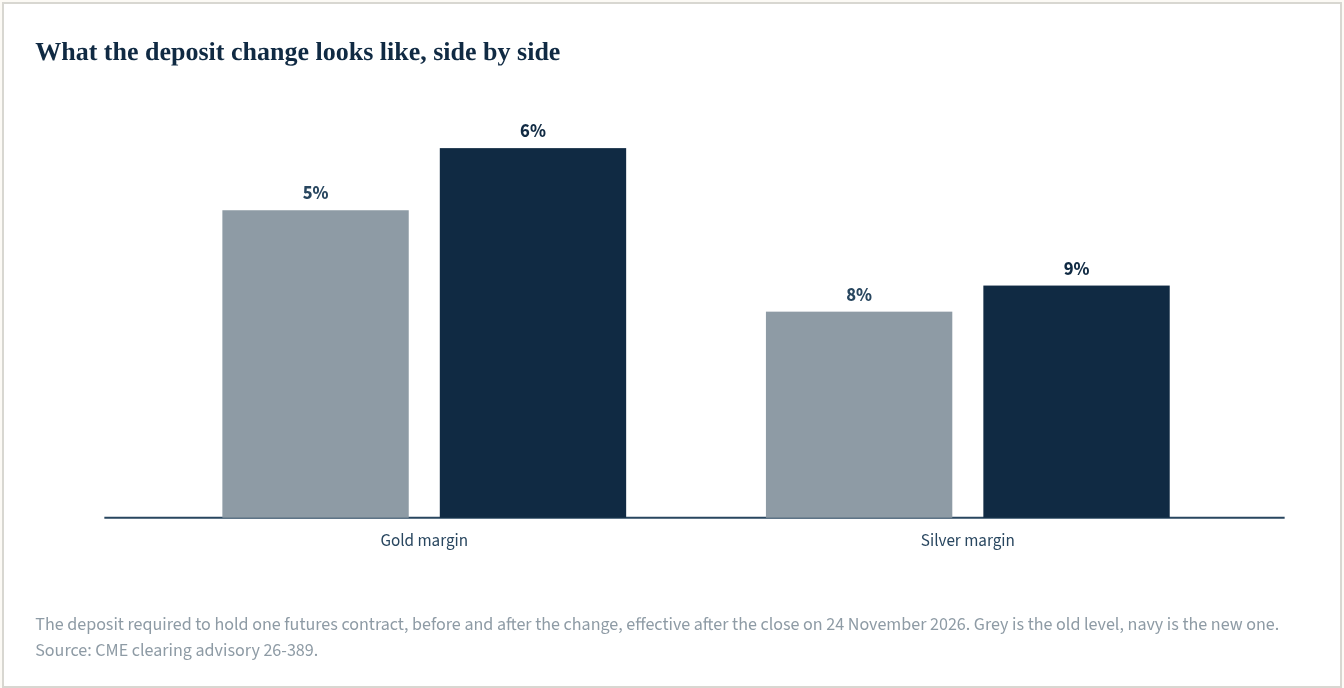
A one-point rise sounds small. On a bet many times the size of the deposit, it is not. It is a fresh cash demand on everyone already holding, on the same day, which is exactly how a rule change turns into forced selling.
The Pattern
The one thing all three have in common
Step back and put the three side by side, because they all landed on the same day, and that is the real signal.
The state steps in behind the AI industry. The Fed starts talking inflation down and the dollar jumps. And the exchange makes it more expensive to hold gold and silver with borrowed money.
Look at what each one does. Every single one protects the system as it is. Each keeps the big things propped up, keeps money cheap and the mood calm, and makes it harder to bet against any of it.
The small group from the start
Remember the small group who tend to come out of moments like this a good deal richer? They are not smarter than you. They pay attention to the rule changes while most people stare at the headlines. So they move a little earlier than everyone else.
A headline tells you about something that has already happened. A rule change tells you about something that is just about to happen. That is the edge, and it is available to anyone who looks in the right place.
The next date is already set
We even have the next room on the calendar. Jensen Huang is due to testify publicly before the Senate Banking Committee on 3 December 2026. That is another place where the rules could move, in either direction. So put it in your diary and watch it. Do not try to predict it.
What To Do Now
The habit that keeps you ahead
Not a hot tip. A plain habit you can run for the rest of your life.
The habit that actually protects you is dull and simple. Every time one of these rule changes lands, you go and look at what you own, and you ask how it is affected. That is the whole game.
- 1. A rule change lands
- 2. List what you own
- 3. Ask who it helps and who it squeezes
- 4. Write down one action
Two questions for everything you hold
For each thing you own, ask two plain questions. What actually pays me here? And what is only standing up because somebody is propping it up?
The first question finds the things that make money on their own. The second finds the things that depend on a rescue. You want to know which is which before the rules move again, not after.
Why this beats predicting
You do not have to guess what happens next. You just have to react faster and more calmly than the crowd when a rule changes. Reacting well is a skill, and it is a learnable one.
This is the work my mentors drilled into me, and it is the work Winston does every day. We read the boring notices so you do not have to, and we say them in plain English.
Act This Week
The one-page checklist
Small, concrete steps. None of them need a spare pound. All of them you can do this week.
- List what you own in one line each. For every investment, write one plain sentence on why you own it and how it makes money. Anything you cannot explain goes on a watch list.
- Mark what needs a rescue. Beside each holding, note whether it pays its own way or leans on cheap money, a bailout or a backstop. Be honest about the second group.
- Check how concentrated your "safe" index is. Look up the top handful of holdings in any fund you own. If one or two giant names dominate, you are more exposed to a single boardroom than you thought.
- Note the dollar's direction. You do not have to trade it. Just know whether the dollar is rising or falling, because it moves gold and your overseas holdings without asking.
- Put 3 December in your diary. The Senate Banking testimony is a scheduled rule-room moment. Watch what comes out of it. Do not try to predict it in advance.
- Book one quiet hour. Put it in the calendar. Money rewards attention, and attention is the one thing a busy week steals from you first.
Glossary
The words, in plain English
Margin. The deposit you put down to control a much bigger bet with borrowed money. Raise the margin and everyone holding the bet has to find more cash at once.
Futures contract. An agreement to buy or sell something later at a price fixed now. You post a deposit, not the full value, which is why a small deposit controls a large position.
Margin call. The demand to top up your deposit when it falls short. If you cannot pay, your position is sold out automatically, which forces selling into the market.
Collateral. Cash or assets you pledge to back a bet, so the exchange is covered if the bet goes against you.
Backstop. Someone standing behind a company or an industry, promising to catch it if it falls. Once one exists, the price reflects the rescue as much as the business.
Bailout. A rescue, usually with public money or public guarantees, of a company or industry that would otherwise fail.
The dollar index. A measure of the US dollar against a basket of other big currencies. When it rises, the dollar is strong, which tends to press down on gold and on foreign earnings.
The Federal Reserve. The US central bank. It sets the base interest rate and heavily influences the cost of money across the whole system.
Inflation. The rate at which prices rise, which is the rate at which your money loses buying power.
The S&P 500. An index of 500 large US companies, often sold as "the market". Today a small group of giant technology firms makes up a large share of it.
Index weight. How much of an index one company makes up. A heavy weight means that single company moves the whole index, and every fund that tracks it.
The Data Room
Every number, sourced
Nothing in this guide is a vibe. Here is the raw table behind every figure, so you can check it yourself. A claim you cannot check, however confident it sounds, is just an opinion in a nice font.
| What | Figure | When | Source |
|---|---|---|---|
| Nvidia one-day gain | +31.5%, +$954.3bn | 23 Nov 2026 | Carson Investment Research |
| Previous record (Microsoft) | +15.5%, +$449.9bn | 30 Jul 2026 | Carson Investment Research |
| Nvidia's share of the largest one-day gains | 10 of the top 21 | As at 23 Nov 2026 | Carson Investment Research |
| US dollar index | Highest since early 2025 | 23 Nov 2026 | Public market data |
| CME gold margin | 5% → 6% (HRP 5.5% → 6.6%) | Effective 24 Nov 2026 | CME clearing advisory 26-389 |
| CME silver margin | 8% → 9% (HRP 8.8% → 9.9%) | Effective 24 Nov 2026 | CME clearing advisory 26-389 |
| Senate Banking testimony | Jensen Huang, public hearing | 3 Dec 2026 | US Senate Banking Committee schedule |
What could change this picture
| If this happens | Then the picture shifts like this |
|---|---|
| The Fed cuts rates for real | The dollar can roll back over, which eases one of the three pressures on gold and silver. |
| The exchange reverses the margin rise | The forced-selling pressure fades, and the short-run squeeze on metals lifts. |
| The AI backstop is tested | If the implied rescue is ever withdrawn, the names leaning on it reprice fast, and index-heavy pensions feel it. |
Figures are reported as published and rounded where the spoken video rounded them. HRP means the higher-risk band in the exchange notice. Always check the sources and form your own view.
Disclaimer
This guide is educational and general in nature. It is not financial advice and not a recommendation to buy or sell any investment, including gold or silver. It does not take account of your personal circumstances. Figures are reported as published and rounded for teaching. Investments can fall as well as rise. Always do your own research, and speak to a regulated adviser before making decisions. The Prehn Institute takes no sponsorships and holds no positions tied to this guide.