
Quantum Computing: The Second Wave
The best 3 months this industry has ever had. The stocks did nothing. Here's what that means.
Felix Nikolas Prehn · 14 August 2026 · 24 pages
Bottom line
Since May 2026, quantum computing has had 4 catalysts that would normally send stocks vertical: Google's CEO compared quantum to AI 5 years ago, Oracle physically installed a quantum computer in its cloud, the US government took ownership stakes in 9 quantum companies, and IonQ posted record revenue of $80.1M (+287%). The stocks moved between -2% and +6%. This report explains why — and what it means for investors sitting in the boring middle of a technology adoption curve.
$850BForecast quantum computing market by 2040 — roughly 30% annual growth
Bottom Line
The best 3 months this industry has ever had. The stocks did nothing.
BOTTOM LINE:
Between May and August 2026, quantum computing produced 4 landmark events. In any normal sector, each one alone would have moved share prices. Combined, they barely registered. IonQ: −2%. D-Wave: +2%. Rigetti: +6%. And every single one of them is still 45–70% below its October 2025 peak.
- −2%
- IonQ since May
- +2%
- D-Wave since May
- +6%
- Rigetti since May
WHAT HAPPENED
4 catalysts in 3 months. Google's CEO compared quantum to AI 5 years ago. Oracle installed a quantum computer inside a data centre. The US government took ownership stakes in 9 companies. IonQ hit $80.1M quarterly revenue, up 287%.
WHAT THE MARKET DID
Almost nothing. The pure-play quantum stocks moved in low single digits. The sector sits in the dull middle of the adoption curve — the part where the news is excellent and nobody cares.
WHY IT MATTERS
October 2025 was the mania. This is the build-out. Every major technology innovation in history has followed the same pattern: hype, crash, boredom, then a second wave that dwarfs the first. The video argues we are in the boredom phase right now.
THE CATCH
1,000% gains and most people still lost. The stocks went up enormously and then fell 45–70% from the peak. Almost everyone who owned them gave back most of the gain, because they didn't have a plan for when to sell.
4 Catalysts Since May
What actually changed
1. Google's CEO said it out loud
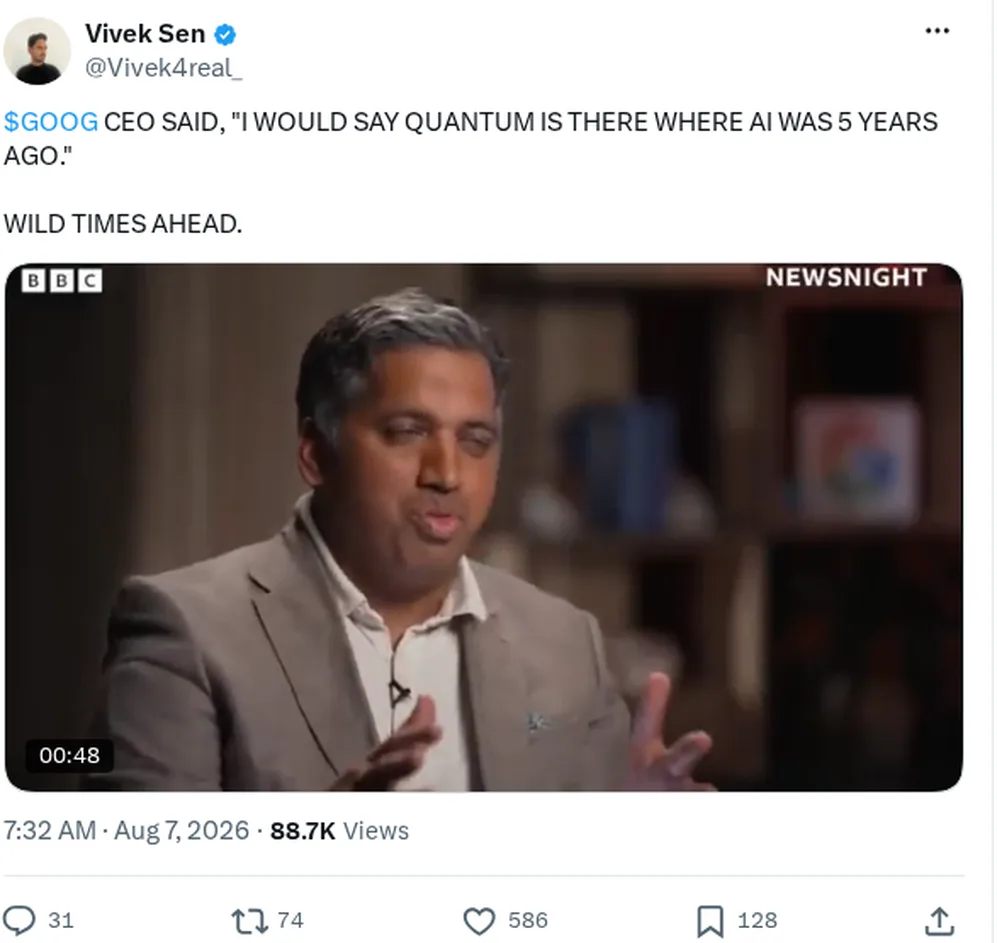
Source screenshot: Vivek Ramaswamy (@Vivek4real_) sharing Sundar Pichai's quote on X, July 2026.
"Quantum is where AI was 5 years ago." That is a direct quote from the CEO of the company whose chip, Willow, started this cycle. He is not a promoter or a startup founder. He runs one of the 4 companies on earth that could actually build a working quantum computer.
Why it matters more than another lab result. 5 years before he said this, if someone had told you what AI was about to do to stock markets, most people would have laughed. Some did laugh — Felix has the comments to prove it.
2. Oracle put a quantum computer in its cloud
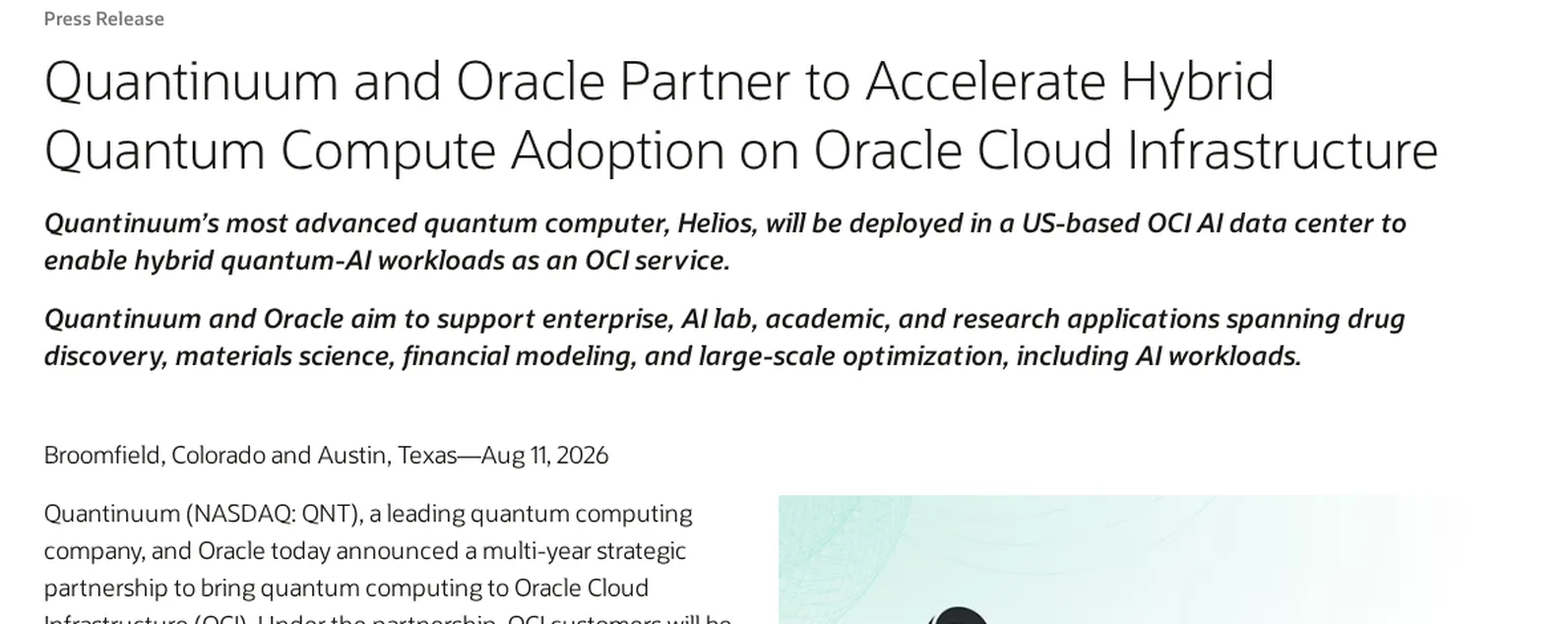
Source screenshot: Oracle newsroom, August 11, 2026.
Not a simulator, not a partnership — hardware in the
building. On August 11, Oracle and Quantinuum announced a multi-year deal. A machine called Helios — 98 trapped-ion qubits, 3rd generation — is being physically installed inside a US Oracle Cloud data centre. Developer preview goes out in the coming months.
The power number. Helios draws about 60 kW. A leading supercomputer draws 16–39 MW. That is a factor of several hundred. The single biggest constraint on the AI buildout right now is electricity. If quantum can do meaningful work at a fraction of the power draw, that changes the economics of everything.
Catalyst 3
The US government bought in
BOTTOM LINE:
$2 billion, 9 companies, and in exchange the government took a minority ownership stake. Not a grant. The same structure used for the chip companies, for rare earths, and for some of the nuclear programme. Governments don't buy into science projects. They buy into things they've decided are strategic.
Company Amount Notes
IBM $1 billion Plus $1B of IBM's own money. New standalone 300mm quantum wafer fab in Albany, NY
GlobalFoundries $375 million Semiconductor manufacturing partner
D-Wave (QBTS) ~$100 million Quantum annealing, only commercial production system
Rigetti (RGTI) ~$100 million Superconducting qubits, owns its own fab
Infleqtion (INFQ) ~$100 million Neutral atom technology, quantum sensing
PsiQuantum ~$100 million Photonic approach (not publicly traded)
Others Remainder Across 3 additional companies
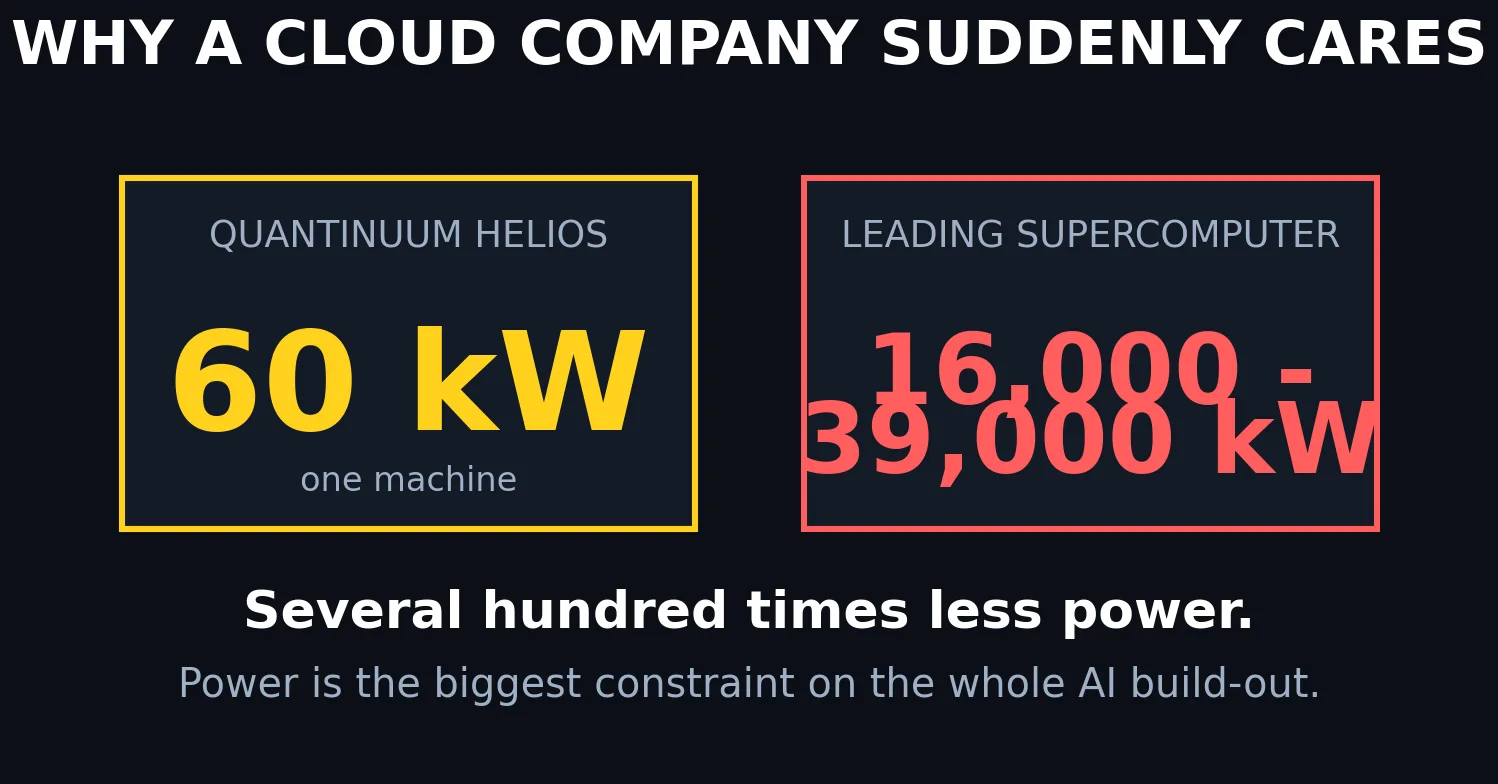
Comparison of typical power draw: quantum systems vs conventional supercomputing. Source: company announcements.
Catalyst 4
One of these companies started making actual money
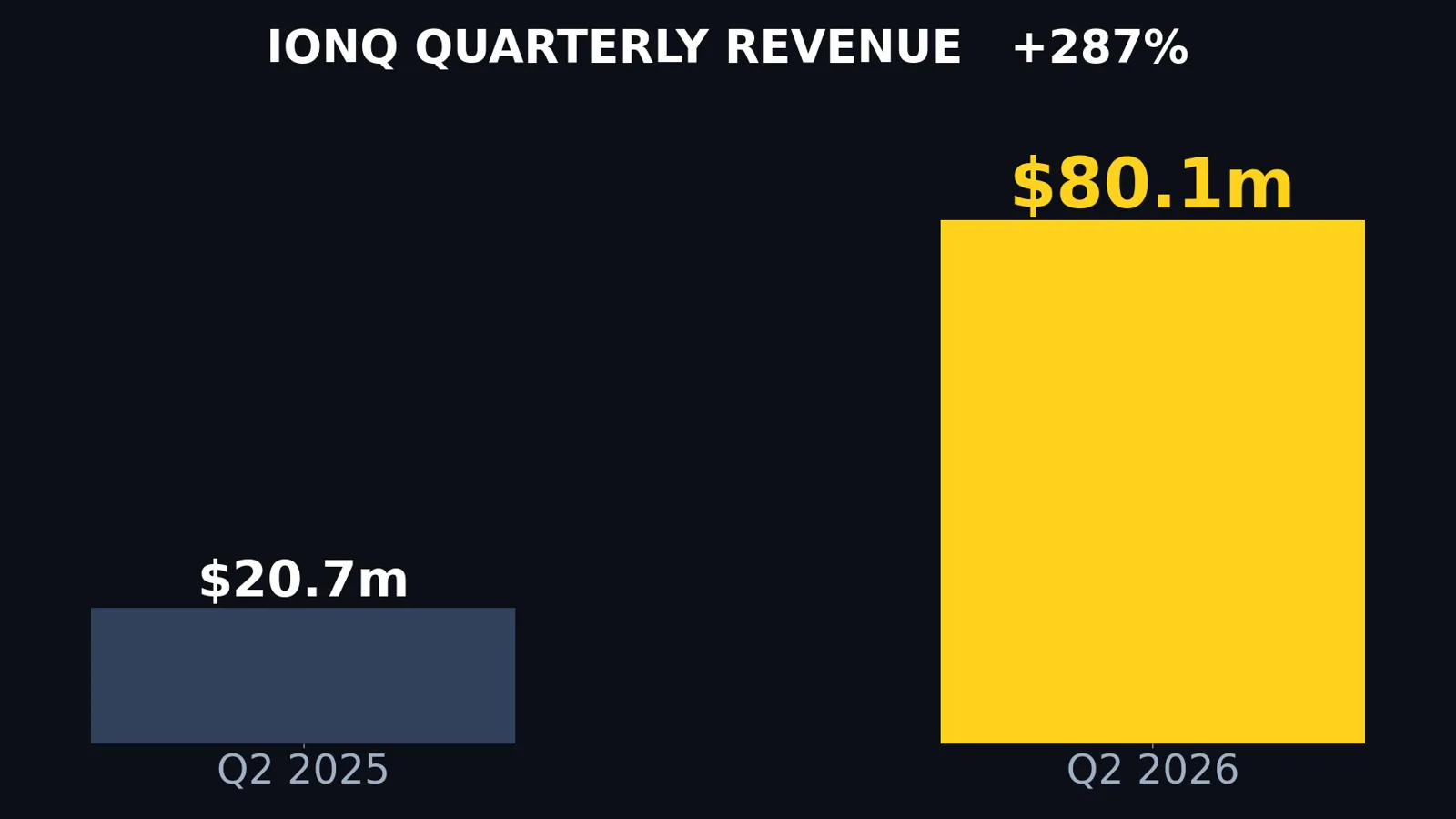
IonQ quarterly revenue. Source: company earnings reports.
Metric Q2 2026 Change
Revenue $80.1 million +287% YoY, 20% above guidance
Full-year guidance (raised) $280–$290 million Up from prior range
Remaining performance obligations (RPO) $485 million +297%
GAAP net loss $1.87 billion Of which $1.58B is non-cash warrant accounting
Adjusted operating loss (actual cash burn) ~$120 million Normal for this stage
Cash position (pro-forma, post SkyWater) ~$2.0 billion After $1.8B SkyWater acquisition
The bear case that expired.
A year ago, the honest bear case on the entire quantum industry was: lovely story, no revenue. IonQ's 5th consecutive record quarter — growing at triple digits with a $485M backlog — means that sentence no longer works.
The Honest Counterargument
What the sceptics say — and what's fair
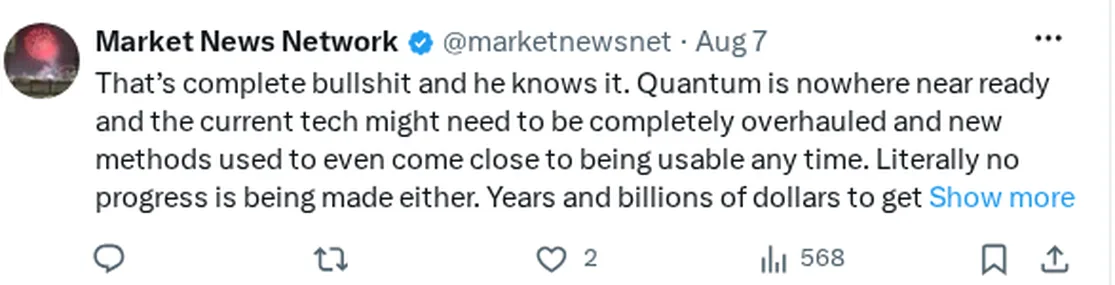
Top reply under the Google CEO clip on X. The video addresses this directly.
THE SCEPTIC'S CASE
"Quantum has made no progress. It's all narrative." For a long time, this was basically true. The sector ran on press releases, qubit counts that meant nothing, and announcements timed to share offerings. Companies with $5B market caps and revenue you could fit in a dental practice.
WHAT'S DIFFERENT NOW
Revenue. $80M in a quarter from IonQ, growing at triple digits, with a $485M backlog. Real customers, real invoices.
Ownership. The government didn't write a cheque and walk away — it took a stake. If this were vapour, that is an odd thing to do with taxpayers' money.
Distribution. Oracle. Amazon. Microsoft. IBM. These are the companies that decide what shows up on enterprise price lists. Once it's on the list, IT departments put it in their budgets. That is a different conversation from a research paper.
WHAT'S STILL FAIR
"Priced ahead of itself" is a legitimate position. These stocks are expensive. They are lossmaking. You could lose half your money in 8 weeks — it has happened. But "no progress" is expired. The honest bear case now is about sizing and timing, not "run away."
2 Ideas, No Cat in a Box
Error correction: bigger now means
better
IDEA 1:
Qubits are fragile and get things wrong constantly. Historically, adding more qubits made the whole system worse. Google's Willow chip changed that: as the chip gets bigger, the error rate goes down. Each time they scaled up the grid, the logical error rate fell by a factor of about 2.14x.
More qubits (old world)
→
More errors
→
System gets worse
More qubits (Willow)
→
Error rate falls 2.14x
→
Engineering challenge, not physics miracle
Why this matters for investors.
If bigger means better, quantum isn't stuck in a lab waiting for a breakthrough. It becomes an engineering problem. Engineering problems get solved when enough money shows up. There is a lot of money showing up.
Source: Google Quantum AI, Willow chip results. Also referenced: HRL Labs, 18 spin qubits at 0.02% error rate.
Idea 2
Moving onto normal factory lines
HRL LABS: 18 SPIN QUBITS AT 0.02% ERROR
Almost no coverage, massive implications. Spin qubits are made on ordinary semiconductor equipment — the same machines that produce the chip in your phone. Everything else in quantum needs exotic hardware in a fridge colder than deep space, hand-built, one at a time.
IBM BOUGHT HRL
The manufacturing route meets the manufacturer. IBM now has the spin-qubit technology and a new $1B wafer factory in Albany to produce it. That changes quantum from a one-off science project into something you can actually scale.
THE INVESTMENT TAKEAWAY
"You don't need to understand quantum. You need to understand who owns the pipes." That's from Felix's original thread, and it's the lens this video uses for every pick. Who controls the supply chain — the chips, the fabs, the cloud distribution — matters more than who has the cleverest physics.
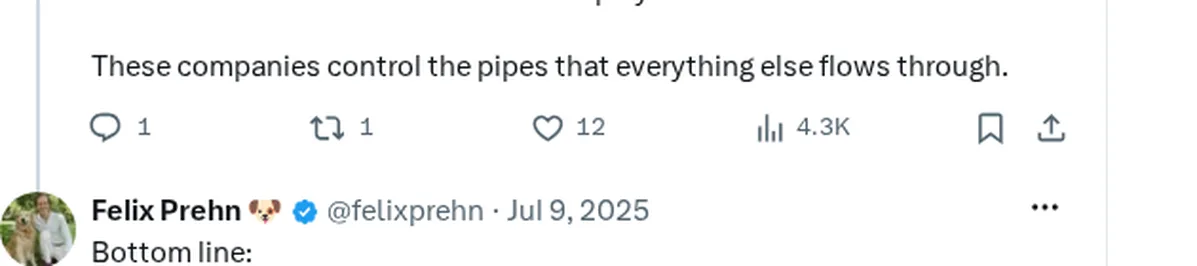
Source: Felix Prehn's quantum thread on X, July 2025.
$10,000 → $115,000 → $51,000
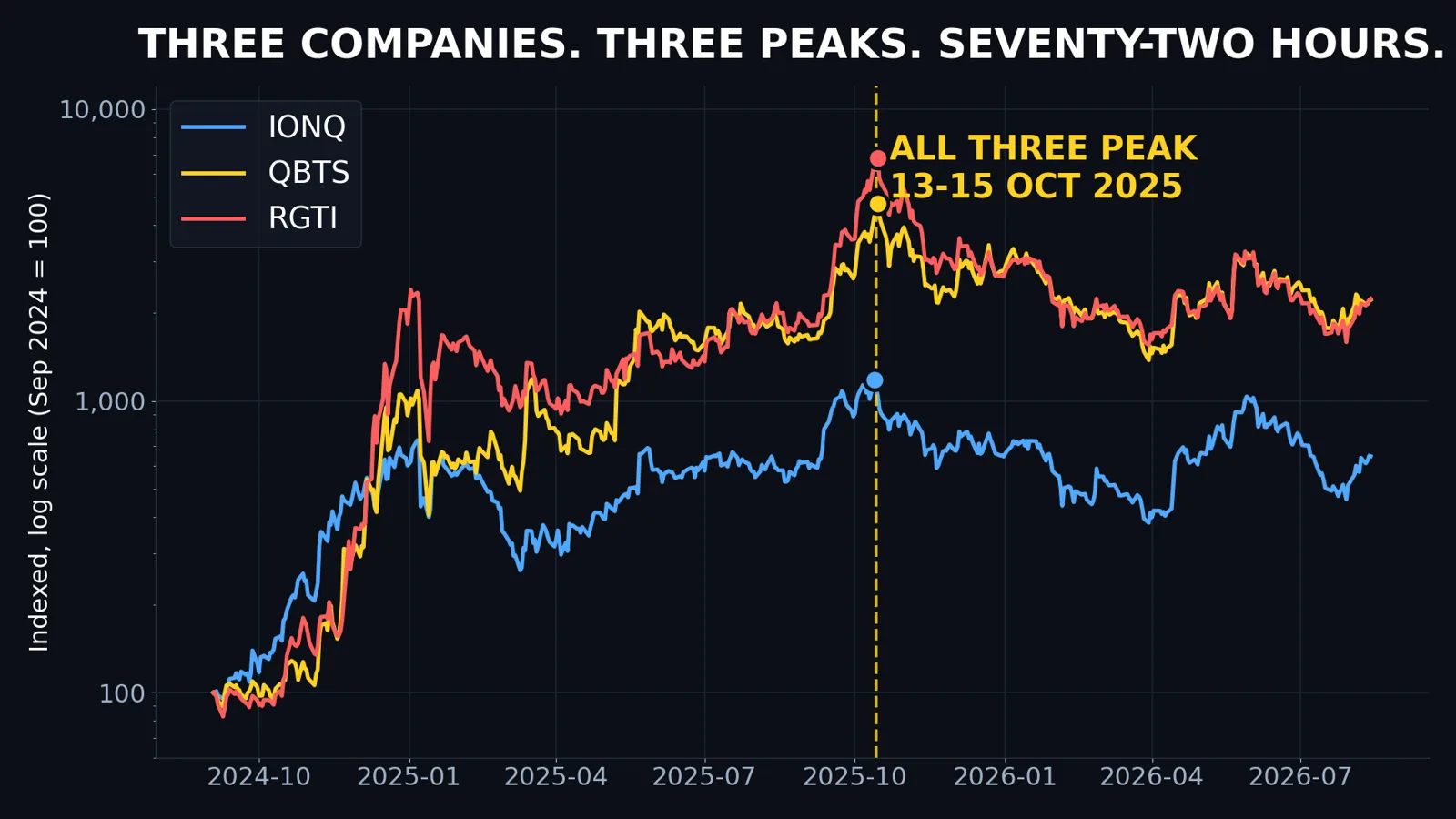
Two-year charts: IonQ, D-Wave (QBTS) and Rigetti (RGTI). All 3 peaked within 72 hours of each other in October 2025.
Stock Peak Date Gain to Peak Fall from Peak
D-Wave (QBTS) Oct 15, 2025 ~1,150% −53%
Rigetti (RGTI) Oct 15, 2025 ~827% −67%
IonQ Oct 13, 2025 ~180% −45%
3 companies. Different technologies. Different customers. Different financials. All
peaked within 72 hours.
That's not 3 companies having 3 separate bad weeks. Somebody flipped a kill switch across the whole sector at once.
The Part That Costs People Money
The news got better the entire way down
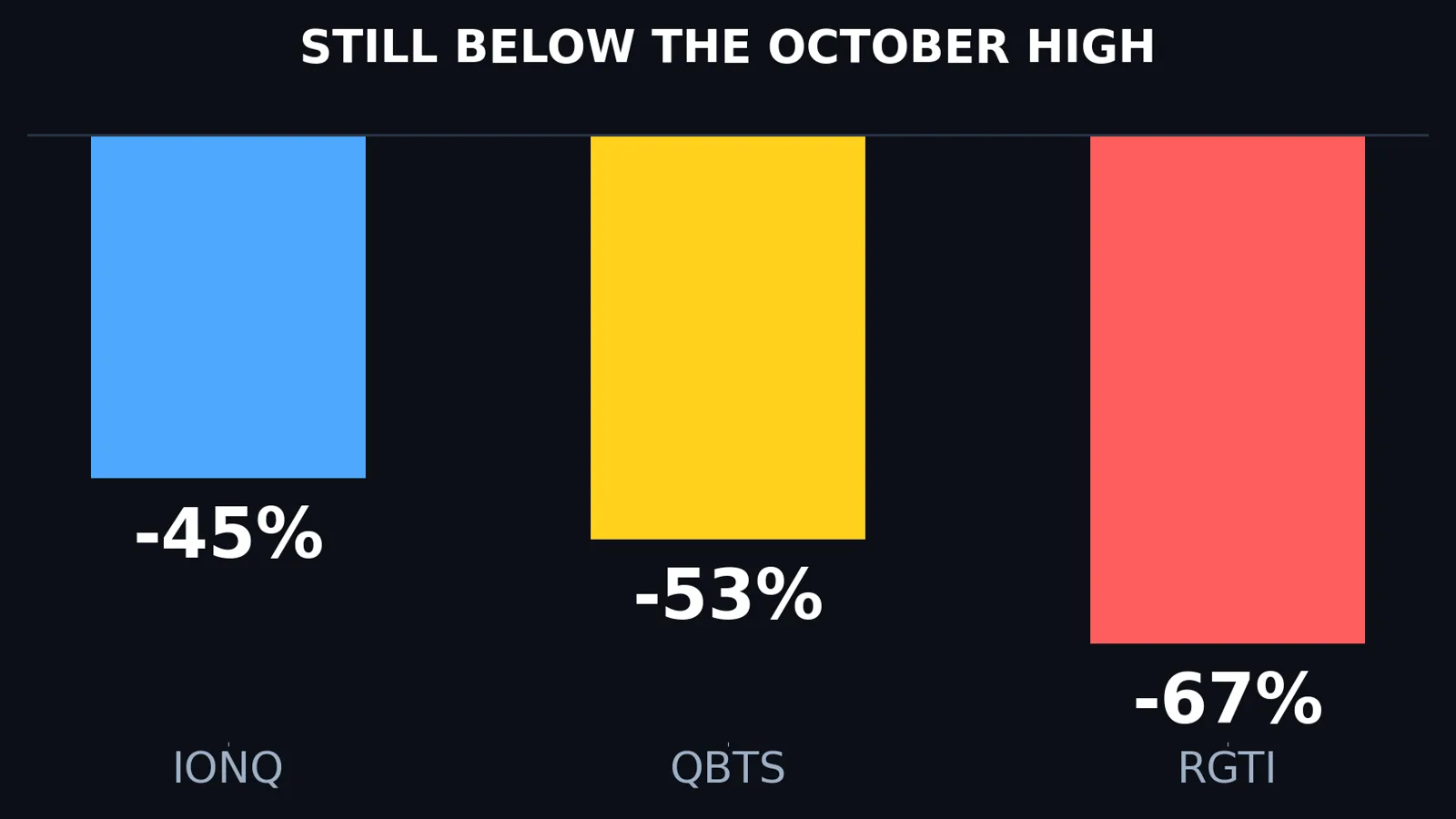
EVERYTHING HAPPENED AFTER THE CRASH
Google CEO quote. Oracle deal. Government money. IonQ's
record quarter. All of it happened after October 2025. Every month brought better news. Every month, prices went lower. If you were holding and thinking "the technology is real, the story is good, I'll hold" — you were right about all of it. And you still gave back 60%.
WHAT WENT WRONG
They didn't have an exit plan. They didn't know when to
sell. They watched life-changing money appear on their screen. Instead of locking it in, they held. Not because they were stupid. Because nobody ever taught them when to get out.
THE HONEST REFRAME
"Greedy is the wrong word. They just didn't know what to
do." There are 10,000 videos on what to buy. An entire industry of courses and newsletters. And almost nothing, anywhere, about when to sell.
Where We Are Now
The boring bit is where the money gets
made
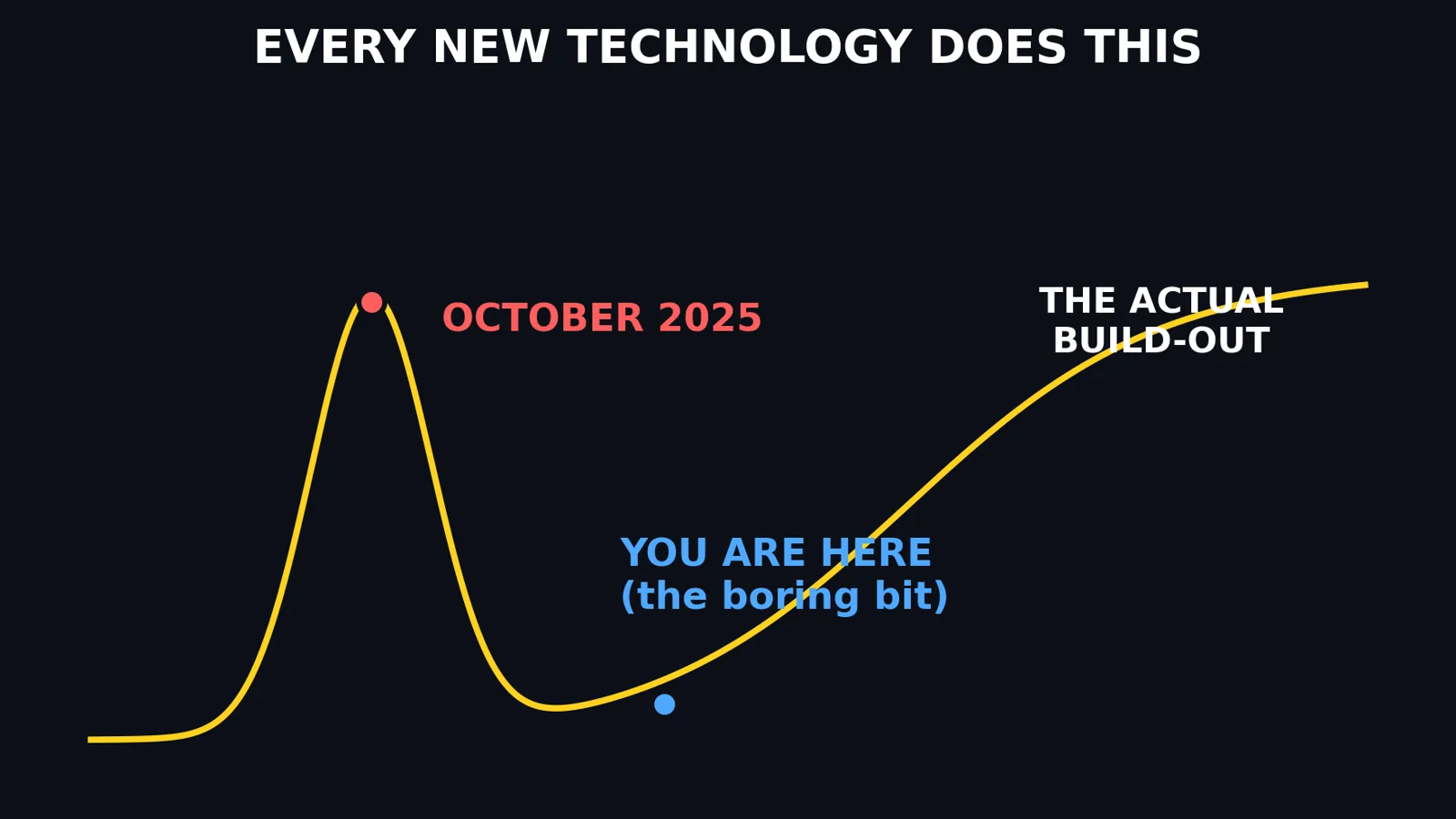
The technology adoption pattern. Same picture Felix showed in May.
THE PATTERN
Every major technology does this. New tech arrives. Everyone gets wildly overexcited. Prices go vertical. Then it crashes — 70%, 80% — and everyone declares it dead. Then, quietly, while nobody's watching, the actual thing gets built, and it ends up far bigger than the mania ever suggested.
HISTORICAL PRECEDENT
Railways did this. The internet did this. The internet crash was 90%. The internet still ate the world. Everyone always points to the crash and says "it was a bubble." Everyone always forgets the second half.
RIGHT NOW
October 2025 was the top of the mania. Today we are in the boring bit — excellent news, flat charts, genuinely dull to own. And it's brutal to sit through, because nothing's happening and you start thinking you should sell and go buy something exciting. That's exactly when you shouldn't.
TIER 1 — PICKS AND SHOVELS
IBM
THE THESIS:
Biggest government cheque ($1B) plus $1B of its own money. Building a brand-new standalone 300mm quantum wafer factory in Albany, NY. Bought HRL (spin qubits). Targeting Starling — the first large-scale error-corrected quantum computer — by 2029. Currently ~28% below its June high.
Detail Data
Government investment $1 billion
IBM's own matched investment $1 billion
Factory New standalone 300mm quantum wafer fab, Albany NY
Acquisition HRL Labs (spin qubits — semiconductor-compatible manufacturing)
Target machine Starling, first large-scale error-corrected quantum computer, 2029
Share price vs high ~28% below June 2026 peak
A wafer fab is a factory.
Not a lab. Somebody has decided quantum needs to be manufactured at scale, and the government has decided it needs to be manufactured in the United States. That is a structural commitment, not a press release.
TIER 1 — PICKS AND SHOVELS
Tier 1
Alphabet (GOOGL)
THE THESIS:
Willow started the cycle. Their CEO just compared quantum to AI 5 years ago. And Alphabet is down about 14% since May. If quantum takes another 8 years — and it might — you still own Google. Search, YouTube, Android, the cloud, the AI. The pure plays don't have that luxury.
THE WILLOW CHIP
The error correction breakthrough is theirs. Each time they scaled up the grid, the logical error rate fell by about 2.14x. That result is what turned quantum from a physics problem into an engineering problem.
THE OPTIONALITY
The cheapest way to be in the room. Unlike pure-play quantum stocks, Alphabet has a profitable core business generating hundreds of billions in revenue. Quantum is a free option on top of a business you'd be happy to own anyway.
THE HONEST BIT
It's also the least exciting. And that, as the video says, is kind of the theme. The least exciting decision in this list has been the most profitable (Honeywell, next page).
- −14%
- Since May 2026
Willow
Started the quantum cycle
"5 yrs"
CEO's AI comparison
The Least Clever, Most Profitable Decision
The Honeywell callback
JULY 2025: THE BORING PICK NOBODY
CLICKED ON
3 quantum plays. 2 obvious. Then Honeywell. A big, dull, profitable industrial company that makes thermostats and jet parts. Felix picked it because Honeywell owned a majority stake in Quantinuum. If quantum went nowhere, you still owned a real business.
AUGUST
2026:
QUANTINUUM
IS
INSIDE
ORACLE'S CLOUD
Helios — the machine Oracle just installed — belongs to
Quantinuum. Of every quantum company in the world, the one a major cloud provider physically put in the building is the one attached to the boring industrial.
THE SHARE PRICE
Honeywell is up about 10% since May and sitting near its highs. Meanwhile the 3 exciting pure plays did nothing.
THE LESSON
"Institutions accumulate while it's boring. Retail turns up for the momentum." Or put it another way — by the time it's exciting, the smart money is already in.
- +10%
- Honeywell since May
- −2%
- IonQ since May
- +6%
- Rigetti since May
TIER 2 — THE REVENUE ONES
IonQ
THE INVESTMENT CASE
Revenue leader. $80.1M Q2 revenue, +287% YoY, 5th record quarter. $485M backlog. Roughly half the business is international, ~60% commercial rather than government. This is a company that sells things.
SKYWATER ACQUISITION
$1.8B, closed July 31. SkyWater is a US-based semiconductor foundry. IonQ now owns its manufacturing — the Tesla model. Own the supply chain from chip design to production. It costs more and takes longer, but nobody can squeeze you on supply.
THE HONEST BIT
The headline loss is scary. GAAP net loss of $1.87B in Q2. But $1.58B of that is a non-cash accounting item on warrants — paper, not real money going out the door. Actual cash burn is ~$120M/quarter. They've got ~$2B in cash after SkyWater. The money is there.
OTHER MOVES
Nexus Photonics (photonic interconnects), plus MOUs with Anduril and Sandia. Broadening the customer base beyond cloud and research into defence and national security.
TIER 2 — THE REVENUE ONES
Tier 2
Rigetti (RGTI)
THE BUSINESS
4 earnings beats in a row. Revenue up 173%. New 108-qubit chip (Cepheus). Owns its own fab. $100M from the government programme. Deals in the UK, India, and a partnership with Quanta in Taiwan.
THE WAIT-FOR-CONFIRMATION RULE
In May, Felix said wait for it to break $20. Ideally push to $27 before getting involved — he wanted the market to confirm the story before paying for it. It never broke $20. It's sitting at $18.60 right now.
THE FRUSTRATION
The business delivered. The share price didn't. 4 beats. New chip. Government money. Everything Felix wanted from the company happened. The confirmation from the market did not.
THE DISCIPLINE
The wait-for-confirmation rule is the same rule that would have got you out in October. You can't use it only when it's comfortable. So Felix still doesn't own Rigetti.
- 173%
- Revenue growth Cepheus qubits
- $18.60
- Still below $20 trigger
TIER 3 — THE LOTTERY TICKET
Tier 3
One speculative name. Your pick.
OPTION A: INFLEQTION (INFQ)
$100M from the government. Different technology —
neutral atoms. Also has a quantum sensing business (navigation and timing) with defence customers who buy things now, not in 2029. Over $440M in cash. Felix's preference, because of the sensing revenue today.
OPTION B: XANADU (XNDU)
First photonic pure play you can buy. Listed March 2026. Revenue quadrupled. Photonics is the "runs at room temperature" route. If it works it's enormous. If it doesn't, it's nothing.
POSITION SIZING
This is the money you can be completely wrong about. If a name in tier 3 going to zero would ruin your year, it's too big.
One demotion: D-Wave (QBTS)
Given a full segment in May. Not this time. The bull case is real — it's the only one in commercial production, its machines solve specific annealing problems today for money. But the stock is up 2% in 3 months across the best news cycle the sector has ever had, and the story hasn't moved in a year.
Owning it isn't stupid. It's just no longer a top pick. Felix would rather tell you that than quietly stop mentioning it.
Full Disclosure
What Felix actually owns
Stock Position Notes
Owns — core Would add on weakness
Alphabet (GOOGL) Owns — core Not going anywhere
IonQ Owns — real position Sized smaller than the boring 2, because it can halve
Honeywell (HON) Owns — never sold "The least clever and most profitable decision in the entire pile"
Rigetti (RGTI) Does not own Still waiting for $20
D-Wave (QBTS) Reduced Not adding
Tier 3 (if any) Would pick Infleqtion Likes sensing business selling to defence today
Sizing principle from the video.
Tier 1 (IBM, GOOGL) = core positions. Tier 2 (IonQ) = real but smaller, because it can halve. Tier 3 = money you can be completely wrong about without it changing your week. Felix owns the video's exact picks in the video's exact sizing logic.
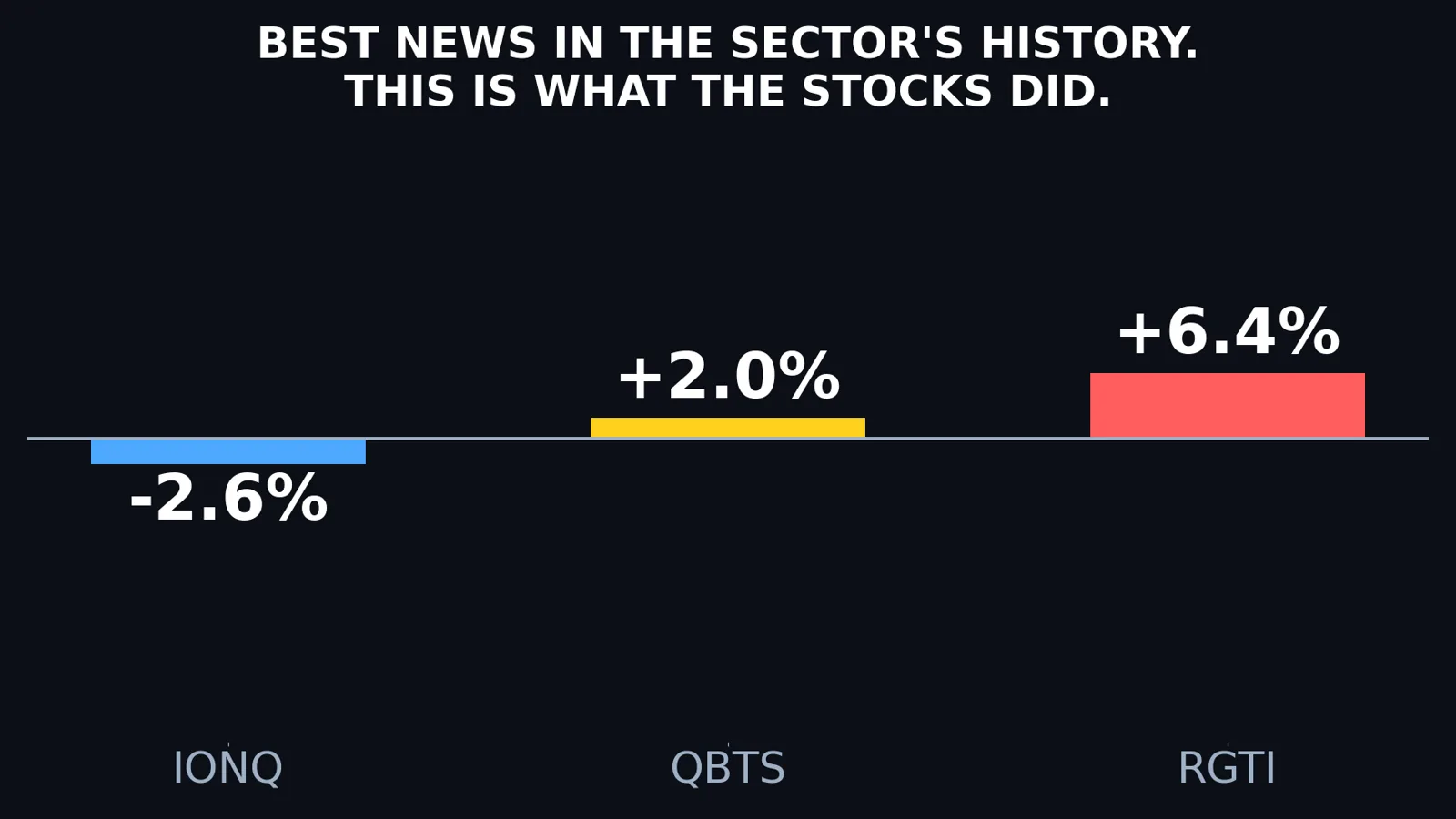
Quantum pure plays since May 2026. Best 3 months ever. The stocks just sat there. Source: Winston app.
Turn Understanding into Process
5 questions before you buy another quantum stock
Free live when-to-sell training
whentosell.org
Live on Zoom · Free · With Felix
US times and Europe / UK times available
Everyone teaches you what to buy.
Almost nobody teaches you when to sell.
Do I already know the price at which I would sell this? Before I buy it, not after it has fallen 40%?
✓
Am I sizing this so that a 50–70% drawdown would be painful but not life-altering?
✓
Do I understand whether I'm buying picks-and-shovels (Tier 1), a real but risky revenue company (Tier 2), or a coin flip (Tier 3)?
✓
Am I buying because the news is good, or because the chart confirms the story?
✓
Could I sit through 3 months of excellent news and a flat chart without panic-selling?
✓
Disclaimer
This report is for educational and informational purposes only and does not constitute financial, investment, legal, tax or accounting advice. It is not a recommendation, solicitation or offer to buy or sell any security, currency, commodity or financial product. No buy/sell rating or price target is provided. All investments involve risk, including the possible loss of principal. Market events, relationships and historical comparisons described here may not repeat. Illustrations simplify complex systems and may omit factors. Readers should conduct their own research and consult appropriately qualified professionals before making financial decisions. Past performance is not indicative of future results. The Prehn Institute makes no guarantee regarding outcomes.