
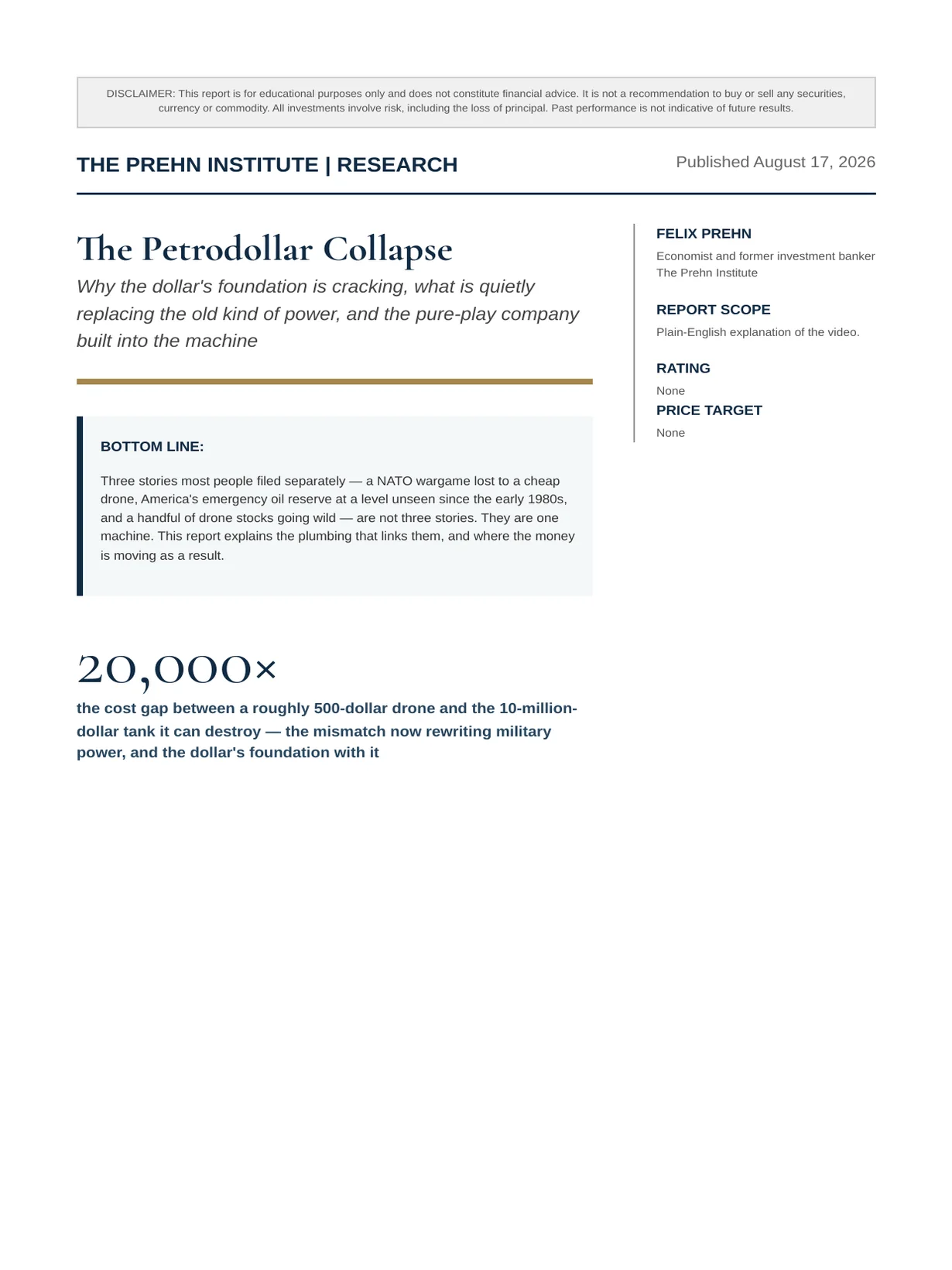
The Petrodollar Collapse
Why the dollar's foundation is cracking, what is quietly replacing the old kind of power, and the pure-play company built into the machine
Felix Nikolas Prehn · 17 August 2026 · 21 pages
Bottom line
Three stories most people filed separately — a NATO wargame lost to a cheap drone, America's emergency oil reserve at a level unseen since the early 1980s, and a handful of drone stocks going wild — are not three stories. They are one machine. This report explains the plumbing that links them, and where the money is moving as a result.
20,000×the cost gap between a roughly 500-dollar drone and the 10-million- dollar tank it can destroy — the mismatch now rewriting military power, and the dollar's foundation with it
Bottom Line
One machine, one shift, one pure play
BOTTOM LINE:
The dollar has not been backed by gold since 1971. What backs it now is a promise: that American military power is unmatched. A cheap drone destroying an expensive tank puts a crack in that promise — and every promise stacked on top of it, from the dollar to the price of everything, starts to wobble.
The military edge is humbled by cheap machines
→
The world rearms toward drones
→
Money floods the parts that every drone needs
THE TRIGGER
A 500-dollar drone beating a 10-million-dollar tank. The muscle that underwrites the whole dollar system no longer looks unbeatable. Countries are watching, and quietly hedging.
THE SHIFT
Every government reached the same conclusion at once. The old way of fighting is over. The world is rearming in a new direction — cheap, smart, replaceable machines, bought fast and in huge numbers.
THE BOTTLENECK
The parts, not the gadget. A huge share of the world's drones and drone parts come from China. Tariffs and “NDAA-compliant” rules are forcing Western buyers toward American-made components — creating a protected home market almost overnight.
THE PLAY
Own the toll booth. This report walks through the pure play — Unusual Machines (UMAC) — and the calmer basket route through drone and defense funds, all checkable inside the Winston app.
The Hole Underneath
Not gold. Not magic. Muscle.
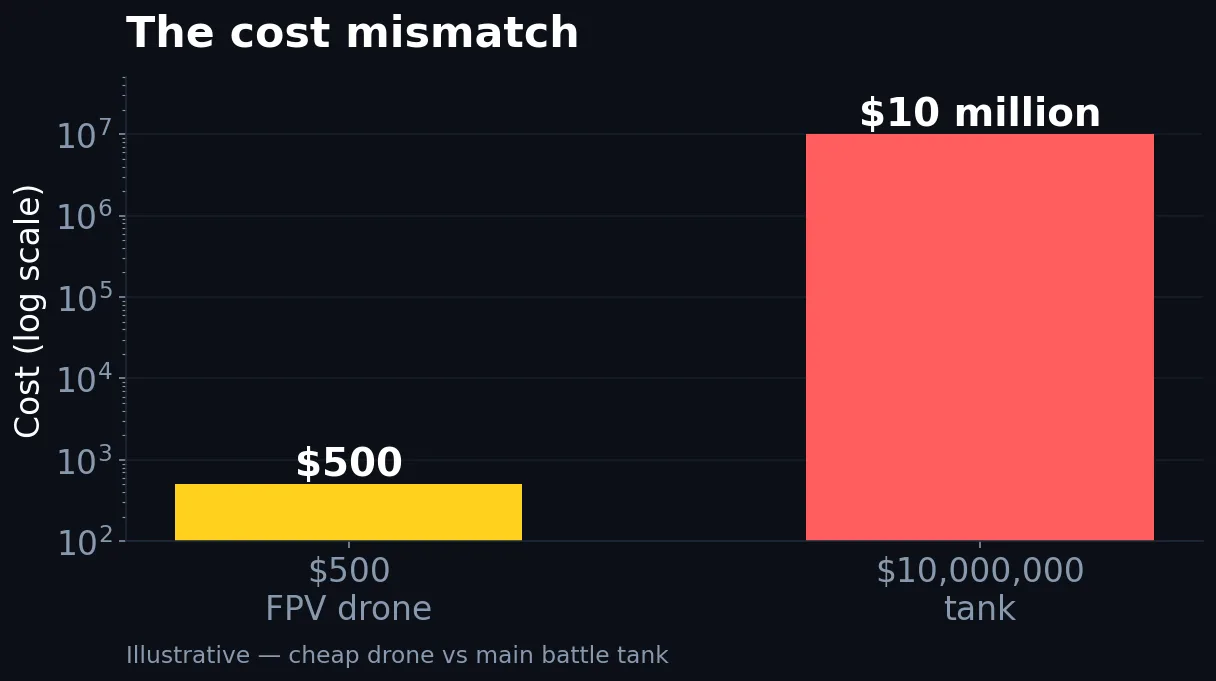
The cost mismatch that spooked the generals. Illustrative comparison of a low-cost FPV drone against a main battle tank. Sources: Business Insider, National Security Journal (drone-versus-tank economics) — see pages 20–21.
THE REAL BACKING
Trust, built on power. Decades ago the world agreed to price oil in dollars and park savings in American government debt — because America was safe, with the biggest military and the strongest economy. Holding dollars meant holding a claim on the strongest country that ever existed.
THE CRACK
A toy humbled the giant. When a 500-dollar machine can destroy a 10-million-dollar tank, the muscle stops looking unbeatable. And when the muscle looks shaky, every promise stacked on top of it — your dollars, your bonds, the price of everything — starts to wobble too.
THE POINT
A money story in disguise. The wargame was not just a military event. It was the first visible sign that the foundation under the dollar is being rewritten — the start of a much bigger shift.
The Rainy-day Fund Runs Low
The reserve at its lowest since the early
1980s
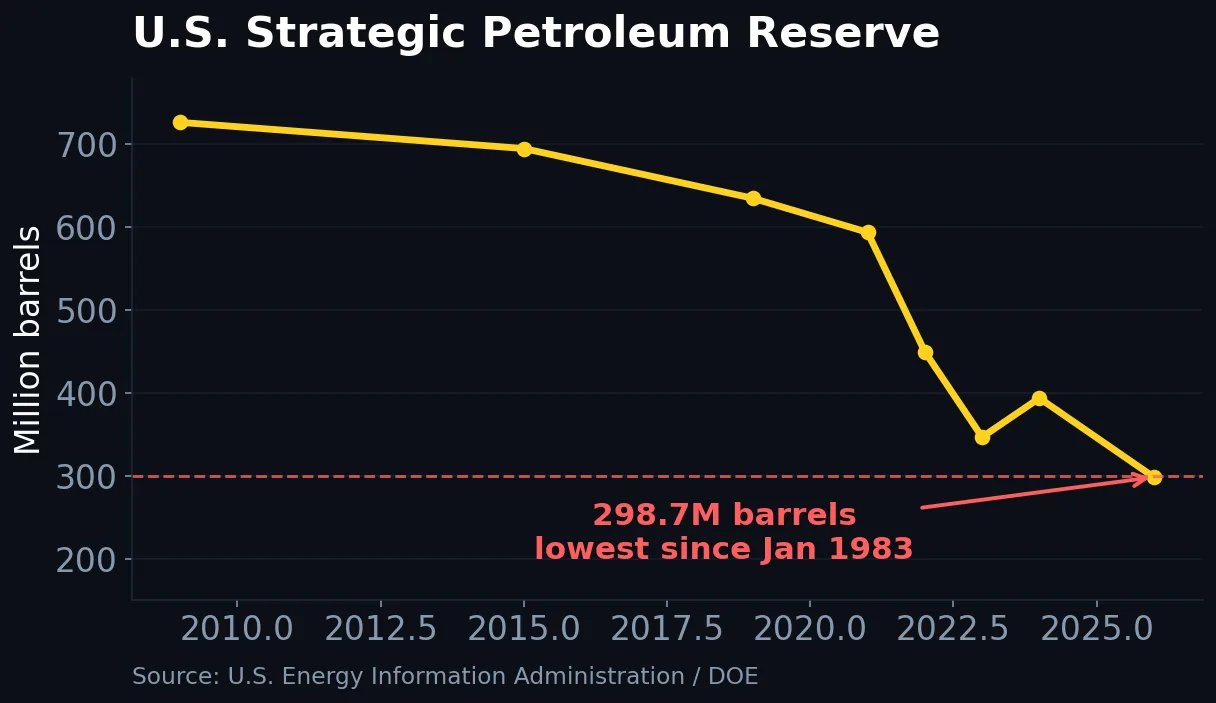
US Strategic Petroleum Reserve, million barrels. The reserve fell below 300 million barrels — a level unseen since January 1983. Source: US Energy Information Administration / DOE; reporting by Fox Business, CNBC, The Hill (see pages 20–21).
WHY OIL IS THE TELL
Oil is everything. The plastic in your phone case, the fertilizer growing your food, the ship bringing your furniture, the jet in the sky — the modern world runs on it, roughly 93 million barrels a day.
THE PETRODOLLAR DEAL
Oil priced in dollars, protected by American power. For 50 years the arrangement was simple: the world buys oil in dollars, holds dollars, and America keeps the sea lanes safe so the oil keeps flowing.
THE WARNING
A thin buffer at a bad time. The country's emergency stash running low, right as the old power arrangement is being questioned, is not a boring number. It is the rainy-day fund running low as the weather turns.
The Petrodollar Cracking
Slowly, then all at once
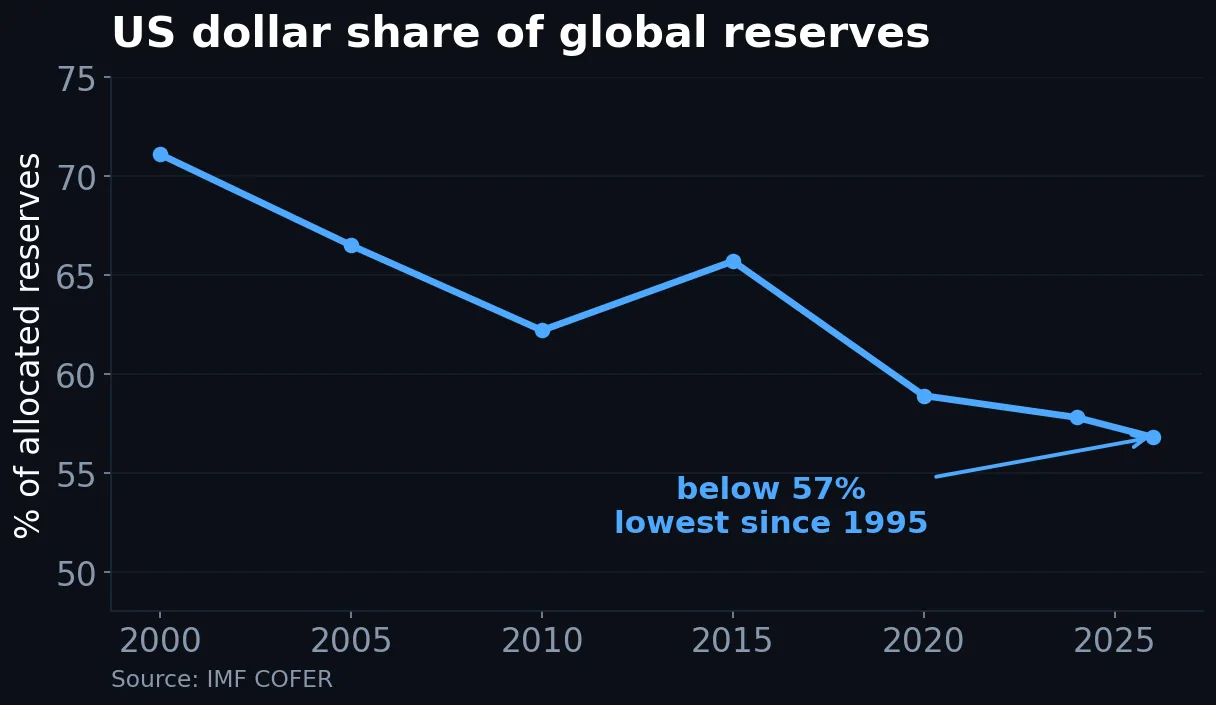
US dollar share of global allocated reserves, percent. The share has drifted below 57% — the lowest since 1995. Source: IMF COFER; context from US Gold Bureau and de-dollarization research (see pages 20–21).
WHAT IS HAPPENING
Countries are hedging. They are cutting side deals to buy and sell oil in their own currencies, and buying gold instead of parking everything in dollars — not because they suddenly hate America, but because they watched the same wargame and are quietly asking whether the muscle is still there.
HOW IT BREAKS
Like a dam, not a switch. The petrodollar is not cracking in a single dramatic day. It is a trickle, then a stream, then all at once.
WHERE THE MONEY GOES
It moves; it does not vanish. When a system this big shifts, the money relocates. The task is to work out where — and it is moving somewhere very specific.
The Same Wake-up Call
The whole world is rearming — in a new
direction
BOTTOM LINE:
Every government got the same wake-up call and reached the same conclusion: you do not need a 10-million-dollar tank when a swarm of cheap drones can find it and kill it. So the world is buying drones — millions of them — fast.
Cheap drones beat expensive platforms
→
Old procurement looks obsolete
→
Governments rearm toward drones at scale
A NEW KIND OF DEMAND
Not more of the old stuff. Eyes in the sky, machines that carry, machines that strike, machines that scout — needed quickly and in enormous numbers.
THE INVESTOR'S SETUP
Three forces at once. Demand exploding, cheap foreign competition getting shut out, and almost nobody set up to supply it yet. That combination is about the most powerful backdrop an investor can find.
THE CATCH
The supply chain has a problem. Right now, much of that supply runs through the one country the West is rearming against — which is exactly what the next page is about.
WHO Makes the Parts
One country makes most of the drones
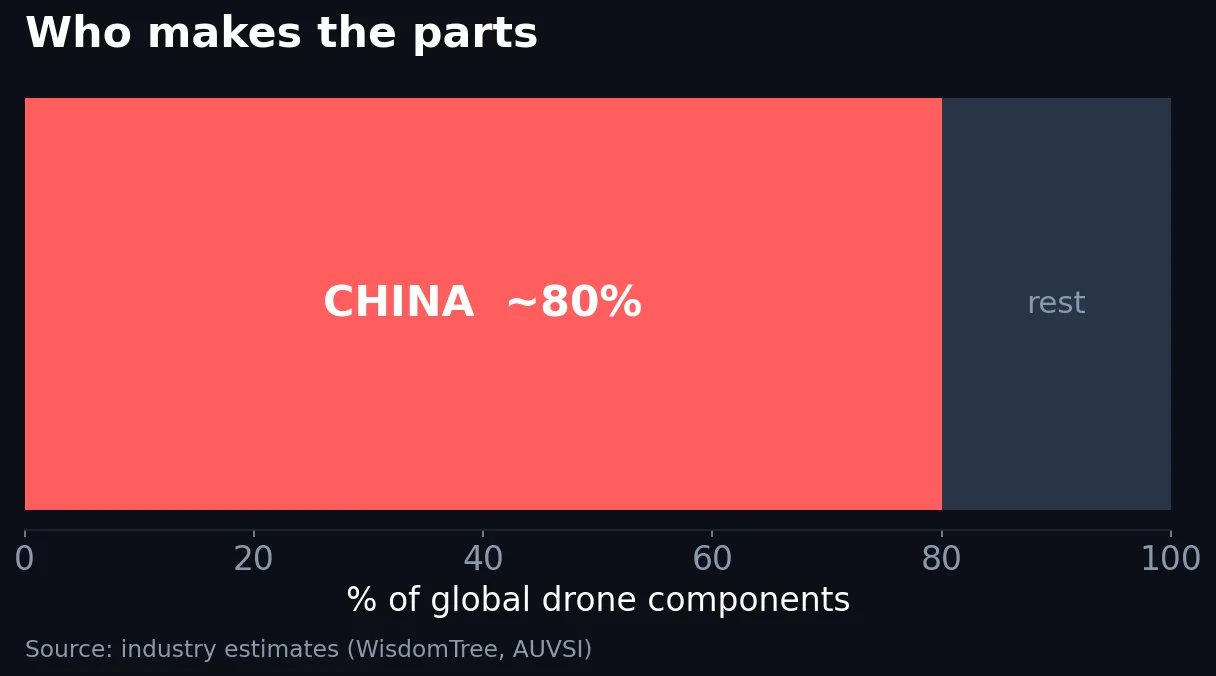
Estimated share of global small-drone and component supply. Industry estimates place China at roughly 80%, with DJI alone dominating the consumer market. Sources: WisdomTree, AUVSI (see pages 20–21).
THE DEPENDENCY
A defense built on a rival's parts. You cannot build your national defense on components that come from the country you might one day be defending against. That is like buying your home alarm from the local burglar.
THE REALISATION
Western governments have woken up. A supply chain concentrated in one country is now treated as a strategic risk, not a cost saving.
THE OPENING
A gap someone has to fill. If the cheap foreign supply is being pushed out, the demand does not disappear — it has to be met by someone building on home soil.
Tariffs and the Ndaa
Two forces creating a protected home
market
Tariffs of up to 100% on foreign- made drones
→
“NDAA-compliant” rules favour
American parts
→
A protected market for US-built components
TARIFFS
Taxes that price out the competition. The US has moved to place tariffs of up to 100% on foreign-made drones and components, making Chinese-made hardware more expensive and less welcome.
NDAA-COMPLIANT
Approved for US defense use. The term simply means “no Chinese parts inside.” Government rules increasingly steer buyers toward American-made drones and American-made components.
THE RESULT
A home market, almost overnight. Together, tariffs and the rulebook create a protected market for anybody who can build this hardware on US soil — demand exploding while competition is locked out.
Why this matters for your money.
Rules that force buyers toward one small group of domestic suppliers are, for those suppliers, a powerful and durable tailwind — the sort of setup that rarely appears so clearly.
Picks and Shovels
Don't guess the winner. Own what they all need.
BOTTOM LINE:
Picking the single winning gadget is hard — remember the phone wars, where dozens of handset makers vanished. The smarter play is the toll booth: own the parts every drone needs, no matter who builds the drone.
Motors, flight controllers, chips, sensors, magnets
→
Every drone maker has to buy them
→
The parts supplier collects a toll on the industry
THE GOLD-RUSH LESSON
Sell the picks and shovels. In the gold rush, the people who reliably got rich were not mostly the miners — they were the ones selling the picks, the shovels and the jeans.
THE TWIST HERE
The only shovels allowed. Because of the “American parts only” rules, a US-soil parts maker is not just selling shovels — it is selling the only shovels the government is allowed to buy.
THE QUESTION
Who is actually the pure play? Not a giant conglomerate where drones are a rounding error — a company that lives and breathes this exact thing. That is the next page.
Unusual Machines · Umac
The company at the center of the
machine
WHAT IT DOES
Drone components, built NDAA-compliant. Unusual Machines makes the motors and parts that go inside drones — American-made, no Chinese parts, approved for US defense use. It is the toll booth: the picks and shovels the American drone industry now legally has to buy from someone like them.
WHAT THE RUN MEANS
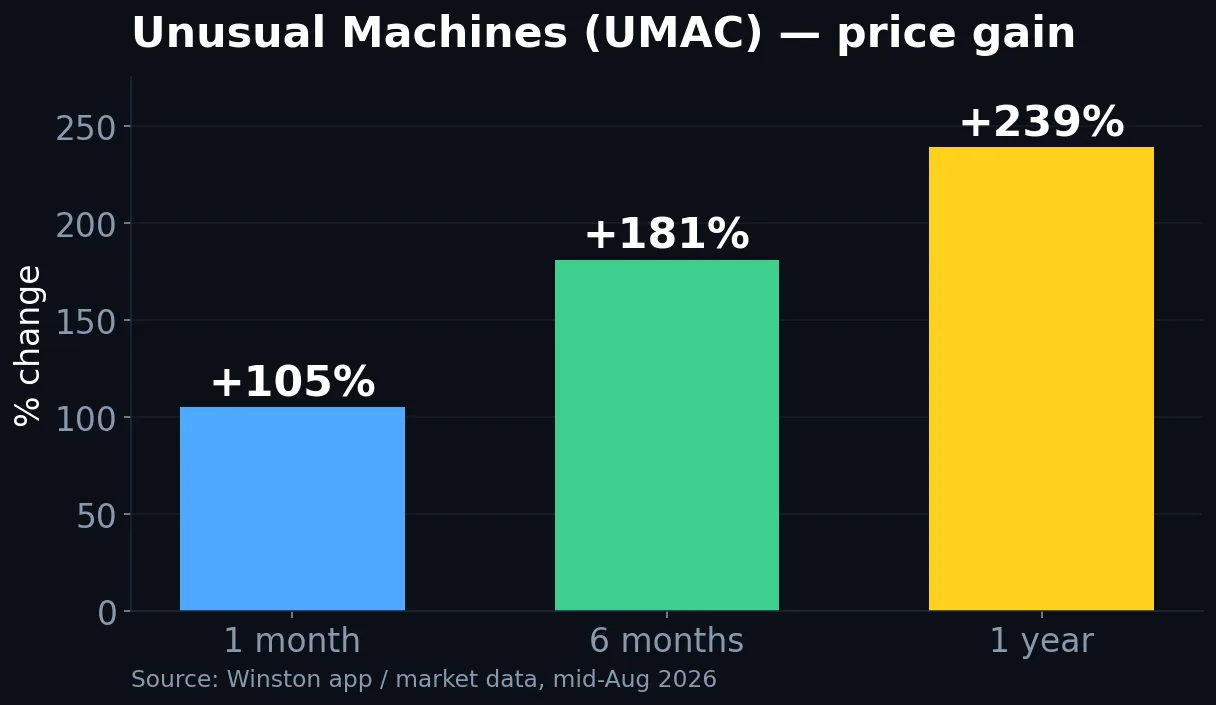
The story is real — and it is not calm. A stock up around 239% in a year tells you big money sees the same setup. It also tells you the stock moves hard, both directions. This is a small, young, fast company, not a sleepy blue chip.
KNOW YOURSELF FIRST
Volatility is the price of entry. If a 20% or 30% drop in a week would make you panic and do something silly, you need to know that about yourself before you ever press buy.
Check It, Don't Take It on Faith
Don't just buy a green line going up
SCORE THE BUSINESS
Look underneath the price. The Winston app scores a company on what actually matters — how fast it is growing, how strong the balance sheet is, and the quality of the business — so you are checking whether there is a real company underneath the hype, not just buying momentum.
THE FUNDAMENTALS
A real business, not just a chart. Unusual Machines is US- based, builds NDAA-compliant hardware, and has reported rapid revenue growth as defense demand for domestic components has ramped. On a name that has moved this much, the homework matters more, not less.
ONE NAME IS NEVER THE PLAN
Clearest is not the same as safest. Unusual Machines is the clearest pure play on this shift — but a single small stock is never a whole plan. The next page is the calmer way to play the same trend.
What to check in the app What it tells you Why it matters here
Growth How fast revenue is expanding Confirms the demand story is real
Balance sheet Cash versus debt Young, fast companies need staying power
Business quality Durability of the advantage Separates a real company from hype
Same Story, Three Speeds
Spreading the bet with funds
BOTTOM LINE:
If a single small stock swinging 30% in a week is not for you — and for many people it should not be — a fund lets you buy a basket of companies at once, so no single one can sink you. The Winston app has drone and defense filters built in, so you can pull the whole group up in one go.
Ticker What it holds Where it sits on the risk scale
UMAC One company — Unusual Machines The sharp end: highest risk, potentially highest reward
UAV A spread of drone names in one fund The middle: still drone-focused, but diversified
DRNZ A spread of drone names in one fund The middle: still drone-focused, but diversified
SHLD The broader defense industry The broad, steady end: less of a rollercoaster
UMAC
sharp end — one company
UAV ·
DRNZ
middle — drones, spread out
SHLD
broad — defense as a whole
Straight Talk
Exciting is exactly when people get hurt
Not financial advice — your situation is your own
Risky, fast names — size them properly
Hype cuts both ways — go in with a plan
NOT ADVICE
This is a view, not an instruction. Nobody here knows your situation. This report shares how the shift looks — it does not tell you what to do with your money.
SIZE IT
Fast names give it back fast. A stock up 239% in a year can hand a big chunk back in a hurry. That is not a reason to avoid it
- it is a reason to use money you can genuinely leave alone, never money you need next year.
HAVE A PLAN
Being early and being wrong can feel identical. When everyone is excited, prices can run ahead of reality and snap back even when the long-term story is right. Know how much you are putting in, know what you will do if it drops, and never bet the house on one name.
The trade-off.
Get the basics right and you can take part in one of the biggest shifts of the decade without lying awake at night. Get them wrong and even the best story in the world can hurt you.
→
→
Zoom Back Out
A once-in-a-generation shift in where defense money flows
The petrodollar is cracking
→
The military edge is rewritten by cheap machines
→
The world rearms toward American-made parts
THE SHIFT
Genuine, not overnight. The petrodollar — oil priced in dollars, backed by American muscle — is cracking, and the whole world can feel it. The edge that held it up is being rewritten in real time by cheap, smart machines.
THE PUSH
Tariffs and law. Every government is racing to rearm in the new direction, and buyers are being pushed — by tariffs and by rules
- toward American-made parts.
THE CLEANEST WAY IN
The toll booth. The picks-and-shovels play: Unusual Machines at the sharp end, and the drone and defense baskets — UAV, DRNZ, SHLD — for a steadier ride. All of them sitting in the app for you to check for yourself.
Turn Understanding into Process
Five questions before you press buy
The habit that separates people.
The wealthy rarely have better stock tips. They have a better system — a way of deciding what to buy, how much, and how it all fits together, so a shift like this makes them richer instead of poorer. That system is learnable.
Am I using money I can genuinely leave alone — not money I need next year?
✓
Have I decided my position size before buying, so no single name can hurt me badly?
✓
Have I pulled the name up in the app and checked its growth, balance sheet and business quality — not just the price line?
✓
Do I know what I will do if it drops 20% or 30% in a week?
✓
Have I picked the speed — single stock, drone basket, or broad defense — that lets me sleep at night?
✓
The Hard Half
Learn the system, not just the tip
BOTTOM LINE:
Everything in this report is one half of the equation — the easy half. The hard half is knowing what to actually do with it. The people who get rich from a shift like this are not the ones with the best stock tip. They are the ones with the best system.
WHAT YOU'LL LEARN
How the wealthy actually think about money. What to buy, how much, how it fits together, and how to tell when it is working and when it is not — applied to any size portfolio, whether you are starting with 1,000 dollars or 500,000.
HOW IT WORKS
Free, live, and you can ask anything. No jargon. No “copy my trades.” Just the way the wealthy think about money, made simple enough to use on Monday morning.
Free live session — “How to Invest Like the 1% Without Being One of Them”
how2invest.org
This Saturday · 9am Pacific · 12 noon Eastern · 5pm London
Disclaimer
This report is for educational and informational purposes only and does not constitute financial, investment, legal, tax or accounting advice. It is not a recommendation, solicitation or offer to buy or sell any security, currency, commodity or financial product. No buy/sell rating or price target is provided. All investments involve risk, including the possible loss of principal. Market events, relationships and historical comparisons described here may not repeat. Illustrations simplify complex systems and may omit factors. Percentages for individual companies and funds reflect price moves over the stated periods as shown in the Winston app around mid-August 2026 and will change over time. Readers should conduct their own research and consult appropriately qualified professionals before making financial decisions. Past performance is not indicative of future results. The Prehn Institute makes no guarantee regarding outcomes.