
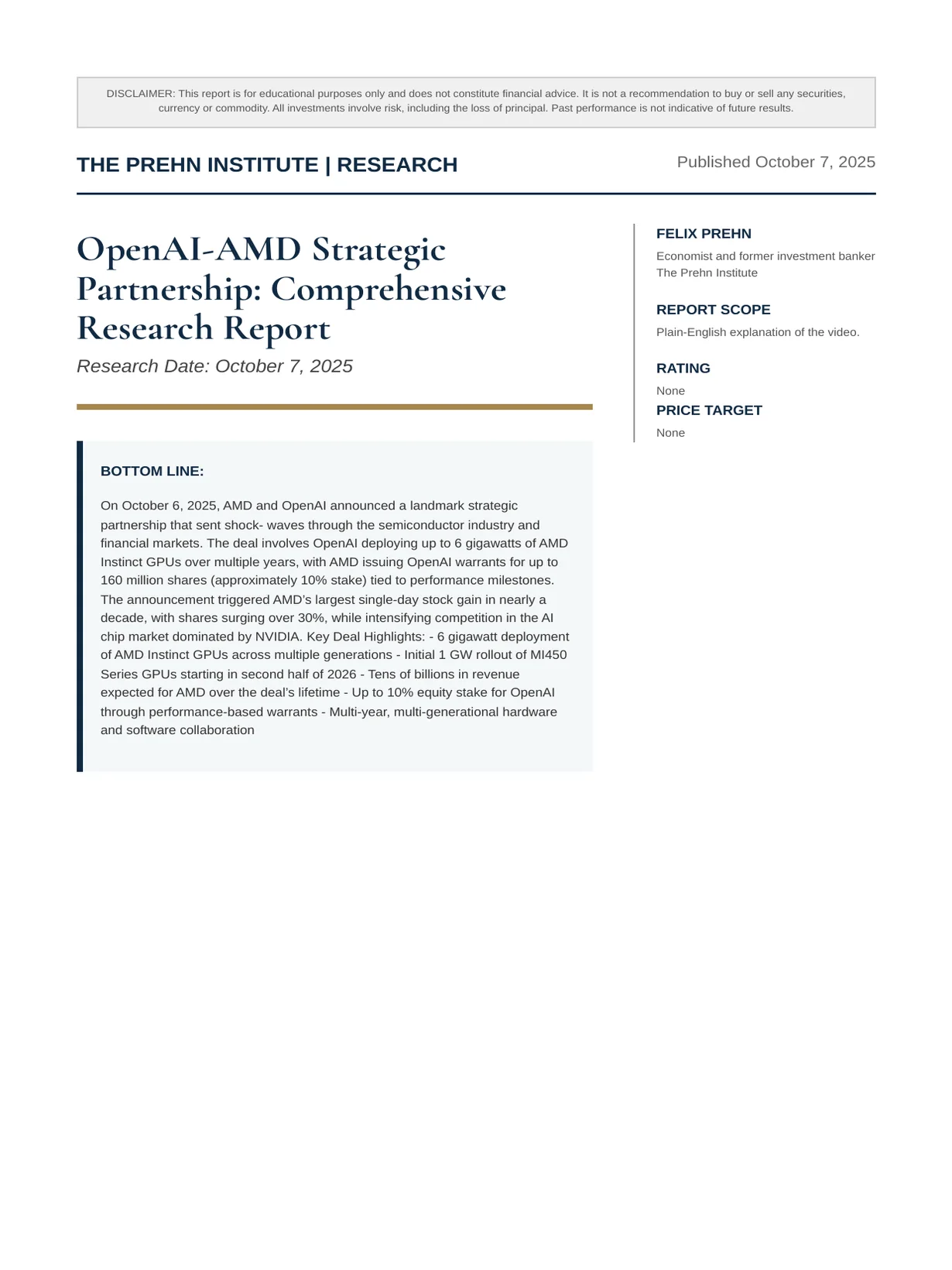
OpenAI-AMD Strategic Partnership: Comprehensive Research Report
Research Date: October 7, 2025
Felix Nikolas Prehn · 7 October 2025 · 32 pages
Bottom line
On October 6, 2025, AMD and OpenAI announced a landmark strategic partnership that sent shock‐ waves through the semiconductor industry and financial markets. The deal involves OpenAI deploying up to 6 gigawatts of AMD Instinct GPUs over multiple years, with AMD issuing OpenAI warrants for up to 160 million shares (approximately 10% stake) tied to performance milestones. The announcement triggered AMD’s largest single-day stock gain in nearly a decade, with shares surging over 30%, while intensifying competition in the AI chip market dominated by NVIDIA. Key Deal Highlights: - 6 gigawatt deployment of AMD Instinct GPUs across multiple generations - Initial 1 GW rollout of MI450 Series GPUs starting in second half of 2026 - Tens of billions in revenue expected for AMD over the deal’s lifetime - Up to 10% equity stake for OpenAI through performance-based warrants - Multi-year, multi-generational hardware and software collaboration
Overview
Ongoing : Multi-generational hardware and software collaboration extending beyond MI450 to future series (MI500 and beyond)
2. Deal Terms and Financial Structure
Hardware Deployment Commitment
Total Capacity: 6 gigawatts of AMD Instinct GPU computing power
- Equivalent to powering approximately 5 million U.S. households
- Three times the annual output of the Hoover Dam
- One of the largest GPU deployment agreements in AI industry history
Initial Phase: 1 gigawatt deployment of AMD Instinct MI450 Series GPUs
- Deployment begins in second half of 2026
- Includes rack-scale AI solutions integrating GPUs, DPUs, and CPUs
- Optimized for large-scale AI training and inference workloads
Multi-Generational Scope:
- Extends beyond MI450 to include MI500 series and future generations
- Involves shared technical expertise to optimize product roadmaps
- Builds on prior collaborations with MI300X and MI350X series
Financial Components
Revenue Expectations:
- AMD CFO Jean Hu stated the deal will generate “tens of billions of dollars in revenue” for AMD
- Analysts estimate potential value ranging from $90 billion to over $100 billion when accounting for ecosystem effects
- Expected to be “highly accretive to AMD’s non-GAAP earnings-per-share“
- Bank of America analyst projects the deal could add to AMD’s string of major agreements worth over $100 billion combined
Warrant Structure: AMD issued OpenAI a warrant for up to 160 million shares of AMD common stock at $0.01 per share. This represents approximately 10% of AMD’s outstanding shares if fully exercised.
Vesting Conditions (Performance-Based):
Deployment Milestones:
- First tranche vests upon initial 1 GW deployment (2H 2026)
- Additional tranches vest as deployments scale toward 6 GW
- Final tranches tied to achieving full 6 GW capacity
Share Price Targets:
- Progressive vesting tied to AMD achieving specific share price milestones
- Final tranche linked to AMD reaching $600 per share (vs. $164.67 closing price on Oct 3, 2025)
- Designed to align long-term interests of both companies
Technical and Commercial Milestones:
- OpenAI must achieve technical milestones to enable large-scale AMD deployments
- Successful integration and optimization of AMD GPUs in OpenAI’s infrastructure
- Meeting commercial performance benchmarks
•
1.
2.
3.
Strategic Alignment: The warrant structure creates mutual incentives:
- AMD benefits from secured long-term revenue and validation of its AI roadmap
- OpenAI gains potential equity upside in a key supplier
- Both parties motivated to achieve deployment and performance goals
3. Strategic Rationale
For OpenAI
- Supply Chain Diversification OpenAI’s infrastructure expansion requires massive compute capacity that no single vendor can reliably supply. The AMD deal is part of a broader multi-vendor strategy:
- $100 billion deal with NVIDIA announced weeks earlier for 10 GW of compute
- AMD partnership adds 6 GW capacity with different supplier
- Ongoing talks with Broadcom for custom chip development
- Partnerships with Oracle, Samsung for additional infrastructure
- Addressing Compute Constraints OpenAI President Greg Brockman revealed critical context: “We are already unable to launch many features in ChatGPT and other products that could generate revenue because of the lack of compute power.” The company faces:
- Severe compute bottlenecks limiting product launches
- Growing demand for AI services outpacing infrastructure capacity
- Need for massive scale to support next-generation models
- Revenue opportunities constrained by hardware availability
- Reducing Vendor Lock-in NVIDIA’s dominance creates risks:
- Supply constraints and allocation challenges
- Limited pricing negotiation power
- Technology dependency on single supplier
- Need for competitive alternatives to maintain leverage
- Cost Optimization Multi-vendor sourcing enables:
- Competitive pricing dynamics
- Leverage in negotiations with all suppliers
- Risk mitigation against supply chain disruptions
- Flexibility in technology choices
For AMD
- Market Validation and Positioning The OpenAI deal represents a major validation of AMD’s AI strategy:
- Positions AMD as a credible alternative to NVIDIA in AI infrastructure
- Demonstrates that AMD is now viewed as a primary partner, not just a backup option
- Validates the performance and scalability of the Instinct roadmap
- Elevates AMD’s brand in the AI ecosystem
- Revenue Growth and Market Share Significant revenue opportunity:
- “Tens of billions of dollars” over multiple years
- One of the largest deals in AMD’s history
- Potential to significantly increase AMD’s share of the AI accelerator market
- Platform for attracting additional large-scale customers
- Competitive Positioning Against NVIDIA The partnership strengthens AMD’s position:
- Direct competition in hyperscale AI deployments
- Proof point for other customers considering NVIDIA alternatives
- Momentum in challenging NVIDIA’s ~92% market share
- Enhanced credibility in the AI chip market
- Technology Development and Collaboration Joint innovation benefits:
- OpenAI’s input helps optimize AMD’s future GPU roadmaps
- Collaborative software development for AI workloads
- Access to cutting-edge AI use cases and requirements
- Accelerated ecosystem development
4. AMD Stock Impact and Market Reaction
Immediate Market Response
Stock Performance on October 6, 2025:
- Premarket surge: AMD shares jumped as much as 36% to $210.08 in early trading
- Intraday gains: Stock rose between 23.71% to 34% during the trading session
- Record high: Reached highest level in company history
- Market cap impact: Added approximately $80 billion to AMD’s market valuation
- Closing valuation: AMD’s market capitalization reached approximately $330 billion
Historical Context:
- Largest single-day gain in nearly a decade for AMD
- Previous underperformance: AMD had gained “only” 200% compared to NVIDIA’s 1,300%+ rise in recent years
- The deal closed a significant valuation gap with competitors
Broader Market Impact
Index Performance: The announcement contributed to record highs in major indices:
- S&P 500 reached new record levels
- NASDAQ hit all-time highs, driven by AI sector optimism
- Technology sector broadly rallied on AI infrastructure themes
Related Stocks:
- Sanmina (SANM) surged over 30% due to its role in AMD’s supply chain
- Other semiconductor and AI infrastructure stocks gained
- NVIDIA shares declined 1-2% on perceived competitive pressure
Investor Sentiment Analysis
Positive Factors Driving Rally:
- Scale of the deal: 6 GW deployment represents massive revenue opportunity
- Validation: OpenAI’s choice legitimizes AMD’s AI technology
- Growth trajectory: Positions AMD for long-term AI market growth
- Strategic partnership: Multi-generational collaboration extends beyond single product cycle
- Equity component: Warrant structure aligns long-term interests
Risk Considerations Noted:
- Execution challenges in scaling production to meet commitments
- Potential shareholder dilution from 10% warrant
- Competition remains intense with NVIDIA’s dominant position
- Supply chain and manufacturing complexities
- Market uncertainties around AI spending sustainability
5. Analyst Reactions and Price Target Upgrades
Wave of Bullish Upgrades
Following the announcement, top Wall Street analysts rushed to upgrade AMD stock, with price targets surging dramatically:
Barclays - Thomas O’Malley
New Price Target: $300Street-high target New Price Target: $300 (raised from $200) - Street-high target
- Projects the deal could add $4.5 billion in quarterly revenue by 2030
- Estimates $3 in quarterly EPS contribution from the partnership
- Expects $15 billion in incremental revenue as early as 2026
- Described the deal as “mutually beneficial” with significant upside potential
- Assumes linear deployment of 6 GW capacity over the timeline
Truist Securities - William Stein
New Price Target: $273 (raised from $213)
- Noted that AMD is now viewed as a primary partner in AI infrastructure, not just a backup option
- Raised AMD’s 2027 earnings forecast from $7.89 to $9.25 per share
- Highlighted the deal as proof of AMD’s competitive positioning
- Emphasized shift in market perception of AMD’s role in AI
Bank of America - Vivek Arya
New Price Target: $250 (raised from $200)
- Estimates the deal could be worth over $100 billion in total value
- Connected this agreement to AMD’s other major deals with Middle Eastern governments and sovereign entities
- Views the partnership as part of a broader trend of large-scale AI infrastructure investments
- Highlights AMD’s momentum in securing major customers
Wedbush Securities
Analysis Highlights:
- Described the partnership as a “major moment in the AI revolution”
- Called it a “huge vote of confidence” in AMD’s technology
- Emphasized AMD’s role in the AI spending cycle
- Positioned the deal as transformative for AMD’s competitive standing
The Motley Fool - Patrick Sanders
Investment Thesis:
- Highlighted the deal as a “massive catalyst” for AMD
- Suggested it could help AMD close the gap with NVIDIA
- Positioned AMD as a viable alternative for AI investors
- Emphasized the long-term growth opportunity
Current Wall Street Consensus
Moderate Buy Rating:
- 22 Buys, 13 Holds in recent analyst ratings
- Average price target: $193.03 (reflects pre-upgrade consensus, being revised upward)
- Street-high target: $300 (Barclays)
- Growing confidence in AMD’s ability to scale AI infrastructure business
Key Themes in Analyst Commentary
- Revenue Impact: Analysts project substantial revenue growth:
- “Tens of billions” in annual revenue per gigawatt deployed
- Potential for over $100 billion in total deal value including ripple effects
- Highly accretive to earnings per share
- Significant boost to AMD’s data center segment
- Competitive Positioning: Analysts see improved market dynamics:
- AMD now viewed as credible NVIDIA alternative
- Shift from “backup option” to “primary partner” in AI
- Enhanced negotiating position with customers
- Platform for attracting additional major customers
- Execution Risks: Analysts note challenges ahead:
- Scaling production to meet 6 GW commitment
- Manufacturing and supply chain complexities
- Meeting technical performance milestones
- Managing shareholder concerns about dilution
- Market Validation: The deal validates AMD’s strategy:
- OpenAI’s endorsement carries significant weight
- Proves AMD’s technology can compete at hyperscale
- Attracts attention from other potential customers
- Strengthens AMD’s AI ecosystem
6. Implications for NVIDIA
NVIDIA’s Current Market Position
Market Dominance:
- Commands approximately 92% market share in AI GPU market
- Established as the gold standard for AI training and inference
- Superior ecosystem with mature software stack (CUDA)
- Strong customer relationships across hyperscalers and enterprises
Financial Performance:
- Over 1,300% stock price appreciation in recent AI boom years
- Dominant profitability in GPU market
- Higher margins than competitors
- Strong product pipeline with Blackwell GPUs launching
Immediate Market Reaction
Stock Performance on October 6, 2025:
- NVIDIA shares declined 1-2% on the announcement day
- Reflected investor concerns about intensifying competition
- Market sensitivity to potential market share erosion
- Short-term uncertainty about pricing pressure
Competitive Pressures from AMD Deal
- Market Share Threats
The AMD-OpenAI partnership creates new competitive dynamics:
- Validation of alternatives: OpenAI’s choice legitimizes AMD as a viable option for other customers
- Diversification trend: Other AI companies may follow OpenAI’s multi-vendor strategy
- Pricing pressure: Competition could reduce NVIDIA’s pricing power
- Inference market: AMD may gain ground in inference-focused applications where NVIDIA has been less dominant
- Supply Chain Diversification
OpenAI’s strategy signals broader industry shift:
- Major customers seeking to reduce single-vendor dependency
- Risk mitigation driving multi-supplier approaches
- Negotiating leverage: Customers use AMD to pressure NVIDIA on pricing and allocation
- Industry preference for competitive alternatives
- Technology Competition
AMD’s advancement challenges NVIDIA’s lead:
- MI450 and future generations designed to compete with NVIDIA’s offerings
- Performance improvements narrowing the gap
- Collaborative development with OpenAI accelerating AMD’s roadmap
- Enhanced software ecosystem for AMD GPUs
NVIDIA’s Competitive Advantages Remain Strong
Despite the competitive pressures, NVIDIA maintains significant advantages:
- Ecosystem Lock-in
- CUDA software platform: Industry standard with massive developer base
- Mature software stack and optimization tools
- Extensive library of pre-optimized AI frameworks
- High switching costs for customers
- Technology Leadership
- Blackwell GPU series: Next-generation architecture with significant performance gains
- Superior performance in both training and inference workloads
- Advanced features and capabilities
- Continued innovation pipeline
- Established Relationships
- Deep partnerships with all major cloud providers and tech companies
- Strong customer loyalty and satisfaction
- Proven track record of execution
- Reliability and support infrastructure
- Superior Profitability
- Higher margins than AMD in GPU business
- Strong pricing power
- Efficient operations and scale advantages
- Better financial resources for R&D investment
OpenAI-NVIDIA Relationship Continues
Critical Context: OpenAI explicitly stated the AMD partnership is “incremental” to its NVIDIA collaborations, not a replacement:
- $100 billion deal with NVIDIA for 10 GW remains in place
- OpenAI plans to increase NVIDIA purchases going forward
- NVIDIA remains the primary supplier for OpenAI’s infrastructure
- AMD partnership addresses additional capacity needs, not displacement
Industry Analyst Perspectives on NVIDIA
Seeking Alpha Analysis:
- Maintains “Strong Buy” rating for NVIDIA despite AMD deal
- Emphasizes NVIDIA’s dominant market position remains secure
- Notes pent-up demand for Blackwell GPUs will drive continued growth
- Highlights that AI market expansion benefits both NVIDIA and AMD
Competitive Analysis Summary:
- NVIDIA’s market leadership not immediately threatened
- Long-term market share erosion possible as AMD gains credibility
- Total AI chip market growing rapidly enough for multiple winners
- NVIDIA expected to maintain majority share but with more competition
Risks to NVIDIA from AMD’s Rise
- Gradual Market Share Loss
- AMD winning major customers could accelerate share erosion
- Enterprise customers may diversify away from NVIDIA over time
- Inference market particularly vulnerable to competition
- Pricing Pressure
- Competition could force NVIDIA to reduce prices or offer better terms
- Margin compression if competitive intensity increases
- Need to maintain price competitiveness while preserving profitability
- Supply Chain Dynamics
- If NVIDIA faces continued supply constraints, customers may permanently shift to AMD
- Risk of losing customers during shortage periods
- Need to balance allocation decisions carefully
- Ecosystem Evolution
- AMD and others investing heavily in software ecosystem development
- Potential for CUDA lock-in to weaken over time
- Open-source alternatives gaining traction
Long-Term Outlook
NVIDIA Remains in Strong Position:
- Technology leadership and ecosystem advantages expected to persist
- AI market growth supports multiple successful players
- NVIDIA’s innovation pipeline positions it for continued dominance
- Superior execution and reliability maintain customer preference
But Competition Intensifying:
- AMD deal signals real competitive threat emerging
- Multi-vendor strategies becoming industry norm
- NVIDIA must continue innovating to maintain lead
- Pricing and terms may face pressure
Bottom Line for NVIDIA: The OpenAI-AMD deal represents a meaningful competitive development but not an existential
threat . NVIDIA’s dominance is challenged but not broken, and the company remains well-positioned for strong growth in the expanding AI market. However, the days of near-monopoly market share may be ending.
7. Implications for Intel
Intel’s Position in AI Accelerator Market
Current Market Standing:
- Intel has been a distant player in the AI GPU/accelerator market
- Historically dominated general-purpose CPU market but lagging in AI-specific chips
- Attempting to enter AI accelerator market with various initiatives
- Faces significant technology and ecosystem gaps versus NVIDIA and AMD
Limited Direct Impact from OpenAI-AMD Deal
Key Finding:minimal direct analysis Key Finding: The research sources provide minimal direct analysis of Intel’s position relative to the AMD-OpenAI partnership. This absence is itself telling:
- Intel not viewed as a primary competitor in AI accelerator space
- Market narrative focuses on AMD-NVIDIA competition
- Intel’s AI offerings not yet at scale to compete for deals of this magnitude
Indirect Implications for Intel
- Market Consolidation Around AMD and NVIDIA
The OpenAI-AMD deal reinforces a two-player dynamic in AI accelerators:
- NVIDIA and AMD positioned as the primary options for large-scale AI infrastructure
- Intel further marginalized in high-performance AI computing
- Harder for Intel to break into market with incumbents strengthening positions
- Windows of opportunity closing as customers commit to AMD/NVIDIA ecosystems
- Increased Competitive Pressure
Intel faces mounting challenges:
- AMD’s momentum makes Intel’s entry more difficult
- Must compete against both NVIDIA’s dominance and AMD’s rising credibility
- Technology gap may be widening rather than narrowing
- Resource constraints as Intel invests across multiple fronts
- Strategic Implications
The deal highlights Intel’s challenges:
- Missing out on major design wins like the OpenAI partnership
- Lack of mentions in analyst discussions of AI accelerator competition
- Need for significant investments to become relevant
- Risk of permanent disadvantage in AI infrastructure market
Intel’s AI Strategy and Initiatives
Gaudi AI Accelerators:
- Intel developing Gaudi series AI accelerators
- Positioning as alternative to NVIDIA/AMD offerings
- Limited customer adoption to date
- Performance and ecosystem gaps remain significant
Data Center Strength:
- Intel maintains strong position in CPU market for data centers
- Complementary products to GPU accelerators
- Opportunity to bundle CPU+GPU solutions
- But not addressing core AI accelerator competition
Recent Developments:
- Partnership with NVIDIA announced for developing custom x86 processors
- Focus on adjacent markets rather than direct AI GPU competition
- Strategic pivot recognizing challenges in competing head-on with NVIDIA/AMD
Market Share Dynamics
AI Accelerator Market Breakdown:
- NVIDIA: ~92% market share
- AMD: ~5-8% market share (growing post-OpenAI deal)
- Intel and others: <3% combined
- OpenAI-AMD deal likely further reduces Intel’s already minimal share
Trend Analysis:
- Intel’s share not growing despite market expansion
- AMD gaining ground at expense of smaller players including Intel
- Two-horse race emerging between NVIDIA and AMD
Financial Impact on Intel
Revenue Implications:
- Limited direct revenue impact as Intel had minimal exposure to this market segment
- Opportunity cost of missing major AI infrastructure deals
- Pressure on Intel’s data center business as customers standardize on NVIDIA/AMD for AI
Stock Market Reaction:
- Intel stock showed minimal reaction to AMD-OpenAI announcement
- Market doesn’t view Intel as significant player in this competitive dynamic
- Investor focus on Intel’s broader challenges rather than AI accelerator competition
Long-Term Outlook for Intel in AI
Challenges Ahead:
- Steep technology curve to catch up with NVIDIA and AMD
- Ecosystem disadvantages with limited software support
- Customer relationships already established with competitors
- Resource allocation tensions across Intel’s portfolio
Potential Paths Forward:
- Focus on specialized AI applications where Intel has advantages
- Leverage CPU strength to create integrated solutions
- Strategic partnerships to gain market access
- Acquisition strategy to acquire AI technology and talent
Realistic Assessment:
- Intel unlikely to compete directly for hyperscale AI accelerator deals in near term
- May find success in niche applications or edge AI computing
- CPU market remains core strength but AI accelerators represent growth opportunity Intel is miss‐ ing
- Significant investment and time required to become relevant competitor
Competitive Positioning Summary
Market Hierarchy in AI Accelerators:
- NVIDIA - Dominant leader with 92% share
- AMD - Rising challenger, validated by OpenAI deal
- Intel - Distant third, struggling for relevance
- Others - Minimal market presence
Intel’s Challenge: The OpenAI-AMD deal widens the gap between Intel and the market leaders, making Intel’s path to relevance even more difficult. Without major technology breakthroughs or strategic shifts, Intel risks permanent marginalization in the high-growth AI accelerator market.
9. Future Outlook and Strategic Implications
AMD’s Path Forward
Execution Requirements for Success:
- Manufacturing and Supply Chain
- Deliver on 6 GW commitment: Must ramp production of MI450 and future generations on sched‐ ule
- TSMC relationship: Secure sufficient advanced node capacity
- Yield improvements: Achieve cost-effective manufacturing at scale
- Supply chain coordination: Manage complex component sourcing
- Technology Development
- Performance roadmap: Continue narrowing gap with NVIDIA
- Software ecosystem: Expand ROCm capabilities and developer tools
- Integration and support: Provide world-class customer service to OpenAI
- Innovation pipeline: Maintain competitive edge across multiple GPU generations
- Market Expansion
- Customer wins: Leverage OpenAI partnership to attract additional customers
- Pricing strategy: Balance growth with profitability
- Brand building: Establish AMD as go-to NVIDIA alternative
- Ecosystem development: Build broader AI partner network
- Financial Management
- Investment requirements: Balance R&D spending with profitability
- Warrant dilution: Manage shareholder concerns about equity issuance
- Capital allocation: Optimize between organic growth and M&A
- Guidance and communication: Maintain investor confidence through execution
OpenAI’s Infrastructure Strategy
Building Out the Stargate Vision:
- Geographic Expansion OpenAI’s infrastructure roadmap includes massive data center buildouts:
- Texas facilities: Major deployment locations
- New Mexico: Data center construction underway
- Ohio: Midwest expansion
- Total capacity: 23 gigawatt infrastructure roadmap with 10 GW already committed
- Multi-Vendor Approach Strategic sourcing across multiple partners:
- NVIDIA: 10 GW commitment, remains primary supplier
- AMD: 6 GW commitment, secondary scale supplier
- Broadcom: Custom chips in development
- Oracle, others: Additional partnerships for infrastructure and hosting
- Compute Capacity Needs Driven by ambitious AI development goals:
- Model scaling: Next generations of GPT and multimodal models requiring massive compute
- Product expansion: ChatGPT, Sora video generation, and new product lines
- Commercial services: Growing enterprise and API business
- Research initiatives: Continued AI research and safety work
- Financial Sustainability Questions Concerns about OpenAI’s funding:
- $4.3 billion revenue in first half of 2025
- $2.5 billion cash burn in same period
- $1 trillion+ infrastructure spending planned over coming years
- Funding sources: Recent funding rounds, Microsoft partnership, potential IPO
Industry-Wide Implications
- AI Infrastructure Buildout Acceleration
The OpenAI deals (both NVIDIA and AMD) signal massive infrastructure expansion:
- Hundreds of billions in chip purchases across industry
- Data center construction boom: Billions in facilities investment
- Energy infrastructure: Gigawatts of new power generation needed
- Supply chain stress: Manufacturing and component sourcing challenges
- Semiconductor Industry Dynamics
Ripple effects across chip sector:
- TSMC capacity crunch: Advanced node production stretched
- Memory chip demand: HBM (High Bandwidth Memory) supply critical bottleneck
- Packaging technologies: CoWoS and advanced packaging in high demand
- Component suppliers: Entire ecosystem benefiting from AI boom
- Cloud Service Provider Positioning
Major cloud platforms adapting strategies:
- Microsoft Azure: Largest OpenAI partner, providing infrastructure
- Amazon AWS: Developing custom chips and OpenAI competitor (Anthropic)
- Google Cloud: Competing with TPUs and AI services
- Oracle: Strategic partner for OpenAI infrastructure
- All racing to build sufficient AI compute capacity
- Energy and Sustainability Concerns
6 gigawatts of computing power raises critical questions:
- Power consumption: Equivalent to 5 million U.S. households
- Carbon footprint: Massive energy demands conflicting with climate goals
- Grid capacity: Strain on electrical infrastructure
- Cooling requirements: Water usage and thermal management challenges
- Sustainability initiatives: Pressure to use renewable energy sources
Risks and Challenges
For AMD:
- Execution Risks
- Manufacturing delays: Production ramp challenges
- Technical issues: Performance or reliability problems with new chips
- Supply chain disruptions: Component shortages or logistics issues
- Integration challenges: Difficulties in OpenAI’s infrastructure deployment
- Competitive Risks
- NVIDIA response: Potential aggressive pricing or product moves
- Technology leapfrog: NVIDIA’s next-gen chips outpacing AMD advances
- Customer defections: Other customers hesitant to follow OpenAI’s lead
- Intel resurgence: Unlikely but possible competitive challenge
- Financial Risks
- Dilution concerns: Warrant exercise impacting existing shareholders
- Investment requirements: High R&D and capex needs
- Margin pressure: Competitive pricing reducing profitability
- Economic headwinds: AI spending slowdown affecting demand
For OpenAI:
- Financial Sustainability
- Cash burn rate: Current spending unsustainable without additional funding
- Revenue growth: Need to monetize AI capabilities more effectively
- Infrastructure costs: Massive capex commitments
- Funding sources: Dependence on continued investor support
- Technology Risks
- AI advancement plateau: If progress slows, infrastructure investment may be excessive
- Competition: Anthropic, Google, others building comparable models
- Compute efficiency: Models may become more efficient, reducing hardware needs
- Regulatory constraints: Potential government restrictions on AI development
- Operational Risks
- Integration complexity: Managing multiple chip vendors and technologies
- Power constraints: Energy availability limiting deployment
- Talent retention: Keeping key researchers and engineers
- Safety concerns: Managing responsible AI development at scale
For the Industry:
- Market Concentration
- Few dominant players: Limited competition in critical infrastructure
- Circular ownership: Complex equity relationships creating systemic risks
- Barrier to entry: Massive capital requirements limiting new competitors
- Innovation constraints: Established players may resist disruptive change
- Geopolitical Risks
- Taiwan dependence: TSMC manufacturing concentration
- U.S.-China tensions: Export controls and technology restrictions
- Supply chain vulnerabilities: Concentration of critical components
- National security: Government intervention in AI infrastructure
- Sustainability Challenges
- Energy consumption: AI’s carbon footprint growing rapidly
- Resource constraints: Chip production requiring rare materials
- E-waste concerns: Rapid obsolescence of expensive hardware
- Water usage: Data center cooling consuming significant water resources
Investment Implications
For Retail Investors:
AMD Stock Considerations:
Bull Case:
- Major growth catalyst: OpenAI deal validates AMD’s AI strategy
- Revenue visibility: Tens of billions in committed revenue
- Market share gains: Path to 10-15% AI accelerator market share
- Valuation opportunity: Trading at discount to NVIDIA despite growth potential
- Product momentum: Strong roadmap with MI450, MI500 series
Bear Case:
- Execution uncertainty: Complex deal with multiple milestones
- Dilution risk: 10% warrant could pressure stock if exercised
- Competitive intensity: NVIDIA remains dominant with strong response capability
- Valuation concerns: Stock surged 30%+ on announcement, already pricing in success
- Market risks: AI spending could slow if economic conditions deteriorate
NVIDIA Stock Considerations:
Bull Case:
- Dominant position: 92% market share difficult to dislodge
- Technology leadership: Continued innovation with Blackwell and beyond
- Ecosystem moat: CUDA and software stack create switching costs
- Growing market: AI expansion benefits all players
- Financial strength: Superior margins and profitability
Bear Case:
- Competition intensifying: AMD deal signals real threat to market share
- Valuation stretch: Stock already reflects substantial growth expectations
- Margin pressure: Competition could force pricing adjustments
- Market saturation: AI chip demand may not sustain current growth rates
- Regulatory risks: Antitrust scrutiny possible given dominance
Intel Stock Considerations:
Limited Direct Impact:
- Intel remains largely sidelined in AI accelerator competition
- Opportunity cost of missing AI boom
- Focus should be on Intel’s broader turnaround story
- AI accelerator market not meaningful factor for Intel investment thesis currently
10. Key Takeaways for US Retail Investors
Top Investment Insights
- AMD: High-Risk, High-Reward Opportunity
- OpenAI deal represents massive validation and growth potential
- Success could drive AMD to $250-$300 (analyst targets) from ~$200 post-announcement
- Execution risks significant: Manufacturing, technology, and integration challenges
- Time horizon: 3-5 years to fully realize deal value
- Recommendation consideration: Suitable for growth-oriented investors comfortable with volatility
- NVIDIA: Dominant but Facing New Competition
- Market leadership remains intact but challenged
- AI market growth supports both NVIDIA and AMD succeeding
- Defensive considerations: Portfolio diversification may be prudent
- Long-term strength: Technology and ecosystem advantages enduring
- Recommendation consideration: Core holding for AI exposure with some competitive risk emer‐ ging
- The AI Infrastructure Boom is Real and Massive
- $1 trillion+ in near-term commitments across industry
- Multiple companies benefiting: AMD, NVIDIA, TSMC, memory makers, data center builders
- Broad exposure: Consider diversified AI infrastructure investments
- Sustainability questions: Long-term viability of current spending levels uncertain
- Multi-Vendor Strategies Becoming Norm
- Reduced concentration risk: No single vendor lock-in for major customers
- Competitive dynamics improving: More balanced market developing
- Innovation incentives: Competition driving faster technology advancement
- Investor impact: Monitor how customers diversify to assess market share trends
- Watch the Execution
- Milestone tracking: Monitor AMD’s deployment timeline and performance
- Financial metrics: Revenue recognition and margin trends critical
- Competitive responses: How NVIDIA and others react matters
- Market validation: Do other customers follow OpenAI’s lead?
Investment Strategies to Consider
For Bullish AMD Investors:
- Core position: 5-10% portfolio allocation if conviction high
- Dollar-cost averaging: Spread purchases over time to manage volatility
- Long-term hold: 3-5 year time horizon to realize deal value
- Risk management: Position size appropriate for high-growth tech stock
For NVIDIA Holders:
- Maintain core position: Dominant position justifies continued holding
- Diversification consideration: Add AMD exposure for balanced AI play
- Monitor competitive dynamics: Be prepared to adjust if market share erodes significantly
- Rebalancing: Consider trimming if NVIDIA’s premium to AMD becomes excessive
For Diversified AI Exposure:
- Semiconductor ETFs: Broad exposure to chip sector benefiting from AI
- Cloud infrastructure plays: Microsoft, Amazon, Google as OpenAI customers/competitors
- Memory manufacturers: Micron, SK Hynix benefit from HBM demand
- Data center REITs: Physical infrastructure plays on AI buildout
Red Flags to Monitor
Warning Signs for AMD:
- Delays in MI450 deployment: If 2H 2026 timeline slips significantly
- Technical performance issues: If chips underperform specifications
- Manufacturing challenges: Supply chain problems or yield issues
- Customer wins stall: If OpenAI partnership doesn’t attract other major customers
- Margin compression: If competitive pressure reduces profitability more than expected
Warning Signs for NVIDIA:
- Accelerating market share loss: If AMD gains exceed 15-20% market share rapidly
- Margin deterioration: Pricing pressure forcing profitability decline
- Technology missteps: If next-generation products disappoint
- Customer diversification: More major customers adopting multi-vendor strategies aggressively
Warning Signs for AI Sector:
- Demand slowdown: AI spending growth decelerating
- Efficiency improvements: Models requiring less compute than expected
- Economic downturn: Recession reducing enterprise AI investment
- Regulatory restrictions: Government limits on AI development or chip exports
- Energy constraints: Power availability limiting data center expansion
Timeline to Watch
Near-Term (Next 6 Months):
- AMD Q4 2025 and Q1 2026 earnings: Initial financial impact discussion
- NVIDIA’s competitive response announcements
- Additional customer wins or partnerships for AMD
- Broader market sentiment on AI spending sustainability
Medium-Term (6-18 Months):
- 2H 2026: First 1 GW deployment milestone
- Initial warrant vesting if deployment succeeds
- Performance benchmarks and real-world results from OpenAI’s AMD infrastructure
- Competitive product launches from NVIDIA (Blackwell successor) and AMD (MI500 series)
Long-Term (2-5 Years):
- Full 6 GW deployment progress
- AMD’s market share trajectory becoming clear
- Total AI market size and growth rate validation
- Financial returns from AMD’s infrastructure investments
- Potential additional major partnerships for AMD
11. Conclusion: A Transformative Deal with Significant
Implications
The OpenAI-AMD partnership announced on October 6, 2025, represents one of the most significant developments in the AI infrastructure landscape. With its 6-gigawatt commitment, performance-based equity structure, and multi-generational collaboration, the deal:
For AMD:
- Validates the company’s AI strategy and technology roadmap
- Provides tens of billions in revenue visibility over multiple years
- Positions AMD as a credible alternative to NVIDIA at hyperscale
- Creates momentum for additional customer wins
- Demands flawless execution to realize full potential
For OpenAI:
- Secures critical compute capacity for AI infrastructure expansion
- Diversifies supply chain and reduces single-vendor dependence
- Provides potential equity upside in key supplier
- Enables faster scaling of AI products and services
- Raises questions about financial sustainability given massive commitments
For NVIDIA:
- Faces first major competitive threat to market dominance
- Maintains strong position but with intensifying competition
- Benefits from continued AI market expansion
- Must respond with innovation and customer focus
- Retains technological and ecosystem advantages
For Intel:
- Remains largely sidelined in AI accelerator competition
- Faces widening gap with NVIDIA and AMD
- Needs major strategic shifts to become relevant
- Focuses on alternative markets and adjacencies
For the Industry:
- Confirms multi-vendor strategies as new norm
- Accelerates massive AI infrastructure buildout
- Raises sustainability and energy consumption concerns
- Creates opportunities across semiconductor ecosystem
- Concentrates market power among few key players
For Investors:
- AMD represents high-risk, high-reward growth opportunity
- NVIDIA remains strong but faces new competitive dynamics
- Diversified AI exposure may be prudent investment strategy
- Execution monitoring critical for investment decisions
- Long-term perspective needed given multi-year timeline
The next 18-24 months will be critical in determining whether AMD can successfully execute on this transformative partnership and whether NVIDIA can maintain its dominant position in an increasingly competitive market. For US retail investors, the OpenAI-AMD deal creates both opportunities and risks that warrant careful consideration and ongoing monitoring.