
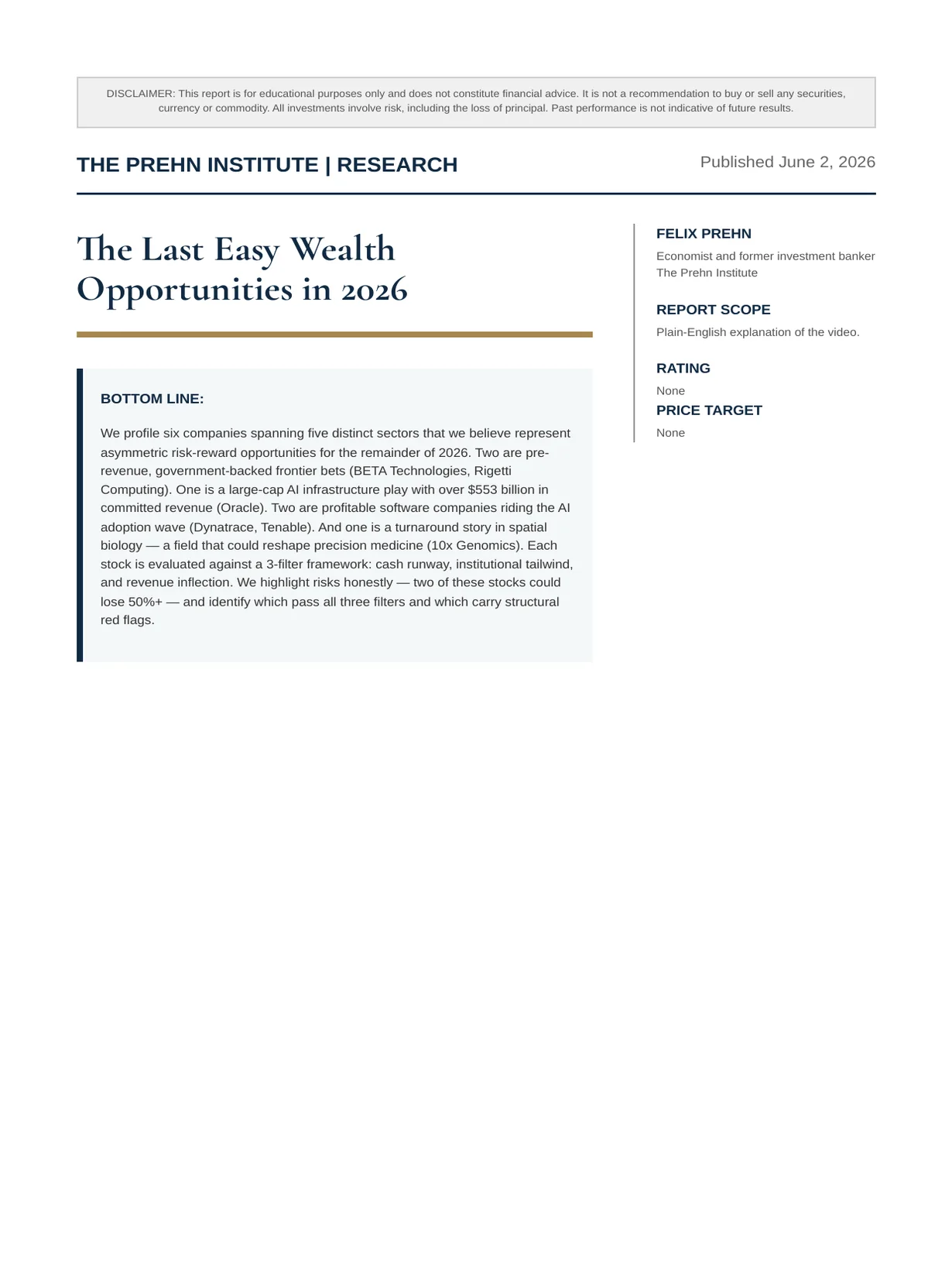
The Last Easy Wealth Opportunities in 2026
Felix Nikolas Prehn · 2 June 2026 · 14 pages
Bottom line
We profile six companies spanning five distinct sectors that we believe represent asymmetric risk-reward opportunities for the remainder of 2026. Two are pre-revenue, government-backed frontier bets (BETA Technologies, Rigetti Computing). One is a large-cap AI infrastructure play with over $553 billion in committed revenue (Oracle). Two are profitable software companies riding the AI adoption wave (Dynatrace, Tenable). And one is a turnaround story in spatial biology — a field that could reshape precision medicine (10x Genomics). Each stock is evaluated against a 3-filter framework: cash runway, institutional tailwind, and revenue inflection. We highlight risks honestly — two of these stocks could lose 50%+ — and identify which pass all three filters and which carry structural red flags.
The Last Easy Wealth Opportunities in 2026
CONTENTS
Executive Summary
The 3-Filter Framework
BETA Technologies (BETA) — Electric Aircraft
Rigetti Computing (RGTI) — Quantum Computing
Oracle Corporation (ORCL) — AI Cloud Infrastructure
Dynatrace (DT) — AI Observability
Tenable Holdings (TENB) — Cybersecurity
10x Genomics (TXG) — Spatial Biology
ETF Alternatives for Lower Risk Exposure
Comparative Summary Table
Key Risk Factors
Sources & Citations
Multi-sector · US Equities
The Last Easy Wealth Opportunities in 2026
The Last Easy Wealth Opportunities in
- 2026
Six stocks across frontier technology, AI infrastructure, cybersecurity, and spatial biology
— evaluated through a disciplined 3-filter framework
BOTTOM LINE:
We profile six companies spanning five distinct sectors that we believe represent asymmetric risk-reward opportunities for the remainder of 2026. Two are pre-revenue, government-backed frontier bets (BETA Technologies, Rigetti Computing). One is a large-cap AI infrastructure play with over $553 billion in committed revenue (Oracle). Two are profitable software companies riding the AI adoption wave (Dynatrace, Tenable). And one is a turnaround story in spatial biology — a field that could reshape precision medicine (10x Genomics). Each stock is evaluated against a 3-filter framework: cash runway, institutional tailwind, and revenue inflection. We highlight risks honestly — two of these stocks could lose 50%+ — and identify which pass all three filters and which carry structural red flags.
THE 3-FILTER FRAMEWORK
A Repeatable System. Rather than present a list of tickers, we apply a disciplined evaluation framework to each stock. This framework is designed to separate genuine opportunity from hype — and to surface the specific risk profile of each position.
Filter 1: Cash Runway
Can this company survive at least two years without selling more shares? When a company issues new shares to raise money, that is dilution — existing shareholders own a smaller slice of the pie. If a company cannot fund its own operations, that is a red flag.
Filter 2: Institutional Tailwind
Is there a structural force — government spending, regulatory mandates, or index fund inclusion rules — that creates mandatory buying pressure? We seek situations where large capital pools are forced to flow into a stock, not optional or discretionary interest.
Filter 3: Revenue Inflection
Is this company crossing the line from "interesting story" to "demonstrating real revenue growth"? Wall Street will tolerate losses for a period. But the moment revenue begins accelerating, institutional capital moves in aggressively.
The Rule. If a stock passes all three filters, it goes on the watch list. If it fails even one, we need to understand exactly why before committing capital.
BETA TECHNOLOGIES (NYSE: BETA)
The Business. Technologies designs and manufactures electric aircraft capable of vertical take-off and landing (eVTOL). These are not consumer drones — they are full-size aircraft designed for cargo and eventually passenger transport. The company went public in November 2025.
The Backlog. BETA holds a $3.9 billion aircraft backlog representing 991 aircraft on order. Customers include UPS and United Therapeutics. GE Aerospace has partnered with the company to develop a hybrid-electric turbogenerator designed to extend aircraft range. BETA has also built 123 charging stations across the United States — effectively constructing both the vehicle and the refuelling infrastructure simultaneously.
3-FILTER SCORECARD — BETA
| Filter | Result | Detail |
|---|---|---|
| Cash Runway | ✅ Pass | $1.59B cash · ~$120M quarterly burn · 3+ years runway |
| Institutional | ||
| Tailwind | ||
| ✅ | ||
| Pass | ||
| Selected for 7 of 8 FAA eIPP | ||
| fast-track certification slots | ||
| Revenue | ||
| Inflection | ||
| ⚠️ Not | ||
| Yet | ||
| Q1 2026 revenue ~$10M · FY | ||
| guidance $39–43M vs $4.2B | ||
| market cap |
Key Financials. Q1 2026 revenue reached $10.1 million, representing 58.5% year-over-year growth. Net loss was $122.3 million, with R&D expenditure of $91.7 million. FY2026 guidance is $39–43 million in revenue.
⚠ KEY RISKS
Pre-revenue company trading on potential. FAA certification timelines are unpredictable. Manufacturing scaling is unproven. Only suitable for capital that can tolerate significant drawdowns.
VERDICT: HIGH RISK / HIGH POTENTIAL
Passes cash runway and institutional tailwind filters convincingly. Revenue inflection has not arrived. This is a long-term bet on the future of electric aviation — position size accordingly.
RIGETTI COMPUTING (NASDAQ: RGTI)
QUANTUM COMPUTING · GOVERNMENT- BACKED
The Business. Rigetti Computing designs and builds quantum processors in-house. Quantum computers use qubits — which can represent multiple states simultaneously — to solve problems that would take classical supercomputers thousands of years. Applications span drug discovery, financial modelling, cryptography, logistics, and materials science.
The Product. Rigetti recently launched the 108-qubit "Cepheus" processor, now available on Amazon Web Services via AWS Braket. The company holds an integration with NVIDIA's NVQLink for connecting quantum processors to AI supercomputing systems, and has a contract with India's Centre for Development of Advanced Computing (C- DAC) for a 108-qubit system.
The Government Backing. In May 2026, Rigetti received a letter of intent for $100 million from the CHIPS Act — part of a $2 billion federal initiative to build America's quantum computing infrastructure. This signals that the government considers quantum computing a national security priority.
3-FILTER SCORECARD — RGTI
| Filter | Result | Detail |
|---|---|---|
| Cash Runway | ✅ Pass | $569M cash · $0 debt · ~5 years runway at current burn |
| Institutional | ||
| Tailwind | ||
| ✅ | ||
| Pass | ||
| $100M CHIPS Act LOI · NVIDIA | ||
| partnership · AWS distribution | ||
| Revenue | ||
| Inflection | ||
| ❌ Fail | ||
| $4.4M |
quarterly revenue ·
Price-to-sales ratio exceeds 700x
Key Financials. Q1 2026 revenue was $4.4 million (beating the $4.1 million estimate). Operating loss was approximately $26 million per quarter. Cash position is $569 million with zero long-term debt.
⚠ KEY RISKS
The most speculative position on this list. At a price-to-sales ratio exceeding 700x, the current valuation is built almost entirely on potential. If quantum computing commercialisation takes longer than the market expects — and historically, breakthrough technologies almost always do — this stock could lose 50–70% or more. Revenue inflection is not a near-term event.
VERDICT: MOST SPECULATIVE — POSITION WITH
EXTREME CAUTION
Government backing and genuine technology. But at these valuations, investors are not buying a business — they are buying a belief. Suitable only for those with a very long time horizon and a tolerance for severe drawdowns.
ORACLE CORPORATION (NYSE: ORCL)
AI CLOUD INFRASTRUCTURE · LARGE CAP
The Thesis. Oracle may be the single most underestimated AI infrastructure story in the market. While NVIDIA captures headlines for making the chips, every AI model — every chatbot, image generator, and autonomous system — requires massive data centre infrastructure to operate.
Oracle is building those data centres faster than nearly any competitor.
The Numbers That Matter. Oracle's remaining performance obligations (RPO) — essentially a backlog of signed, committed contracts — reached $553 billion in Q3 FY2026, up 325% year-over-year. This is not a forecast or an analyst estimate. This is money that customers have already contractually committed to spending with Oracle.
The Growth Cascade. Q3 FY2026 revenue was $17.2 billion, growing 22% year-over-year. Cloud services revenue grew 44%. Oracle Cloud Infrastructure (OCI) grew 84%. AI infrastructure revenue grew 243%. And multicloud database services — Oracle databases running on Amazon and Microsoft platforms — grew 531%.
3-FILTER SCORECARD — ORCL
| Filter | Result | Detail |
|---|---|---|
| Cash Runway | ✅ Pass | $17.2B quarterly revenue — self-funding cash machine |
| Oracle Growth Metrics | Q3 FY2026 | YoY Growth |
|---|---|---|
| Total Revenue | $17.2B | +22% |
| Cloud Services | $8.9B | +44% |
| Oracle Cloud Infrastructure (OCI) | $4.9B | +84% |
| AI Infrastructure Revenue | — | +243% |
| Multicloud Database Services | — | +531% |
| RPO Backlog | $553B | +325% |
Forward Guidance. Oracle has guided for $90 billion in revenue for FY2027 and has set an OCI target of $144 billion by FY2030. Capital expenditure commitments total approximately $50 billion for FY2026, and the company raised $30 billion in debt and equity in February 2026.
⚠ KEY RISKS
Oracle carries over $100 billion in long-term debt. The company is effectively betting its entire balance sheet on the continuation of AI infrastructure spending. If the AI spending cycle decelerates — and every cycle eventually does — that debt burden becomes a material concern. Execution risk at this scale of capital deployment is significant.
The revenue inflection is not coming — it is already here. Oracle passes all three filters. However, the leverage is real: this is a confident bet that AI infrastructure spending continues to accelerate through the decade.
AI Observability · Software · Toll Booth
Dynatrace (NYSE: Dt)
The Business. If Oracle builds the highways for AI, Dynatrace builds the toll booths. Every AI system needs monitoring — someone has to ensure these systems actually work, catch failures, and prevent costly outages. Dynatrace is the air traffic control for AI and digital infrastructure. Their platform monitors, observes, and manages everything from code to cloud to AI agents.
The
AI
Angle. The company launched "Dynatrace
Intelligence" — an agentic AI operations system that does not just detect problems, it fixes them automatically without human intervention. As AI deployment accelerates across enterprises, Dynatrace's revenue grows automatically through its usage-based DPS pricing model, now adopted by over 75% of customers.
3-FILTER SCORECARD — DT
| Filter | Result | Detail |
|---|---|---|
| Cash Runway | ✅ Pass | $2B+ ARR · 30% FCF margins · $1B buyback program |
| Institutional | ||
| Tailwind | ||
| ✅ | ||
| Pass | ||
| AWS Marketplace >$1B · DPS | ||
| model >75% adoption | ||
| Revenue | ||
| Inflection | ||
| ✅ | ||
| Pass | ||
| +18.8% YoY · Log management | ||
| >$100M |
annualised · Beat estimates
Key Financials. FY2026 revenue reached $2.02 billion, up 18.8% year-over-year. Annual recurring revenue surpassed $2 billion. Non-GAAP operating margin was 29% and free cash flow margin was 30%. Q4 FY2026 EPS was $0.41, beating consensus estimates. The company announced a $1 billion share buyback program, of which $849 million remains. FY2027 guidance is $2.317–2.335 billion in revenue. Log management crossed $100 million in annualised revenue.
⚠ KEY RISKS
Growth is solid but not explosive. At 18.8% revenue growth, Dynatrace is a compounder — not a moonshot. If enterprise AI spending slows or competition intensifies from alternatives, growth could decelerate. This is a steady-state position, not a high-volatility bet.
A picks-and-shovels AI play with real cash flows, expanding margins, and structural demand growth. Not exciting — but consistently profitable and positioned to compound as AI adoption accelerates.
Cybersecurity · Exposure Management
Tenable Holdings (NASDAQ: Tenb)
The Business. Most cybersecurity companies build walls — firewalls, antivirus, intrusion detection. Tenable does something fundamentally different: it shows organisations every crack in the wall before attackers find it. Their approach is called "exposure management."
The Platform. Tenable One scans an organisation's entire digital footprint — cloud, code, AI systems, IoT devices — and identifies vulnerabilities, severity levels, and remediation priorities. The company recently launched Hexa AI, an agentic security system that automatically finds, prioritises, and patches vulnerabilities. In a world where every AI deployment expands the attack surface, Tenable maps that surface. The OPEN partner exchange network enables third- party security tools to integrate with Tenable One, increasing platform stickiness.
3-FILTER SCORECARD — TENB
| Filter | Result | Detail |
|---|---|---|
| Cash Runway | ✅ Pass | Profitable · EPS $0.47 (beat $0.34 estimate) |
| Institutional | ||
| Tailwind | ||
| ✅ | ||
| Pass | ||
| Cybersecurity |
is non- discretionary spend · OPEN ecosystem
Revenue Inflection
⚠️ Watch
+9.6% YoY · FY guidance $1.068–1.078B · Mixed analyst sentiment
Key Financials. Q1 2026 revenue grew 9.6% year-over- year. EPS was $0.47 versus the $0.34 consensus estimate
- a significant beat. FY2026 guidance is $1.068–1.078 billion in revenue.
The Investment Case. The market may be underpricing the cybersecurity tailwind. Every company rushing to deploy AI is simultaneously creating thousands of new attack vectors. Cybersecurity is the one line item that companies literally cannot cut — it is non-discretionary spending. At current valuations, we believe the risk-reward may be asymmetric to the upside if revenue growth accelerates as AI adoption expands the addressable market.
The 9.6% revenue growth rate is the slowest on this list. If growth does not accelerate, the stock likely goes sideways. Analyst sentiment is mixed. The thesis depends on Hexa AI and expanding attack surfaces driving demand — this could take longer than expected.
VERDICT: PROFITABLE WITH ASYMMETRIC UPSIDE —
REQUIRES GROWTH ACCELERATION
Profitable, non-discretionary addressable market, expanding AI-driven demand thesis. But the 9.6% growth rate must inflect higher. If it does, the stock re-rates significantly.
Cybersecurity · Exposure Management
10X Genomics (NASDAQ: Txg)
SPATIAL BIOLOGY · GENOMICS · PRECISION MEDICINE
Why This Matters. When a doctor suspects cancer, they take a biopsy and look at tissue under a microscope. They can tell if cancer cells are present — but they cannot tell what those cells are doing, which are aggressive, which are dormant, or which are about to spread. It is like looking at a city from an airplane and trying to determine which buildings have people inside.
Spatial biology changes that. It allows scientists to see inside individual cells at the molecular level — understanding not just what cells are present, but what they are doing, how they communicate, and which ones are dangerous. Imagine mapping every cell in a tumour and knowing exactly which to target with treatment — years before a traditional test would catch it. That is what 10x Genomics is building. They are the leader in this field.
The Turnaround. 10x Genomics has been aggressively cutting costs. Operating expenses are down 15% year-over- year. Gross margins expanded to 70%. And they beat earnings estimates by a wide margin last quarter: a loss of $0.10 per share versus the $0.29 loss analysts expected. Revenue is growing again while costs decline — the textbook turnaround setup.
The Catalysts. The company is launching the "Atera" spatial biology platform in H2 2026 — a next-generation product designed to take spatial biology from research labs into clinical applications. They also partnered with Bioptimus, an AI company, to launch "STELA" — a spatial data initiative combining 10x Genomics' biology data with artificial intelligence. Biology plus AI. This is the convergence that very few investors are discussing.
| Filter | Result | Detail |
|---|---|---|
| Cash Runway | ✅ Pass | $539.8M cash · Gross margin 70% · OpEx down 15% |
| Institutional | ||
| Tailwind | ||
| ✅ | ||
| Pass | ||
| Atera platform launch H2 2026 · | ||
| Bioptimus AI partnership | ||
| Revenue | ||
| Inflection | ||
| ✅ | ||
| Pass | ||
| Q1 $150.8M (beat) · FY $600– | ||
| 625M · Double-digit consumable | ||
| growth |
Key Financials. Q1 2026 revenue was $150.8 million, beating the $146.4 million consensus. EPS was -$0.10 versus the -$0.29 estimate. Gross margin improved to 70% from 68%. Operating expenses declined to $123.2 million. Cash position was $539.8 million. FY2026 guidance is $600– 625 million. Both single-cell and spatial consumables are growing at double-digit rates.
⚠ KEY RISKS
This is a turnaround. Turnarounds do not always work. If the Atera platform underperforms expectations, if clinical adoption is slower than anticipated, or if the Bioptimus partnership does not deliver, this stock could remain dead money or decline further. The stock has been beaten down for a reason — that history demands respect.
VERDICT: ALL 3 FILTERS PASSED — HIGHEST-
CONVICTION PICK
AI meets biology at the exact moment the world is waking up to precision medicine. Cancer treatment, gene therapy, drug discovery — all run through companies like 10x Genomics. The upside, if the turnaround continues, could be extraordinary. This is the stock on this list that the fewest investors are watching — and that is precisely where the biggest opportunities tend to hide.
ETF ALTERNATIVES FOR LOWER RISK
EXPOSURE
For investors who find individual stock selection too concentrated, the following sector and thematic ETFs provide diversified exposure to the themes covered in this report:
| Theme | ETF | Ticker | Rationale |
|---|---|---|---|
| Electric Aviation / eVTOL | ARK Autonomous Tech & Robotics ETF | ARKQ | Broad exposure to autonomous transport and advanced aviation |
| Quantum | |||
| Computing | |||
| Defiance | |||
| Quantum ETF | |||
| QTUM | |||
| Diversified | |||
| quantum, AI, and | |||
| machine |
learning exposure
/ Cloud
Infrastructure
First Trust Cloud Computing ETF
Broad cloud infrastructure including Oracle, AWS partners
AI Observability / Software iShares Expanded Tech- Software ETF
IGV
Large-cap software names including Dynatrace exposure
Cybersecurity
Global X Cybersecurity ETF
BUG
Pure-play cybersecurity basket including Tenable
Genomics / Biotech
ARK Genomic Revolution ETF
ARKG
Genomics, gene editing, and precision medicine exposure
Important Note. ETFs reduce single-stock risk but introduce their own dynamics — management fees, sector concentration, and tracking error. They do not eliminate risk. Conduct your own due diligence.
COMPARATIVE SUMMARY
| Stock | Sector | Cash Runway | Tailwind | Revenue | Overall |
|---|---|---|---|---|---|
| BETA | Electric Aircraft | ✅ $1.59B | ✅ 7/8 FAA | ⚠️ Pre- revenue | High Risk / High Potential |
| RGTI | |||||
| Quantum | |||||
| Computing | |||||
| ✅ | |||||
| $569M | |||||
| ✅ | |||||
| CHIPS | |||||
| Act | |||||
| ❌ 700x | |||||
| P/S | |||||
| Most | |||||
| Speculative |
ORCL AI Cloud Infra
✅ $17.2B/Q
✅ $553B RPO
✅ +84% OCI
All 3 Passed
DT
AI Observability
✅ $2B ARR
✅ AWS >$1B
✅ +18.8%
Compounder
TENB Cybersecurity
✅ Profitable
✅ Non- discr.
⚠️ +9.6%
Asymmetric Upside
TXG
Spatial Biology
✅ $539.8M
✅ Atera + AI
✅ Beat est.
Highest Conviction
KEY RISK FACTORS
Pre-Revenue Exposure. Two of the six stocks (BETA, RGTI) are pre-revenue companies trading on potential. These