
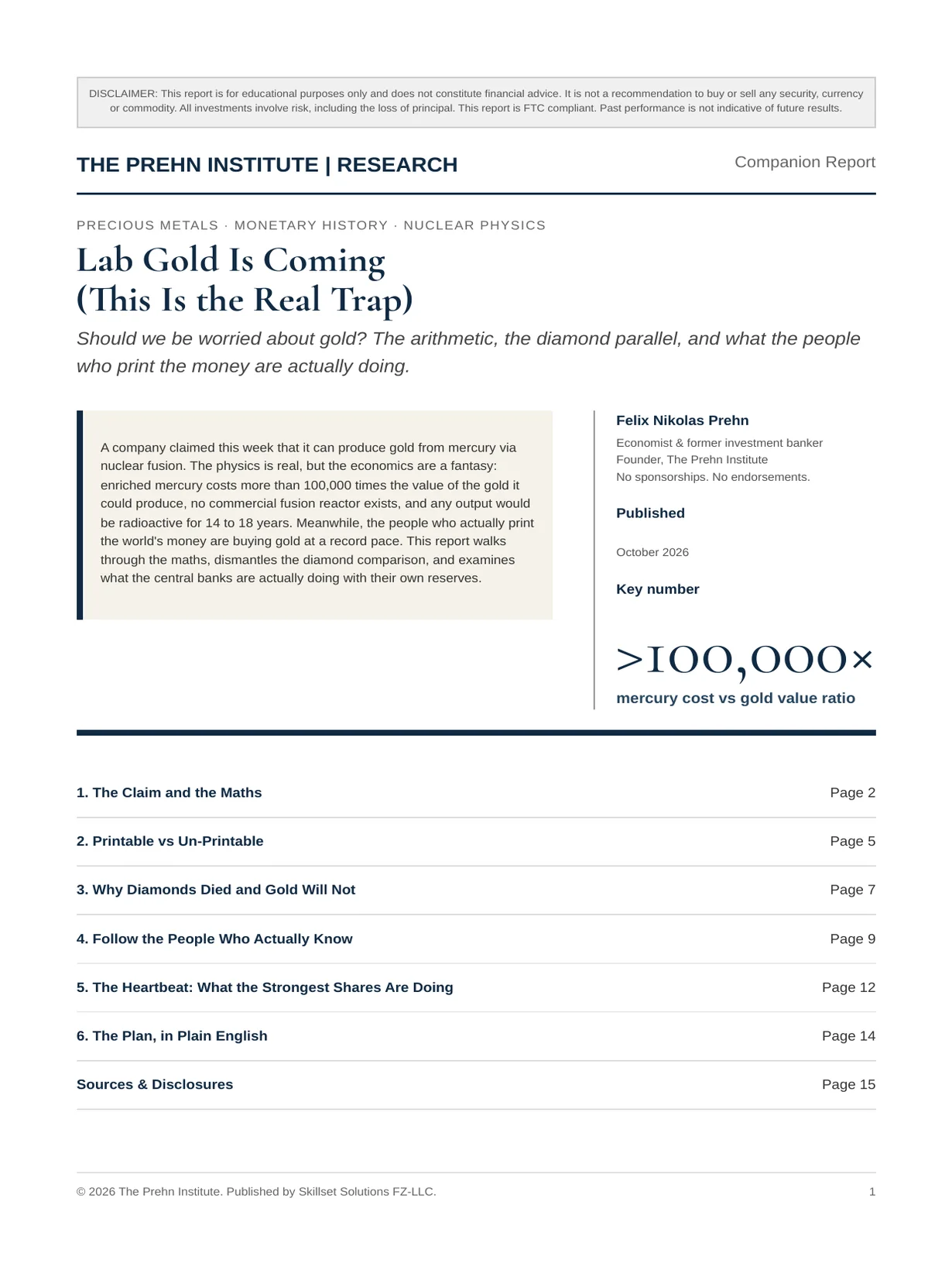
Lab Gold Is Coming (This Is the Real Trap)
Should we be worried about gold? The arithmetic, the diamond parallel, and what the people who print the money are actually doing.
Felix Nikolas Prehn · 26 October 2026 · 8 pages
Bottom line
A company claimed this week that it can produce gold from mercury via nuclear fusion. The physics is real, but the economics are a fantasy: enriched mercury costs more than 100,000 times the value of the gold it could produce, no commercial fusion reactor exists, and any output would be radioactive for 14 to 18 years. Meanwhile, the people who actually print the world's money are buying gold at a record pace. This report walks through the maths, dismantles the diamond comparison, and examines what the central banks are actually doing with their own reserves.
>100,000×mercury cost vs gold value ratio
1. The Claim and the Maths
The physics is real
A company announced this week that it can take enriched mercury-198 and, using a fusion reaction, transmute it into gold. Nuclear transmutation is genuine physics. Scientists have been turning one element into another since Ernest Rutherford first did it in 1919. The modern version uses a neutron source or a particle accelerator to knock a proton off the mercury nucleus, converting it to gold. The physics works. Nobody serious disputes that.
The question is not whether it can be done. The question is whether it can be done at a scale and a cost that would matter to the gold market. And when you run the numbers, the answer is unambiguous.
The supply arithmetic
In the company's own best-case projection, a single fusion plant might produce between 2 and 5 tonnes of gold per year. The world already mines between 3,500 and 4,000 tonnes of gold out of the ground every single year, and has done consistently for decades. One plant running flawlessly would add roughly a tenth of one percent to the global supply. In commodity markets, a tenth of a percent is not a disruption. It is a rounding error.
No plant exists
The number of commercial fusion power plants operating anywhere on Earth today is zero. Not a small number. Not an early prototype. Zero. The factory that is supposedly going to flood the world with gold has not been built. No country has a working commercial fusion reactor of any kind producing electricity for the grid. The technology remains, by any honest assessment, decades away from commercial viability.
The cost of the ingredients
The enriched mercury-198 required for this process costs approximately $15,000 per milligram. A milligram of gold, at current prices, is worth about 14 cents. The raw material going into the machine costs more than 100,000 times what the gold coming out of it is worth.
To put that in plain English: it is like burning down a house in order to toast a single slice of bread. The arithmetic does not merely fail to work. It fails on a scale that borders on the absurd.
Radioactive storage
By the company's own admission, the gold produced by this process is slightly radioactive and must be stored for 14 to 18 years before it can legally be sold. A bar produced today, assuming the plant existed, would not reach the market until some time in the 2040s.
This is not a gold rush. It is a science experiment with a very good public relations team attached to it.
2. Printable vs Un-Printable
The long, slow war
Almost everything in your financial life comes down to a war between two kinds of things. Things that can be created at will, and things that cannot.
The money in your bank account can be created at will. A government that owes far too much can conjure new money into existence with nothing more than a keystroke, and it does, and it will keep doing it. The total amount of money in the system is growing at its fastest pace in years. Every major rich country is running some version of the same play, because their debts have grown too large to ever be paid back honestly.
They are not going to suddenly announce that they cannot pay. They are going to pay you back in money that is worth less and less each year, slowly, while you are distracted by headlines about trade wars and elections and robots.
The one real enemy
When you can print the money itself, you have only one real enemy. Something you cannot print. For 5,000 years, that something has been gold. Not because it is shiny, not because of tradition, but because it is genuinely, physically, stubbornly hard to get. It takes real energy, real machinery, real risk, and real years to pull a single ounce of it out of the earth. That difficulty is not a bug. It is the entire point.
They are not ringing gold's death bell. They are accidentally ringing the dinner bell.
3. Why Diamonds Died and Gold Will Not
Diamonds were never rare
In the 1930s, De Beers came to control around 85 percent of the world's supply of rough diamonds. They held most of it in vaults, releasing only a trickle, to maintain an artificial scarcity. In 1947 they ran one of the most effective advertising campaigns in the history of business: "a diamond is forever." They convinced the entire Western world that a common lump of carbon was priceless, and more or less invented the idea that you must spend two months of your salary on a ring to prove you love someone.
The scarcity was manufactured. Start to finish, it was a story, propped up by a near monopoly and a genius marketing budget.
What happened when the story broke
The moment somebody worked out how to grow chemically identical diamonds in a factory for a fraction of the cost, the story broke. The wholesale price of lab-grown diamonds has fallen by 90 to 95 percent since 2015. The parent company behind De Beers has written down close to 7 billion dollars. A cheap fake-scarcity product shattered the original, because the scarcity was fake the entire time.
Gold is the precise opposite
No company on Earth controls gold. No advertising campaign ever invented its value. Its scarcity was not a decision taken in a boardroom. It is a law of physics and geology. You cannot vote it away. You cannot advertise more of it into existence. And you cannot yet build it in a machine for anything less than a fortune.
4. Follow the People Who Actually Know
Central banks are buying, not selling
The world's central banks have been buying gold at a record pace, year after year. These are the institutions that create the money out of thin air. They are the ultimate insiders on the true value of their own product. And they are deliberately choosing to swap some of their own currency for a metal they cannot create.
When the counterfeiter himself starts hoarding the real thing and locking it away, you have learned something that no television segment is going to tell you plainly.
The official story vs the real measure
The official inflation figure gets adjusted and fiddled with until it tells whatever story is convenient that year. At The Prehn Institute, we measure prices not in money, but in time. How many hours does an ordinary person have to work to afford the things they are trying to save up for?
Your hours cannot be faked, re-jigged, or spun.
Measured that way, the ordinary things people save for — a house, a decent car, a little put by for later — that would have cost you about 100 hours of your working life at the turn of the century, cost you well over 300 hours today. The things you work and save for have more than tripled in the price of your own life, in just a generation.
The whole picture, as one thing
Debts far too large to ever repay. Money being printed to escape them. The very people doing the printing hoarding real, un-printable assets for themselves. And at that exact moment, out of nowhere, a story appears telling ordinary savers that real assets are about to become worthless, so they had better hurry up and sell.
You do not need to believe in a secret cabal in a dark room. You only need to understand who stands on each side of that trade, and to make very sure that the person handing over their gold for pennies at the bottom is not you.
6. The Plan, in Plain English
Three rules
- Do not sell something genuinely good because a frightening headline told you to. The fusion story is real physics wrapped in fantasy economics. The headline is designed to move you, not inform you.
- If a 30 percent move in anything you own would cost you a night of sleep, bring the amount down. The person who can sleep is the person who does not sell at the very bottom. You survive volatility by not needing to react to it.
- Ask one question of everything you own: is this thing genuinely scarce, or is its value just a story that somebody is able to break? That one question will protect your money more than any hot tip.
Two kinds of people
There have only ever been two kinds of people who walk out of a moment like this one. The ones who understood what they owned and held on, and the ones who sold the real thing in a fright to the very people who print the fake thing. One group gets richer in every cycle. The other gets poorer. It is not luck. It is the plain historical record, without a single exception.
Which of the two you end up being is genuinely a choice, and it is a choice you make in the next few weeks, not the next few years.
Disclaimer
Felix Nikolas Prehn is the founder of The Prehn Institute and Winston Daily. He holds positions in gold-related assets. This report is for educational purposes only. It does not constitute financial advice and is not a recommendation to buy or sell any security. All investments involve risk, including the loss of principal. Past performance is not indicative of future results.
The heartbeat scanner patterns described in this report are perishable and shift from week to week. They are described for educational purposes only. Any names mentioned are examples of a shape, not recommendations. Always do your own research.
No part of this report was sponsored, paid for, or endorsed by any company, fund, or institution mentioned within it.