
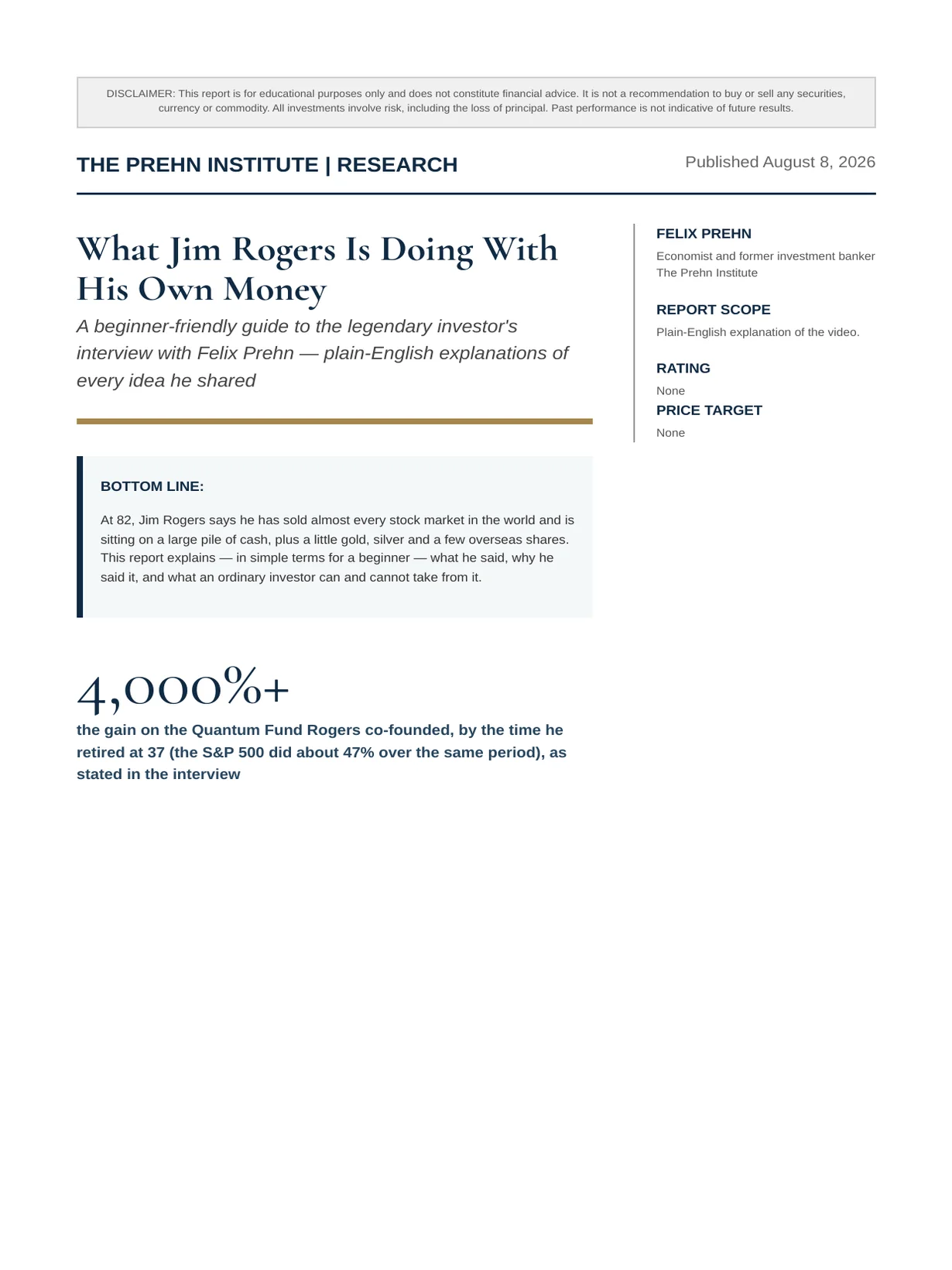
What Jim Rogers Is Doing With His Own Money
A beginner-friendly guide to the legendary investor's interview with Felix Prehn — plain-English explanations of every idea he shared
Felix Nikolas Prehn · 8 August 2026 · 15 pages
Bottom line
At 82, Jim Rogers says he has sold almost every stock market in the world and is sitting on a large pile of cash, plus a little gold, silver and a few overseas shares. This report explains — in simple terms for a beginner — what he said, why he said it, and what an ordinary investor can and cannot take from it.
4,000%+the gain on the Quantum Fund Rogers co-founded, by the time he retired at 37 (the S&P 500 did about 47% over the same period), as stated in the interview
Credibility
Who is Jim Rogers?
WHY LISTEN TO HIM:
Jim Rogers is one of the most experienced investors alive. Understanding his track record helps you weigh his views — while remembering that even he insists you should think for yourself.
THE TRACK RECORD
He co-founded the Quantum Fund with George Soros in 1973. By the time he retired at just 37, the interview states that fund was up over 4,000%, while the S&P 500 (the main index of large US companies) rose about 47% over the same period.
THE ADVENTURES
He then rode a motorcycle around the world twice and wrote a bestselling book about each trip. He later moved his family to Singapore because he believed the 21st century might belong to Asia, and wanted his daughter to grow up speaking Chinese.
THE REPUTATION
He has spent decades calling commodity "super cycles" and the long-term decline of the US dollar. He has just turned
- He grew up somewhere so small, he jokes, that his family telephone number was simply "5."
THE HONEST CAVEAT
He is refreshingly modest. Throughout the interview he repeats that he has made "many, many mistakes" and hopes to make many more — because, he says, mistakes are how he learned.
4,000%+
Quantum Fund gain by his retirement
(per the interview)
- ~47%
- S&P 500 over the same period (per the interview) age at which he retired
The Headline
"I sold almost everything"
All-time high: the highest price a market or asset has ever reached. When almost everything is at an all-time high at once, it can mean investors are very optimistic — and prices may already reflect a lot of good news.
WHAT HE ACTUALLY HOLDS NOW
Mostly cash, plus a few exceptions. He says he is "a pretty simple person right now": a large amount of US-dollar cash, a few shares in China, a few in Uzbekistan, and some physical gold and silver. That's it.
WHY THIS SURPRISES PEOPLE
It contradicts the usual advice. As Felix notes, most people are taught to "buy the index fund, hold forever, and never sell." Rogers has done the opposite here — not because that common advice is wrong, but because his own read of the moment told him to step back.
WHAT TRIGGERED IT
Everyone was having too good a time. He says that when "everybody's having a good time" and hitting all-time highs, it is "a time to look out the window and maybe ask some questions." So he sold — admitting he was probably "too soon."
THE KEY NUANCE
Selling early is a choice, not a failure, for him. "I don't mind being too soon," he says. He would rather step aside before trouble than try to guess the exact top.
Important for beginners.
Rogers is describing what he is doing with his money after 50+ years of experience. He is not telling you to sell everything. Later in this report he says the opposite: most people should stick to what they know, and index funds are "a fine way to invest."
The Safe-haven Puzzle
Why hold cash in US dollars?
Safe haven: an asset investors rush into when they are frightened, because they believe it will hold its value in a crisis. Cash, US dollars, gold and government bonds are often treated this way.
THE TWIST:
Rogers holds US dollars even though he does not personally believe the dollar is truly safe. His logic: it doesn't matter what he thinks — it matters what everyone else believes.
- Jim Rogers
Trouble arrives in markets
→
Frightened investors look for a
"safe haven"
→
Most of them pick US dollars — so dollars can rise
THE BEHAVIOURAL INSIGHT
Follow the crowd's fear, not your own opinion. Rogers says that when things go wrong, "people look for a safe haven," and in 2026 most of the world still treats the dollar as that haven — "rightly or wrongly." You can call them wrong, he says, but "it doesn't matter."
WHY CASH AT ALL
Cash gives him courage and choices. When a real bargain appears, having cash ready is what lets him act. As he puts it, opportunities favour those with "courage and cash."
THE CATCH HE ADMITS
Cash slowly loses value to inflation. He openly worries about this (see page 12) — which is why he pairs his dollars with gold and silver rather than holding cash alone.
The One Big Signal
Despair vs. euphoria
BOTTOM LINE:
If Jim Rogers has one repeatable idea, it is this: extreme emotion in the crowd is a signal. Widespread despair often means things are cheap. Widespread excitement often means caution is due.
Despair
everyone gives up on something → a place to look for bargains
Euphoria
everyone is thrilled → time to be careful and ask questions
Facts
emotion tells you where to look; facts tell you whether to act
Contrarian: an investor who tends to buy what others are avoiding and avoid what others are chasing. Rogers doesn't love the label — he says he simply "likes to buy cheap things," and things are usually cheap precisely because everyone else is looking away.
HOW HE USES IT
Despair is an invitation to investigate — not an automatic
"buy." When the TV and everyone on it says something is "finished, it's all over," that, he says, "is a time to ask questions, and perhaps to act and buy."
THE HONEST LIMIT
He has no rigid formula. Felix asks whether he counts headlines or has a hard system. Rogers answers plainly: "It's just experience... and watching the mood of the markets." Emotion points him toward opportunities; only the facts decide.
WHY IT WORKS
Human emotions never change. "Railroads were once wildly exciting. Electricity was once the most exciting thing you could imagine," he notes. Booms and busts repeat because people repeat.
Owned, but Not Being Bought
Gold and silver
OWN VS. BUY — A KEY DISTINCTION
You can hold an asset without adding to it. Rogers already owns physical gold and silver (he even holds up a silver cup during the interview). But with prices near record highs, he is not buying more today. This is a great beginner lesson: owning and buying are two separate decisions.
WHY METALS AT ALL
They have held value for thousands of years. "Gold and silver have always been of great value throughout history," he says, joking that silver was valuable even when "Jesus Christ was sold for 30 pieces of silver."
HIS BUYING TRIGGER
A fall, plus despair. He says he would "hope to be smart enough to buy more" if prices drop — consistent with his despair signal from page 7. He deliberately does not give a specific price or rule.
ON MARKET MANIPULATION CLAIMS
He shrugs them off. Asked about accusations that futures markets suppress silver prices, he says he has heard such claims "for many, many decades" and keeps coming back to the same point: look for despair, ask questions, and act on facts.
Physical vs. "paper" metals: physical means real bars, coins or a silver cup you can hold. "Paper" exposure (futures, leveraged ETFs) is a financial contract tied to the metal's price. Rogers prefers holding the real thing.
Disaster = Opportunity
Japan, bailouts and where cash pays off
Carry trade: borrowing money in a country with very low interest rates (like Japan) almost for free, then using it to buy assets elsewhere that pay more. It works until the borrowed currency (the yen) rises, making the loan expensive to repay — which can force investors to sell in a hurry.
THE CONTEXT FELIX RAISED
The Japanese "carry trade" was wobbling. Felix describes how, as Japan's interest rates rose, this popular trade started to unwind — and how, on one recent Friday, the market fell sharply in the last 40 minutes on that fear, with the US Fed reportedly opening a support line to Japan.
ROGERS' ACTUAL ANSWER
Bailouts always come — and disasters create chances. He didn't predict Japan specifically. His point was broader: humans "always want to be bailed out" and usually find someone to do it. And "when there is a disaster... it is often an opportunity."
WHY THIS TIES TO HIS CASH
Cash is the tool for catching those chances. Opportunities in a crisis go to those with "courage and cash," he says — which is exactly why he is holding so much dry powder today.
THE HISTORICAL PROOF HE GIVES
Even catastrophe can pay off. "If you'd invested in Germany in 1945," he says — right after it lost a world war — "you'd be rich now." Maximum despair was maximum opportunity.
Beginner caution.
"Disaster equals opportunity" only works if you survive the disaster. Rogers stresses this himself on page 13: staying with a losing position too long "is often going to cause worse problems." Courage without survival is gambling.
The Advice He Repeats Most
"Invest in what you know — don't listen to me"
Turn off the TV and the noise
Stick to things you genuinely understand
Make your own decision, based on facts
This is how you survive the next downturn
WHY HE KEEPS SAYING IT
Copying tips is fragile. If you buy something only because someone told you to, you won't know what to do when it falls. Understanding is what lets you hold your nerve — or sell with confidence.
HIS STRONGEST VERSION
"Don't listen to other people, including me." Asked what a nervous beginner should do, this is his very first answer. "Stay true to yourself... try to make your own decisions."
HOW FELIX REINFORCES IT
Have a process you trust. Felix adds that you need "another process you have confidence in, with good risk management, so you will survive the next disaster." Knowledge plus a plan, not stock tips.
How to read this report, then.
Treat it as education, not instructions. Use it to understand how a master investor thinks, then apply that thinking to things you understand.
→
→
→
For Most People, a Fine Choice
Are index funds fine for beginners?
Index fund: a low-cost fund that simply buys a whole market (for example, all 500 companies in the S&P 500). Instead of trying to beat the market, it aims to match it. It is one of the simplest ways for a beginner to invest.
HIS VERDICT:
Yes. Despite selling his own holdings, Rogers is clear that for ordinary investors, index funds are "a fine way to invest" — because the plain truth is that most people do not beat the market.
THE HONEST MATHS
An index fund does as well as the market. As Rogers puts it: "She won't do better, but she won't do worse." For many people, matching the market is a perfectly good outcome.
WHY MOST PEOPLE UNDERPERFORM
Emotions. "We're all human beings. We all have the same emotions... fear... hysteria." Those emotions push people to buy high and sell low, which is how they fall behind a simple index.
SQUARING IT WITH HIS OWN SELLING
Different people, different jobs. Rogers is a full-time professional acting on decades of experience. He is not saying beginners should imitate his cash pile — he is saying most beginners are better served by a simple, low-cost index than by chasing tips.
Why He Keeps Metals
Inflation and the case for gold and silver
Inflation: the gradual rise in prices over time, which means each dollar buys a little less. It is the main reason cash sitting idle slowly loses value.
Governments print more money
→
More money chasing goods → inflation
→
Hold some gold & silver to protect value
HIS WORRY ABOUT CASH
He knows his dollars are eroding. Asked if he worries about inflation nibbling his cash, he says: "Of course I'm worried about it." He believes governments' easy answer is to "print money" — and printing money leads to more inflation.
HIS SIMPLE HEDGE
Keep some metal aside. "Keep some gold in the closet. Keep some silver under the bed," he says. Metals are his insurance against paper money losing value.
WHY HOLD BOTH CASH AND METALS
They do different jobs. Dollars give him a safe haven and ready buying power in a crisis; gold and silver defend his wealth against long-term inflation. It is not either/or — he holds both on purpose.
Hedge: an asset you hold specifically to offset a risk. Here, gold and silver are Rogers' hedge against the risk that cash loses purchasing power to inflation.
Mistakes, Patience and Emotion
Mistakes, risk and controlling emotions
BOTTOM LINE:
Rogers is strikingly honest about getting things wrong. His edge is not being right every time — it is learning from mistakes, waiting for facts, and knowing that emotion is the real enemy.
WAIT — DON'T RUSH
Acting for the sake of acting is the classic error. "The easy way is to act, act, act. But I have learned that that's usually a mistake. The thing to do is to wait and be sure, and learn more."
ON STOP-LOSSES
He admits he lacks a hard rule — and it can hurt. Some investors automatically sell if something drops, say, 15%. Rogers says: "Sometimes I wish I had those rules," admitting he tends to wait until it "hurts too much" and then sells at the wrong time.
EMOTION IS THE ENEMY
Markets are ruled by feelings, not facts. "There's so many emotions at work... and facts don't matter" in the short run. He has learned to understand this even if, he admits, he isn't always good at beating it.
SURVIVAL FIRST
You must live to invest another day. Felix and Rogers agree: many people are set back years by one large mistake. "Staying with a loser is often going to cause worse problems." Protect yourself first.
Stop-loss: a pre-set rule to automatically sell an investment once it falls by a certain amount, to cap your loss. Rogers doesn't use them but acknowledges they help many investors avoid holding losers too long.
Turn Wisdom into Habits
Beginner takeaways from Jim Rogers
Free live beginners seminar
fasttrackforbeginners.com
Remember.
This report explains what one legendary investor is doing with his own money. It is not advice to copy him. Use it to sharpen how you think, then make your own decisions about things you understand.
Invest only in things you genuinely understand — don't act on tips, "including from me," says Rogers.
✓
Watch the crowd's mood: widespread despair is a place to look for bargains; widespread euphoria is a reason for caution.
✓
Owning an asset and buying more of it are two different decisions — Rogers owns gold and silver but isn't buying at highs.
✓
Keep some cash for courage and flexibility, but remember inflation slowly erodes it.
✓
For most people, a low-cost index fund is "a fine way to invest" — most investors don't beat the market.
✓
Emotion is the enemy: wait for the facts, and above all make sure you survive your mistakes.
✓
Disclaimer
This report is for educational and informational purposes only and does not constitute financial, investment, legal, tax or accounting advice. It is not a recommendation, solicitation or offer to buy or sell any security, currency, commodity or financial product. No buy/sell rating or price target is provided. All investments involve risk, including the possible loss of principal. Views expressed by Jim Rogers are his own and are described here for educational purposes; he states repeatedly in the interview that viewers should not simply copy his positions. Market events, relationships and historical comparisons described here may not repeat. Readers should conduct their own research and consult appropriately qualified professionals before making financial decisions. Past performance is not indicative of future results. The Prehn Institute makes no guarantee regarding outcomes.