
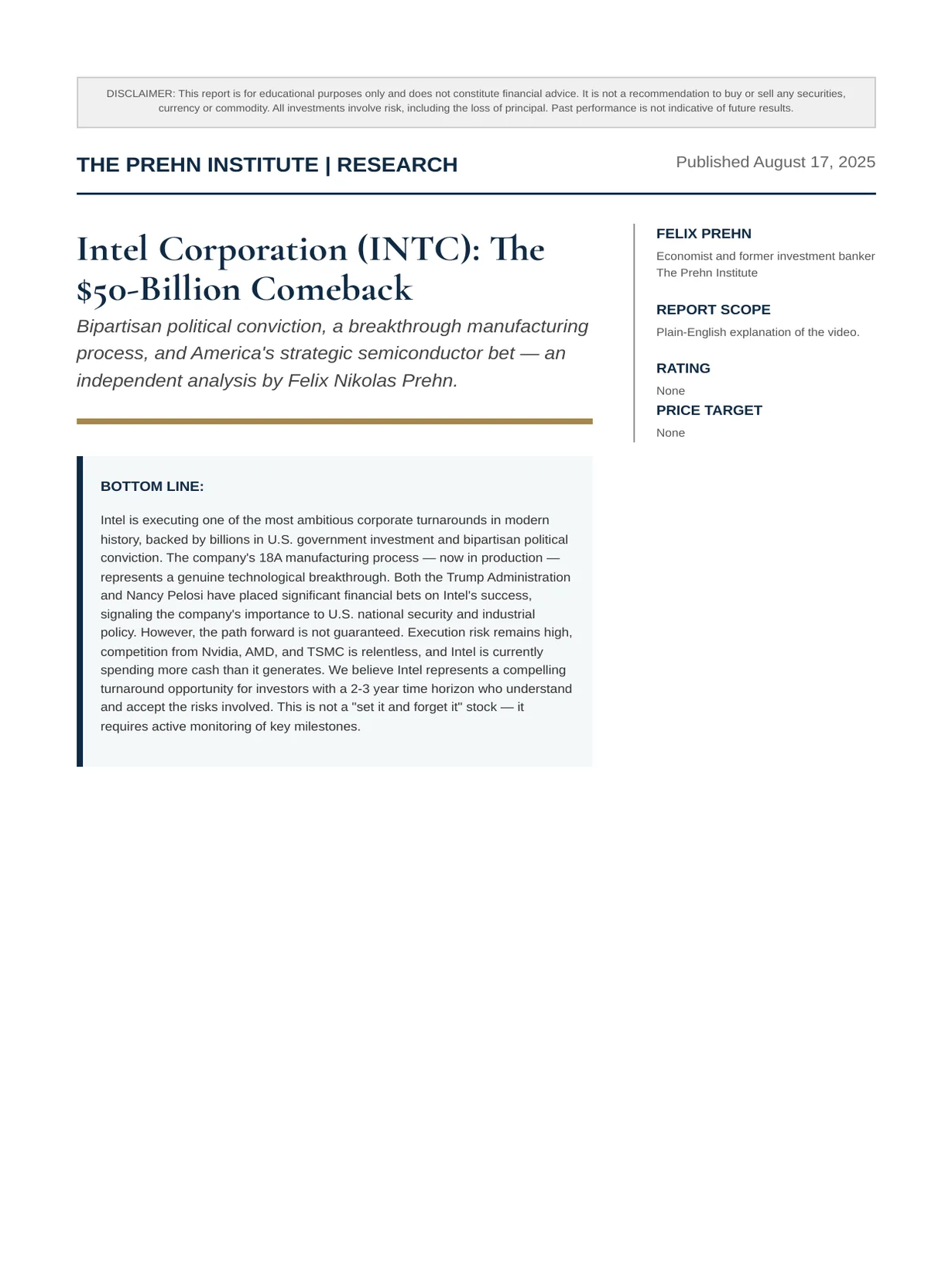
Intel Corporation (INTC): The $50-Billion Comeback
Bipartisan political conviction, a breakthrough manufacturing process, and America's strategic semiconductor bet — an independent analysis by Felix Nikolas Prehn.
Felix Nikolas Prehn · 17 August 2025 · 17 pages
Bottom line
Intel is executing one of the most ambitious corporate turnarounds in modern history, backed by billions in U.S. government investment and bipartisan political conviction. The company's 18A manufacturing process — now in production — represents a genuine technological breakthrough. Both the Trump Administration and Nancy Pelosi have placed significant financial bets on Intel's success, signaling the company's importance to U.S. national security and industrial policy. However, the path forward is not guaranteed. Execution risk remains high, competition from Nvidia, AMD, and TSMC is relentless, and Intel is currently spending more cash than it generates. We believe Intel represents a compelling turnaround opportunity for investors with a 2-3 year time horizon who understand and accept the risks involved. This is not a "set it and forget it" stock — it requires active monitoring of key milestones.
1. Why Politicians Are Betting on Intel
The Signal. Two of the most influential people in American politics — one from each party — are placing significant financial bets on the same stock. That alone makes Intel worth examining closely. When the President and one of the most-followed stock-picking politicians in Congress align on a single investment, it tells us something important about how Washington views this company's future.
This Is Not a Recommendation. We want to be crystal clear: politicians buying a stock is never, by itself, a reason to invest. Politicians can be wrong. They may have motives we cannot see. What their trades do offer is a signal — a window into the strategic thinking at the highest levels of government. Our analysis goes far deeper than political trades.
1.1 Nancy Pelosi's Call Options
The Trade. In late May 2026, Paul Pelosi (Nancy Pelosi's husband) purchased a substantial batch of call option contracts on Intel. This was the Pelosi portfolio's first major disclosed trade in months — when she breaks a silence like that, the market pays attention.
What Are Call Options? (Simple Version). Buying a call option is like putting a deposit down on a house at a locked- in price. If the house goes up in value, you make a fortune. If it doesn't, you lose your deposit — but nothing more. Pelosi's bet says: "I believe Intel will be worth significantly more within the next year."
Why It Matters. These options were already "in the money" when purchased — meaning Intel's stock was already trading above her target price. She paid a premium for these contracts because she believes there's substantially more upside ahead. This was not a cheap lottery ticket. It was a high-conviction, multi-million dollar bet on continued growth.
Key Takeaway: Pelosi placed a multi-million dollar options bet that Intel goes meaningfully higher within the next year. These were not speculative lottery tickets — they were premium, in-the-money contracts reflecting high conviction.
1.2 TRUMP: THE GOVERNMENT BET + PERSONAL TRUST
Level One: Uncle Sam Becomes a Shareholder. In August 2025, the Trump Administration made a historic move. The U.S. government took a direct ownership stake in Intel — roughly 10% of the entire company. Billions of taxpayer dollars were invested through a combination of CHIPS Act grants and Department of Defense funding. This was not a loan. Not a grant. The government literally became one of Intel's biggest shareholders.
Think About What That Means. The United States government doesn't just want Intel to survive — they need Intel to succeed. They have "skin in the game." The White House has publicly boasted about the unrealized gains on this investment. When the government puts that kind of money behind a single company, it sends a powerful signal about strategic importance.
Level Two: Trump's Personal Trust. Separately, Trump's personal revocable trust has been accumulating Intel positions — both corporate bonds and common stock, in multiple purchases. The Trump Organization maintains these decisions are made by third-party managers, but this is not a blind trust. Trump signs the disclosure forms himself and is aware of the holdings.
The Bipartisan Intel Bet
Biden Signed CHIPS Act
↓
Trump Administration ~10% Equity Stake
↓
Trump Personal Trust Bonds + Stock
↓
Nancy Pelosi Call Options (Millions)
1.3 WHAT THIS POLITICAL SIGNAL MEANS
An Industrial Policy Signal. The bipartisan nature of this support is what makes it exceptional. The CHIPS Act was signed under Biden. The equity stake happened under Trump. Pelosi is buying call options. When both parties agree on something in Washington — that almost never happens. It tells you Intel has been designated as "too strategic to fail."
But Political Buying Alone Is Never Enough. Our analysis framework demands we go deeper. The remainder of this report applies rigorous fundamental analysis to determine whether the business case supports the political enthusiasm.
2. THE QUALITY STOCK SCORECARD
| Is the Business Profitable? | ||
|---|---|---|
| Gross Margin | 39.4% (Q1 2026 GAAP) / 34.8% (FY 2025) | MODERATE — Improving but below semiconductor industry averages (~55-60%). The heavy foundry investment cycle is compressing margins. We want to see consistent 40%+ going forward. |
Operating Margin Negative (GAAP) / ~11% (Non-GAAP
WEAK — GAAP operating income is negative due to restructuring charges and foundry losses. Non-GAAP shows profitability is possible when one-time items are excluded. This is the key metric to watch for improvement.
| ROCE | Negative | WEAK — With operating losses and massive capital investment, the return on capital employed is currently negative. This is expected during the heavy investment phase but must turn positive within 2-3 years. |
|---|---|---|
| Is It Generating Cash? | ||
| Cash Conversion | Limited | WEAK — Intel generated $1.1B in operating cash flow in Q1 2026, but this is dwarfed by capital expenditures. Cash conversion is poor during this transformation period. |
Free Cash Flow Margin
Negative (~-9% FY 2025)
WEAK — Free cash flow was -$4.9B for FY 2025 and -$2.0B for Q1 2026. Intel is burning cash to fund its factory expansion. Similar to Amazon in its early years — spending now to build future returns.
Is It Financially Stable?
Leverage
Elevated but manageable
MODERATE — Intel carries significant debt, but Fitch maintains a BBB investment-grade rating (with Negative Outlook). The government's equity stake and CHIPS Act funding provide a critical financial cushion.
| Interest Cover | Tight | MODERATE — Interest coverage is under pressure due to operating losses. However, the company has multiple levers: asset sales (Mobileye, Altera stakes), government support, and improving operational performance. |
|---|---|---|
| Valuation Snapshot | ||
| P/E Ratio | N/A (GAAP negative earnings) | TRANSITIONAL — Traditional P/E is not meaningful for a company in a turnaround with negative earnings. Investors are pricing in future profitability, not trailing losses. |
| Earnings Growth | ||
| Non-GAAP EPS | ||
| trending positive | ||
| MODERATE — Non-GAAP EPS was $0.29 in Q1 2026 vs. | ||
| losses in prior periods. The trend is improving. Revenue grew 7% | ||
| YoY in Q1 2026, beating guidance. |
EPS Consistency
Inconsistent — turnaround phase
WEAK — Earnings have been volatile due to restructuring, write-downs, and the foundry investment cycle. Consistency will only come once the turnaround matures.
Honest Assessment: By our traditional quality scorecard, Intel does NOT pass as a typical "quality stock" today. Multiple metrics are weak or negative. However, this is a turnaround play — and turnarounds by definition score poorly on backward-looking metrics. The question is whether Intel is on the right trajectory. We believe the data shows clear early signs of improvement.
2.5 the Moat Assessment
Does Intel Have a Competitive Moat? This is where Intel's story gets genuinely interesting, because the company is actively building multiple new moats while its old ones eroded.
| Moat Type | Assessment | Details |
|---|---|---|
| Cost Advantage | BUILDING | Intel's new foundries, once operational at scale, could provide cost advantages over shipping chips across the Pacific from TSMC. Proximity to U.S. customers reduces logistics costs and tariff exposure. |
| Size / Scale | STRONG | |
| Intel is one of only three companies in the world capable of manufacturing leading-edge chips (alongside | ||
| TSMC and Samsung). This is an extraordinarily high barrier to entry — it costs tens of billions of dollars | ||
| and years of R&D to build a competitive fab. | ||
| Switching | ||
| Costs | ||
| MODERATE | ||
| For the PC and server CPU business, switching costs are moderate. For foundry customers, switching | ||
| costs are very high — migrating chip designs to a new manufacturer is expensive, time-consuming, and | ||
| risky. |
Patents & IP STRONG Intel holds one of the largest semiconductor patent portfolios in the world. Its proprietary RibbonFET and PowerVia technologies in the 18A node are genuine innovations. Government licensing and CHIPS Act support add a "government license" dimension to the moat.
3. Intel's Three Businesses — Simply Explained
Think of Intel Like Three Companies in One. To understand Intel, you need to understand that your money isn't going into one business — it's going into three very different businesses under one roof.
Business #1: PCs (Client Computing Group). This is Intel's biggest business — about 60% of revenue. These are the chips that go inside laptops and desktop computers. Think of it like owning a reliable rental property. It's not growing fast, but it pays the bills and generates steady income. Revenue was stable in Q1 2026.
Business #2: Data Centers & AI (DCAI). This is the growth engine. Revenue grew 22% in Q1 2026 — the fastest- growing part of Intel. Why? Because as AI gets more complex, you need powerful processors to manage everything. Think of Intel as the air traffic controller at a busy airport. The GPUs (from Nvidia) are the planes, but someone has to manage the whole system. That's Intel's Xeon processors.
Business #3: The Foundry (Intel Foundry). This is the big bet — Intel making chips for OTHER companies. Revenue grew 16% in Q1 2026 to $5.4 billion, but the foundry is losing money right now. Think of it like opening five new restaurant locations at once — in the first year, you're deep in the red. The question is whether those restaurants will be full a year from now.
| Segment | What It Does | Q1 2026 Trend | Role in the Story |
|---|---|---|---|
| Client Computing (PCs) | Chips for laptops & desktops | Stable (+1% YoY) | Cash cow — pays the bills |
| Data Center & AI | |||
| Server processors for cloud & | |||
| AI | |||
| Strong growth (+22% YoY) | |||
| Growth engine — benefits from AI shift to | |||
| inference | |||
| Intel Foundry | |||
| Making chips for other | |||
| companies | |||
| Growing (+16% YoY) but | |||
| unprofitable | |||
| The big bet — requires patience and | |||
| execution |
Source: Intel Q1 2026 Earnings Release; cross-referenced via Winston app
4. THE 18A MANUFACTURING BREAKTHROUGH
What Is 18A? This is Intel's newest, most advanced chip- making process — and it's the crown jewel of the entire turnaround story. It's now in production and shipping in real products.
Why It Matters (Simple Version). Making computer chips is the most complex manufacturing process humans have ever created. You're building structures measured in atoms. Intel's 18A process uses two brand-new technologies that nobody else has combined before:
Intel's Strategy: Don't Fight the King — Build the
Kingdom. Intel isn't trying to beat Nvidia at training. Instead, Intel is positioning itself for the next phase: running AI at scale. Think of it this way — Nvidia builds race car engines. Intel wants to build the pit crew, the track, and the traffic management system. As AI goes mainstream, you need all of it.
Intel's Secret Weapon: oneAPI. Intel is building an open software platform called oneAPI that lets developers write code that works across different types of chips — without being locked into one vendor. This is a direct challenge to Nvidia's proprietary CUDA ecosystem and could become increasingly valuable as companies seek to avoid vendor lock-in.
AMD: The Other Challenger. AMD is the "second source" to Nvidia, with its Instinct MI350 chips offering industry-leading memory capacity. More memory means you can run bigger AI models on fewer chips — a real cost advantage. However, AMD's software ecosystem (ROCm) is still maturing compared to CUDA.
| Company | AI Focus | Key Strength | Key Weakness |
|---|---|---|---|
| Nvidia | Training + Inference (GPUs) | Dominant market share, CUDA ecosystem | Highest cost, vendor lock-in |
| AMD | Training + Inference (GPUs) | Best memory capacity, competitive pricing | Software ecosystem less mature |
| Intel | Inference + AI Orchestration (CPUs + Gaudi) | Open standards, total cost of ownership | Limited GPU market presence |
Source: Public company statements, industry analysis; cross-referenced via Winston app
6. The Government Backstop
Why Intel Is "Too Strategic to Fail." Most of the world's advanced chips are manufactured in Taiwan, primarily by TSMC. If something were to disrupt that supply chain — whether through geopolitical conflict, natural disaster, or trade restrictions — the global economy would face a crisis. This is why the U.S. government has decided that having a world-class domestic chipmaker is a matter of national security.
The Government Has Skin in the Game. The U.S. government now owns approximately 10% of Intel. Think of it like having a co-signer on your mortgage who happens to be the richest, most powerful entity on Earth. It doesn't guarantee success, but it dramatically changes the risk profile. The government has both a financial incentive (protecting taxpayer investment) and a national security incentive (ensuring domestic chip production) to support Intel's success.
Bipartisan Support Is Rare — and Meaningful. The CHIPS Act was signed under a Democratic president. The equity stake happened under a Republican president. A leading Democratic politician is buying call options. When Washington agrees on anything, pay attention. Intel's strategic importance transcends partisan politics.
The Soft Floor: The government's stake creates what we call a "soft floor" under Intel's stock. While it doesn't prevent declines, it means the U.S. government has a vested interest in Intel's long-term success. This is a backstop that almost no other turnaround story can offer.
7. RISK FACTORS
Our analysis would be incomplete — and frankly irresponsible — without a thorough discussion of the risks. Most YouTube videos about stocks only tell you the good stuff. That's dangerous. Here are the risks that keep us up at night:
Risk #1: Execution Risk (HIGH). Intel's "five nodes in four years" plan has zero margin for error. Making cutting-edge chips means building structures measured in atoms. If too many chips come off the production line broken (yield problems), the entire plan could fall apart. Reports indicated that Nvidia tested Intel's 18A process but didn't commit to mass production — showing potential customers are still in "wait and see" mode. The analogy: it's like watching a tightrope walker cross Niagara Falls. The plan is incredible, the skill is there, but one wrong step and it's over.
Risk #2: The Foundry Trust Deficit (HIGH). Intel is competing against TSMC — a company with 30 years of perfecting contract chip manufacturing. When Apple or Nvidia hands you the blueprints to their most important chip, they need to trust you completely. Intel hasn't earned that trust yet. It's like trying to compete with a Michelin-star restaurant that's been perfecting its craft for three decades. You might have a great recipe, but the reputation gap is enormous.
Risk #3: Financial Strain (MODERATE). Intel is spending more cash than it's generating. The dividend has been suspended. Free cash flow is deeply negative. Think of it like renovating a house to flip it — you're spending a fortune on construction, betting the finished product will be worth much more. But if you run out of money before the renovation is done, you're stuck with a half-finished house.
Risk #4: Three-Front War Intel is simultaneously fighting Nvidia in AI, AMD in processors, and TSMC in manufacturing. That's three battles against three of the best companies in the world — all at the same time. Even if Intel executes perfectly, the competition never sleeps.
| Risk Factor | Severity | What to Watch |
|---|---|---|
| Execution / Yield Problems | HIGH | 18A benchmark reviews, independent chip tests, customer adoption announcements |
| Foundry Trust Deficit | HIGH Major external customer announcements (Apple, Nvidia, Qualcomm) | |
| Financial Strain | MODERATE Free cash flow trajectory, debt levels, CHIPS Act funding deployment | |
| Competitive Pressure | MODERATE Nvidia/AMD product launches, TSMC customer wins, market share data |
8. Catalyst Timeline
Near-Term (2026). The single most important catalyst is the real-world performance of 18A products. If Panther Lake and Clearwater Forest deliver on Intel's promises, it validates the entire turnaround. Watch for: independent benchmark reviews, customer adoption rates, and any major foundry customer announcements.
Medium-Term (2027). The foundry business must show a clear path to breakeven. If Intel can secure a "mega-whale" external customer — like Apple, Nvidia, or Qualcomm committing to high-volume production — it would be a game- changer. Intel management has said they won't invest in mass production of the next-gen 14A node unless they secure a significant customer first. That's smart capital discipline.
Long-Term (2028+). If the turnaround succeeds, Intel could become "America's chipmaker" — the domestic counterpart to TSMC, with a thriving foundry business, leading-edge technology, and a central role in the AI infrastructure buildout. The multiple expansion potential is significant if this thesis plays out.
Bearish Catalyst. On the downside, confirmed yield problems or manufacturing delays would be devastating. If the foundry fails to show a path to profitability, investor patience will erode. Watch for any slippage in the 14A timeline or reports of major customers choosing TSMC over Intel for their next-generation chips.
9. ETF ALTERNATIVES FOR LOWER-RISK EXPOSURE
If you want exposure to the semiconductor sector and the themes discussed in this report — without concentrating your risk in a single turnaround stock — we highlight the following ETFs for consideration:
| ETF | Ticker | What It Holds | Why Consider It |
|---|---|---|---|
| VanEck Semiconductor ETF | SMH | Top 25 U.S.-listed semiconductor companies (Nvidia, TSMC, Broadcom, Intel, AMD, etc.) | Broad exposure to the entire chip industry. If semiconductors win, you win — regardless of which company leads. |
| iShares | |||
| Semiconductor ETF | |||
| SOXX | |||
| 30+ U.S. semiconductor companies, more | |||
| diversified than SMH | |||
| Slightly broader exposure including equipment makers and | |||
| foundries. Good for investors who want the "whole | |||
| ecosystem." | |||
| SPDR S&P | |||
| Semiconductor ETF | |||
| XSD | Equal-weighted semiconductor holdings | ||
| Equal weighting means less concentration in Nvidia. Better | |||
| for investors who believe smaller/mid-cap chip companies will | |||
| outperform. |
Source: ETF provider websites; cross-referenced via Winston app
ETF Consideration: If you believe in the U.S. semiconductor story but want to manage single-stock risk, a position in SMH or SOXX gives you exposure to Intel, Nvidia, AMD, TSMC, and the broader chip ecosystem without betting everything on one company's turnaround.

10. The Three-pillar Framework Applied to Intel
We use a three-pillar framework to evaluate any stock where political buying has generated attention. This framework helps separate signal from noise:
| Pillar | Rating | Assessment |
|---|---|---|
| Pillar 1: Fundamentals | MODERATE → STRONG | Breakthrough technology (18A) now shipping. AI segment growing 22%. Over $50B in annual revenue. But foundry still unprofitable and FCF negative. Trajectory is positive. |
| Pillar 2: Risks | MODERATE | |
| Execution risk is high. Competition is fierce. Financial strain is real. But the government | ||
| backstop meaningfully reduces existential risk. This is not a startup — it's backed by the U.S. | ||
| government. | ||
| Pillar 3: Catalysts | STRONG | |
| Multiple near-term triggers: 18A product reviews, potential mega-customer for foundry, AI | ||
| inference growth acceleration, continued government support deployment. |
11. Position Sizing Guide
Even if you're bullish, the question is: how much should
you allocate? This is where most investors make mistakes
- they either go all-in or do nothing.
Tier 1 — Starter (1-3% of Portfolio). You believe in the thesis but want to manage risk. Enough to pay attention and benefit from upside, not so much that a big drop ruins your year. Appropriate for most investors considering Intel for the first time.
Tier 2 — Conviction (3-5% of Portfolio). You've done the homework. You understand the risks. You believe Intel will execute. This is meaningful exposure — you're saying "I've studied the fundamentals, assessed the risks, and I like the setup."
Tier 3 — Concentrated (5%+ of Portfolio). Only for investors who can afford to be wrong, have a long time horizon (3+ years), and will actively monitor every earnings report and product launch. This is high-conviction, high-risk.
The Three Questions. Before deciding, ask yourself honestly:
- Do you believe the U.S. government will keep backing American chipmaking?
- Can you handle a significant drop on bad news before it potentially goes higher?
- Are you willing to hold for at least 2-3 years?
If yes to all three — Intel may deserve consideration. If no to any — that's perfectly OK. Be honest about your risk tolerance.
💡 First & Only LIVE Training on