
The Unthinkable Is About to Happen to Gold
Why the world's biggest banks, the AI-debt boom, and central banks are quietly turning gold back into a reserve asset
Felix Nikolas Prehn · 6 August 2026 · 28 pages
Bottom line
The approved video script argues that gold's recent quiet stretch is not weakness but the pause before a structural shift. Around eight major institutions turned bullish within roughly two weeks, a forty-year link between gold and real interest rates has broken, and the same hidden debt that is inflating the AI boom is quietly pushing large investors toward the one asset that cannot default or be printed. major institutions turned bullish on gold within about two weeks, per the script
Overview
How to use this report.
Read it beside the video. The sections follow the script's information and order. The goal is not to predict the next price of gold. It is to explain the machinery underneath the headlines, so you can recognise what is happening without needing anyone to tell you what to do.
Bottom Line
One setup, six warning lights
BOTTOM LINE:
The script presents six developments that look separate but point the same way: gold is quietly being re-rated from a nervous- times trade into a core reserve asset that the largest players trust more than paper promises.
More debt in the system
→
Less trust in the dollar
→
Big money moves to gold
THE CONSENSUS
Banks rarely agree. The script notes that around eight major institutions published bullish gold views within roughly two weeks — unusual, because large banks normally disagree for a living.
THE BROKEN RULE
A 40-year relationship snapped. For four decades, rising real interest rates pulled gold down. Recently real yields rose and gold refused to fall — a “structural decoupling.”
THE HIDDEN DEBT
The AI boom runs on borrowing. The script describes off- balance-sheet AI obligations heading toward roughly $3 trillion, with the credit market flashing stress signals.
THE BUYERS
Countries, not day traders. China's imports, record central- bank buying and a fixed supply of new gold form a demand picture that ordinary sellers cannot offset.
THE PATTERN
Gold moves in phases, not lines. The script lays out a repeatable four-phase pattern that explains why gold can feel “boring” right before its biggest moves.
THE TAKEAWAY
Understand the machine. This report explains the mechanics so you are less likely to be shaken out at the wrong moment. It contains no rating, no price target and no recommendation to buy or sell.
Frustration, Explained
Why your gold felt broken — and why that is
normal
BOTTOM LINE:
The script's opening idea is simple: if your gold has felt disappointing lately, you are probably not wrong — you are early. Quiet stretches are a feature of how gold behaves, not a verdict on the thesis.
THE FEELING
You did everything right. You owned the safe haven while the world looked chaotic — debt, wars, money printing, a runaway AI boom — and gold just sat there. That gap between the story and the price is where doubt creeps in.
THE REFRAME
Early is not the same as wrong. The script argues that the biggest banks only began saying the quiet part out loud in the last few weeks. Being ahead of the crowd usually feels uncomfortable before it feels smart.
THE PROMISE
A pattern, not a prediction. Rather than a price call, the video teaches a way to read where gold is in its cycle. This report follows that same order — setup first, mechanics second, pattern last.
THE TONE
Calm, not hype. Nothing here is a promise of profit. Gold can and does fall. The value is in understanding why this moment differs from previous gold rallies.
A note on numbers.
The Consensus
Eight banks, same direction, same two weeks
WHY AGREEMENT IS THE SIGNAL
Disagreement is normal. One desk says buy, another says sell
- that is how markets function. So when many large institutions point the same way within days of each other, the agreement itself is worth stopping for.
WHAT THEY PUBLISHED
A cluster of bullish notes. The table lists the line-up named in the script. These are the banks' own published views, reported here only to explain the video.
Institution
State Street Base case range $4,750–5,500; bull case $5,500–6,250
Deutsche Bank $4,600 by year-end; describes gold in an “explosive phase”
Goldman Sachs Note titled “start nibbling,” with a floor around $4,000
UBS $4,600 by December; $5,000 by the following March
BNP Paribas “Rebuilding longs,” flagging squeeze risk
ANZ “Shift to accumulation,” support around $4,000–4,200
Jefferies “Structural decoupling” — the one covered on page 8
Figures are the banks' own published forecasts as described in the approved script (bank gold-forecast consensus, Jul–Aug 2026). They are attributed to each institution and are not The Prehn Institute price targets. The script refers to about eight aligned institutions; the named line-up is shown above.
Deutsche Bank Went Furthest
What an “explosive phase” actually means
BOTTOM LINE:
“Explosive phase” is not marketing language. The script explains it as a statistical test that flags when a price has broken away from every normal way of valuing it.
THE PLAIN-ENGLISH VERSION
The usual gravity stops working. Most assets are anchored to something — earnings, yields, fair-value models. The test detects when a price pulls away from all of those anchors at once.
HOW LONG IT HAS RUN
Since August 2024. By this measure gold has been reading as “explosive” for more than a year. It ran hot, cooled off its peak, and — importantly — is still above the line.
WHY IT MATTERS TO YOU
The engine is still running. Even after a pullback from the highs, the underlying condition the banks are describing has not switched off. That is the point the script wants a beginner to take away.
THE HONEST CAVEAT
Explosive cuts both ways. The same framework that allows fast gains also allows sharp drops. The script is explicit that a meaningful correction is possible inside this phase.
Normal valuation anchors
→
Price breaks away from them
→
Test reads “explosive”
The Jefferies Point
The 40-year rule that just broke
BOTTOM LINE:
For roughly forty years, when real interest rates rose, gold fell. Recently real yields have risen and gold has refused to drop with them — what Jefferies calls a “structural decoupling.”
Real yields UP
→
Old rule: gold DOWN
→
Reality now: gold holds near
$4,000
THE OLD LOGIC
Interest is the rival to gold. If a safe government bond starts paying a real return, gold — which pays nothing — looks less attractive, and money flows to the thing that pays. That relationship held for four decades.
WHAT CHANGED
The relationship snapped. Real yields rose, yet gold held its ground. When a rule that reliable stops working, the script argues, something fundamental in the plumbing of the system has shifted.
WHY IT IS THE CENTREPIECE
The “why” is the whole story. The decoupling is the clue that ties the rest of the report together: it points to buyers who are not chasing yield at all — they are seeking safety that cannot default.
Two Stories, One Machine
Gold and the AI bubble are secretly the same
story
A few giants spend ~$725B/yr on AI
One company's spending is another's revenue
High revenue justifies high stock prices
A growing share is funded by debt
THE CIRCULAR FLOW
Spending holds up the market. The script describes roughly three-quarters of a trillion dollars a year of AI spending across Microsoft, Google, Amazon and Meta. That spending becomes revenue elsewhere, which supports lofty valuations.
THE HIDDEN FUEL
A lot of it is borrowed. As long as the spending grows, everyone looks brilliant. The risk is that the growth is increasingly financed with debt rather than paid for out of pocket.
THE LINK TO GOLD
Debt is the bridge. The more the boom leans on borrowing, the more it matters who is nervous about that debt — and, as the next pages show, that nervousness is exactly what pushes large investors toward gold.
→
→
→
Below the Waterline
The debt you are not being shown
BOTTOM LINE:
The script describes a growing amount of AI-related borrowing that is kept off the main balance sheet, where the headline numbers do not show it. Added up, it is described as heading toward roughly $3 trillion.
~$3T
off-balance-sheet AI obligations, per the script
$329B
Microsoft lease commitments not yet commenced
~$725B
annual AI spending across four giants
THE ICEBERG
The visible tip is small. Headline balance sheets show one number. The script's point is that a large mass of obligations sits below the surface, in commitments that have not yet started.
THE LIVE EXAMPLE
One analyst did the math on air. The script attributes the tally to an analyst on CNBC who added up these obligations across the big AI players. Microsoft alone is described as having over $329 billion in lease commitments that have not yet begun.
WHY IT UNSETTLES MARKETS
Hidden leverage is still leverage. Debt that is hard to see is still debt that must be serviced. The more of it there is, the more sensitive the whole structure becomes to any wobble in confidence.
The Canary in the Coal Mine
Oracle: booming on paper, insured like 2008
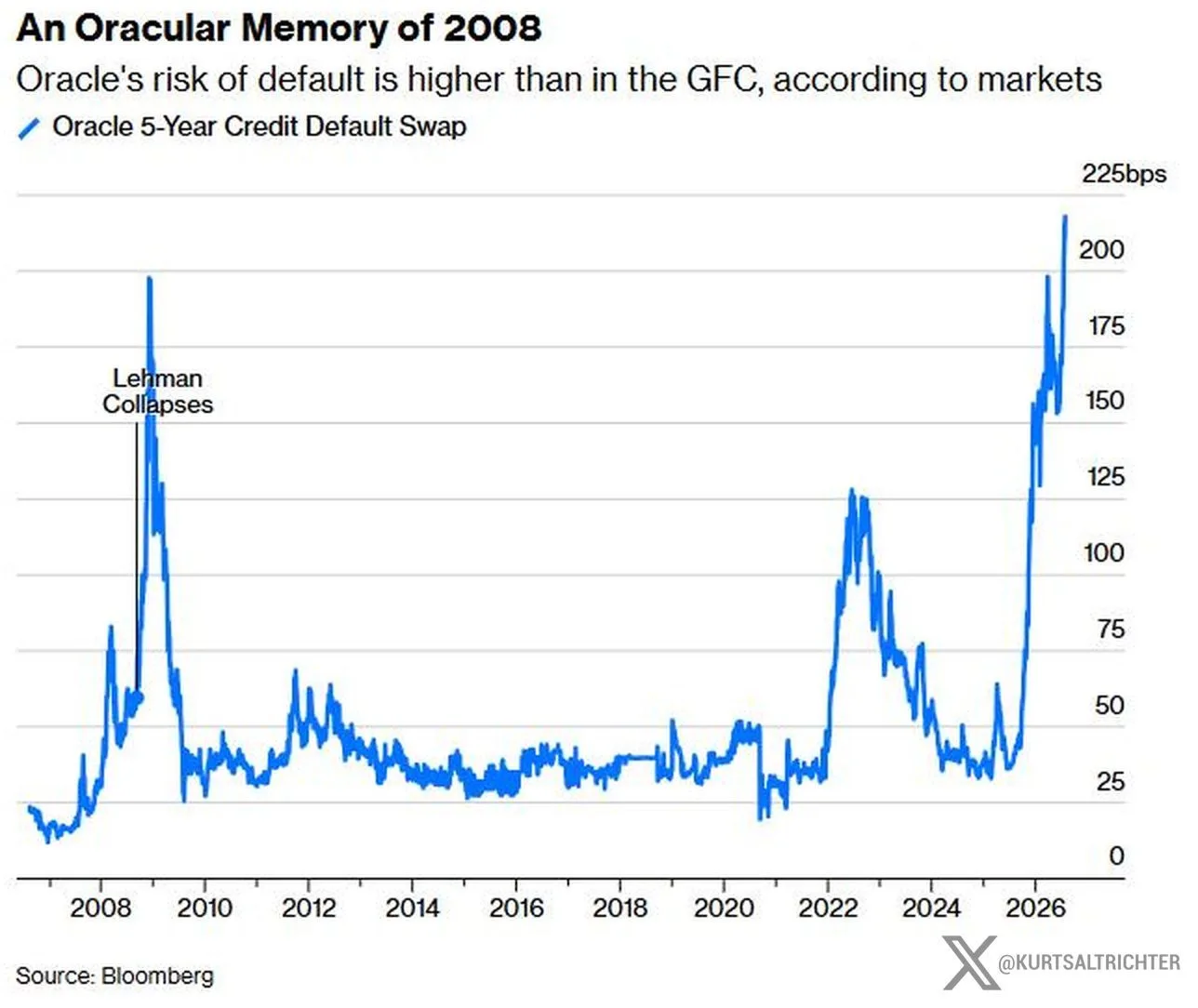
WHAT A CDS IS
Insurance on a company's debt. A credit default swap is a policy that pays out if a company fails to pay what it owes. The more dangerous the market thinks a company is, the more that insurance costs.
THE SIGNAL
Above the 2008 peak. The script notes Oracle's five-year insurance cost pushed above 215 — higher than the week Lehman Brothers collapsed. That is the market quietly pricing in real risk.
The Split Screen
A rocket ship on the top line, a hole in the cash
flow
LOOKS LIKE A ROCKET
Revenue grew about 21%
Cloud business grew about 93%
Order backlog reached roughly $638 billion
UNDERNEATH THE SURFACE
Free cash flow was negative $23.7 billion for the year
Raised $43 billion in debt to fill the gap, with about $40 billion more planned
Total debt near $130 billion; rating cut to one notch above junk (BBB−)
Quality lens What the figures suggest (per the script)
Is it generating cash? No — free cash flow is deeply negative despite strong revenue
Is it financially stable? Rising debt and a downgrade to BBB− point to increasing financial risk
Is the growth real? Revenue and backlog are genuinely large; the question is how the growth is being funded
Why This Reaches Your Gold
When credit and stocks disagree, credit usually
wins
Credit market prices in fear
→
Stock market keeps partying
→
History favours the credit market
WHO THE CREDIT MARKET IS
The cynics with the data. The bond and credit crowd deal in the risk of not being repaid. They are usually the most sober voices in the room, and right now the script says they are pricing in real concern about AI debt.
THE DISAGREEMENT
Two markets, two moods. Equities can stay euphoric while credit turns cautious. When those two split, the script argues, the credit market has the better track record.
THE FLIGHT TO SAFETY
Toward what cannot break. As credit stress spreads, big money seeks an asset that cannot default, cannot be printed, and depends on no one keeping a promise. The script's answer is gold — the quiet reason the largest players are moving.
Reserve Diversification
The dollar is quietly losing its crown
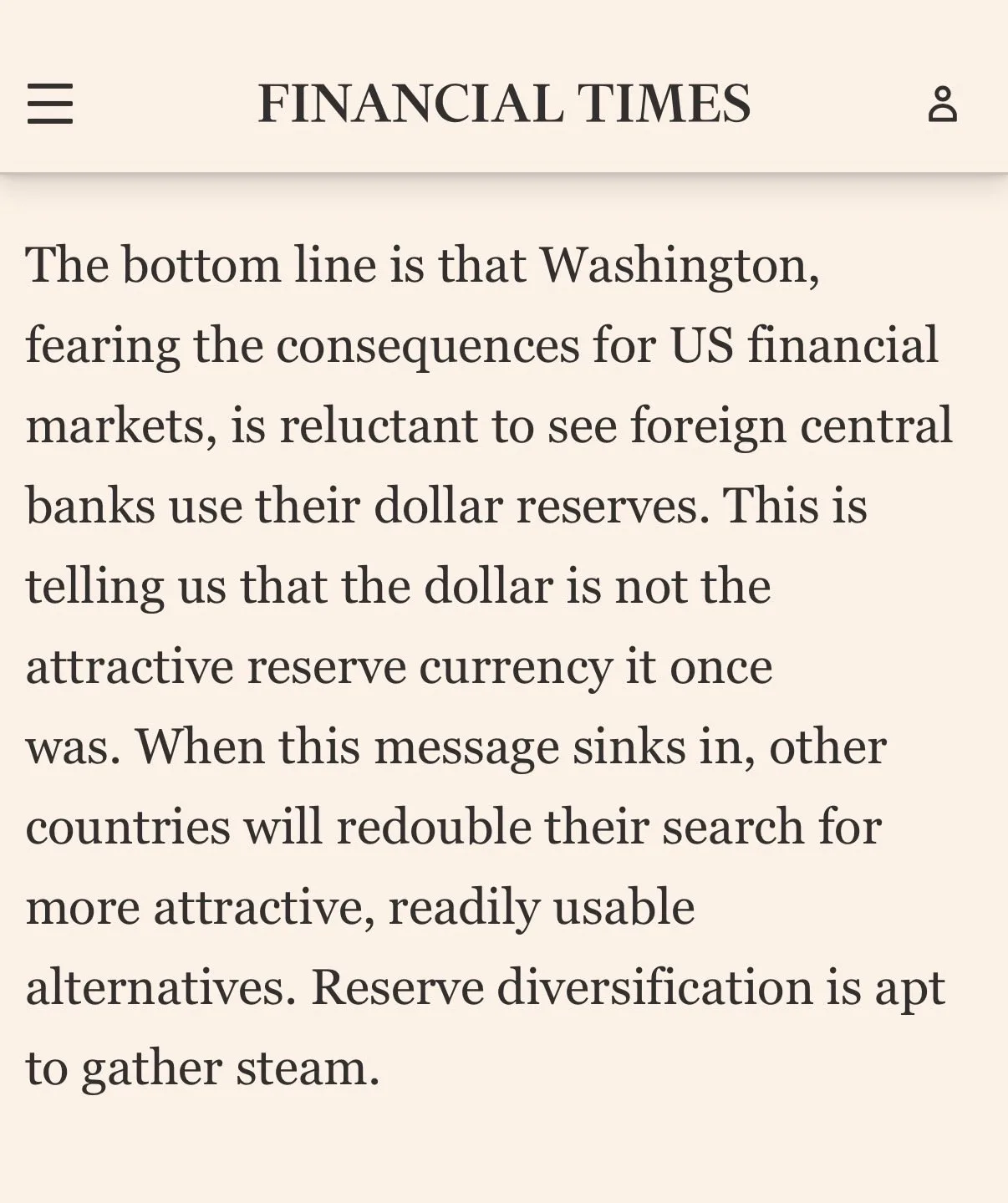
Illustrative Financial Times excerpt supplied with the video materials, describing reserve diversification away from the dollar.
THE 80-YEAR DEFAULT
Treasuries were the safe asset. For eighty years, a country storing its national savings bought US government debt. The dollar was king, and Treasuries were the automatic choice.
THE SHIFT
Confidence is wobbling. The concern laid out in the FT is that Washington has grown nervous about foreign countries actually using their dollar reserves — which tells the world the dollar may not be the flawless reserve asset it once was.
GOLD DID THE JOB
Sell Treasuries and the crisis worsens; sell gold and it
calms. During a recent crisis, dumping Treasuries threatened to spiral, while gold could be sold instantly and steadied things. Gold quietly did the job Treasuries used to do.
China's Quiet Gold Rush
One country, ten mining nations' worth of gold
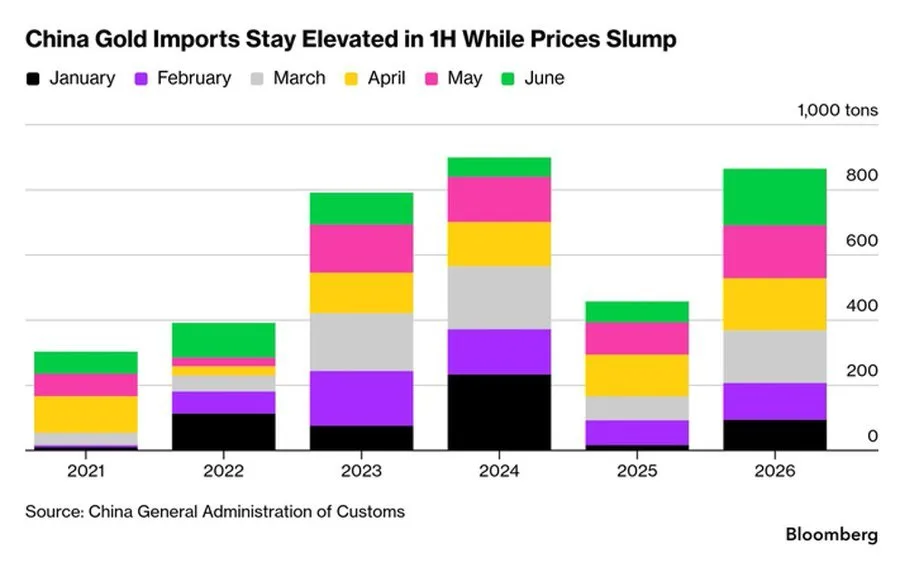
Illustrative Bloomberg chart supplied with the video materials, showing China's gold imports staying elevated (monthly bars, 2021–2026).
THE SCALE
Top-ten output, in one month. In a single month this year, China is described as importing the equivalent of what the top ten gold-producing countries mine in a month — combined. Annualised, that is around 60% of all the gold pulled from the ground worldwide.
THE TIMING
Gold and oil at once. China also quietly stockpiled record amounts of oil around the time conflict flared in the Middle East. The script poses this as an open question: when a country that plans in decades hoards gold and oil together, what is it preparing for?
Everyone, All at Once
Record central-bank buying meets a supply that cannot grow
~$45B
central-bank gold demand in a single quarter — the highest ever, per the script
10–15 yrs
to bring a new mine online asset with no counterparty that cannot be frozen
WHY CENTRAL BANKS BUY
Distrust of someone else's currency. The script says official demand hit around $45 billion in one quarter — a record — because reserves held in another nation's currency can be frozen or sanctioned. Gold cannot be frozen and has no counterparty.
THE SUPPLY WALL
There is no hidden mountain of gold. New mines take ten to fifteen years to open, so supply barely grows. Meanwhile ETFs are drawing everyday buyers back in.
THE SQUEEZE
Fixed supply, rising demand. When unstoppable demand meets a supply that cannot keep up, the script argues, price is the only variable left that can move.
What “Unthinkable” Really Means
The unthinkable is not a price. It is a change of
role.
BOTTOM LINE:
The script is explicit: the “unthinkable” is not $5,000 or $6,000 gold. It is that gold is quietly becoming a reserve asset again — the thing the biggest players trust more than the dollar.
A FOUNDATION, NOT A TRADE
This is about plumbing. A price target is a trade. A change in what the world treats as its safe asset is a change in the foundation of the financial system. The script frames the shift at that deeper level.
WHY MOST PEOPLE MISS IT
Foundations move quietly. By the time a foundational change is obvious, the price already reflects it. That is why the story can feel “boring” while it is happening — the movement is underneath, not on the screen.
THE INVESTOR'S JOB
Recognise, do not predict. The report's aim is not to tell you what gold will do next week. It is to help you recognise a structural shift while it is still quiet.
How Gold Actually Moves
The four-phase pattern, explained simply
BOTTOM LINE:
Gold does not move in a straight line. The script describes a repeatable four-phase pattern that explains why gold often falls first in a crisis and makes new highs later.
Phase What happens What most people do
1 — Panic Drop A shock hits; oil and inflation fears jump; rates and the dollar rise; gold dips short- term Panic-sell, confused that gold fell
2 — The Shakeout Gold drifts lower for weeks; the cruelest phase Give up and sell near the bottom
3 — The Structural Bid
Real buyers — central banks, countries, the supply squeeze — step in; gold finds its footing Stay on the sidelines, too burned to return
4 — New Highs Gold makes new all-time highs, above pre-crisis levels Notice only after the move
History, not a promise.
The script says this sequence has played out after essentially every major shock of the last fifty years — 1973, 1979, 1991, 2001 and 2022. Different crisis, same four phases. History can rhyme without being a guarantee.
Reading, Not Predicting
The pattern the pros watch — and two kinds of
investor
WHAT PROFESSIONALS WATCH
A signature, not a guess. The script says professionals do not guess the phase; they watch for a specific chart signature — the way a price stops falling, goes quiet, coils, and shows a particular fingerprint before the structural move. It is how they tell a dead-cat bounce from a real turn.
AN HONEST LIMIT
This cannot be taught in sixty seconds. The script is candid that reading this pattern takes live instruction. Based on what it describes, gold looks like it has been working through the shakeout and building a base — pattern recognition, not a prediction, and never a buy or sell signal.
TWO TYPES OF INVESTOR
Same chart, opposite conclusions. Type one sees a pullback and decides the trade is over. Type two sees the same pullback as the shakeout and accumulates quietly, like the central banks. The difference is understanding the mechanics — not being rich or connected.
THE TAKEAWAY
Prepare, do not react. The value is in recognising where you are in the cycle so a normal pullback does not shake you out at the worst moment.
Important.
Nothing here is a signal to buy or sell, and no outcome is guaranteed. Pattern recognition describes probabilities and context, not certainties.
The Other Side
Risk factors an honest reader must weigh
DRAWDOWN RISK
Explosive works both ways. The script notes that even the most bullish bank on the list admits a sharp drop — on the order of ~30% — is possible inside this explosive phase. Gold can and does correct.
BEHAVIOURAL RISK
The shakeout is designed to hurt. Phase 2 is where most people sell at the wrong time. The biggest risk for many investors is their own reaction, not the asset itself.
CONCENTRATION RISK
No single asset is a plan. Gold is one piece of a portfolio. Over-concentration in any one theme — including gold — raises the odds of being forced to act at a bad moment.
NARRATIVE RISK
Stories can change. The reserve-diversification and AI-debt themes are powerful, but policy, rates and confidence can shift. History rhymes; it does not repeat on a schedule.
Risk Why it matters How the script suggests thinking about it
Sharp correction Explosive phases allow big drops Expect volatility; do not confuse a dip with the end of the thesis
Selling at the bottom Phase 2 shakes out the impatient Know the pattern before it happens
Over-concentration Forced selling destroys plans Keep an emergency buffer and balance
Opportunities
Broad, lower-risk ways to think about gold
exposure
BOTTOM LINE:
ETF (ticker) What it broadly tracks Relative risk profile
SPDR Gold Shares (GLD) Physical gold bullion price Lower — direct bullion exposure, no company risk iShares Gold Trust (IAU) Physical gold bullion price Lower — direct bullion exposure, no company risk abrdn Physical Gold (SGOL) Physical gold bullion price Lower — direct bullion exposure, no company risk
VanEck Gold Miners (GDX) Basket of large gold-mining companies Higher — adds operational and equity risk on top of gold
VanEck Junior Gold Miners (GDXJ) Basket of smaller mining companies Highest of the group — smaller companies, more volatility
BULLION VS MINERS
Two different bets. A bullion fund tracks the metal itself, so it carries no single-company risk. A miner fund adds the business risk of the companies — costs, management, debt — which can amplify both gains and losses.
WHY A BASKET LOWERS RISK
Diversification. Spreading exposure across many holdings, or across the metal itself, reduces the damage from any single company stumbling — the classic argument for a sector ETF over a lone stock.
How Goat Academy Judges Quality
“We look for quality stocks” — and it explains
Oracle
BOTTOM LINE:
Felix's framework does not chase “value” or “growth” labels — it looks for quality. The same checklist that vets a great business also explains why the market grew nervous about a booming-but-cash-negative company like Oracle.
Question What it reveals
Is the business profitable? (gross & operating margin, ROCE) The size of the moat and how well it controls costs
Is it generating cash? (cash conversion, free-cash-flow margin) Whether profit becomes real cash — where Oracle raised a red flag
Is it financially stable? (leverage, interest cover) How much financial risk sits under the story — debt and downgrades matter
Valuation (P/E and forward P/E) A snapshot — the least important metric, per Felix
Does it have a moat? A durable edge: cost or scale advantage, high switching costs, patents or brand
Applied to the report.
Oracle passed the “is it growing?” test easily but stumbled on “is it generating cash?” and “is it financially stable?” — which is exactly why the credit market grew cautious even as revenue soared. Quality is about the whole checklist, not one exciting number.
Turn Understanding into Process
Five questions before gold's next big move
Free live beginners seminar
fasttrackforbeginners.com
The first-ever session built purely for beginners — gold, stocks and the AI bubble, from the ground up, including how to read patterns like the one in this report.
Do I understand why a quiet stretch can come before gold's biggest moves?
✓
Can I tell the difference between a normal shakeout and a broken thesis?
✓
Am I over-concentrated in any single theme — including gold?
✓
Do I have an emergency buffer so a pullback never forces me to sell?
✓
Do I know how I will react in Phase 2, before it arrives?
✓
Disclaimer
This report is for educational and informational purposes only and does not constitute financial, investment, legal, tax or accounting advice. It is not a recommendation, solicitation or offer to buy or sell any security, currency, commodity or financial product. No buy/sell rating or price target is provided; any bank forecasts mentioned are the banks' own figures, reported to explain the video. All investments involve risk, including the possible loss of principal. Market events, relationships and historical comparisons described here may not repeat. Illustrations simplify complex systems and may omit factors. Readers should conduct their own research and consult appropriately qualified professionals before making financial decisions. Past performance is not indicative of future results. The Prehn Institute makes no guarantee regarding outcomes.