
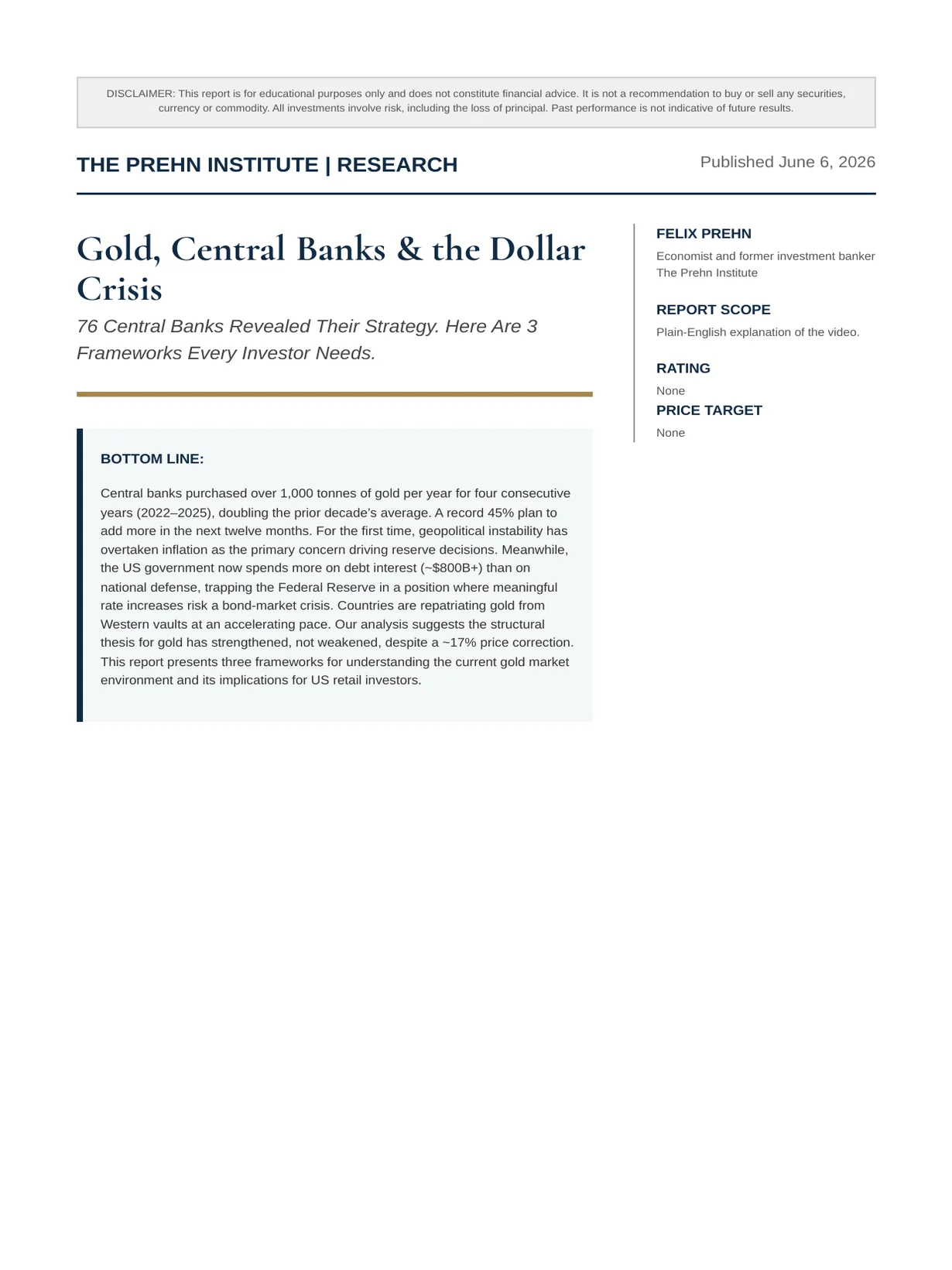
Gold, Central Banks & the Dollar Crisis
76 Central Banks Revealed Their Strategy. Here Are 3 Frameworks Every Investor Needs.
Felix Nikolas Prehn · 6 June 2026 · 16 pages
Bottom line
Central banks purchased over 1,000 tonnes of gold per year for four consecutive years (2022–2025), doubling the prior decade’s average. A record 45% plan to add more in the next twelve months. For the first time, geopolitical instability has overtaken inflation as the primary concern driving reserve decisions. Meanwhile, the US government now spends more on debt interest (~$800B+) than on national defense, trapping the Federal Reserve in a position where meaningful rate increases risk a bond-market crisis. Countries are repatriating gold from Western vaults at an accelerating pace. Our analysis suggests the structural thesis for gold has strengthened, not weakened, despite a ~17% price correction. This report presents three frameworks for understanding the current gold market environment and its implications for US retail investors.
Overview
Conclusion: The 3-Framework Summary
Sources & Citations
Disclaimer
| Momentum Characteristic Structural Buyers Buyers FRAMEWORK 1: SMART MONEY VS. DUMB MONEY Hedge funds, Who Central banks retail traders The Correction in Context. Gold corrected approximately 17% Policy mandate — diversify Price is rising; rom its recent highs. Headlines declared the gold trade “over.” Why they buy reserves, protect against FOMO We believe this narrative fundamentally misreads what happened crises and, more importantly, what it means going forward. Low — buy consistently High — buy high, Price sensitivity regardless sell on drops To understand the correction, we employ a simple analogy that strips away the complexity. Role in market THE FOUNDATION THE NOISE The House Analogy Behaviour during Kept buying (244 tonnes Q1 Panic-sold and correction 2026 gross) exited A Solid Property, Overpriced by Flippers. Imagine a house in a good neighborhood, genuinely worth $500,000. Solid foundation. As one analyst put it: “Central banks are the buyer of first resort. Good location. Long-term value is real. Now imagine flippers Investors are the buyer of last resort.” Central banks buy arrive, bidding the house to $550K, $600K, eventually $700K. proactively, rain or shine. Investors typically pile in only when They are not paying $700K because the house improved. They concerned about a visible threat. are paying $700K because they believe someone else will pay $750K tomorrow. Framework 1 Key Question: When you see a scary gold That is speculation. That is momentum. And that is exactly what headline, ask: “Did the structural buyers stop?” If no — the happened with gold in late 2025 and early 2026. foundation is intact. The noise left. The real buyers are still there. Gold surges on momentum & speculation ↓ The Next Phase. We believe the next leg of the gold bull market will not be driven by momentum, but by investors who are genuinely concerned about global stability, dollar weakness, and Rubber band snaps back — ~17% correction financial risk. That type of buying is more durable and more powerful than speculation. ↓ Headlines: “Gold is over! Sell now!” FRAMEWORK 2: FOLLOW THE CENTRAL BANKS ↓ The WGC Survey: Record Participation, Record Intent. Every But structural buyers (central banks) never stopped year, the World Gold Council (WGC) surveys the world’s central banks on their reserve management strategies. The 2026 edition received responses from 76 central banks — a record high. Two Types of Buyers These institutions collectively manage trillions of dollars in national reserves. We identify two distinct categories of market participants during he gold rally. Their behaviour during and after the correction tells he real story. 45% 89% of central banks plan to ADD gold expect global CB gold reserves in the next 12 months (record) to increase 84% 76 believe gold’s share of reserves central banks responded will be higher in 5 years (record participation) | Characteristic | Structural Buyers | Momentum Buyers |
|---|---|---|---|
| Who | Central banks | Hedge funds, retail traders |
The Accelerating Trend
The proportion of central banks planning to add gold has risen every year since the survey began. This is not a plateau. It is an acceleration.
| Year | % Planning to Add Gold | Trend |
|---|---|---|
| 2019 | 8% | — |
| 2020 | 20% | ↑ |
| 2021 | 21% | ↑ |
| 2022 | 25% | ↑ |
| 2023 | 24% | — |
| 2024 | 29% | ↑ |
| 2025 | 43% | ↑↑ |
| 2026 | 45% | ↑↑ (Record) |
The 1,000-Tonne Phenomenon
A Structural Demand Floor. For four consecutive years (2022– 2025), central banks purchased over 1,000 tonnes of gold per year. In the prior decade (2010–2020), the average was approximately 500 tonnes per year. We have seen a doubling of the buying pace.
This creates what we call a “structural demand floor” — a level of consistent, policy-driven buying that provides fundamental support for the gold price regardless of short-term market sentiment.
Why They’re Buying: The Motivation Shift
The survey asked central bankers to rate the relevance of various factors in their reserve management decisions. The results reveal a major shift in 2026.
| Factor | % Rating Relevant | Note |
|---|---|---|
| Crisis performance | 90% | Record high |
| Geopolitical instability | 88% | Now #1 concern |
| Store of value / inflation | ||
| hedge | ||
| 84% | — | |
| Portfolio diversification | 83% | — |
| Inflation | 79% | No longer #1 |
| Geopolitical risk hedge | 78% | — |
| No default risk | 68% | |
| Gold |
can’t go bankrupt
The 2026 Shift: For the first time in the survey’s 9-year history, geopolitical instability has overtaken inflation as the #1 concern driving reserve management decisions. This is directly tied to escalating global conflicts, trade wars, and the weaponisation of financial systems.
The Emerging Market Revolution
The Global South Is Leading. Emerging Market and Developing Economy (EMDE) central banks are significantly more aggressive than advanced economy counterparts in their gold accumulation.
| Metric | EMDE Central Banks | Advanced Economy CBs |
|---|---|---|
| Cite geopolitical risk | 85% | 56% |
| Cite crisis performance | 92% | 81% |
| Cite trade conflicts | 60% | 33% |
| Plan to increase gold | ~50% | Lower |
| Run domestic purchase | ||
| programs | ||
| 53% | — |
The fastest-growing economies in the world — India, Brazil, Poland, China, and others — are leading the gold rush. They are the most concerned about geopolitical risk, the most worried about US dollar exposure, and the most proactive in building gold reserves.
One central banker stated in the survey: “We expect that there will be a downward shift in the share of total reserves held in US dollars. This reduction will come primarily from countries whose relationships with the US are likely to be affected by US foreign policy and political relations.”
Accelerating Drivers (Year-over-Year)
Among central banks planning to add gold, the drivers with the sharpest acceleration are telling:
| Driver | 2025 | 2026 | Change |
|---|---|---|---|
| Higher economic risks in reserve currency economies | 12 CBs (39%) | 23 CBs (68%) | Nearly 3× |
| US dollar weakness | |||
| CBs | |||
| (32%) | |||
| CBs | |||
| (56%) | |||
| Nearly | |||
| 2× | |||
| Trade conflicts / tariffs | |||
| CBs | |||
| (35%) | |||
| CBs | |||
| (50%) | |||
| +43% | |||
| Reserves diversification policy | 22 CBs | ||
| CBs | |||
| (91%) | |||
| ↑ |
The Message. Central banks are telling us exactly why they are buying more gold: (1) They are losing faith in the dollar. (2) They are worried about US fiscal health. (3) They are concerned about trade wars and weaponised economics. (4) They see geopolitical risk as the dominant issue of our time.
Framework 3: The Dollar Trap
Interest Payments Exceed Defence Spending. The US government now spends more money paying interest on its national debt than it spends on national defence — the most powerful military in the world.
| Metric | Approximate Value |
|---|---|
| US national debt | $33+ trillion |
| Debt-to-GDP | |
| 105–122% |
(varies by methodology)
Annual defence spending ~$800 billion
Annual interest on debt $800 billion+ (and growing)
Average interest cost on debt ~3.37%
Tax revenue allocated to interest
20%+
The Household Budget Analogy. Think of it like a family earning $100K per year. Over $20K goes just to interest payments — not paying down the mortgage, not saving for retirement. Just keeping up with the interest. And every year, the debt grows a little more. Now imagine your interest rate goes up even slightly. That is the position the US government finds itself in.
The Liz Truss Precedent
UK PM announces budget (Sept 2022)
↓
Bond market loses faith → rates spike
↓
PM forced to resign after just 45 days
The Bond Market Can Fire Leaders. In September 2022, UK Prime Minister Liz Truss announced a mini-budget that spooked the bond market. Investors questioned the UK’s ability to manage its debt. Bond prices crashed. Yields spiked. Truss was forced to resign after 45 days — the bond market effectively fired her.
The parallel to the US is significant. If the bond market loses faith in US fiscal sustainability, the government cannot respond by raising taxes or cutting spending enough to fix it. The math does not work. The Federal Reserve is therefore trapped — it cannot let rates rise significantly without risking a US version of the Liz Truss moment.
Debunking “Rates Up = Gold Down”
The Myth. A common narrative holds that higher interest rates are inherently bad for gold because gold pays no yield.
The Reality. What matters for gold is not the nominal interest rate, but the REAL interest rate — the interest rate minus inflation.
Savings account pays 3%
↓
But inflation is running at 5%
↓
Real rate = −2% → You are losing purchasing power
Negative real rates are historically bullish for gold. Because the US government cannot allow significant rate increases (due to the debt trap), real rates are likely to remain low or negative for an extended period. This creates what we consider the most favourable structural environment for gold in decades.
Historical Precedent: the 1970s. During the 1970s, both interest rates and gold rose simultaneously. Real rates remained negative because inflation outpaced rate increases. The current environment shares more structural characteristics with the 1970s than with recent decades.
Central Banks on De-Dollarization
- 74%
- of CBs expect dollar’s share of reserves to be LOWER in 5 years
- 62%
- of EMDE specifically expect lower dollar share
Three out of four central bankers expect the US dollar to lose ground as a reserve asset over the next five years. As one respondent noted: “Although interest in diversifying away from the US dollar has grown, the liquidity and depth of dollar- denominated assets remain far superior to those of other alternatives.” Translation: they want to diversify away, but the best available alternative is gold.
Current Global Reserve Composition
| Asset | Share | Direction |
|---|---|---|
| US Dollar | 42% | ↓ Declining |
| Gold | 26% | ↑ Rising |
| Euro | 16% | ↔ Stable |
| Others | 15% | ↔ Stable |
| Chinese Renminbi | 1% | ↔ Stable |
The Vault Story: Gold Repatriation
Countries Are Moving Their Gold Home. For decades, the world’s central banks stored their gold in a handful of Western vaults: the Bank of England, the Federal Reserve Bank of New York, the Swiss National Bank, and the Bank for International Settlements. These institutions were considered the world’s safe deposit boxes.
That trust is eroding — rapidly.
The $300 Billion Wake-Up Call
Russia invades Ukraine (February 2022)
↓
Western allies freeze ~$300B of Russian CB reserves
↓
Every central banker asks: “Could they freeze mine?”
↓
Gold stored domestically = cannot be frozen
The freezing of approximately $300 billion in Russian central bank reserves in 2022 was a watershed moment. It demonstrated that reserves held in Western financial institutions could be weaponised. Every central banker with a complicated relationship with the West took notice.
Vaulting Location Data (2026 WGC Survey)
| Vault Location | % of CBs Using | Note |
|---|---|---|
| Bank of England | 57% | Largest custodian |
| Domestic storage | 49% | Growing |
| Bank |
for International
Settlements
16% —
Federal Reserve Bank of New York
12% —
Banque de France 7% —
Swiss National Bank 6%
Down from 12% (cut in half)
“Prefer not to respond” 20% Up from 8% (tripled)
Key Signals:
- Gold repatriation (domestic storage increase): 5–10× increase from prior year
- Swiss National Bank custodian role: cut in half in a single year (12% → 6%)
- Secrecy increasing: “Prefer not to respond” tripled (8% → 20%)
What It Means. Central banks are preparing for a fragmented, multipolar world. In such a world, the one asset that transcends all borders, has value everywhere, and cannot be frozen or seized remotely is gold. This is not about investment returns. This is about national sovereignty and control.
WHAT CENTRAL BANKS ARE NOT BUYING
The AI Bubble Parallel
Every Generation Has a “Can’t Lose” Story. The current AI infrastructure buildout shares characteristics with three previous episodes that did not end well for investors.
| Era | Technology | Outcome for Investors |
|---|---|---|
| 1870s | Railroads | Real technology; most railroad companies went bankrupt |
| Late | ||
| 1990s | ||
| Telecoms | ||
| Massive overbuild; mediocre returns at | ||
| best | ||
| 2000 | ||
| Internet/Dot- | ||
| Com | ||
| NASDAQ fell 78%; took 15 years to | ||
| recover | ||
| Today | ||
| AI | ||
| infrastructure | ||
| Debt-financed |
buildout; extreme valuations
A Critical Distinction. “This technology will change the world” is not the same as “this stock is a good price.” The technology can be genuinely transformative while the investment is simultaneously overpriced. Current equity valuations sit at 2.5–3 standard deviations above the historical mean — levels seen only 0.3% of the time in over a century of market data.
Asset Class Allocations: Where Central Banks
Stand
| Asset Class | % with NO Plans to Increase | Signal |
|---|---|---|
| Alternatives (PE, hedge funds) | 97% | Near-total avoidance |
| Real estate | 96% | |
| Near-total | ||
| avoidance | ||
| High-yield |
corporate bonds
89% Strong avoidance
Equities 82%
Significant avoidance
Gold
55% (45% ARE adding)
Strong demand ↑
The world’s most conservative money managers — people whose job is to preserve national wealth — are avoiding equities, real estate, and alternatives. They are adding gold. Their behaviour speaks volumes about where they see risk and where they see safety.
GOLD
OWNERSHIP:
A
PRACTICAL
FRAMEWORK
We do not advocate moving an entire portfolio into gold. Every investor’s situation is unique. However, the following framework may help structure thinking about gold allocation.
4 Steps for Your Portfolio
Step 1: Know Your Why — Insurance? Currency hedge? Diversification?
↓
Step 2: Choose Your Method — Physical, ETFs, or
Miners
↓
Step 3: Know What You’re Hedging — Dollar loss?
Market crash? Geopolitical risk?
↓
Step 4: Decide Allocation — Traditional: 5–10%. If you have 0%... why?
Three Ways to Own Gold
| Method | Advantages | Considerations |
|---|---|---|
| Physical Gold | Maximum control; no counterparty risk; cannot be frozen remotely | Storage required; less liquid; higher transaction costs |
| Gold |
ETFs
(e.g. GLD, IAU)
Easy to buy/sell; low holding costs; highly liquid
You own fund shares, not physical gold; management fees
Gold Miners
Leveraged upside if gold rises; potential dividends
More volatile; correlated to stock market; company- specific risk
Gold ETFs for Lower-Risk Exposure
For investors seeking gold exposure without the complexity of physical ownership or individual miner selection, the following ETFs provide broad-based access:
| ETF | Ticker | Type | Expense Ratio |
|---|---|---|---|
| SPDR Gold Shares | GLD | Physical gold-backed | 0.40% |
| iShares Gold Trust | IAU | Physical gold-backed | 0.25% |
| SPDR |
Gold
MiniShares
GLDM
Physical gold-backed (smaller units)
0.10%
VanEck Gold Miners ETF
GDX
Gold mining companies
0.51%
VanEck Junior Gold Miners
GDXJ
Junior gold mining companies
0.52%
Aberdeen Physical Gold Shares
SGOL
Physical gold, Swiss vaults
0.17%
Risk Factors
Our analysis highlights the bullish structural case for gold, but every investment thesis carries risks. Investors should consider the following:
Gold Pays No Yield. Unlike bonds or dividend stocks, gold generates no income. It is purely a store of value and crisis hedge. In a sustained positive real-rate environment, gold could underperform yield-bearing assets.
US Fiscal Reform. If the US government implements meaningful fiscal reform that reduces the debt-to-GDP trajectory, the dollar crisis thesis would weaken, potentially reducing the urgency of de-dollarization.
Geopolitical De-escalation. A significant de-escalation in global tensions — resolution of active conflicts, trade truces, reduced sanctions — could reduce central bank demand for gold as a geopolitical hedge.
Technological Disruption of Mining. Significant advances in gold extraction could increase supply and depress prices, although this risk appears remote in the near term.
Central Bank Policy Reversal. While the current trend is strongly toward accumulation, a coordinated shift in central bank policy away from gold — however unlikely given current data — would undermine the structural demand thesis.
Short-Term Volatility. Gold remains subject to significant short- term price swings, as demonstrated by the recent ~17% correction. Investors with short time horizons or low risk tolerance should size positions accordingly.
Conclusion: The 3-Framework Summary
Framework 1: Smart Money vs. Dumb Money The correction was noise. Momentum traders got shaken out. Structural buyers — central banks — never stopped. The foundation didn’t crack. The decorations fell off.
Framework 2: Follow the Central Banks 1,000 tonnes/year for four years. 45% planning to add more — a record. Geopolitical instability has overtaken inflation as the top concern. Emerging markets are leading. This is not a bubble. This is a generational institutional shift.
Framework 3: The Dollar Trap 74% of central bankers expect lower dollar reserves. US interest payments exceed defence spending. The Fed cannot raise rates without risking a bond market crisis. Real rates are likely to stay low or negative. This environment is structurally supportive of gold.
76 central banks told us their plan. They are buying
gold. The question is: are you listening?
First & Only LIVE Training
“The 90-Day Playbook: How I’m Trading & Investing the Rest of 2026”
90dayplaybook.org
Disclaimer
This report is for educational and informational purposes only. It does not constitute financial, investment, tax, or legal advice. It is not a recommendation to buy, sell, or hold any security, commodity, or financial instrument. All investments involve risk, including the possible loss of principal. Past performance is not indicative of future results. The information contained herein has been compiled from sources believed to be reliable, but no representation or warranty, express or implied, is made as to its accuracy or completeness. The analyst (“Winston”) and The Prehn Institute do not provide buy/sell ratings or price targets. This report does not contain technical analysis. No claims are made regarding the performance of Felix Nikolas Prehn, or its students. The reader should always consult with a qualified financial advisor before making any investment decisions. This report is FTC compliant. ETF data is provided for educational reference only and is not a solicitation to purchase.