
The Global Monetary Reset, in Plain English
Three things landed in the same month: an emergency oil reserve run down to a 44-year low, a Treasury buying its own debt faster than during COVID, and the biggest new fortunes locked away in private hands. Put them side by side and you can see the reset being quietly switched on.
Felix Nikolas Prehn · 23 September 2026 · 12 pages
Bottom line
America has cut its Strategic Petroleum Reserve for 26 weeks in a row, down to 284.6 million barrels , the lowest level since 1982, a 44-year low, even though the country pumps and exports more crude than anyone. The reserve is being run down to hold the oil price low, which keeps the reported inflation figure calm. A calm inflation number is what lets a trapped government keep printing and borrowing cheaply.
New Thing Number One · The Oil Reserve
- America has cut its Strategic Petroleum Reserve for 26 weeks in a row, down to 284.6 million barrels , the lowest level since 1982, a 44-year low, even though the country pumps and exports more crude than anyone.
- The reserve is being run down to hold the oil price low, which keeps the reported inflation figure calm. A calm inflation number is what lets a trapped government keep printing and borrowing cheaply.
- At the same time, the Treasury has doubled how much of its own debt it buys back, and the Fed is buying short-term government paper faster than it did during COVID .
- And the biggest new fortunes are being built inside three private companies ordinary investors cannot buy, while the public market most people can reach has never been more crowded into a handful of names.
- Debt size and the interest bill are the known backdrop, not the story. The story is what they are willing to break to keep the cost of that debt down, and what the biggest players are doing with their own money right now.
26 weeks of draining the tank
The Strategic Petroleum Reserve is America's emergency oil backup, crude stored in salt caverns along the Gulf Coast for the day a real supply shock arrives. For 26 weeks in a row, it has been drawn down. Last week it fell another 400,000 barrels to 284.6 million, the 26th consecutive weekly decline and the lowest reading since 1982.
Here is what makes that strange. A decade ago the reserve held nearly 700 million barrels. It is now well under half of that, and the pace has not slowed for half a year. This is not somebody topping up when prices dip and drawing down when they spike, which is what the reserve is actually for. It is a one-way street. And the United States is not the net importer it was in 1982: it pumps around 13 million barrels a day and exports roughly 6 million of them. So there is no supply reason to empty the emergency tank week after week. The reason is somewhere else.
- 284.6M
- barrels left in the reserve, a 44-year low
- 26
- straight weeks of decline
- 700M
- barrels a decade ago, now well under half
Why It Matters
The reserve is being used as a price tool
Selling oil from the reserve puts more supply into the market, and more supply holds the price down. A lower oil price feeds straight into a lower headline inflation number. And a calm inflation number is exactly what a heavily indebted government needs, because a bad one is the single thing that stops them printing. So the reserve is being leaned on as a shock absorber used as a price control.
Trump said 22 days ago that the reserve would be refilled with Venezuelan oil. It has not started, and it cannot start at any speed that matters. Venezuela pumps only about 1.2 million barrels a day, its oil industry has been falling apart for 20 years, tankers wait more than 30 days to load, and the crude is heavy and high in sulphur, the wrong specification for the reserve. It is not a plan. It is a headline, put out to stop you asking why the tank is still being emptied.
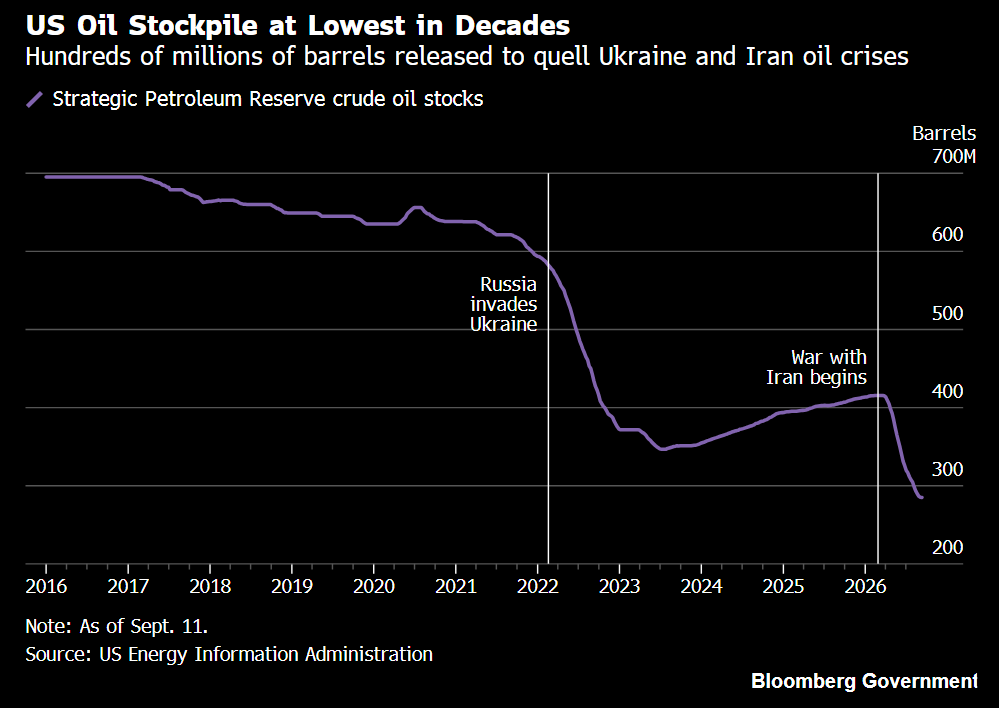
That leaves a trap inside a trap. The only way to hold the price down like this is to keep letting oil out, but the tank is nearly empty. If a shock arrives, a hurricane in the Gulf, a conflict in the Middle East, there is no cushion left. Diesel jumps first, because diesel moves freight, and the second diesel jumps everything that travels on a lorry gets dearer almost at once. They are borrowing calm from tomorrow to make today's inflation number look tidy, and tomorrow always turns up.
New Thing Number Two · The Treasury
Printing money, by another name
The US Treasury has announced it is doubling the amount of its own debt it buys back, 4 billion dollars per operation, described as liquidity support. In plain terms, the government has become a buyer of its own debt because not enough outside lenders will do it at a price the government can stomach.
Who normally buys all this? For decades it was foreign governments, China, Japan, the Gulf states, plus the big pension funds and banks, all happy to park money in US bonds. The trouble now is there is simply too much of it being issued, and some of those old buyers have quietly stepped back. So the government leans on the one buyer that never says no: itself, with money that did not exist the day before. The Fed creates new money to buy short-term bills, the Treasury uses cash to buy back long-term debt, and that buying pushes the interest rate down. New money is created at one end and comes out the other holding the government's own borrowing cost down. That is money printing, whatever it is called.
Make it real. Say you have 50,000 sitting in a savings account, being sensible. When they create new money to buy up debt like this, they do not take a penny out of your account. The number on your statement stays exactly the same. What changes is what that number buys. The new money floods in, prices drift up, and quietly your 50,000 buys you less every month. You were robbed and the receipt says nothing happened. It is the most polite theft ever invented, because the victim never sees the hand move.
That is the one number worth sitting with. During COVID the entire economy was shut down and they opened the taps as wide as they ever have. We are now doing it faster than that, with the economy supposedly fine. You do not run the emergency pump harder than the actual emergency unless you can already see something coming that the public cannot. They move early, quietly, while the headline numbers still look tidy, and count on you reading that calm as safety. By the time the reason is obvious to everyone else, the cheap window to protect your own money will already have closed.
New Thing Number Three · Where The Money Goes
Your index fund is not as spread out as you think
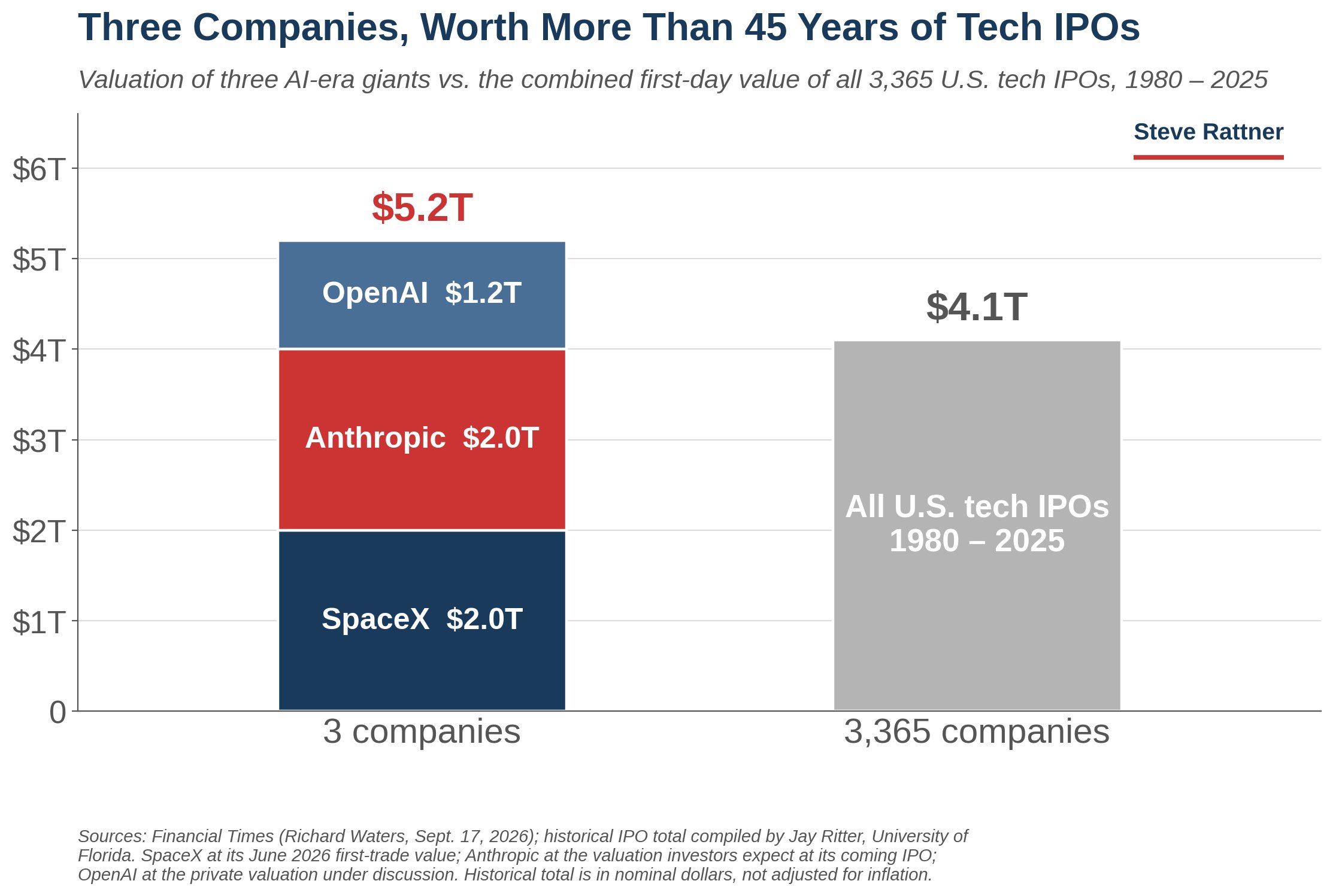
This month it was reported that SpaceX, Anthropic and OpenAI, three private companies, are worth more than every single US tech company that went public in the past 45 years combined. The biggest pile of new wealth being created right now is being built behind a door that regular investors are locked out of. So even the upside, the growth, is being funnelled to people who are already rich, before the boom has even proven itself.
And the market you can reach is more crowded than it has ever been. American households have never been more exposed to the stock market: around a quarter of total household net worth is now tied to shares, higher than the dot-com peak, higher than 2008, higher than 1929, the most on record. And it is piled into fewer names than ever. The five largest companies in the S&P 500 make up about 30 percent of the whole index. If you hold a normal index fund inside a pension, roughly a third of that money sits in just five names, all in the same corner of the same sector. That is not the safety people think an index fund gives them. It is concentration wearing a safety jacket, and it took the Nasdaq 15 years to get back to its 2000 high.
Compare it to a normal bubble. Normally, when one crowded trade cracks, the money runs somewhere safer and life carries on. This time the safer-looking corner, the index fund sitting in your pension, is the crowded trade. There is no quiet room to hide in, because nearly everyone is standing in the same room holding the same five names. So the ordinary saver gets the concentrated risk, and the insiders get the concentrated reward. That is not a market doing its job. It is a funnel, and most people are at the wrong end of it.
Line Them Up
Three headlines, or one plan
Separately these are just news. Together they are a plan. One: the oil price is being held down with a tank that is nearly empty, to keep the inflation number calm. Two: the Treasury and the Fed are creating new money to hold down the government's borrowing cost, faster than they did during COVID. Three: the biggest new fortunes are being locked up in private hands you cannot reach, while the public market you can reach is crowded into a handful of names.
Someone is working very hard to keep prices looking calm and borrowing looking cheap, right at the moment they need to print, and the gains from all that printing are being steered away from ordinary people before they even land. That is not three headlines. That is the reset, quietly switched on.
Follow The Money
What the big players are actually doing
The clearest signal is not what people say, it is what they buy. Donald Trump's latest filings show well over 600 trades. On the way in: Berkshire Hathaway, Visa and Mastercard, Tractor Supply, Home Depot, Republic Services. Card networks are a toll booth, they take a small cut of every swipe and that cut rises when prices rise, so inflation actually helps them. On the way out: Meta, Palantir, Netflix, the crowded technology names. Boring toll booths bought, hot AI sold.
Notice the pattern. It is not exciting. Card networks, waste collection, home improvement. Dull, essential businesses that keep taking their cut whether the economy is booming or on its knees, and can lift their own prices as everything else rises. Nobody brags about owning a rubbish-collection company at a dinner party. But boring is the point. Boring is what survives.
Central banks are telling the same story. They are buying gold at the fastest pace since 1997, the institutions that print money moving into the one asset that cannot be printed, because they know what comes next. The last time governments were trapped like this and chose to print their way out, in the 1970s, gold went from about 100 dollars to 850. The people who held hard assets came through it fine. The people sitting in cash, waiting for it to blow over, were quietly cleaned out. Not because they were stupid. Because they were late.
What To Do About It
Position early, on your own terms
This is not financial advice, and the point is not to copy anyone's portfolio. It is to understand the pattern and get on the right side of it while you are still early, because most people are not looking at any of this yet. The recurring theme across every episode like this one is ownership of things that hold their value when money is being printed.
- Know what you actually own. Check how much of your pension or index fund sits in the top five names before you assume you are diversified.
- Favour cash-producing, real businesses. Companies with pricing power can raise prices when inflation returns. Companies without it get squeezed.
- Understand toll-booth models. Businesses that take a small cut of activity regardless of the economy tend to hold up when prices climb.
- Learn why gold and silver behave the way they do. They cannot be printed, which is the whole reason central banks are buying them now.
- Be wary of the crowded trade. The most-owned, most-loved names are the ones with the furthest to fall if the story slips.
- Build a plan that fits your life. Your age, your timeline and your risk tolerance decide the right mix. A generic template does not.
Disclaimer
This report is educational and is not personalised financial advice. Figures are drawn from public data current at the time of writing, including EIA and Federal Reserve releases and public filings. Markets carry risk, and past patterns do not guarantee future results. Do your own research and, where appropriate, speak to a qualified professional before making decisions with your money.