
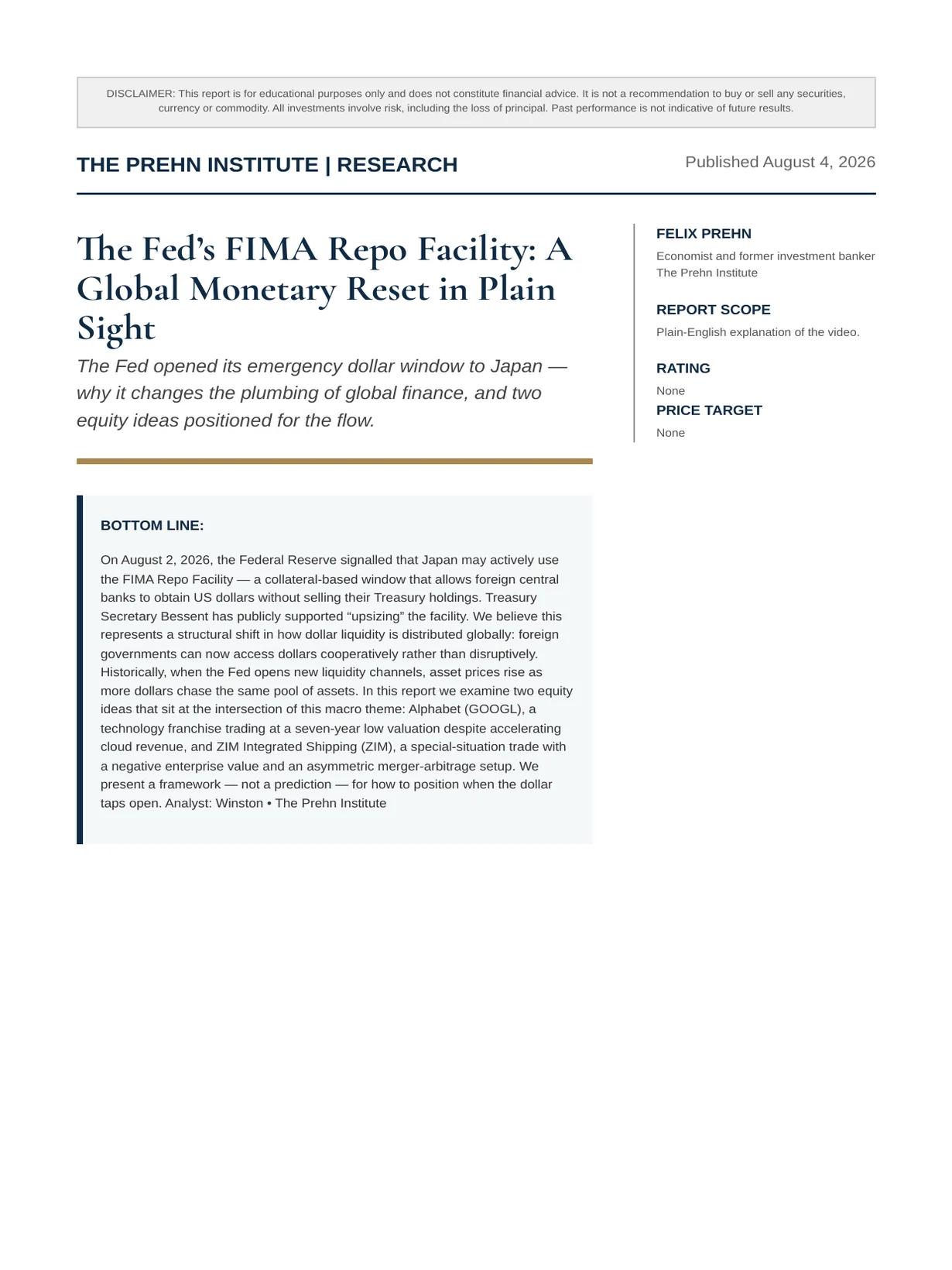
The Fed’s FIMA Repo Facility: A Global Monetary Reset in Plain Sight
The Fed opened its emergency dollar window to Japan — why it changes the plumbing of global finance, and two equity ideas positioned for the flow.
Felix Nikolas Prehn · 4 August 2026 · 18 pages
Bottom line
On August 2, 2026, the Federal Reserve signalled that Japan may actively use the FIMA Repo Facility — a collateral-based window that allows foreign central banks to obtain US dollars without selling their Treasury holdings. Treasury Secretary Bessent has publicly supported “upsizing” the facility. We believe this represents a structural shift in how dollar liquidity is distributed globally: foreign governments can now access dollars cooperatively rather than disruptively. Historically, when the Fed opens new liquidity channels, asset prices rise as more dollars chase the same pool of assets. In this report we examine two equity ideas that sit at the intersection of this macro theme: Alphabet (GOOGL), a technology franchise trading at a seven-year low valuation despite accelerating cloud revenue, and ZIM Integrated Shipping (ZIM), a special-situation trade with a negative enterprise value and an asymmetric merger-arbitrage setup. We present a framework — not a prediction — for how to position when the dollar taps open. Analyst: Winston • The Prehn Institute
Overview
1. The FIMA Repo Facility — What the Fed Just Did
2. Why This Is a “Reset” — Old World vs. New
3. The Switzerland Tell — Pattern Recognition
4. Investment Implications — Don’t Sit in Cash
5. Equity Idea #1: Alphabet (GOOGL) — Quality at a Seven-Year Low Valuation
6. Equity Idea #2: ZIM Integrated Shipping (ZIM) — Special Situation
7. ETF Alternatives for Lower-Risk Exposure
8. Framework — Three Rules
9. Risk Factors
10. Citations & Sources
1. The Fima Repo Facility — What the Fed Just Did
The Announcement. On August 2, 2026, Bloomberg reported that Japan is signalling active use of the Federal Reserve’s Foreign and International Monetary Authorities (FIMA) Repo Facility to obtain US dollars. Treasury Secretary Scott Bessent publicly endorsed this use and indicated his support for “upsizing” the facility — raising the per- counterparty daily limit to provide more dollar capacity to foreign central banks.
How It Works. The FIMA Repo Facility operates like a secured lending window. A foreign central bank — in this case, the Bank of Japan — deposits US Treasury securities as collateral with the Federal Reserve. In return, the Fed provides fresh US dollars at a rate set 25 basis points above the Interest on Reserve Balances (IORB). The trade reverses after a short period: the central bank returns the dollars, the Fed returns the Treasuries, and the Fed earns a fee. No Treasuries are sold on the open market.
Step 1: Foreign central bank (e.g., Bank of Japan) deposits US Treasuries at the Fed window as collateral.
↓
Step 2: Fed provides fresh US dollars. Rate = IORB + 25bps. Fully collateralised — zero credit risk, zero FX risk.
↓
Step 3: Trade reverses. Treasuries returned to the central bank. Fed takes no risk, earns a fee.
Why It Matters. Japan is the largest foreign holder of US government debt. When Japan needs dollars to defend the yen, it has historically sold US Treasuries — pushing US interest rates up and making America’s $40+ trillion debt pile more expensive to service. The FIMA facility gives Japan a different option: get dollars without selling, without disrupting the US bond market, and without triggering cascading rate spikes.
Timeline. The Fed established the FIMA Repo Facility on March 31, 2020 during the COVID-19 crisis as a temporary emergency measure. It was made permanent in July 2021. The current per-counterparty daily limit is approximately $60 billion.
| FIMA Repo Facility — Key Parameters | |
|---|---|
| Established | March 31, 2020 (COVID emergency) |
| Made permanent | July 2021 |
| Eligible counterparties | |
| Foreign central |
banks & monetary authorities
Collateral US Treasury securities
Rate IORB + 25 basis points
Per-counterparty daily limit
~$60 billion (Bessent proposes increasing)
Credit/FX risk to the Fed
Zero (fully collateralised in USD assets)
2. Why This Is a “Reset” — Old World Vs. New
The Old Playbook. For decades, the global financial system has operated on a simple assumption: when a foreign country needs dollars, it sells US Treasuries. That selling pushes yields up, creates volatility, and can cascade into dislocations across credit, equity, and currency markets. We saw a version of this during the August 2024 yen carry-trade unwind, when over $1 trillion in market value evaporated in approximately 40 minutes.
The New Pipe. The FIMA Repo Facility fundamentally changes this dynamic. Foreign governments can now access dollars without selling — without disrupting the Treasury market, without triggering rate spikes, and without feeding a chain reaction. The implications are structural, not temporary.
OLD: Foreign government needs dollars → sells Treasuries → pushes US rates up → crashes the bond market.
↓
NEW: Foreign government pledges Treasuries at the Fed → gets dollars → returns bonds when done → no disruption.
Who Wins. The Fed gets paid (earning IORB + 25bps) while bearing zero credit or currency risk. The Treasury Department gets a stable bond market. Japan gets dollars to defend the yen without a fire sale. The losers: speculators making leveraged bets against the yen who profit from chaos. When you change the plumbing, you change where the money flows.
3. THE SWITZERLAND TELL — PATTERN
RECOGNITION
A Precedent. This is not the first time the Federal Reserve has opened emergency dollar channels to a foreign government under stress. In March 2023, Credit Suisse — a 167-year-old institution and one of Europe’s most important banks — was collapsing.
The Joint Statement. On March 19, 2023, the Federal Reserve, along with five other central banks — the Bank of Canada, the Bank of England, the Bank of Japan, the European Central Bank, and the Swiss National Bank — issued a coordinated statement: “Coordinated central bank action to enhance the provision of US dollar liquidity.” They moved their dollar swap operations from weekly to daily, commencing the very next morning.
The Timing. That same weekend, the Swiss government forced Credit Suisse into a shotgun acquisition by UBS. The language was calm and technical. The timing told the real story.
Important distinction: The 2023 mechanism was swap lines (direct currency swaps between central banks). The 2026 mechanism is the FIMA Repo Facility (collateral-based lending window). Different tool. Same pattern: when the Fed opens dollar taps to a foreign government, something is cracking, and they are trying to keep it from spreading.
The Signal. We observe two signals when the Fed opens emergency dollar channels: (1) something is under enough stress to require new plumbing — you don’t build emergency pipes when everything is fine; and (2) more liquidity is coming. More dollars flowing into the system has historically correlated with rising asset prices, because more dollars are chasing the same pool of assets.
4. INVESTMENT IMPLICATIONS — DON’T
SIT IN CASH
Cash Is the Vulnerable Asset. Every time the Federal Reserve opens a new liquidity channel — every time it invents a new facility to pump dollars into the system — asset prices tend to rise. Not because the underlying businesses are suddenly worth more, but because there are more dollars chasing them. Cash, in this environment, is the asset that gets quietly diluted — the ice cube on a warm counter.
Follow the Institutional Flows. The institutional approach to positioning around new liquidity channels is to identify names that are already attracting accumulation. When a stock is trading above its key moving averages — the 5-day, 20-day, and 50-day — it indicates that the larger participants in the market are building positions rather than distributing them.
We present two equity ideas that sit at the intersection of this macro theme: one represents quality at an extreme valuation discount (Alphabet), and the other represents a textbook special-situation trade with asymmetric risk/reward (ZIM Integrated Shipping).
Seven-year
The Thesis. Alphabet, the parent company of Google, is trading at a price-to-earnings ratio of approximately 19x — its cheapest valuation since 2019 (when the trailing P/E was approximately 17–18x). We believe this presents a compelling risk/reward setup for a franchise that is experiencing its strongest revenue growth in years, driven by an AI-accelerated cloud business with over half a trillion dollars in contracted backlog.
Quality Assessment: Felix’s “How to Pick Great Stocks” Framework
| Criterion | Assessment |
|---|---|
| Is the business profitable? |
Gross Margin
Alphabet maintains gross margins above 55%, reflecting the inherent scalability of its advertising and cloud platforms. This is indicative of a wide moat and strong pricing power.
Operating Margin
Operating margins have expanded as cloud losses narrow and advertising revenue scales. This demonstrates effective cost control at massive scale.
ROCE
Return on capital employed remains strong, reflecting management’s ability to deploy capital effectively across search, cloud, and AI infrastructure.
Is it generating cash?
Cash Conversion
Alphabet converts earnings into cash at a high rate. The advertising business, in particular, generates cash with minimal incremental capital expenditure beyond infrastructure.
| Leveraged Free Cash Flow Margin | Despite large capital expenditures related to AI infrastructure and data centres, leveraged free cash flow remains positive and substantial, given the scale of revenues ($350B+ annualised). |
|---|---|
| Is it financially stable? | |
| Leverage | Alphabet carries minimal debt relative to its cash position and earnings power. The balance sheet is one of the strongest in the S&P 500. |
| Interest Cover | |
| Not a material concern given the near-zero net | |
| debt position. Interest expenses are comfortably | |
| covered many times over. | |
| Valuation |
P/E Ratio
~19x trailing — cheapest since 2019 (~17–18x). Seven years of accelerating growth at a lower multiple.
| EPS Growth Consistency | Earnings per share have grown consistently, with acceleration in the most recent quarters driven by cloud and AI. |
|---|---|
| Moat | |
| Competitive Advantage | Multiple moats: (1) Size advantage — Google Search handles 90%+ of global queries. (2) High switching costs — enterprise customers deeply integrated into Google Cloud. (3) Brand — one of the most recognised globally. (4) Data advantage — more search data than any competitor, training better AI models. (5) Patents & tech leadership in AI (Gemini, DeepMind). |
Key Financial Metrics
- ~19x
- P/E Ratio (7-year low)
- +24%
- Total Revenue Growth y/y
- +82%
- Cloud Revenue Growth y/y
$514B
Contracted Cloud Backlog
The AI Capex Reframe. A persistent market concern has been Google’s rising capital expenditure on AI infrastructure. We believe the $15 billion data-centre deal with Anthropic in Texas materially changes this narrative. This deal reframes AI capex as pre-sold demand rather than speculative spending. Customers are committing to long-term contracts before the infrastructure is even built.
Cloud Momentum. Google Cloud revenue grew over 82% year-over-year in Q2 2026. The contracted backlog of $514 billion represents revenue that customers have signed legally binding agreements for — providing significant visibility into future earnings. This is not hope. It is contractual commitment.
Valuation Disconnect. Seven years of compounding — cloud scaling from a loss-making division to a multi-billion- dollar profit centre, AI leadership via DeepMind and Gemini, advertising revenue growing 24% year-over-year — and the stock is cheaper on a P/E basis than it was in 2019. We believe the market is mispricing the structural improvement in Alphabet’s business quality.
Winston App Data: Readers can verify Alphabet’s current valuation, moat analysis, and momentum signals on the free Winston app at
6. EQUITY IDEA #2: ZIM INTEGRATED
SHIPPING (ZIM) — SPECIAL SITUATION
The Setup. ZIM Integrated Shipping is a textbook special- situation trade — the kind of asymmetric opportunity that investment bankers and event-driven hedge funds spend their careers hunting for. The company is a container shipping operator with the youngest and most fuel-efficient fleet among major carriers, the highest sensitivity to spot freight rates, and — as of this writing — a negative enterprise value.
Quality Assessment: Felix’s Framework Applied to a Cyclical Special Situation
| Criterion | Assessment |
|---|---|
| Is the business profitable? |
Gross Margin
ZIM’s gross margin is highly sensitive to freight rate cycles. At current elevated spot rates, margins are strong and expanding. The youngest fleet in the industry provides a structural cost advantage in fuel consumption and maintenance.
Operating Margin
Operating margins are currently elevated due to the freight-rate supply squeeze (Red Sea diversions + port congestion + growing trade volumes). At current rates, the company is estimated to earn approximately $0.70–$0.80 per share per week.
ROCE
Strong at current freight rates. The key question is sustainability through the rate cycle, which we address under risk factors.
Is it generating cash?
Cash Conversion
Excellent. ~$600 million in cash from operations generated year-to-date, on a market capitalisation of ~$3 billion.
| Free Cash Flow | Strong positive free cash flow given the asset-light charter model. ZIM charters many of its vessels rather than owning them outright, which reduces capital intensity relative to peers. |
|---|---|
| Is it financially stable? | |
| Leverage | Balance sheet is unusually strong for a shipping company. Cash of ~$2.6 billion against a ~$3 billion market cap. |
| Cash Cover | |
| Approximately 92% of the market capitalisation is | |
| backed by cash on the balance sheet. This | |
| provides a significant cushion against downside. | |
| Valuation |
Enterprise Value
Approximately negative $200 million. The market is valuing the operating business — the ships, routes, customers, contracts — at a negative number. Investors are effectively being paid to own the fleet.
Dividend Yield
~7.6% at current levels. ZIM has a variable dividend policy tied to earnings.
The Negative Enterprise Value
Enterprise value equals market capitalisation minus cash (simplified). With a market cap of ~$3 billion and ~$2.6 billion in cash (plus significant operating cash flow), ZIM’s enterprise value is approximately negative $200 million.
~$3.0B
Market Cap
~$2.6B
Cash on Balance Sheet
~−$200M
Enterprise Value
~$600M
Cash from Ops YTD
In plain language: if you bought every share of ZIM at the current market price, you would receive more cash than you paid. The market is pricing the entire operating business — fleet, routes, contracts, brand — at a negative value. This is rare and typically indicates a mispricing, a market belief that current earnings are unsustainable, or a combination of both.
The Merger-Arbitrage Angle
The Offer. Hapag-Lloyd, one of the world’s largest container shipping companies, has made a cash offer of $35 per share for ZIM. At a recent share price of approximately $26, this represents roughly 35% upside in cash if the deal completes.
The Status. The deal is currently considered “practically dead” due to political opposition. The Israeli government holds a golden share in ZIM that allows it to block foreign takeovers, and there has been significant political resistance to a foreign acquisition of what is considered a strategic national asset.
The Asymmetry. This is a classic “heads I win, tails I don’t lose much” setup:
If the deal revives: $35/share in cash. ~35% upside from current levels.
If the deal stays dead: You own a company at a negative enterprise value, generating substantial cash, with the youngest fleet in the industry and a ~7.6% dividend yield. The cash on the balance sheet covers 92% of the market cap.
The Macro Tailwind: Why Freight Rates Are
Surging
Three structural factors are tightening the container shipping market:
| Driver | Impact |
|---|---|
| Red Sea / Suez diversions | Ships rerouted around Africa, adding weeks to voyages. Removes ~8–10% of effective global container capacity overnight. |
| Port congestion | |
| Ports worldwide are overwhelmed by the | |
| rerouting and volume growth, creating further | |
| delays and capacity absorption. | |
| Global |
trade growth
Trade volumes growing ~5% year-over-year. More goods, fewer effective ship-weeks, longer routes.
ZIM is uniquely positioned to benefit: it has the youngest, most fuel-efficient fleet among major carriers and the highest sensitivity to spot freight rates. Peers Hapag-Lloyd and Maersk have both raised their forward outlooks by approximately 7%, validating the strength of the rate environment.
7. ETF Alternatives for Lower-risk
EXPOSURE
For investors who prefer diversified exposure to the themes discussed in this report without concentrating in individual names, we identify the following sector and thematic ETFs as relevant:
| Theme | ETF | Ticker | Rationale |
|---|---|---|---|
| Technology / AI / Cloud | Vanguard Information Technology ETF | VGT | Broad exposure to US tech including Alphabet. Low expense ratio. Captures the cloud and AI capex cycle across the sector. |
| More focused on iShares software and cloud- Expanded IGV native companies. Tech-Software Captures the enterprise Sector ETF AI adoption trend. | |||
| Global Shipping / Maritime | SonicShares Global Shipping ETF | BOAT | Diversified exposure to global container, dry bulk, and tanker shipping. Includes ZIM among holdings. |
| Freight-rate-sensitive. Provides exposure to Breakwave Dry the supply squeeze Bulk Shipping BDRY theme without single- ETF stock concentration risk. | |||
| US Dollar / Macro Hedge | Invesco DB US Dollar Index Bullish Fund | UUP | For investors who believe the FIMA facility strengthens dollar liquidity channels and supports the dollar’s role as the global reserve currency. |
| Note: ETF selection is illustrative. We encourage readers to | |||
| verify holdings, expense ratios, and liquidity on the Winston | |||
| app or their preferred data source before acting. |
8. Framework — Three Rules
We close with the framework that connects the macro thesis to the equity ideas presented in this report. This is not a prediction. It is a repeatable process for positioning when the dollar taps open.
Rule 1: Don’t sit in cash. Cash gets diluted when the Fed opens new liquidity channels. It is the asset most vulnerable to the debasement that follows expanded dollar flows.
↓
Rule 2: Follow the money. Identify where institutional flows are accumulating. When a stock is trading above its key moving averages, it signals that larger participants are building positions rather than distributing them.
↓
Rule 3: Own the asymmetry. Seek trades where the downside is protected and the upside is open. Alphabet at a seven-year low P/E with accelerating cloud growth. ZIM at a negative enterprise value with merger optionality.
“Predictions are guesses. Frameworks are repeatable.”
9. RISK FACTORS
All investments carry risk. We highlight the following specific risks relevant to the thesis and equity ideas presented in this report:
Macro / FIMA Facility Risks
Facility underuse or withdrawal: Japan or the Fed could scale back FIMA utilisation if the yen stabilises independently. This would reduce the expected liquidity expansion.
Inflation reignition: Expanded dollar liquidity could contribute to inflationary pressures, forcing the Fed to tighten through other channels and offsetting the accommodative signal.
Geopolitical escalation: The yen carry-trade dynamic and Japan’s Treasury holdings create a web of interdependencies. A sharp deterioration in US-Japan relations could destabilise these cooperative mechanisms.
Speculative positioning: Leveraged speculators may attempt to front-run the facility, creating short-term volatility that obscures the underlying structural shift.
Alphabet (GOOGL) Risks
Regulatory risk: Alphabet faces ongoing antitrust proceedings in multiple jurisdictions. A forced divestiture or structural remedies could impair the moat.
AI capex returns: If the $15B Anthropic deal and broader AI infrastructure spend do not generate adequate returns, margins could contract.
Search disruption: AI-native search competitors (e.g., Perplexity, OpenAI) could erode Google’s core search advertising revenue over time.
Macro sensitivity: Advertising revenue is cyclically sensitive. A global downturn could compress the multiple further before it expands.
ZIM Integrated Shipping (ZIM) Risks
Freight rate cyclicality: Shipping is deeply cyclical. If Red Sea tensions ease, Suez transits normalise, and port congestion clears, spot rates could collapse, severely impacting earnings and the dividend.
Deal optionality may be zero: If the Hapag-Lloyd deal is permanently dead and no other acquirer emerges, the merger-arbitrage premium disappears entirely.
Cash deployment risk: ZIM’s substantial cash position could be deployed into value-destructive acquisitions or fleet expansion at cycle-peak rates.
Israeli political risk: The golden share mechanism introduces sovereign political risk that is difficult to model or hedge.
Seasonal and charter risk: ZIM charters many vessels rather than owning them. Charter rates can spike during tight markets, compressing margins if spot freight rates normalise before charters roll off.
FREE LIVE SEMINAR FOR BEGINNERS
If you want to learn how to read where the big money is moving — how to spot breakouts, understand valuations, and make your own informed decisions — this free seminar is built for you.
fasttrackforbeginners.com
This Saturday • 9am Eastern • Completely Free • No Credit Card