
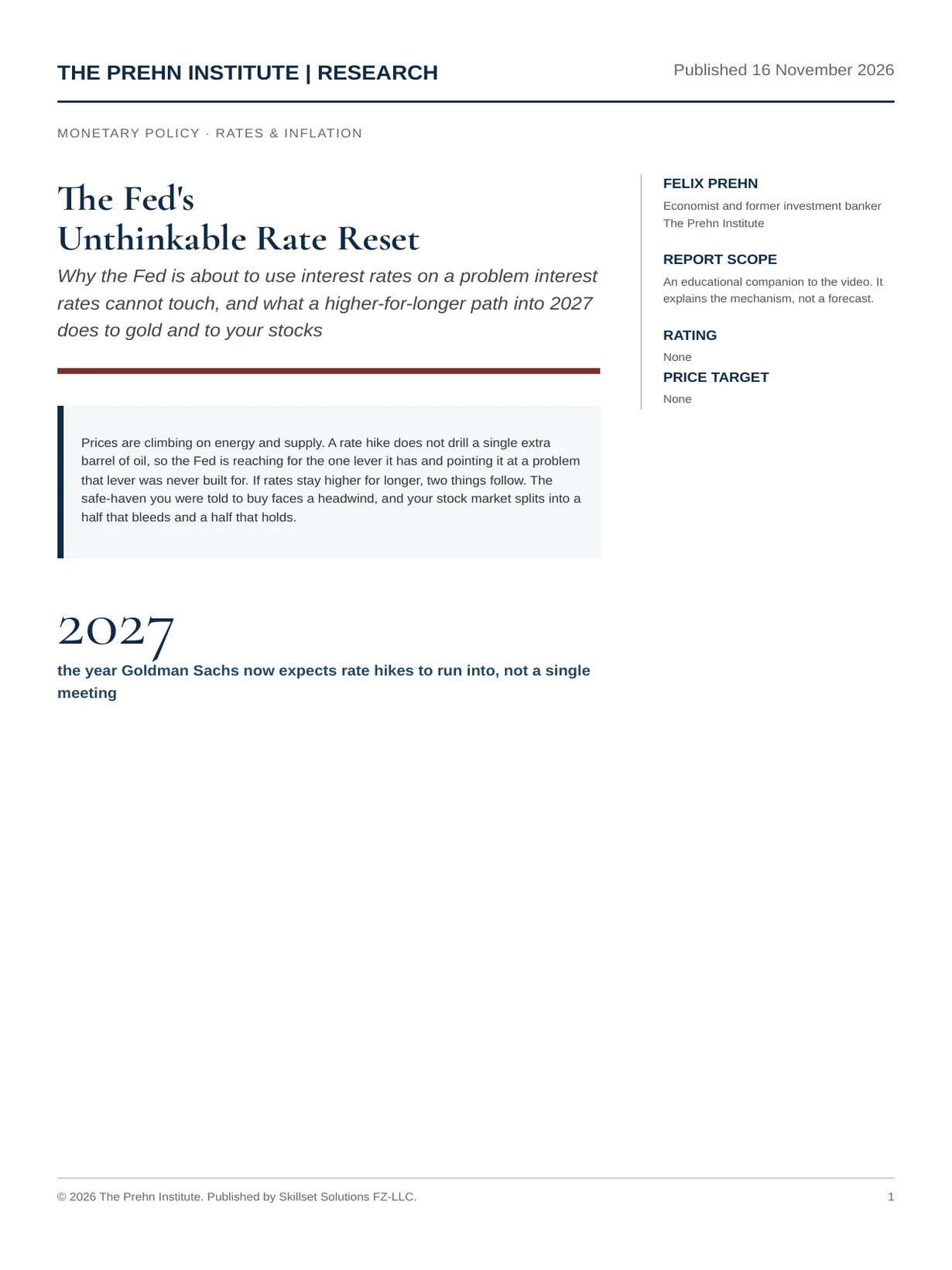
The Fed's Unthinkable Rate Reset
Why the Fed is about to use interest rates on a problem interest rates cannot touch, and what a higher-for-longer path into 2027 does to gold and to your stocks
Felix Nikolas Prehn · 16 November 2026 · 13 pages
Bottom line
Prices are climbing on energy and supply. A rate hike does not drill a single extra barrel of oil, so the Fed is reaching for the one lever it has and pointing it at a problem that lever was never built for. If rates stay higher for longer, two things follow. The safe-haven you were told to buy faces a headwind, and your stock market splits into a half that bleeds and a half that holds.
2027the year Goldman Sachs now expects rate hikes to run into, not a single meeting
Bottom Line
One wrong tool, two effects on your money
Bottom line. The inflation in these numbers is coming largely from energy and supply. Rates cool demand. They do nothing to supply. So the Fed is using the wrong tool, it knows it, and it looks set to keep using it into 2027.
- A hot inflation print, mostly energy and supply
- The Fed hikes anyway, and signals higher for longer
- Gold loses its edge, and your stocks split in two
The trigger
The number lied to you. A hot print landed, and the news called it the Fed getting tough. But open it up and a big part of it is oil and the cost of moving things around. And no rate on Earth fixes that.
The first effect
Gold faces a headwind, for now. When cash and bonds start paying you again, a metal that pays nothing has a real cost to hold. And a firmer dollar leans on it too. So the safe-haven stumbles in the exact week it should shine.
The second effect
Your market splits clean in two. A stock is the cash it will hand you over its life. Higher rates mark down cash that arrives far in the future. So the far-off growth names bleed, and the pays-you-now names hold.
The lesson
Ask one question, not a hundred. When does this actually pay me? Now, in real earnings, or years out on a promise? That one question tells you which half of your portfolio is most exposed to the meeting coming this December.
The First Thing To Understand
The wrong tool for the job
What actually happened
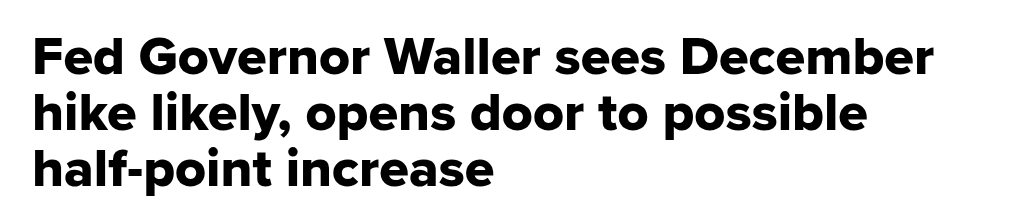
A governor raised the stakes, then the data obliged. Waller said that if inflation ran hot again, the Fed should not do a gentle quarter point, it should go for a half.
And almost on cue, core inflation landed at 0.3% for the third month running. Headline came in at 0.4%. Two-year Treasury yields then jumped the most since April 2025.
The bit nobody says out loud
What inflation are we even talking about? Open the number up and a huge slice of it is energy and supply. It is oil. It is the cost of moving things around. It is stuff coming out of the ground and off a lorry.
Why rates are the wrong lever
A rate is a tool for cooling demand. You make borrowing dearer, so people buy fewer houses and fewer cars, and firms hire a little less. That is the whole mechanism.
And it does nothing to supply. A higher rate does not drill one more barrel, it does not train one more lorry driver, it does not unblock one port.
It has a name
This is cost-push inflation, a supply shock. And rates are the wrong tool for it. It is like turning the thermostat down to fix a leaking roof.
You can fiddle with the dial all day. The roof still leaks.
The Credibility Anchor
Goldman sees hikes running into 2027

This is not a doom channel talking
Goldman Sachs are on the record. They now expect three quarter-point hikes, December 2026 and then into 2027, with the base case around March. So not one hike. A run of them.
And they are clear on why
Energy, again. A big piece of their case is the Middle East feeding straight through into prices. So this is not really about one meeting. It is a direction of travel that could last years, pointed the wrong way at the wrong problem.
Where the path is meant to end
A terminal rate near 4.25% to 4.50%. And the first cut not pencilled in until December 2027.
That is the detail that matters. That gap, hikes now and cuts much later, is the part that matters most for your money.
Why it changes the stakes
Higher for longer is a regime, not a scare. A one-off hike you can wait out. A multi-year direction you have to position for. And that is the difference between a headline and a plan.
- 3
- quarter-point hikes Goldman now expects this cycle
- 4.25% to 4.50%
- terminal rate in their base case
- Dec 2027
- before the first cut, on their path
What Higher For Longer Really Means
The same house, 600 dollars more a month

This is not abstract
About 186,000 households, one year, one shock. These are adjustable mortgages that reset in 2027. And when they do, the typical payment climbs by more than 600 dollars a month. On the same house they already own.
Nothing about the house changed
The rate changed. Not the bricks, not the roof, not the family inside it. Just the number on the loan. And that is the whole game in one example.
Why it lands here first
Higher for longer stops being a headline. For these people it is 600 dollars, gone, every single month. So when you hear a governor talk about a half point at a conference, this is where it actually arrives.
The deeper cohort
For some, the jump is far worse. The 2020 seven-year cohort, roughly 74,000 loans, faces a median rise closer to 1,066 dollars a month. Same mechanism. Bigger bill.
- 186,000
- adjustable mortgages resetting in 2027
- +$645
- median monthly rise, about 24%
- +$1,066
- median rise for the 2020 seven-year cohort
The First Surprise
The safe-haven that stumbles in a crisis week
Bottom line. Gold is used here only to teach the mechanism. It is never a buy call, and there is no price target, because anyone handing you a gold number for next year is guessing. The point is the lever behind the move: real yields and the dollar.
Why it is usually safe
Gold pays you nothing, and that is fine when nothing else pays either. It is a lump of metal in a vault. No dividend, no interest. So when your savings account pays basically zero, holding gold costs you nothing. You are not missing out.
What a hawkish Fed changes
Two things turn against it at once. Cash and bonds start paying you to sit and wait. So now holding a metal that pays nothing has a real cost, every month you give up the interest you could have had.
The term is opportunity cost. In plain English, the boring safe stuff pays you and gold still does not.
The dollar does the rest
Higher rates tend to pull money into the dollar. And because gold is priced in dollars, when the dollar goes one way, gold tends to get shoved the other. The link is almost mechanical.
Keep two timescales apart
Short run and long run are different arguments. For now, rising rates lean on gold. The longer case, the debt and the money printing, is still there.
But that is a separate conversation, and mixing the two is how people get caught.
The Big One
Why the same rate rise helps one half and hurts the other
Start with what a stock is
A stock is the cash it will hand you over its life. All the future cash, added up. That is what you are buying. Nothing more romantic than that.
The bit that matters this week
Future cash is worth less today when rates rise. A pound in your hand in ten years is worth less than a pound this year. And the higher rates go, the bigger that gap gets. It is just maths. It is called discounting. And the Fed is turning that dial right now.
So the market splits
Growth names keep their reward far out in the future. The story is always, never mind the profits now, the payoff is years away. So almost all their value sits way out there.
And what happens to far-off cash when rates rise? It gets marked down hardest. So they bleed the most, not because the business got worse this week, but because the maths on the promise did.
And the other half shrugs
Profitable names hand you real cash now. This year, out of real earnings. A lot of their value is close in, not way out.
So when the Fed turns the dial they barely flinch. And many can pass higher costs straight on to their customers anyway.
- A stock is its future cash
- Higher rates mark down cash that arrives later
- Far-off growth bleeds, pays-you-now holds
What To Do, Not Just What To Fear
What holds up now, and what to buy cheap later
Move one, own what gets paid
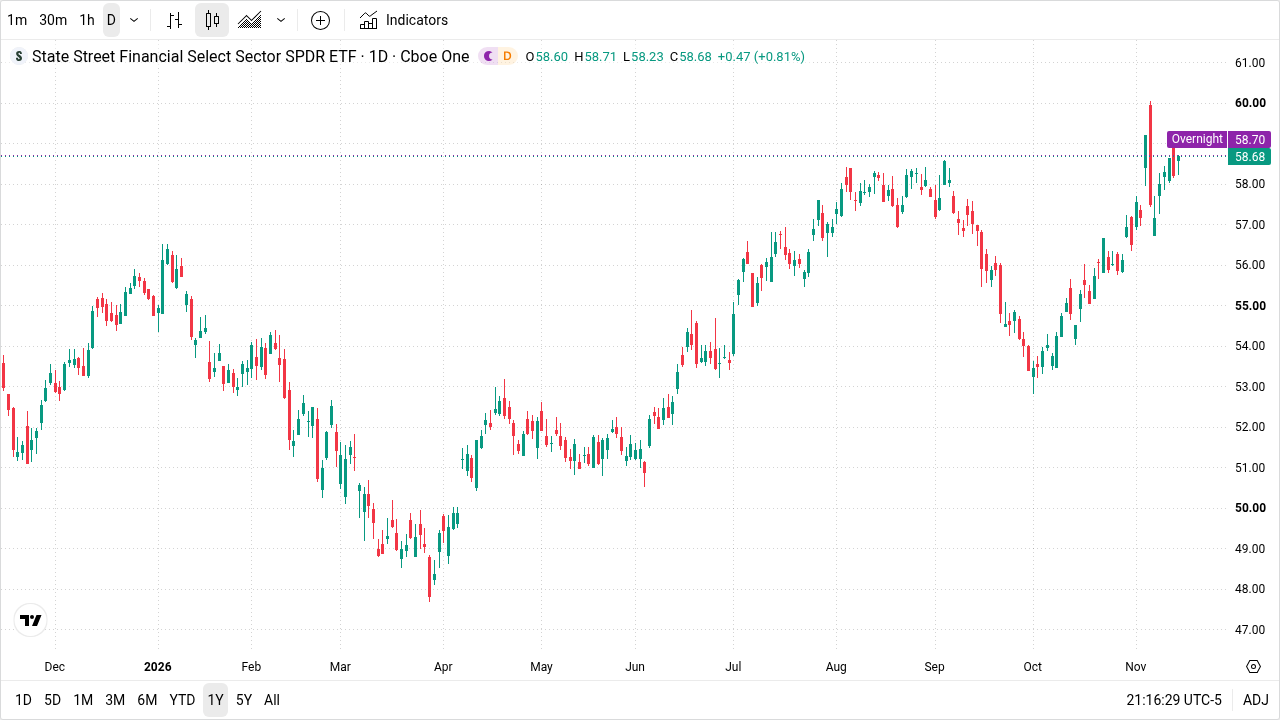
Find the businesses rising rates reward, not punish. Think about the banks and financials, because many of them earn more when rates are higher. That is their bread and butter. Think about energy, because energy is the actual source of this inflation, so the thing causing the problem often does well out of it. And think about the dull, solid firms that hand you cash every month, the kind of business that literally picks up the rubbish and gets paid for it.
This is how to think, not what to buy
No shopping list here. The names above are illustrations of a type, a pays-you-now business, not a recommendation. The skill is spotting the type yourself, and then finding your own.
Move two, the one few have the stomach for
Rates do not rise forever. They never have, and the cuts always come after. Goldman themselves pencil the first cut in further down the line. So the time to buy the beaten-down, rate-sensitive names is while everyone else is terrified of them.
But be careful which ones
Quality growth, not rubbish. The good long-duration companies, the ones whose payoff sits far in the future, getting marked down today purely on that discounting maths, those are the ones that recover. Not the names with no earnings, because that stuff can keep going to zero. And telling the two apart is the whole skill.
- Banks
- often earn more as rates rise
- Energy
- the source of the inflation, and a beneficiary
- Cash now
- dull firms that pay you every month
A Plan, Not A Panic
When does this pay me?
Where this leaves you
The Fed is reaching for a tool that cannot fix the real problem. And because it looks set to keep doing it into 2027, it leans on the very thing you were told was safe, and it splits your stocks into a half that bleeds and a half that holds.
But you are not just watching anymore
You have the one question. You can look at your own account tonight and ask it. When does this pay me? And then you know which half you are holding, which half to buy cheap before the cuts come, and why.
So here is tonight's task
Go and look at your portfolio. Hold each thing up to that one question. Now, in real earnings, or a promise years out? That is the whole exercise, and most people never do it.