
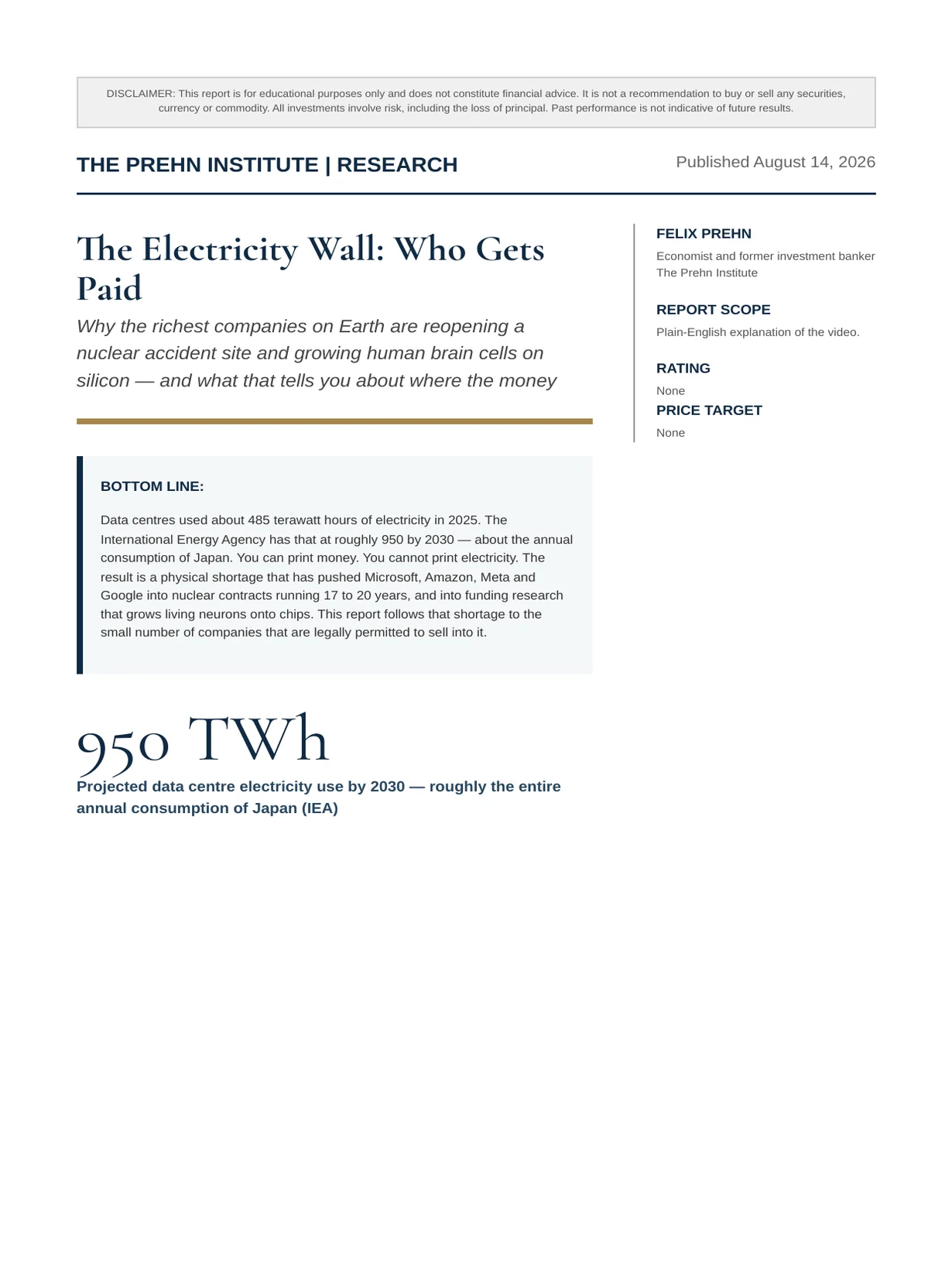
The Electricity Wall: Who Gets Paid
Why the richest companies on Earth are reopening a nuclear accident site and growing human brain cells on silicon — and what that tells you about where the money
Felix Nikolas Prehn · 14 August 2026 · 24 pages
Bottom line
Data centres used about 485 terawatt hours of electricity in 2025. The International Energy Agency has that at roughly 950 by 2030 — about the annual consumption of Japan. You can print money. You cannot print electricity. The result is a physical shortage that has pushed Microsoft, Amazon, Meta and Google into nuclear contracts running 17 to 20 years, and into funding research that grows living neurons onto chips. This report follows that shortage to the small number of companies that are legally permitted to sell into it.
950 TWhProjected data centre electricity use by 2030 — roughly the entire annual consumption of Japan (IEA)
Bottom Line
Desperation is information
BOTTOM LINE:
The 4 richest companies in history are running out of electricity. Their response has been to sign 17 and 20-year nuclear contracts, reopen the site of the worst nuclear accident in American history, and fund laboratories growing human neurons onto silicon. Nobody does any of that for a problem they expect to solve next year. The shortage is real, it is enormous, and by the length of the contracts being signed, it lasts for decades.
20 W
A human brain
100 kW
One AI server rack
750 MW
One new AI data centre
THE PROBLEM
AI demand is roughly doubling every 2 years. A gas turbine has a waiting list measured in years. A new nuclear plant takes a decade. Those speeds do not match, and the gap between them is the whole story.
THE EVIDENCE IT IS ALREADY BINDING
Gartner expects power shortages to restrict 40% of AI data centres by 2027. Of roughly 12 gigawatts of American AI capacity announced for this year, only around 5 is actually under construction. The rest is queuing, mostly for power.
THE PRICE SIGNAL
PJM capacity prices went from $28.92 to $333.44 per
megawatt-day in about 2 years. That is roughly 11 times, and it hit the regulator's price cap 3 auctions running. Markets only do that when something is physically scarce.
WHO GETS PAID
A very short list. Most American nuclear plants sit inside regulated utilities and cannot sell power privately. A handful sit in deregulated markets and can. 3 companies own a meaningful fleet of those: Constellation, Vistra and Talen. Behind them sit the toll collectors — the turbine, transformer, grid and cooling suppliers who get paid whichever technology wins.
THE CATCH
The market is not asleep. All 3 names have already moved a long way. All 3 are also 20–33% below their own 52-week highs as this is written. A stock that has run is not the same thing as a stock that is expensive, and telling those apart is the actual work.
Melbourne, Australia
A computer that spends its afternoons playing Doom
What it is. Cortical Labs, a company in Melbourne, sells a machine called the CL1. Inside it are roughly 200,000 living human neurons, grown in a lab from human skin cells, kept in a nutrient bath and wired directly onto a silicon chip. It is a commercial product, not a thought experiment.
What it did. An independent developer, Sean Cole, connected the neurons to a Doom-engine game called Freedom. Nobody programmed the cells to play. They were given the game and a reward signal, and worked the rest out. It took about a week.
This is not the first time. In 2022 the same team ran a system called DishBrain — around 800,000 neurons that learned to play Pong. The Doom result matters because it happened on a product anyone can buy time on, not on a one-off rig in a research lab.
Why anyone would bother. Biological neurons compute at a power budget nothing built from silicon has come close to. Your brain runs on about 20 watts. Your fridge uses about 400. That gap is why serious money is being pointed at wet, living hardware.
THE NUMBER THAT FRAMES EVERYTHING
The whole biocomputing field, added together, has raised less money than a single large electricity contract costs
one hyperscaler for one year. Cortical Labs itself has raised about $11.56 million in its entire existence. Not billion. Million.
So the freak show is worth millions. The problem it is trying
to solve is worth trillions. The brain in the dish is not the trade. It is the signal flare that tells you how bad the underlying shortage has become.
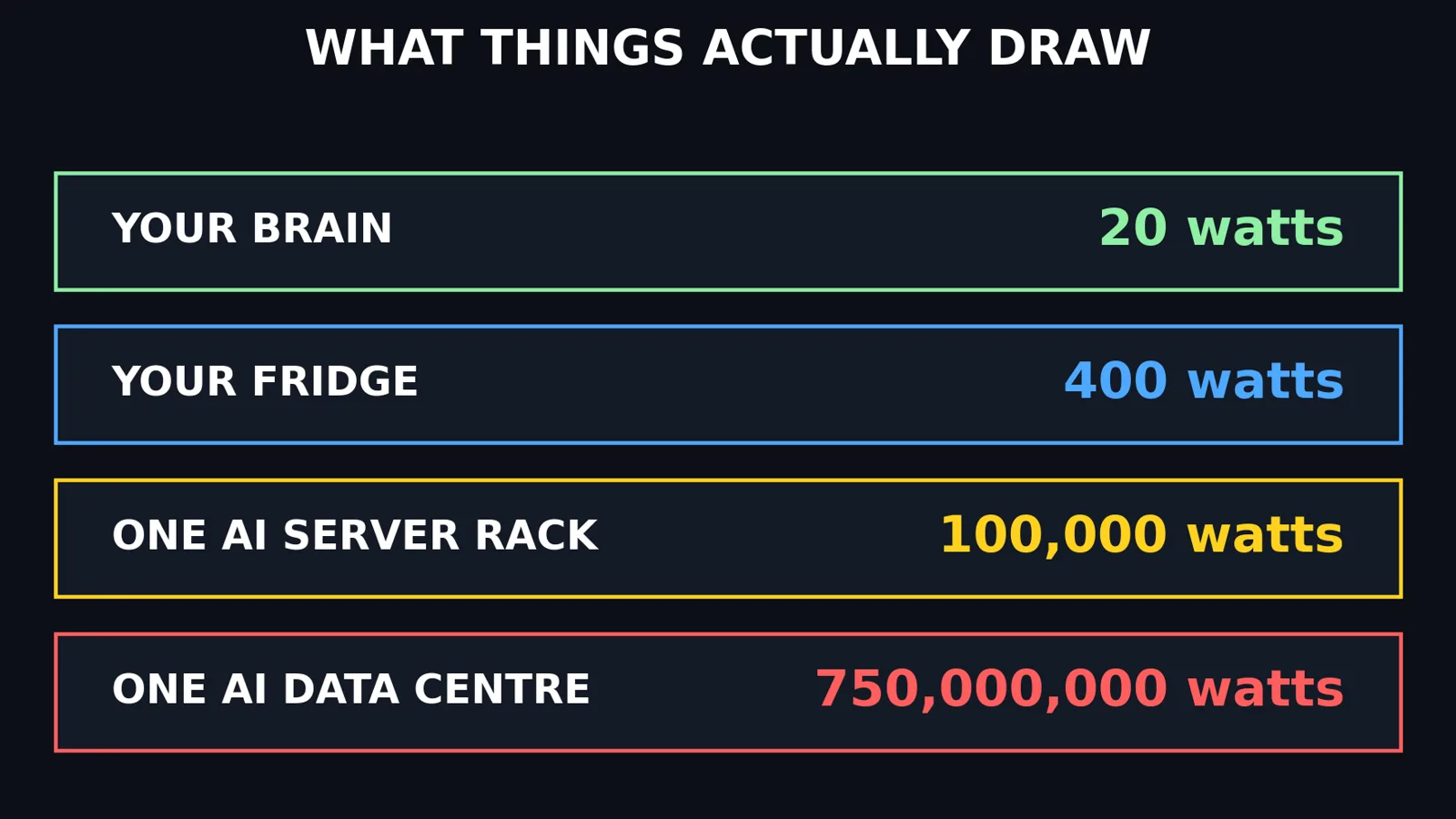
Power draw, like for like. The human brain is the most efficient computer anybody has ever measured, and nothing manufactured has come close to it.
First Question
No, you cannot buy the brain computer
company
BOTTOM LINE:
Cortical Labs is private. There is no ticker. Total money raised across its entire existence is about $11.56 million — less than a nice house in central London. Even if it listed tomorrow, whether biological computing works at commercial scale is genuinely unknown, and the honest timeline is a decade or more. If somebody in a comment section offers you a biocomputing ticker, check what you are actually being sold.
WHAT TO DO WITH A SIGNAL YOU CANNOT
BUY
Read it, do not chase it. The value of the Melbourne machine to an investor is not the shares. It is the information. It tells you that companies with effectively unlimited capital have exhausted the sensible options and are working through the strange ones.
Follow the constraint, not the novelty. Every technology cycle produces one photogenic thing and one boring thing. The photogenic thing gets the coverage. The boring thing — in this case, generating and moving electrons — gets the cash flows.
THE PIVOT
The rest of this report ignores biocomputing entirely. It follows the shortage instead: how big it is, what it is already doing to prices, and the small number of companies that are legally allowed to sell into it.
A note on lottery tickets.
There is nothing wrong with owning a speculative position, as long as you have called it what it is and sized it so that a total loss changes nothing about your life. The mistake is not buying a lottery ticket. The mistake is telling yourself it is an investment.
The Numbers
You can print money. You cannot print
electricity.
Scale Draw What that is equivalent to
Human brain ~20 watts Less than the bulb over a kitchen table
Domestic fridge ~400 watts 20 brains
One AI server rack up to 100,000 watts A couple of hundred homes, from one cabinet
One new AI data centre 750 megawatts A small city, in one building
Data centres, 2025 ~485 TWh More than most countries use in a year
Data centres, 2030 (IEA) ~950 TWh Roughly all of Japan — 120 million people
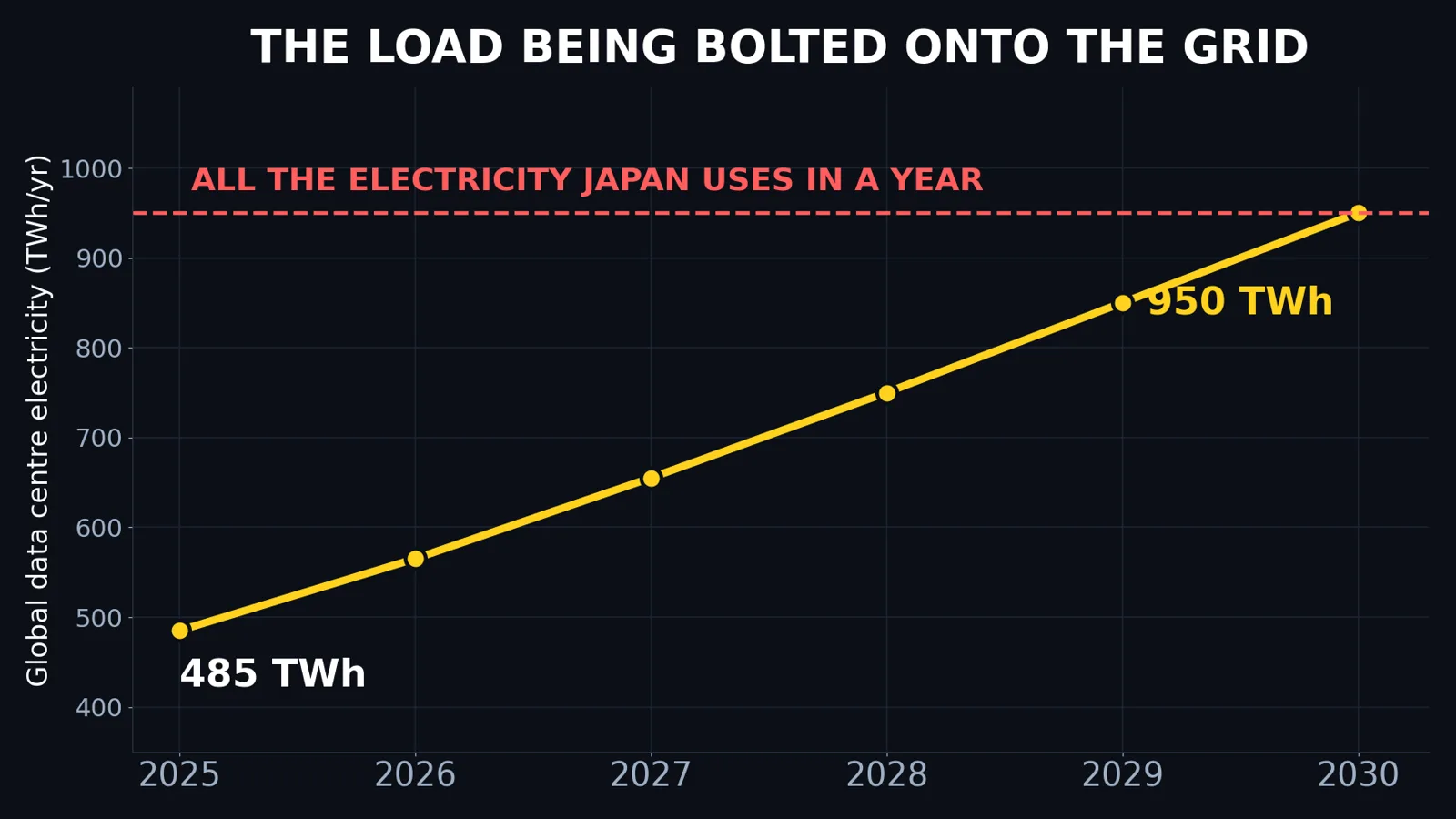
Data centre electricity consumption, 2025 actual against the IEA's 2030 base case. The additional load is comparable to adding a country the size of Japan to the world's grids.
A doubling in 5 years. That is the headline, but the timing underneath it is the real problem. AI compute demand is roughly doubling every 2 years. New generation does not arrive at that speed and never has.
The mismatch, in build times. A large gas turbine has a delivery queue measured in years. A new nuclear plant takes a decade if nothing goes wrong, and something usually goes wrong. Grid connections and transformers have their own multi- year queues on top.
Speed Mismatch
2 clocks that do not match
AI Demand
doubles in ~2 years
≠
Gas Turbine
queue measured in years
≠
New Nuclear
~10 years, minimum
WHY EFFICIENCY DOES NOT RESCUE YOU
Every gain gets eaten. Chips get more efficient every generation, and every generation total consumption goes up anyway. Cheaper inference means more inference. This is a very old pattern in industry, and it has never once produced a net reduction in demand during a boom.
WHY THIS IS NOT A FORECAST
The constraint is already visible in construction data. Roughly 12 gigawatts of American AI capacity was announced for this year. Only around 5 gigawatts is actually under construction. The difference is not shyness about spending. It is a queue.
WHAT A STALLED DATA CENTRE ACTUALLY
IS
A very expensive empty building. Hundreds of billions of dollars a year is being committed to structures that cannot switch on without a firm power supply. That is the pressure that produced everything in the next 4 pages.
The one-line version.
Money is abundant. Electrons are not. When one input to a boom becomes physically scarce, the owner of that input gets to set the price. That is the entire investment case, and it fits on a napkin.
Already Happening
The money is already parked and
waiting
- 40%
- Of AI data centres expected to be power-restricted by 2027 (Gartner)
5 of 12
Gigawatts of announced US AI capacity actually under construction
- 11x
- Rise in PJM capacity price in about 2 years
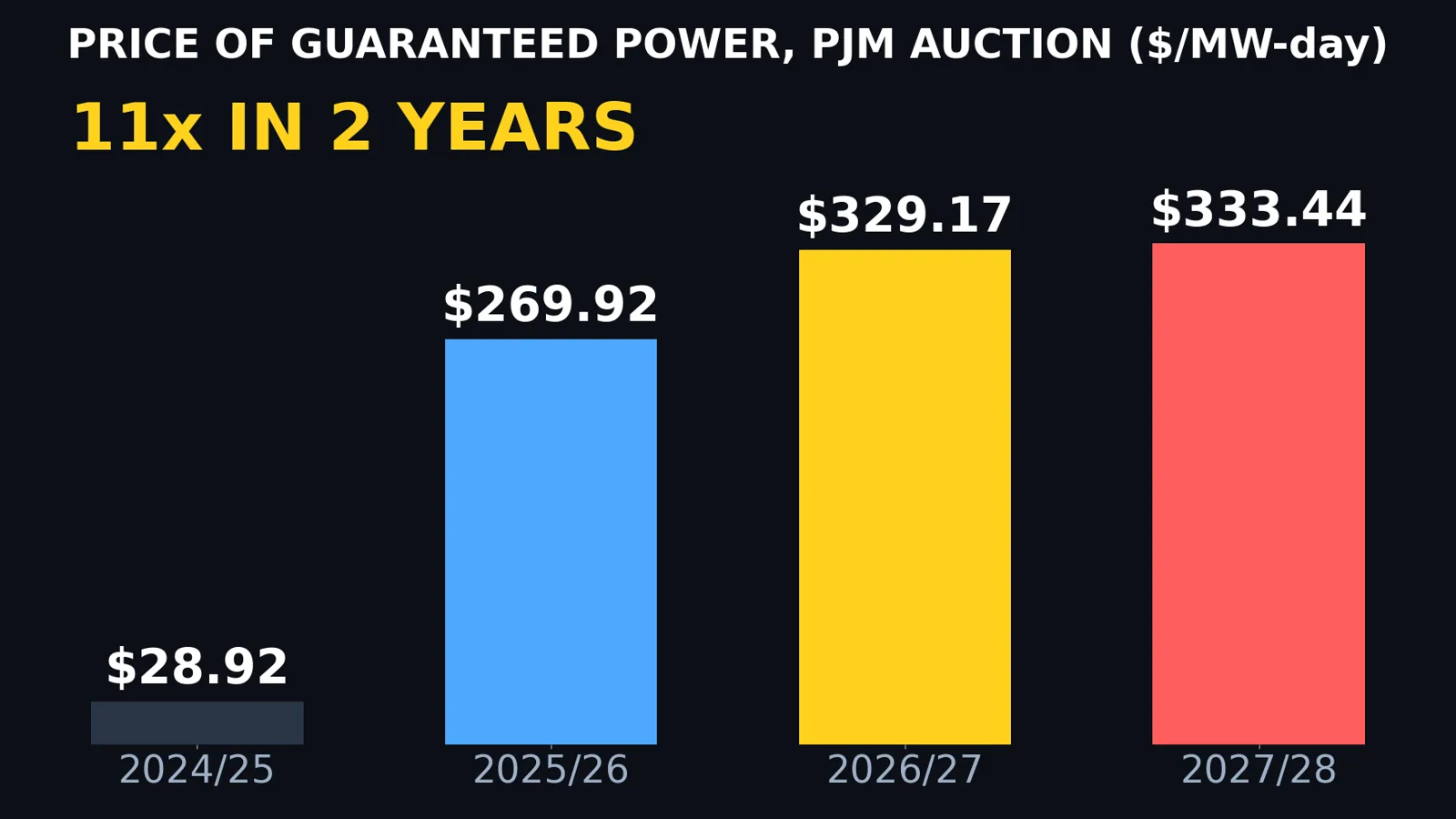
PJM capacity auction clearing price, $/MW-day. PJM runs the largest electricity market in the United States. The last 3 auctions cleared at or against the regulator's price cap.
It is the price of a promise. Generators are paid to guarantee they will be available when the grid needs them. It is the closest thing the American power market has to an insurance premium against running short.
WHAT IT DID
$28.92, then $269.92, then $329.17, then $333.44 per
megawatt-day. Roughly 11 times in about 2 years, and it pressed against the cap 3 auctions running. A capped price is a market telling you it would have gone higher if it were allowed to.
WHY IT MATTERS TO A SHAREHOLDER
Capacity payments land on the generator's income
statement. They do not depend on how much power is actually used. For an owner of firm, always-on generation, this is the part of the revenue line that repriced first.
4 Rungs
The desperation ladder
If you run one of these companies, you work down this ladder in order. Watch how far down it they have already gone.
Rung 1 — Efficiency
Better chips, cooling, software. Every gain gets eaten by more usage.
Rung 2 — Buy the Grid
Long contracts, lock up existing power, get to the front of the queue. Done. Still not enough.
Rung 3 — Go Nuclear
Reopen Three Mile Island. Sign 17 and 20-year contracts. Pay well above the going rate.
Rung 4 — Grow a Brain
Fund living neurons on silicon and hope it works in a decade.
THE READING
These are the richest companies that have ever existed. They can buy anything that is for sale. What they have chosen to buy is a nuclear accident site and a tray of human brain cells.
When the smartest money starts doing things that look
insane, it is not insane. It is cornered. And a cornered buyer tells you 3 things: the shortage is real, the shortage is enormous, and the shortage lasts for decades — because nobody signs a 20-year power contract for a 2-year problem.
→
→
→
Rung 3, in Detail
The largest private nuclear buying spree since the 1970s
Buyer Seller / Plant Size & term Notes
Microsoft Constellation — Three Mile Island
Unit 1, Pennsylvania 835 MW, 20 years
First commercial nuclear restart in US history. Site of the worst US nuclear accident, 1979. Unit 1 ran until 2019, shut for economic reasons. Analysts estimate roughly double the going power rate. Target: late 2027.
Amazon Talen Energy — Susquehanna,
Pennsylvania up to 1,920 MW, 17 years
$18 billion contract, inside a $20 billion Pennsylvania campus. Amazon had earlier bought an adjacent 960 MW data centre campus for $650 million.
Meta Vistra — Ohio and Pennsylvania; also Constellation Clinton, TerraPower, Oklo up to 6.6 GW, through 2035
Includes over 2,600 MW from Vistra's fleet. Mix of existing output and future reactors.
Big 4 combined
Multiple ~9.8 GW across 13 projects
Existing plant output, restarts, uprates and next-generation reactors.
Three Mile Island, in plain terms.
Unit 2 suffered a partial meltdown in 1979 and never restarted. Unit 1 sat next to it and ran profitably for 4 more decades, then closed in 2019 because cheap gas made it uneconomic. It is being reopened, at cost, to power one customer's computers. That is the single clearest measure of how much the price of firm, carbon-free electricity has changed.
Notice what is not in this table. There is no speculation, no pilot programme and no memorandum of understanding. These are signed, long-dated purchase agreements with take-or-pay economics behind them, from counterparties with the strongest balance sheets on Earth.
Notice the term lengths. 17 and 20 years. That is the buyers telling you, with their own money, how long they expect to be short.
WHO Is Allowed to Sell
A moat made of law
BOTTOM LINE:
Most nuclear plants in America are owned by regulated utilities. Regulated means they cannot sell their output to whoever they choose. Every deal goes through a state commission: a public process, hearings, objections, years. It is not slow or difficult for a hyperscaler to buy that power. It is not permitted. A minority of plants sit in deregulated markets, and those operators can sign a private contract with a private buyer, directly. 3 listed companies own a meaningful fleet of them.
Regulated Utility
Output must be sold through the state commission process
vs
Deregulated Merchant
Free to sign a private 20-year contract, directly
WHY THIS IS A GENUINE MOAT
You cannot out-innovate a statute. A competitor with better technology and lower costs still cannot sell into these contracts if their plants sit in the wrong regulatory regime. To compete you would have to change the legislation of a dozen American states.
WHY IT IS ALSO THE BIGGEST RISK
The same pen that created it can move it. Regulators are already examining whether large buyers should be allowed to take existing nuclear output off a grid while household bills rise. That is covered properly on page 18.
THE DEMAND SIDE OF THE SAME COIN
The most desperate buyers capitalism has produced, with effectively infinite money, and 3 shops they are legally
permitted to walk into. That is an unusual bargaining position for a seller to be in, and it is why the contracts have been signed above prevailing market rates.
THE ANCHOR
NASDAQ: Ceg
Constellation Energy
WHAT IT ACTUALLY OWNS
The largest carbon-free generator in the United States. A nuclear fleet spread across the deregulated markets, which is precisely the fleet a hyperscaler is permitted to buy from.
Three Mile Island Unit 1. The Microsoft restart is Constellation's revenue line. 835 MW under a 20-year agreement, targeted for late 2027.
Clinton, Illinois. Constellation also signed Meta at the Clinton plant, keeping a unit running that had been at risk of closure.
WHAT TO LOOK AT IN THE APP
Earnings, not headlines. What the business earns, what you are being asked to pay for those earnings today against its own history, where the price sits inside its own 52-week range, and what institutions who must file their positions publicly have been doing with it.
THE HONEST POSITION
It has already run, and it is about 31% below its own 52-
week high as this is written. Both of those statements are true at the same time. Page 16 explains why that combination matters more than either one on its own.
Metric As of 13 Aug 2026
Share price $278.64
52-week high $402.32
Below 52-week high ~31%
Since the Three Mile Island announcement (Sep 2024) ~1.1x
THE CONCENTRATED ONE
NASDAQ: Tln
Talen Energy
WHAT IT ACTUALLY OWNS
Susquehanna. The Pennsylvania nuclear plant sitting underneath Amazon's $18 billion, 17-year agreement for up to 1,920 MW, and underneath the $20 billion campus being built beside it.
The smallest of the 3, and the most directly attached to a single customer. That cuts both ways. It is the purest expression of the theme, and it is the one with the most concentrated counterparty exposure.
WHY CONCENTRATION MATTERS HERE
A single large contract can dominate the earnings profile. When one buyer is that large a share of the revenue, the quality of that buyer is part of the investment case. In this instance the buyer is Amazon, which is about as strong a counterparty as exists — but it is still one counterparty.
THE HONEST POSITION
It has roughly doubled since the Three Mile Island announcement, and is about 20% below its own 52-week
high. Of the 3 names it has moved the most and given back the least.
Metric As of 13 Aug 2026
Share price $358.40
52-week high $445.84
Below 52-week high ~20%
Since the Three Mile Island announcement (Sep 2024) ~1.9x
THE FLEET OPERATOR
Vistra
WHAT IT ACTUALLY OWNS
A large generation fleet sitting in the right markets. Nuclear alongside a substantial conventional fleet, concentrated in deregulated regions where private contracting is permitted.
The Meta agreement. Meta has contracted for over 2,600 MW across Vistra plants in Ohio and Pennsylvania as part of its nuclear programme running to 2035.
WHY THE MIX MATTERS
More diversified than Talen, less nuclear-pure than Constellation. The conventional fleet earns from the same capacity price rises documented on page 9, which gives the business a second way to benefit from the same shortage.
THE HONEST POSITION
Up meaningfully since 2024 and about 33% below its own 52-week high — the largest drawdown of the 3 names as this is written.
Metric As of 13 Aug 2026
Share price $146.40
52-week high $217.02
Below 52-week high ~33%
Since the Three Mile Island announcement (Sep 2024) ~1.4x
The Part Nobody Says Out Loud
Early in the structure, late in the price
BOTTOM LINE:
All 3 names have already run a long way. All 3 are also 20–33% below their own 52-week highs. The story went up, the price came back down, and the 20-year contracts underneath it did not move an inch. The customers did not cancel. The law did not change. The queue for turbines did not get shorter. A stock that has run is not the same thing as a stock that is expensive, and if you cannot tell those apart you will either walk away from something good or panic-buy it at the worst moment.
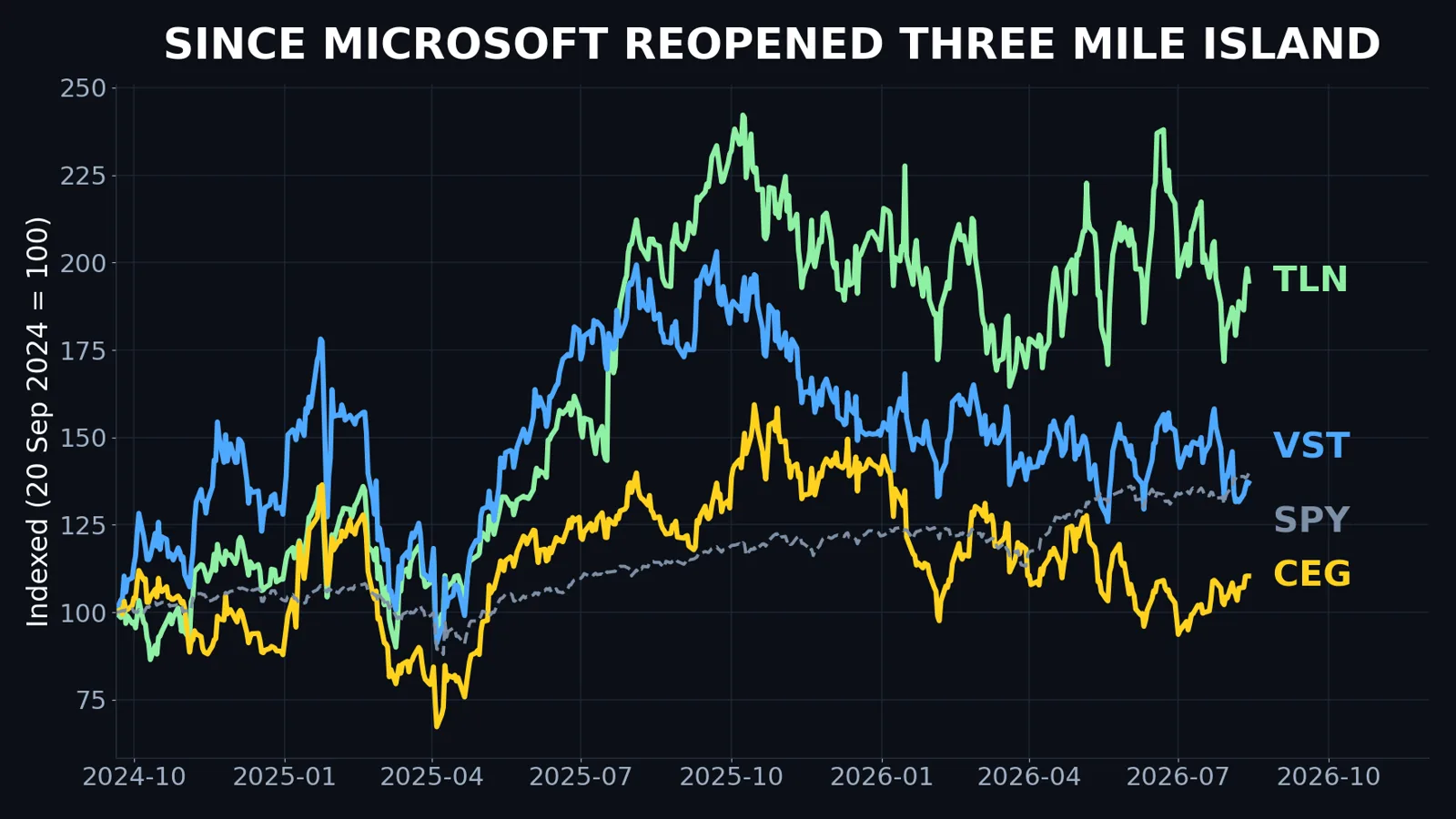
Indexed price performance since the Three Mile Island restart announcement, September 2024, against the S&P 500. Source: EOD price data, 13 August 2026.
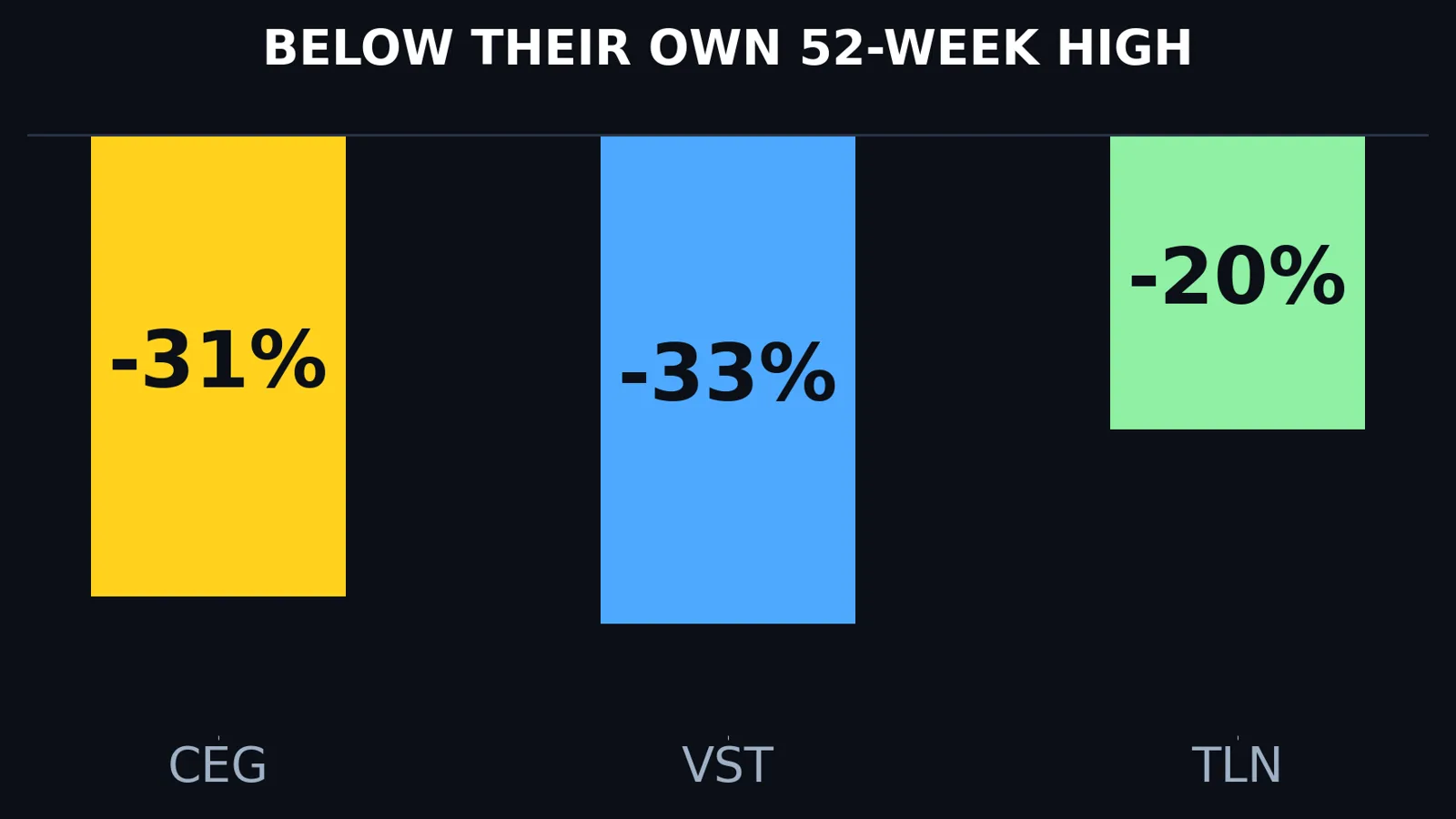
Distance below own 52-week high, 13 August 2026. The structural contracts underneath these businesses were unaffected by the drawdown.
How to tell the 2 apart. Look at what the business earns, what you are paying for those earnings against the company's own history rather than against a headline, where the price sits in its own range, and what disclosed institutional positions have been doing. That takes a couple of minutes per name and it converts "it has gone up a lot" into a number you can act on.
This is a tilt, not a bet. A slice of a diversified portfolio pointed at something structural. Sizing is on page 19 and it matters more than the picks do.
If 3 Names Feels Narrow
The toll booth does not care which car goes through it
Forget who wins the generation race. It might be nuclear. It might be gas, or small modular reactors, or solar with very large batteries, or one day the neurons. Nobody knows, and anybody who tells you they do is selling something.
Whoever wins, the electricity still has to be moved. Stepped down, switched, distributed and then used to cool the racks it is powering. Somebody sells the turbines. Somebody sells the transformers. Somebody builds the lines. Somebody cools the buildings. Those are the toll collectors.
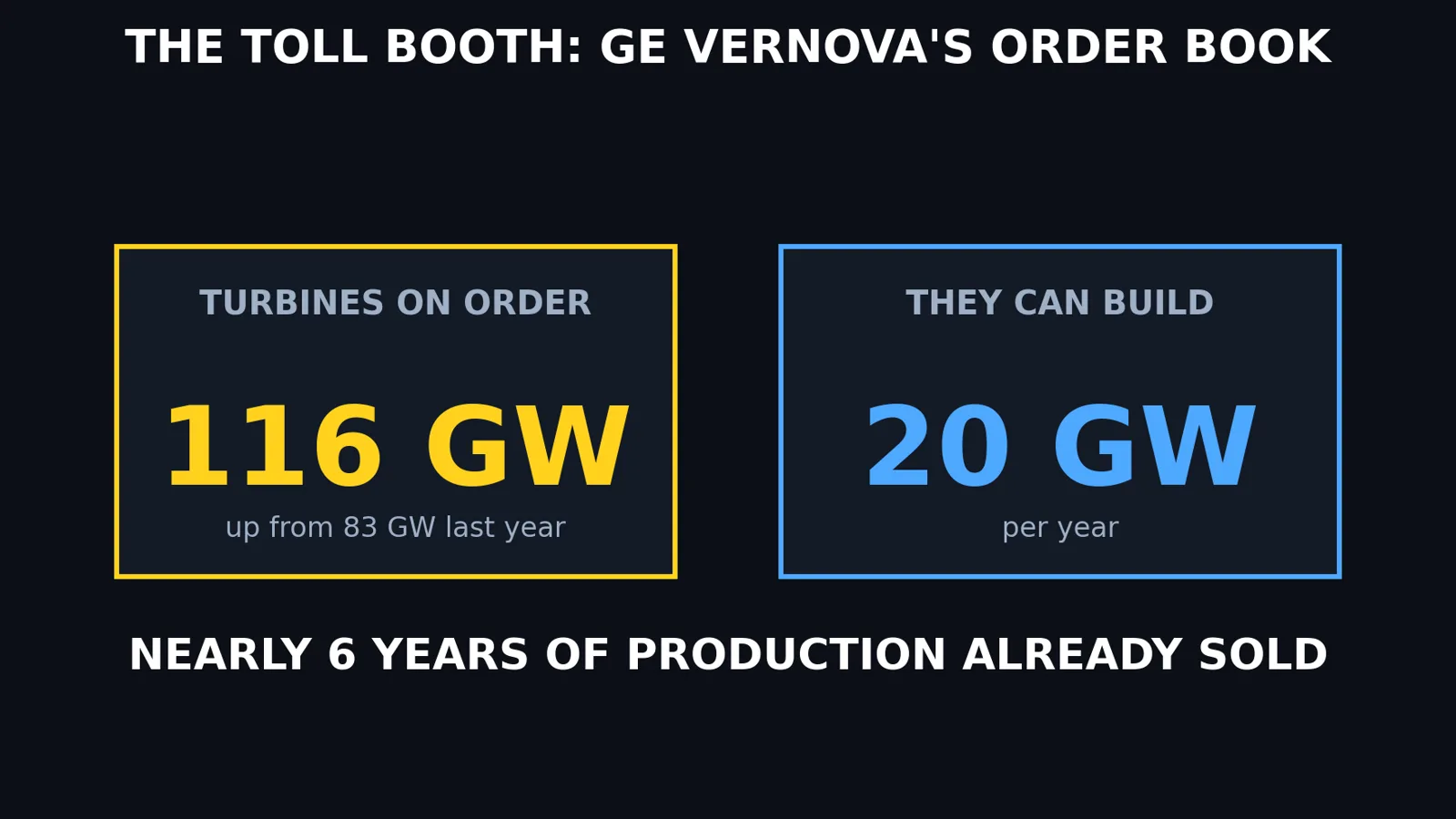
GE Vernova gas turbine backlog, end-2025 against Q2 2026. At a build rate of roughly 20 GW per year, the current book represents nearly 6 years of production.
What they sell Evidence the queue is real
Gas turbines & grid equipment GE Vernova turbine backlog 83 GW → 116 GW; build rate ~20 GW/year; 2029 and 2030 factory slots close to gone; Electrification backlog above $42.4 billion
Transformers & switchgear Global shortage with multi-year lead times. In a shortage, the seller sets the price
Grid construction Transmission and substation work is the physical bottleneck between a signed contract and a powered building
Data centre cooling & power distribution Rack densities climbing toward 100 kW make thermal management a hard requirement, not an upgrade
The 12-year-old test.
If you cannot state your investment case in one sentence, you do not have one. Here it is: the world is short of electricity, and I own the companies that sell it and move it. This is the quality sleeve of a portfolio — profitable businesses with real earnings and order books stretching past 2030 — not the casino sleeve.
READ THIS PAGE TWICE
The Case Against
The risks, honestly
1. ANNOUNCEMENTS ARE NOT BUILDINGS
A data centre announcement is a claim on power, not a fact. A meaningful share of what has been announced will never be built. If AI capital spending slows even modestly, the demand curve flattens quickly — and these shares are priced for the curve, not for the current year.
2. THE MOAT IS MADE OF RULES, AND
RULES CHANGE
A pen stroke in Washington is a genuine risk here. Regulators are already examining whether large private buyers should be permitted to take existing nuclear output off a shared grid while household bills rise. The structure that makes these 3 companies special is the structure most exposed to political attention.
3. THE RUN-UPS ARE REAL
Even 30% off the high, none of these is cheap by historical
measure. Paying any price for a good structure is exactly how a good story turns into a bad investment. The structure being sound does not make the entry price sound.
4. NUCLEAR TIMELINES SLIP
That is not cynicism, it is the recorded history of the industry. The Three Mile Island restart is targeted for late 2027. Targeted. Restart work involves regulatory approval, refurbishment and grid reconnection, and any of those can move.
5. CONCENTRATION RISK ON THE SMALLEST
NAME
One dominant customer is a strength until it is a weakness. A renegotiation, a delay or a change in the buyer's own plans lands disproportionately on a business with one very large contract.
What the risks mean in practice.
They are why this belongs in a portfolio as a sized tilt rather than a conviction bet. Get the sizing right and none of the 5 is fatal. Skip the sizing and any one of them can take a serious bite out of you.
Action
How to size it, and what to check first
BOTTOM LINE:
A tilt is a slice of a diversified portfolio pointed at something structural. It is not a concentrated position and it is not a trade. The sizing decision matters more than the choice between these names, because the sizing is the thing that determines whether being wrong is an inconvenience or a problem.
CHECK THESE 3 YOURSELF RATHER THAN TAKE ANYONE'S WORD FOR IT
gogetwinston.com
Winston is the app Felix and his team built. Earnings, valuation against a company's own history, position inside the 52-week range, and disclosed institutional activity — on one page, per stock. Free for 30 days. No phone call.
Decide the total size of the tilt before you look at a single price. Write the number down.
✓
Check what each business actually earns, not what the headline says about it.
✓
Compare what you are being asked to pay for those earnings against the company's own history, not against another sector.
✓
Look at where the price sits inside its own 52-week range before deciding whether "it has run" is a real objection.
✓
Read what institutions who must disclose their positions have actually been doing.
✓
Separate the generators from the toll collectors. They are different risks and they belong in different sleeves.
✓
Write down, in advance, what would make you sell. A structural thesis needs an exit condition just as much as a trade does.
✓
Re-read page 18 before you place anything.
✓
Disclaimer
Felix Prehn owns shares in some of the companies discussed in this report and in the accompanying video. This report is educational content produced by The Prehn Institute. It is not financial advice, not a recommendation to buy or sell any security, and not personal to your circumstances.
All investments carry risk, including the total loss of capital invested. Past performance does not predict future results. Share prices and market data quoted are as of 13 August 2026 and will have changed by the time you read this. Verify every number against a live source before acting on anything.