
The Circular Machine
How the AI building boom is being paid for with borrowed money — and why a chunk of it may already be sitting in your retirement account.
Felix Nikolas Prehn · 14 July 2026 · 20 pages
Bottom line
The companies building artificial intelligence are no longer paying for it mostly out of their own profits — they are borrowing enormous sums to do it. In the first half of 2026, six firms (Amazon, Alphabet, Nvidia, Meta, Oracle and SpaceX) issued roughly $182 billion of bonds, up from about $13 billion in the same period a year earlier. Technology now accounts for about 20% of all US investment-grade bond issuance — a record. A large share of that debt ends up inside ordinary retirement funds. We do not tell you whether to buy or sell anything. Our aim is simpler: to explain, in plain language, how this machine works, where the real risks sit, and lower-risk ways investors can get exposure to the theme.
Overview
The Circular Machine
A snapshot of the AI-infrastructure trade, the debt paying for it, and what it means for ordinary
portfolios.
BOTTOM LINE:
The companies building artificial intelligence are no longer paying for it mostly out of their own profits — they are borrowing enormous sums to do it. In the first half of 2026, six firms (Amazon, Alphabet, Nvidia, Meta, Oracle and SpaceX) issued roughly $182 billion of bonds, up from about $13 billion in the same period a year earlier. Technology now accounts for about 20% of all US investment-grade bond issuance — a record. A large share of that debt ends up inside ordinary retirement funds. We do not tell you whether to buy or sell anything. Our aim is simpler: to explain, in plain language, how this machine works, where the real risks sit, and lower-risk ways investors can get exposure to the theme.
2. WHY THIS REPORT MATTERS TO YOU
You are probably already invested. If you have a 401(k), an IRA, a pension or a target-date fund, you almost certainly own a slice of the AI-infrastructure trade — both the stocks and the bonds. You did not pick them one by one. They were placed there automatically by the default settings inside most retirement plans, which buy big index funds and investment-grade corporate bonds.
The link is not obvious. Nobody sends you a letter saying “this month your savings helped fund a data center in Texas.” But that is, in effect, what happens. Your fund manager buys the bonds these companies issue, and the money flows to the AI build-out.
Concentration is the quiet risk. Seven large technology companies now make up more than 30% of the S&P 500. So even a “plain” index fund is, under the hood, a big bet on this handful of names. When they move, the whole market moves with them.
What we will do. We will walk through the industry, follow the money, look closely at Nvidia's numbers using Felix's stock-picking checklist, lay out the risks and the opportunities, and point to sector ETFs that spread risk across many companies instead of concentrating it in one.
3. THE INDUSTRY: AI INFRASTRUCTURE
What “AI infrastructure” actually means. Think of AI like electricity. To deliver it, someone has to build the power plants, the wires and the meters. In AI, the “power plants” are giant data centers full of specialized computer chips. The “fuel” is the chips themselves, mostly made by Nvidia. The companies renting out this computing power are the big cloud providers — Microsoft, Amazon, Google and Oracle — often called hyperscalers because they operate at enormous scale.
The value chain in one breath. Chip designers (Nvidia, AMD) sell chips to hyperscalers and AI labs. Hyperscalers pack those chips into data centers. AI labs (like OpenAI and Anthropic) rent that computing power to train and run their models. Businesses and consumers are supposed to be the final customers who pay for it all. As we will see, that last link — the paying customer outside the circle — is the one under the most scrutiny right now.
Why it is booming. The technology is real. The chips work, the models keep improving, and demand for computing power has been genuine. That is exactly why so much money has rushed in. Our concern is not whether AI is real — it is how the build-out is being financed.
The One Idea to Hold Onto
A great technology and a safe investment are not the same thing. Railroads, the internet and modern housing were all real and transformative — and all three still produced brutal losses for investors who arrived late and paid with borrowed money. The technology being real does not make the financing safe.
Nvidia & AI Infrastructure · July 14, 2026
4. The Borrowing Machine
Spending every dollar — then borrowing more. Imagine a business that takes every single dollar it earns and pours it into one giant bet, keeping nothing in reserve — and then goes to the bank to borrow hundreds of billions on top. That is close to what is happening across AI infrastructure today. Industry analysis cited in our source material puts hyperscaler capital spending at roughly 100% of operating cash flow: essentially all the cash the business generates is being reinvested into the build-out.
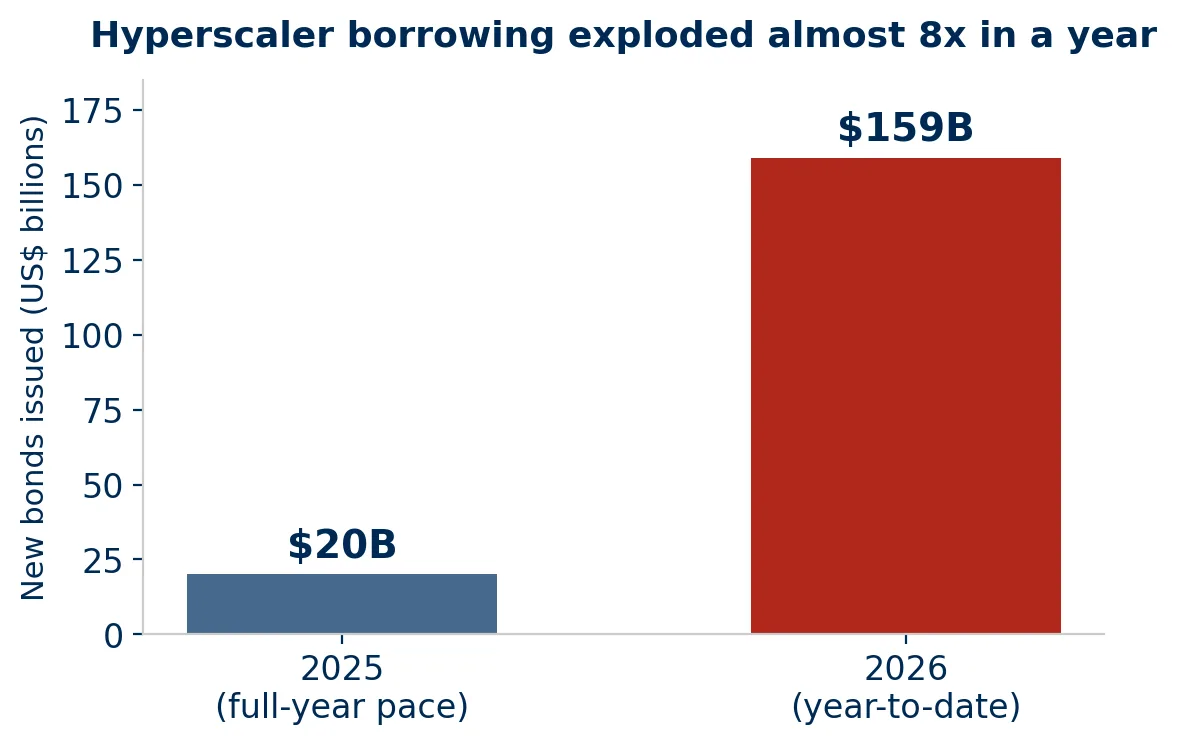
The debt ramp is the headline.$20 billion$159 billion The debt ramp is the headline. Combined hyperscaler bond issuance jumped from about $20 billion in 2025 to roughly $159 billion in the 2026 period. Five of these companies now make up about 4% of the entire investment-grade bond index by themselves. When a small group of borrowers grows this fast, the market becomes very sensitive to their fortunes.
EXHIBIT 1 — HYPERSCALER BOND ISSUANCE: 2025 VS 2026 YEAR-TO-DATE
Source: Morgan Stanley data as cited in The Prehn Institute source material. Figures rounded.
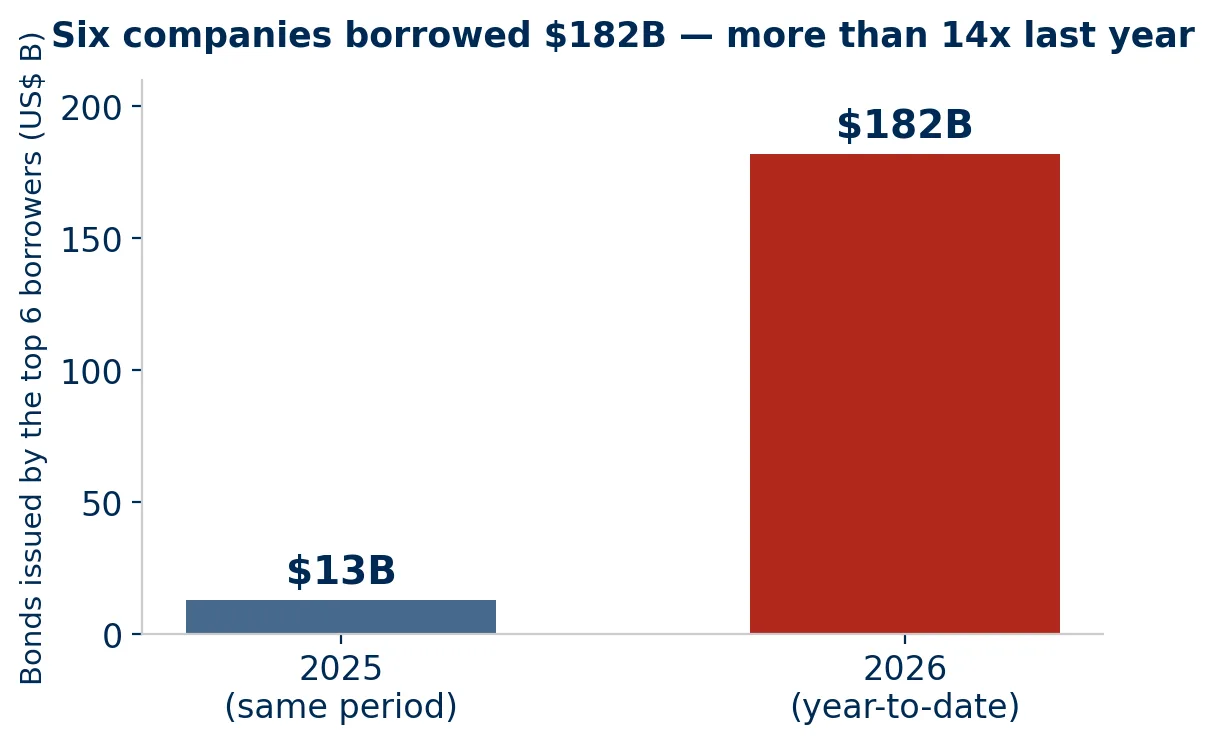
Six companies, one huge number. Zoom out to the six biggest borrowers — Amazon, Alphabet, Nvidia, Meta, Oracle and SpaceX — and the picture is even starker. Together they issued about $182 billion of bonds in 2026 year-to-date, versus roughly $13 billion in the same stretch of 2025. That is more than a fourteen-fold increase in a single year.
Source: Bloomberg data as cited in The Prehn Institute source material. Figures rounded.
The historical rhyme. In 2007, the biggest banks in the world ran a similar machine with housing: spend everything, borrow the rest, and tell everyone it was fine. The lesson is not that AI equals subprime. It is that when one group of borrowers dominates the market and leans heavily on cheap debt, the system becomes fragile in the same way.
5. WHO IS ACTUALLY LENDING THE MONEY?
A bond is just an IOU. When a company needs cash, it can issue a bond: “Give us your money now, and we will pay you back later, with interest.” Investors who buy the bond are the lenders. Simple.
Your retirement fund is a big buyer. The funds that manage 401(k)s, IRAs and pensions hold large amounts of investment- grade corporate bonds. Target-date and balanced funds automatically buy them. So when Amazon or Oracle issues a bond, ordinary retirement money is often on the other side of the trade — without any saver being asked.
Why that echoes 2007. Before the housing crash, regular people's savings were quietly funding mortgages they had never heard of. The money simply flowed there through the plumbing of the financial system. The mechanism today is different in the details but similar in spirit: savings funding a boom that most savers cannot see.
Appetite is the pressure gauge. Recently, the signs of investor appetite have started to crack — measured by weaker demand (lower “cover ratios”) on some of the largest tech bond deals. When lenders start to hesitate, the cost of borrowing rises, and the whole build-out gets more expensive to fund.
6. THE CIRCULAR FINANCING PROBLEM
The trick to understand. Here is the part that deserves the most attention. Some of the “demand” that makes AI revenue look so strong may be money moving in a circle rather than new money arriving from outside customers.
The chip circle. Nvidia invests billions into AI startups. Those startups then use that money to buy Nvidia's chips. Nvidia books the purchases as revenue and tells the market demand is booming. On paper, sales rise. But a portion of that money started at Nvidia and ended at Nvidia — it went in a circle. Industry estimates in our source material suggest Nvidia's ecosystem investments equal a meaningful slice (around a third) of its expected free cash flow.
The cloud circle.$13 billion The cloud circle. The same pattern shows up among the big cloud providers. Microsoft invested about $13 billion in OpenAI; OpenAI spends heavily on Microsoft's Azure cloud, which Microsoft reports as AI revenue. Google invested in Anthropic; Anthropic buys Google cloud services. Amazon also invested in Anthropic; Anthropic buys Amazon cloud services. Money is injected into an AI lab and reappears as the investor's own revenue.
The Question That Matters Most
Who is the real customer — the one outside the circle who is actually paying? According to research from Apollo cited in our source material, there are so far no clear signs of profit margins rising outside the technology sector because of AI. If the outside customer never shows up in force, a lot of today's “demand” is really just borrowed money going round and round.
The 1999 echo. During the dot-com era, a similar loop existed: equipment makers helped finance the very startups that then bought their equipment, all lifted by rising stock prices. When outside demand failed to catch up, the loop unwound and the Nasdaq fell 78%, taking about fifteen years to recover its peak. The pattern — not the exact companies — is what we watch.
Nvidia & AI Infrastructure · July 14, 2026
7. Company in Focus: Nvidia (Nvda)
Why Nvidia. Nvidia designs the chips that do most of the heavy lifting in AI. It sits at the center of the value chain and the center of the circular-financing debate, which makes it the clearest single window into the whole theme. Note: per The Prehn Institute policy, this report contains no buy/sell ratings, no price targets and no technical analysis. We are describing a business, not issuing a recommendation.
The business in one line. Nvidia sells the “picks and shovels” of the AI gold rush. When any company — big or small — wants to build AI, it usually needs Nvidia chips. That position has produced remarkable profitability.
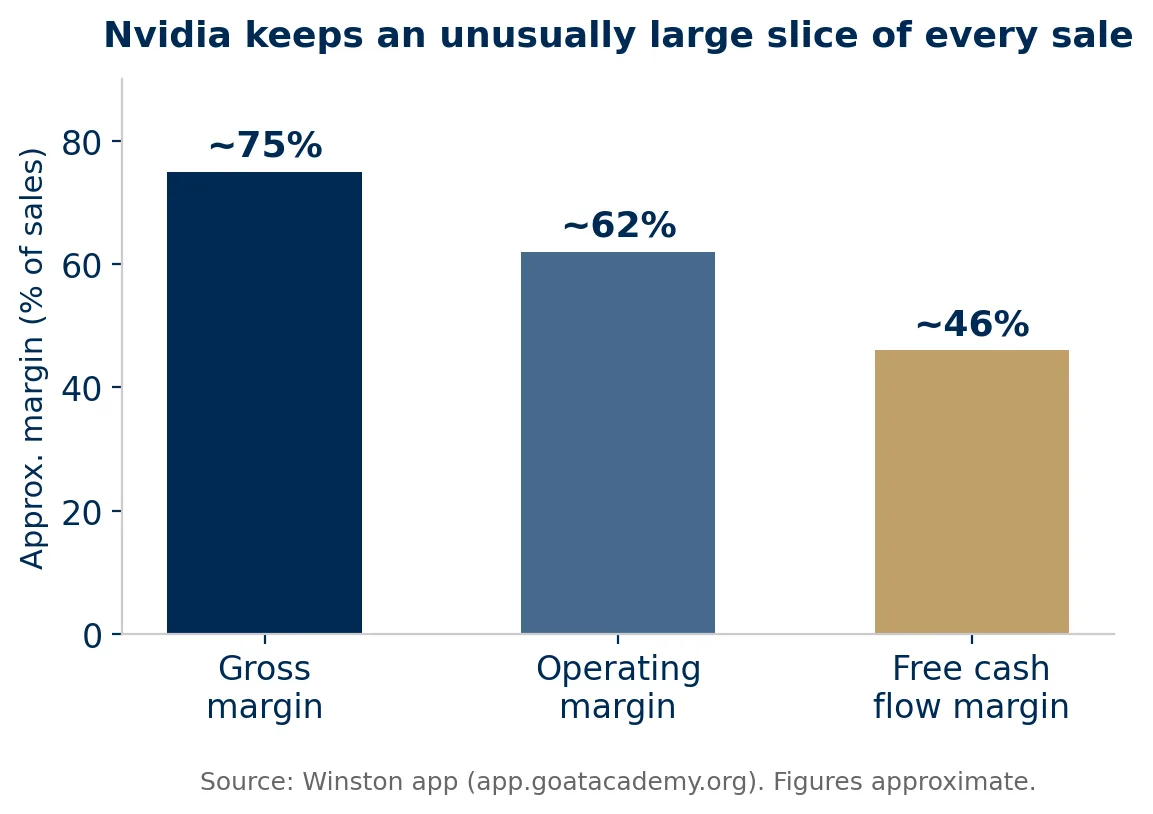
Source: Winston app. Figures approximate and rounded; shown to illustrate quality of the business, not as precise accounting.
The catch. High margins and strong cash generation are exactly what make a business high quality. But two things sit alongside that quality here: first, a valuation that already assumes years of rapid growth; and second, the circular-financing question — how much of the demand is genuinely external. A wonderful business can still be a risky investment if the price already bakes in a perfect future.
8. FELIX'S RULES: HOW TO PICK GREAT STOCKS
Felix's framework does not chase “cheap” or “fast-growing” for their own sake. It looks for quality. Here is the full checklist The Prehn Institute teaches, in one place.
Operating Margin Reveals profitability after all operational costs. A good measure of cost control.
ROCE Return on capital employed — the return to all financial stakeholders (equity and debt). A good measure of management effectiveness.
IS IT GENERATING CASH?
Cash Conversion Ability to convert profits into actual cash. A good measure of efficiency and flexibility.
| Leveraged Free Cash Flow Margin | Reveals what portion of sales ends up as cash after debt costs. |
|---|---|
| IS IT FINANCIALLY STABLE? | |
| Leverage | A measure of financial risk. Tells a story about the volatility of returns. |
| Interest Cover | Degree of financial comfort regarding debt. A high ratio suggests stability and flexibility. |
| VALUATION | |
| P/E + Forward P/E | A short-term valuation snapshot plus a forward-looking view. This is the least important of our metrics. |
| Consistent earnings growth? | Shows whether management and the business are reliable or cyclical. |
| Rising EPS? | Reveals whether shareholder value is increasing or being diluted. |
| MOAT — THE COMPETITIVE ADVANTAGE | |
| Sources of a moat | Cost advantage; size advantage (economies of scale); high switching costs; patents, brand and government licenses. |
9. NVIDIA THROUGH FELIX'S QUALITY LENS
| Metric | Nvidia (approx.) | What it tells a beginner |
|---|---|---|
| Gross margin | ~75% | Very high. Points to a wide moat and pricing power — few rivals can match its chips today. |
| Operating margin | ~62% | Excellent cost control; most of the gross profit survives after running the business. |
| Free cash flow margin | ~46% | Nearly half of sales can turn into spendable cash — a hallmark of quality. |
| Leverage (net debt) | Net cash | Holds more cash than debt. Financially very stable on its own balance sheet. |
| Interest cover | Very high | Profits dwarf interest costs. Little near-term financial stress at the company level. |
| Earnings/EPS trend | Rising fast | Growth has been rapid — but rapid growth is harder to sustain and easier to disappoint. |
| Valuation (P/E) | Elevated | The price already assumes years of strong growth. Least important metric, but a real risk if growth slows. |
On profitability, cash generation and balance-sheet stability, Nvidia scores as genuine quality. The two open questions are valuation (a lot of good news is already priced in) and demand durability (how much of the revenue depends on the circular financing described in Section 6). Quality of the business ≠ safety of the entry price.
Nvidia & AI Infrastructure · July 14, 2026
10. The Rules for Growth Stocks
Nvidia straddles the line between “quality” and “growth.” For faster-growing companies where there is less history to lean on, Felix applies a second, stricter checklist.
| ADDITIONAL CRITERIA FOR GROWTH STOCKS | |
|---|---|
| Same valuation method applies | The quality lens still comes first. |
| Longer time horizon | You need more time to judge whether it worked. |
|---|---|
| FOCUS ON THE METRICS THAT ARE AVAILABLE | |
| High operating margin | Proof the model works at scale. |
| Strong revenue growth | It is a growth company — it must beat others in its sector. |
| Low debt & good cash position | Enough cushion to survive a crash. |
| Large target market (25x+ TAM) | Room to grow for years. |
| Strong, clean brand & tech leadership | Hard for rivals to copy. |
| High R&D spend | Builds and defends the moat. |
| ALIGNMENT & UNDERSTANDING | |
| CEO/founder heavily invested | Skin in the game (e.g., Tesla, Square, Spotify, MercadoLibre, AMD). |
| Fully understand the model | Can you write down three reasons it beats competitors? |
How Nvidia looks on the growth checklist. It scores strongly on operating margin, revenue growth, cash position, market size, brand, tech leadership and R&D. The honest weak spots are the valuation and the durability of demand — the same two flags from the quality lens. A disciplined investor writes those flags down rather than explaining them away.
11. THE HYPERSCALER CUSTOMERS
Nvidia's biggest customers are also, in a sense, its closest ecosystem peers: the hyperscalers who buy the chips and rent out the computing power. Their financial character has shifted as the AI build-out accelerated.
| Company | Role in the chain | Financial character today |
|---|---|---|
| Microsoft | Azure cloud; major OpenAI backer | Very profitable, strong cash generation; capex rising sharply to fund AI capacity. |
| Amazon | AWS cloud; Anthropic backer | Huge revenue base; among the largest AI borrowers; capex at record highs. |
| Alphabet (Google) | Google Cloud; Anthropic backer | High-margin core; heavy AI investment; strong balance sheet historically. |
| Meta | AI models & compute for its | |
| apps | ||
| Strong cash flow; large, debt-funded AI capex program. | ||
| Oracle | Cloud capacity for AI workloads | Aggressive AI-capacity expansion; more leverage than peers; a key swing borrower. |
The shared pattern. Individually, most of these are high-quality, cash-rich businesses. Collectively, they have taken on debt at a pace not seen in years, and their leverage as a group has roughly doubled over a short span. That is why the theme — not any single company — is where the risk concentrates.
Nvidia & AI Infrastructure · July 14, 2026
12. The Closest Competitor: AMD
The obvious rival. Advanced Micro Devices (AMD) is Nvidia's nearest listed competitor in AI chips. It is a genuine technology leader with a credible product roadmap and a founder-operator culture Felix's framework favors.
Why it matters to the thesis. AMD is smaller in AI market share and typically earns lower margins than Nvidia today, but it gives the hyperscalers a second supplier. More competition is good for buyers and can, over time, pressure the extraordinary margins Nvidia currently enjoys — a factor worth watching for anyone studying the durability of Nvidia's moat.
The same macro risk applies. AMD's AI demand flows from the very same customers borrowing heavily to build. If the build-out slows, both chipmakers feel it. Diversifying across chipmakers reduces single-company risk but not the shared, sector-wide financing risk.
13. HOW STRESSED IS THE MARKET?
Three pictures tell the story of a market that is absorbing less and less before it wobbles.
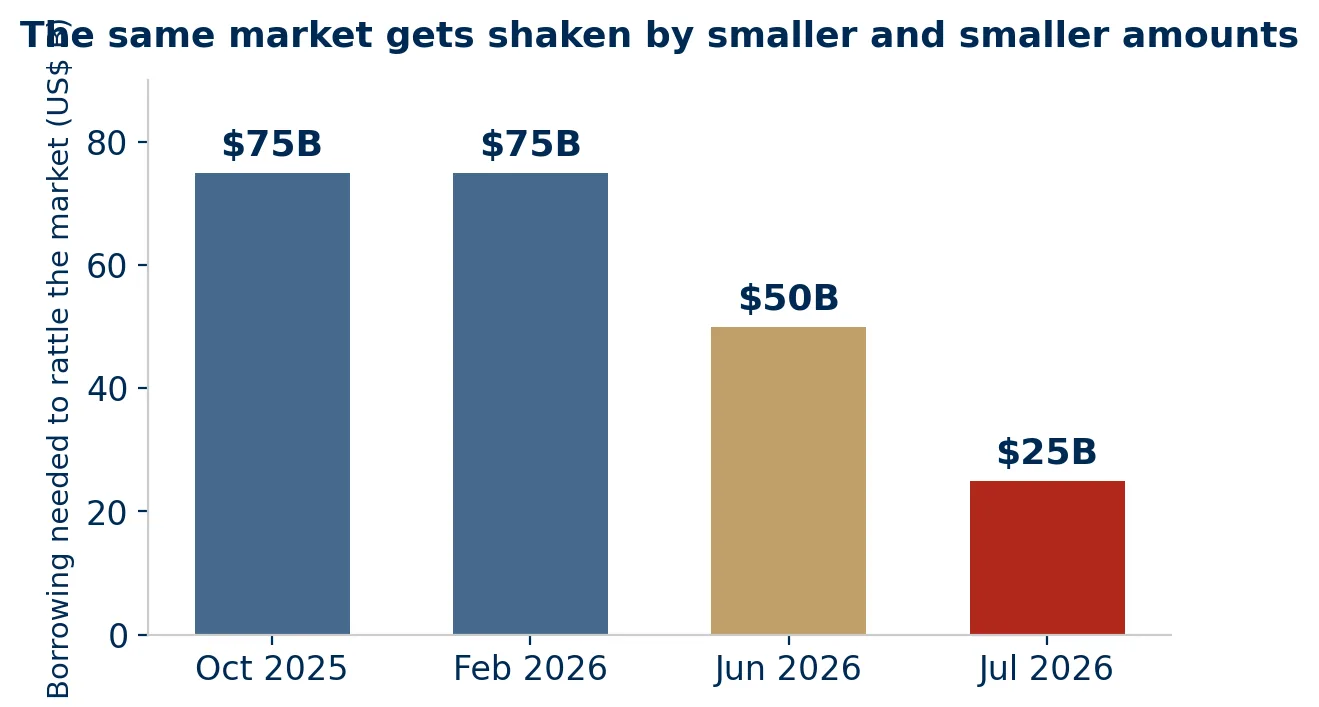
The market gets shaken by smaller doses. According to a Goldman trader's note cited in our source material, last October it took about $75 billion of new AI borrowing to rattle the bond market. In February, $75 billion again. By June, only $50 billion. By July, just $25 billion. Like an immune system wearing down, the same patient reacts to a smaller and smaller dose.
Source: Goldman Sachs trading note as cited in The Prehn Institute source material.
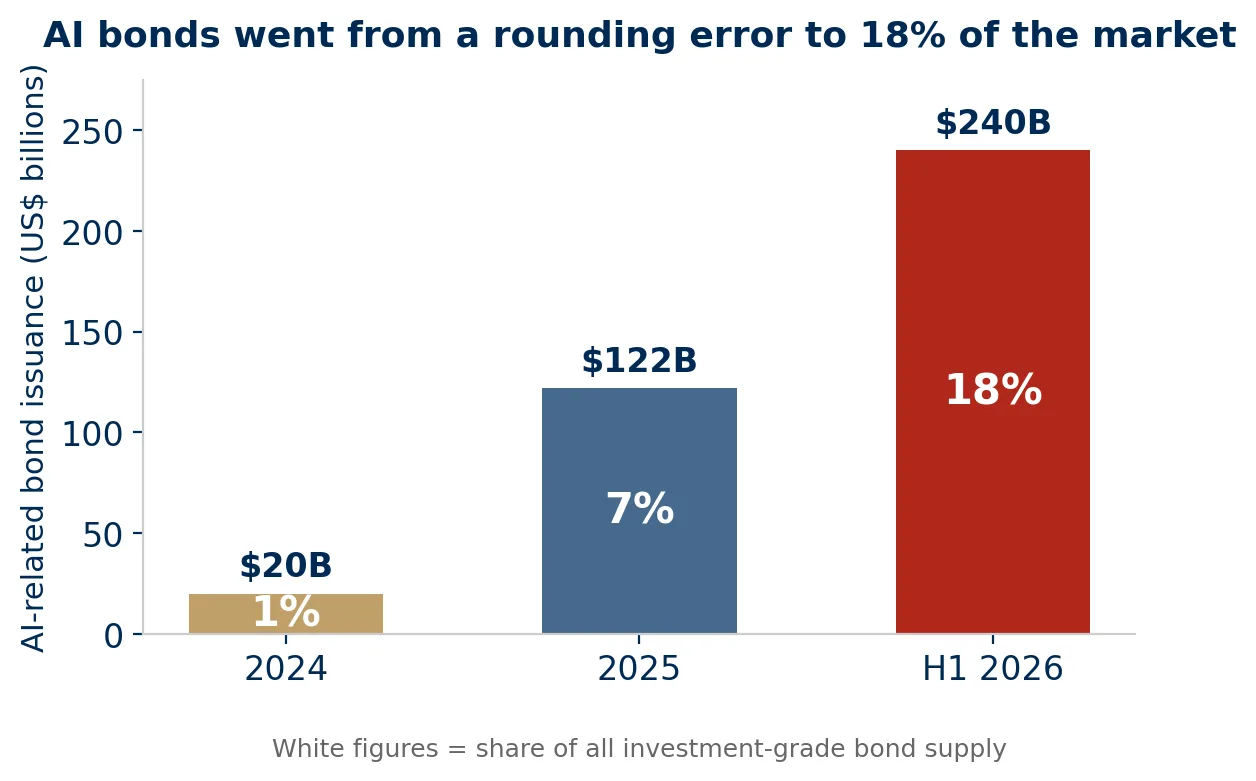
AI bonds are a growing share of supply.$20 billion (about 1% of supply) in 2024 AI bonds are a growing share of supply. AI-related bond issuance has gone from roughly $20 billion (about 1% of supply) in 2024, to about $122 billion (7%) in 2025, to roughly $240 billion (18%) in the first half of 2026. The market's health is now tied tightly to this one theme.
Source: Goldman Sachs data as cited in The Prehn Institute source material.
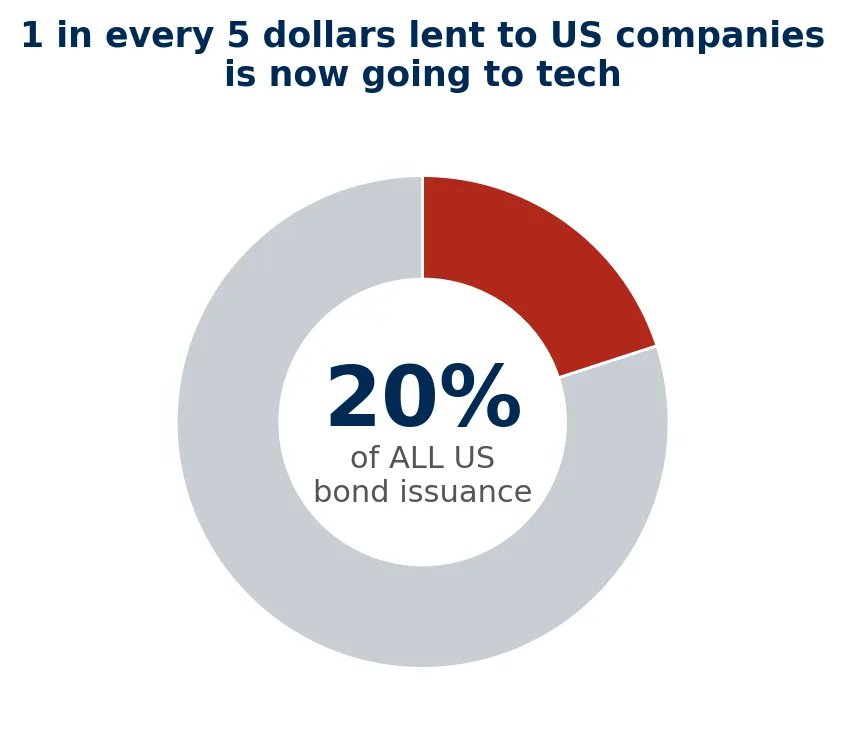
Technology dominates all borrowing.20% Technology dominates all borrowing. Step back to the whole market and technology now accounts for about 20% of all US investment- grade bond issuance — roughly one in every five dollars lent to American companies. That has never happened for any single sector before.
Source: Dealogic data as cited in The Prehn Institute source material.
14. RISK FACTORS
Risk 1 — Circular Revenue.
If a meaningful part of AI “demand” is investors and partners buying from each other, reported revenue could be overstating true outside demand. If the outside customer does not scale up, growth expectations may prove too high.
Risk 2 — Debt & Refinancing.
The build-out leans on cheap borrowing. If lenders keep pulling back, borrowing costs rise, planned spending gets cut, and the revenue circle can break. Credit investors have signalled it will be hard to fund another ~$360bn over the next 12 months on the same terms.
Seven companies are more than 30% of the S&P 500. A sell-off in these names mathematically drags down index funds — even if every other company is fine. “Contained” is not an option at this weight.
Risk 4 — A Slower Payoff (Not Even a Crash).
Per Apollo, if the AI payoff simply takes longer than hoped, it could “risk tipping the economy into recession and the S&P 500 into a correction.” The risk is not only collapse — it is delay.
Risk 5 — Valuation.
When a lot of perfect future is priced in, even good-but-not-perfect results can lead to sharp repricing. This is a risk of the entry price, separate from the quality of the business.
15. OPPORTUNITIES
Real, durable technology. AI is genuinely useful and improving. Companies that convert it into real outside revenue — not circular revenue — could be long-term winners.
Genuine quality leaders. Nvidia and several hyperscalers are, on the numbers, high-quality, cash-generative businesses with wide moats. Quality tends to survive downturns better than hype.
Volatility creates entry points. If financing stress causes a broad repricing, patient investors with a plan and a watchlist may find better prices on quality names than are available today.
Diversification is available and cheap. Low-cost sector ETFs let investors participate in the theme while spreading single-company risk (see Section 16).
Second suppliers emerging. Competition (e.g., AMD, custom hyperscaler chips) broadens the field and reduces reliance on any one supplier over time.
16. LOWER-RISK EXPOSURE: SECTOR & INDUSTRY ETFS
One way to reduce single-stock risk is to own a basket instead of one name. An ETF (exchange-traded fund) holds many companies at once, so a stumble at any single company hurts less. This is lower risk than owning one stock — not no risk, and it does not remove the sector-wide financing risk described above. The ETFs below are selected as sector/industry baskets relevant to this theme.
| Ticker | Fund | What it gives you & why it can lower single-stock risk |
|---|---|---|
| SOXX | iShares Semiconductor ETF | A basket of chipmakers (Nvidia, AMD and many others). Spreads the “picks-and- shovels” bet across the whole chip industry. |
| SMH | VanEck Semiconductor ETF | Another broad semiconductor basket. Similar idea to SOXX with a slightly different mix and weighting. |
| XLK | Technology Select Sector SPDR | Large US technology companies broadly — wider than just chips, so less tied to any one sub-industry. |
| VGT | Vanguard Information Technology ETF | Very broad, low-cost US tech exposure across hundreds of names. |
| QQQ | Invesco QQQ Trust (Nasdaq-100) | The 100 largest non-financial Nasdaq companies. Tech-heavy but includes other industries, spreading risk further. |
Even diversified funds can be top-heavy: many tech ETFs still hold a large weight in the same handful of mega-cap names. Diversification helps, but always check what is actually inside a fund before assuming it spreads your risk as much as you think.
Nvidia & AI Infrastructure · July 14, 2026
17. History Rhymes: Railroads, Dot-com, 2008
Every one of these booms was built on a real technology or asset. In every case, the people hurt worst were those who arrived late, paid with borrowed money, and were told “this time is different.”
| Era | The real thing | What went wrong for latecomers |
|---|---|---|
| Railroads (1800s) | Railways genuinely transformed the economy. | Overbuilding funded by debt led to busts that wiped out investors even though the trains kept running. |
| Dot-com (1999) | The internet was real and world- | |
| changing. | ||
| Circular funding and no outside profits; the Nasdaq fell 78% and took ~15 years to recover. | ||
| Housing (2008) | Houses are real and people need | |
| them. | ||
| Debt-fuelled buying and hidden risk in retirement portfolios; Americans lost ~40% of | ||
| retirement savings on average. | ||
| AI (today) | AI is real and improving. | Open question: debt-funded build-out, circular revenue, and heavy concentration in retirement portfolios. |
18. WHAT SMART INVESTORS DO NOW
This is not a call to panic and it is not a prediction of a crash. It is a call to have a plan before you need one. Felix teaches that the difference between people who got hurt and people who came out ahead was rarely about predicting the timing — it was about preparation. Three questions to answer honestly:
- How much of my money is in the top seven tech names? If you own an S&P 500 index fund, the answer is probably “more than you think” — roughly one dollar in three.
- Does my retirement fund hold AI bonds? Very likely yes. Target-date, balanced and pension funds routinely buy investment-grade corporate bonds, and AI issuers are now among the biggest.
- Do I have a plan if this simply slows down? Not crashes — just takes longer than hoped. If the answer to all three is “I don't know,” that is the gap worth closing.
Every bubble rewards the people who prepare and punishes the people who assume someone else is watching out for them. Knowing what is inside your own portfolio is the first, cheapest and most powerful step.
F E L I X ' S F I R S T A N D O N LY L I V E T R A I N I N G
Survive The Bubble
Step by step, Felix walks you through how to check your real exposure, how to reduce your risk, and how to position yourself
- whether AI keeps booming or the borrowing machine finally breaks.
Grab your free ticket →
Show up live, bring your questions · survivethebubble.com
Nvidia & AI Infrastructure · July 14, 2026
19. Bottom Line
What we expect investors to take away. The AI technology is real, and several of the businesses at the center of it — Nvidia foremost — are genuinely high quality on profitability, cash generation and balance-sheet strength. But the way the build-out is being financed — near- total reinvestment of cash flow, a fourteen-fold jump in borrowing by the top six issuers, circular revenue flows, and record concentration in ordinary portfolios — carries real risk that many savers do not realize they are holding. Our analysis suggests the prudent response is not fear but preparation: understand your exposure, favor quality, consider diversified baskets over single bets, and have a plan for a slower payoff, not just a faster one.
Plain-English Reference · July 14, 2026
Appendix a — Plain-english Glossary
Every term in this report, explained the way you'd explain it to a friend (or a curious 10-year-old).
| Term | What it really means |
|---|---|
| Bond | An IOU. A company takes your money now and promises to pay it back later with interest. If you own the bond, you are the lender. |
| Bond issuance | A company creating and selling new IOUs to raise cash. “$182 billion issued” means that much new borrowing. |
| Investment-grade (IG) | Bonds from companies rated as fairly safe to lend to. Most retirement funds are only allowed to buy this “safer” kind. |
| Hyperscaler | A giant cloud company that runs enormous data centers — Microsoft, Amazon, Google, Oracle. |
| Capex (capital expenditure) | Money spent building big long-term things — here, data centers and chips. |
| Operating cash flow | The actual cash a business generates from running day-to-day. “Capex = 100% of cash flow” means they're spending all of it. |
| Gross margin | Out of every $100 in sales, how much is left after the direct cost of making the product. Higher = stronger business. |
| Free cash flow (FCF) | The spare cash left after a business pays its bills and its capex. This is the money it can actually keep or return. |
| Leverage | How much debt a company uses. More leverage = more risk if things go wrong. |
| Interest cover | How easily a company's profits can pay the interest on its debt. Higher = more comfortable. |
| Moat | A durable advantage that keeps competitors away — like a castle's moat. Brands, patents, scale or switching costs. |
| P/E ratio | Price divided by earnings. A rough gauge of how expensive a stock is versus its profits. |
| ETF | A single fund that holds many stocks or bonds at once, so you don't bet everything on one company. |
| Circular financing | When money goes in a loop — a company funds a customer who then buys from that same company — making sales look bigger than real outside demand. |
| Cover ratio | How much investor demand there is for a bond deal. A falling cover ratio means appetite is cooling. |
| Correction | A market fall of about 10% or more from a recent high. |
APPENDIX B — QUICK FAQ
“Is AI a Scam?”
No. The technology is real and useful. This report is about how the build-out is being paid for (a lot of borrowing) and how concentrated the bet has become — not about whether AI works.
“Should I Sell Everything?”
This report gives no buy or sell advice. The point is preparation: know what you own, understand your exposure, and have a plan for a slower payoff as well as a faster one.
“How Would I Even Own This Without Knowing?”
Through default 401(k), IRA, pension and target-date funds, which automatically buy big index funds (heavy in the top tech names) and investment-grade corporate bonds (increasingly issued by AI companies).
Look inside your own retirement fund and measure two things: how much sits in the top seven tech names, and whether it holds corporate bonds. That one check is the foundation of any plan.