
The Last Time Central Banks Did THIS, Gold Went Vertical
Why gold fell, who kept buying, and what America's interest bill means for your savings
Felix Nikolas Prehn · 21 October 2026 · 21 pages
Bottom line
Gold just fell to its lowest point in seven weeks. But the world's central banks kept buying, at nearly 5 times the pace they ran before 2022. So this report shows you what they are positioning for, and what you can do about it.
85 tonnesa month of central bank buying on Goldman Sachs' 3-month estimate, against 17 tonnes a month before 2022
Bottom Line
Gold fell. The central banks bought.
Bottom line. The short-term story is about interest rates and the dollar. The long-term story is about trust. And the people with the most information on Earth are acting on the long-term story.
- 2022: Russia's reserves are frozen
- Central banks buy at 5 times the old pace
- A record interest bill makes inflation the easy way out
The buying
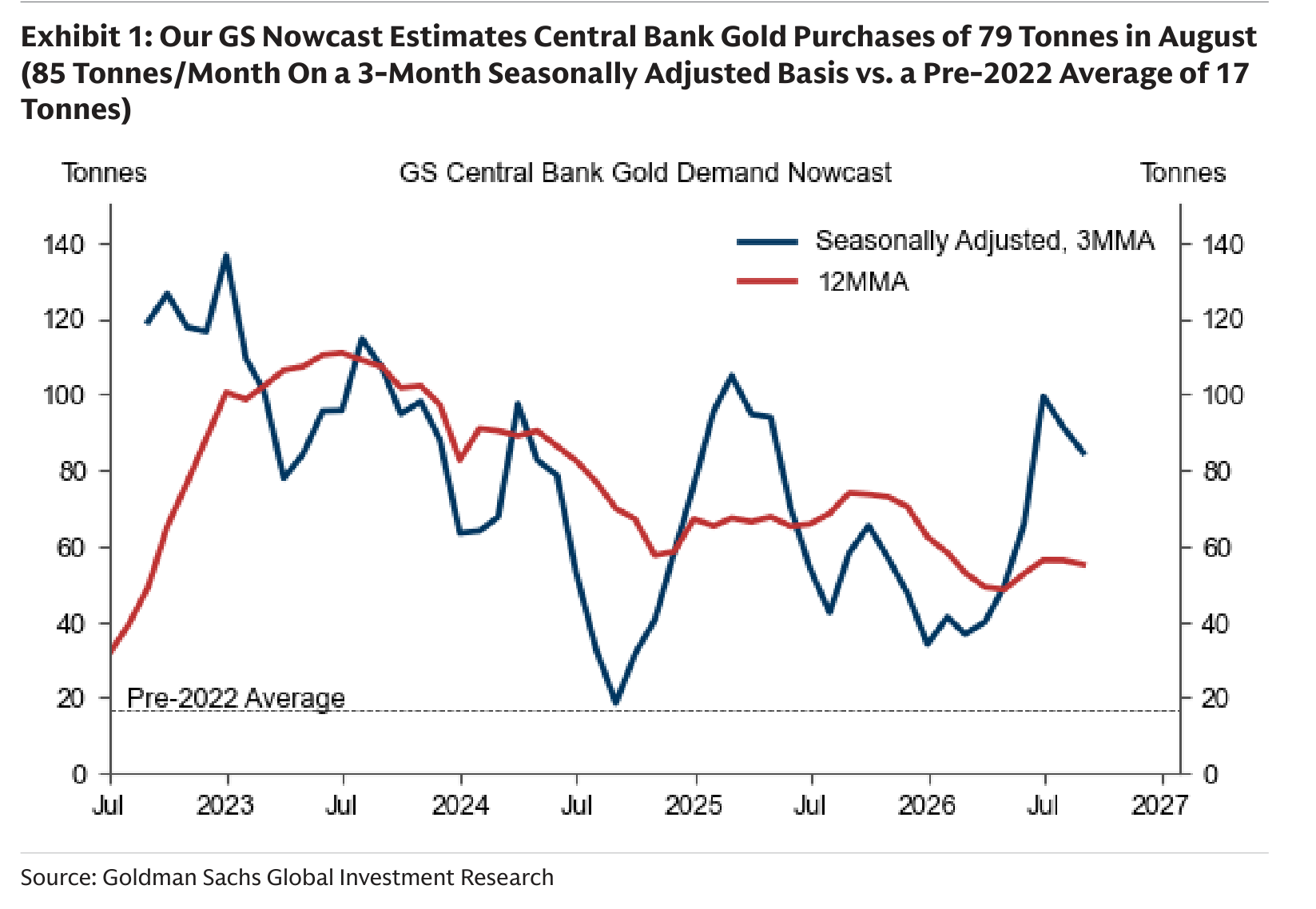
The central banks are buying more gold. Goldman Sachs estimates central banks bought 79 tonnes in August. Before 2022 the average month was 17 tonnes. So the pace is now nearly 5 times the old normal, and they have run at close to that rate for four years.
The fall
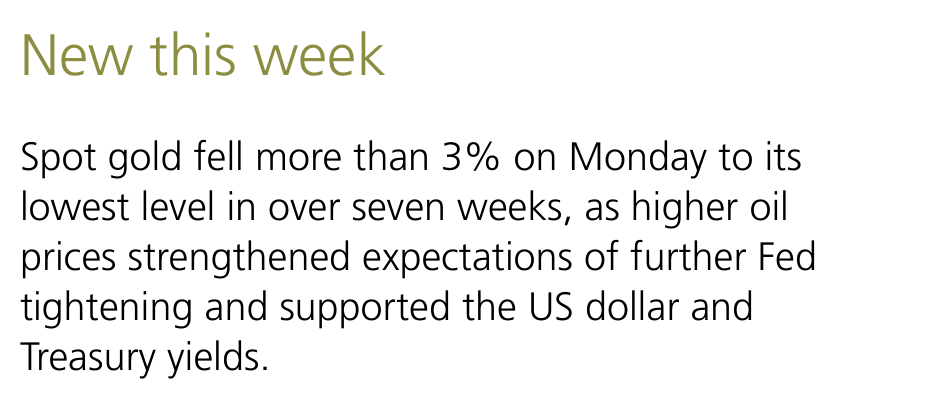
All of this as the price fell to a seven-week low. UBS says spot gold dropped more than 3 per cent in one day. Higher oil prices made markets expect more rate rises from the Federal Reserve, and that lifted the dollar, which is bad news for a metal priced in dollars all over the world. And gold, which pays you nothing, looked less attractive for a while. The central banks kept buying anyway.
The bill
America's interest bill is heading past Social Security. Bank of America puts it at $1.4 trillion over 12 months. And governments that owe this much have an old way out, which they have used many times before, and it works by letting inflation shrink the debt while savers look the other way.
What it means for you
If your cash and your pension earn less than inflation, you pay for that way out. So this report gives you the facts, a plan, and the signs that would tell me I'm wrong.
The Long-Term Story
Who is buying, and how much
- 17 t
- average month of central bank buying before 2022
- 79 t
- Goldman Sachs estimate for August 2026
- 85 t
- a month on a 3-month smoothed basis, 5 times the old pace
The nowcast
Official figures arrive late. Some countries don't report at all. So Goldman builds its own estimate from trade and customs data as it happens. It calls this a nowcast.
For August the nowcast came in at 79 tonnes. That's well over 4 times the old average month.
Four years at double speed
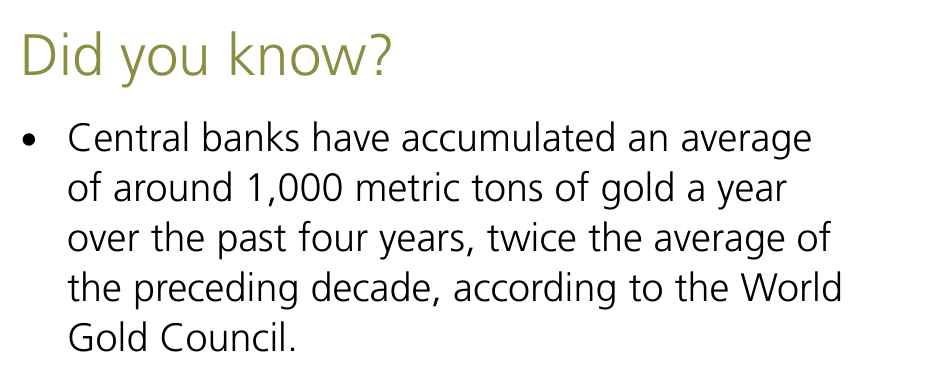
UBS adds the bigger picture from World Gold Council data, and it shows central banks buying around 1,000 tonnes a year for 4 years running, twice the average of the decade before. And it works out at close to 20 tonnes every week.
What changed in 2022?
Goldman names the anchor. It is the freezing of Russia's reserves in 2022.
Every central bank in the world watched a large economy discover that its money held abroad could be switched off overnight, so many of them asked the obvious question. Could that happen to us? And a bar of gold is nobody else's promise to pay.
Will it last?
Goldman expects the reasons to spread reserves away from the big Western currencies to stay in place, and it assumes 50 tonnes a month this year and 40 tonnes a month next year. Even those lower numbers are more than double the old normal.
So if you think this is a one-month blip, the people closest to the data disagree with you.
The Short-Term Story
Why gold fell
Oil, rates and the dollar
The fall is real. So it's worth understanding before you decide anything.
UBS gives a simple chain. Oil prices rose. Dearer energy makes people fear that inflation will stick. So markets began betting that the Federal Reserve, America's central bank, would raise interest rates again. UBS says markets priced roughly a 70 per cent chance of a rise in October. That lifted the dollar and the yield on US government bonds.
Why higher rates hurt gold
Gold pays you no interest and no dividend. So when a government bond pays you more than inflation, holding gold costs you more. Economists call that inflation-adjusted return the real yield. And when it rises, some money walks out of gold.
Goldman Sachs makes the same point. When markets price rate rises, it weighs on gold exchange traded funds, the funds that hold gold for ordinary savers.
The fast money
Goldman tracks 3 kinds of investor demand. Western gold funds. Hedge fund bets in the New York futures market. And options bought as insurance against bad policy decisions. Each of them can walk in and out within a week. Central banks can't, and don't want to.
Forced selling
Now a word of caution. This part is my explanation of how markets work. It is not in the bank reports.
After a big run, gold becomes a crowded trade. Many people hold it through futures, which let you control gold with a small deposit. When the price dips, the broker asks for more deposit. That's a margin call. If you can't pay, you get sold out, and the price drops further. So a fall can feed on itself for a few days without anything changing in the real world.
It has happened before this year
In the summer, markets last priced rate rises. Goldman wrote that gold then climbed 10 per cent from its mid-July low once those fears eased.
So watch the gap between markets and the experts. UBS says markets price 3 more Fed rises by the end of 2027. UBS itself expects 1 more, in December. If UBS is right, a lot of the pressure comes off.
What UBS did with the fall
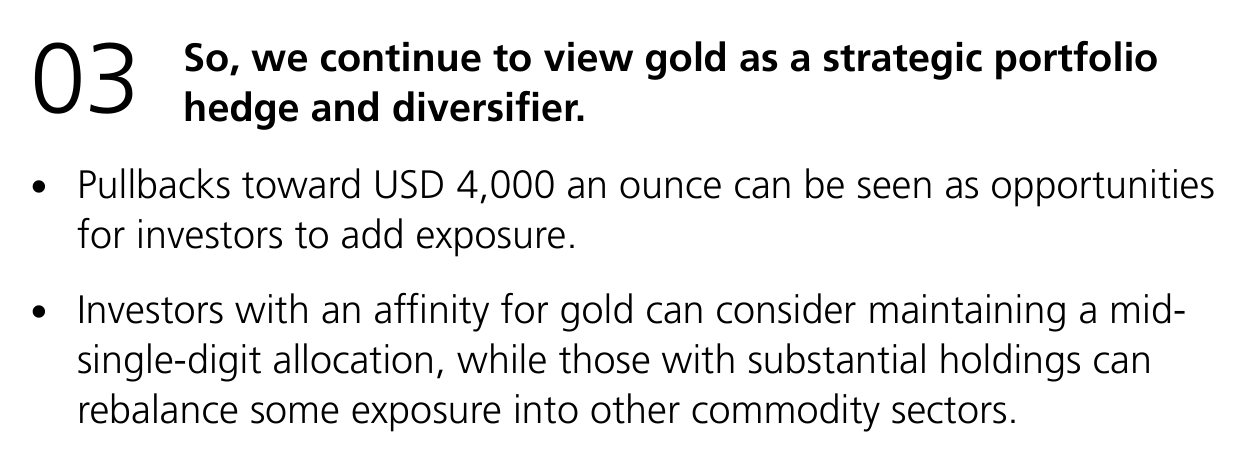
UBS warns the headwinds may keep gold volatile. But in the same note it called the weakness "an opportunity to add exposure". And it named a level. Pullbacks toward $4,000 an ounce, it said, can be seen as opportunities for investors to add.
Bank of America
The five words

Who is Michael Hartnett?
Hartnett is Bank of America's chief investment strategist. His weekly note goes to the bank's big clients, and it is among the most widely read notes on Wall Street, so when he writes a short line, people pay attention.
The rule behind the words
In his latest note he sets out his rules for investing in the 2020s. One of them is Anything But the Dollar. Under it he wrote 5 words. The trade is long gold.
Long just means you own it. You are betting it rises.
What he is hedging against
He calls gold the best hedge against 3 things. The dollar losing value. A collapse in bonds. And the prices of what you own inflating away from your wages.
Put it together
So the central banks are buying at 5 times the old pace. And one of the best known strategists on Wall Street tells his clients to own it.
Why? The answer is a bill.
Debt and Interest
The bill America can't easily pay
The debt
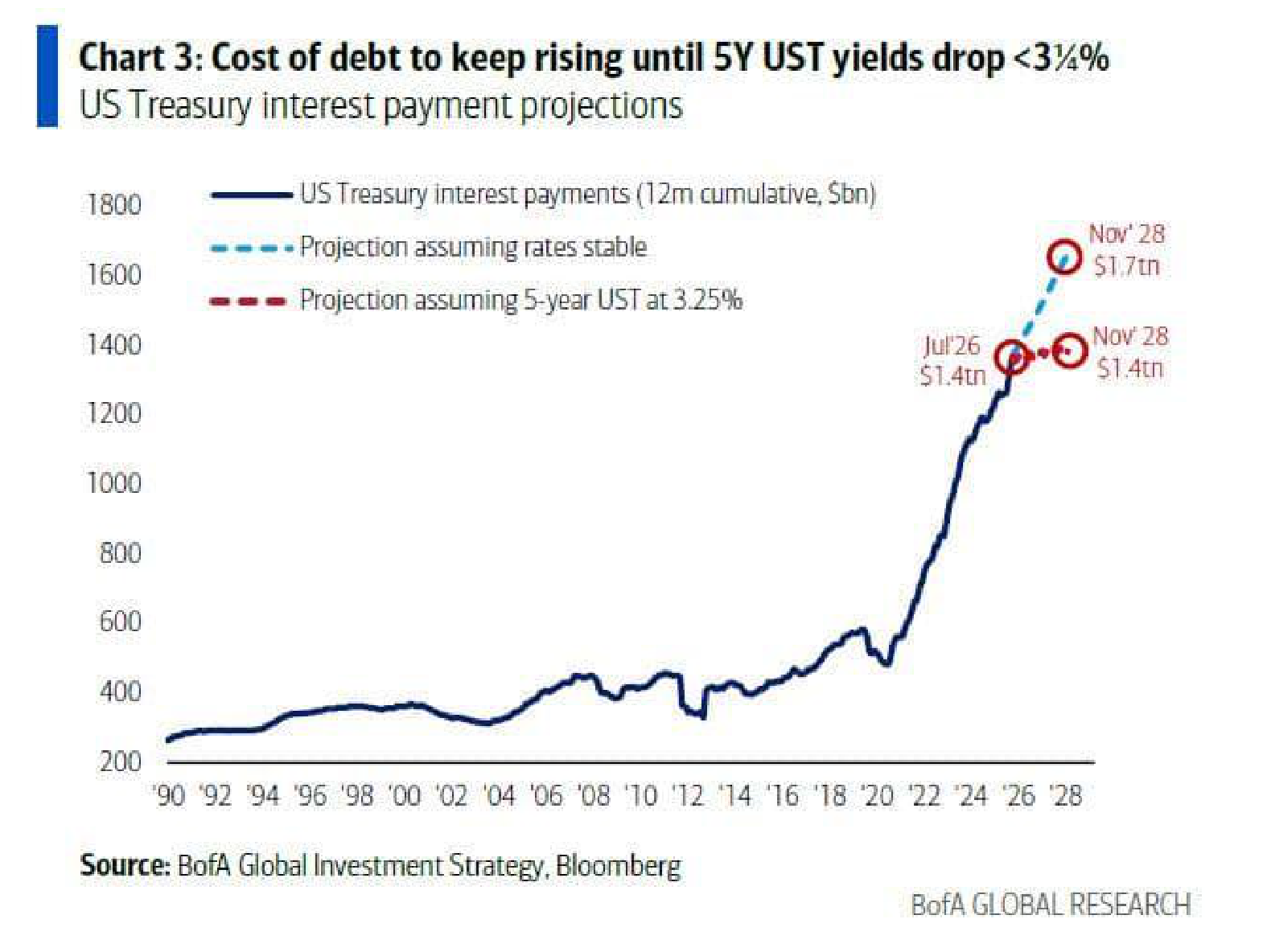
You've heard about America's debt before. Bank of America says it is about to pass $40 trillion. And it is on course for $50 trillion by 2029. Numbers that big stop meaning anything.
The interest
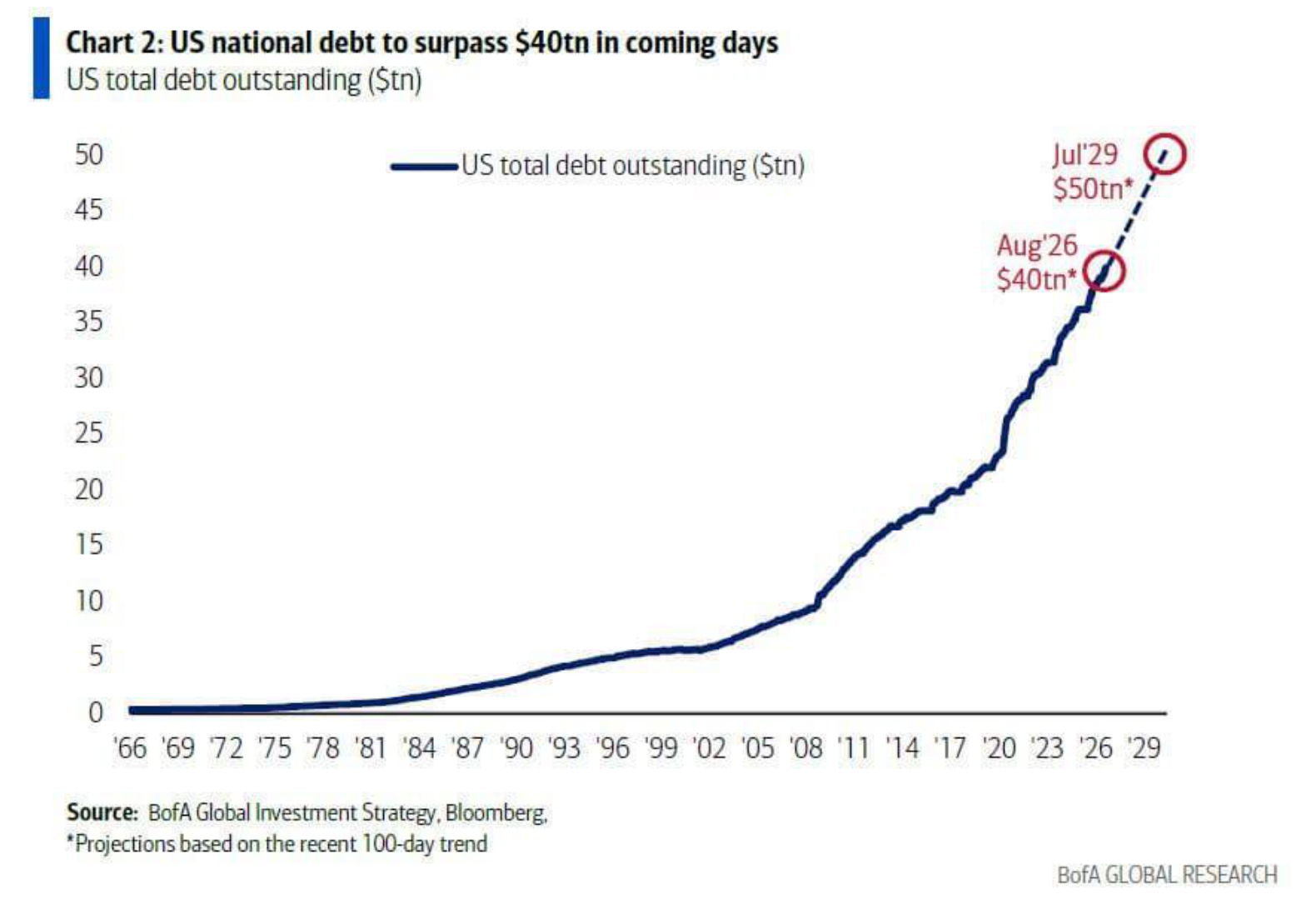
So look at the interest instead. Hartnett puts the cost of servicing the debt at $1.4 trillion over the past 12 months. That puts it on pace to overtake Social Security as the single biggest thing the US government spends money on.
And he says it keeps rising until the 5-year government bond rate drops below 3.25 per cent. His chart shows the bill reaching about $1.7 trillion a year by November 2028 if rates stay where they are.
Danger money
On the day American stocks hit new highs, the government sold 30-year bonds at a yield of 5.126 per cent. That's the highest in 25 years. So Washington had to promise more than 5 per cent a year for 3 decades to borrow. Stocks were celebrating. Lenders wanted danger money.
New competition for your savings
Charlie McElligott, a strategist at Nomura, says borrowing by AI companies and data centres runs at roughly 12 times its yearly average from 2015 to 2024. It is already double the total for all of last year.
Every dollar a pension fund lends to a data centre is a dollar it doesn't lend to the Treasury. That's crowding out. And when the biggest borrower on Earth competes for cash, it pays more.
Who Pays
How governments shrink a debt
The way out
So what does a government do when it owes more than it can comfortably repay?
Hartnett answers in one line. He says investors are convinced that "policymakers see nominal GDP boom as solution to indebtedness". Nominal GDP is the size of the economy before you take inflation out.
If prices rise 4 per cent a year and the debt stays put, the debt shrinks against everything else. Nobody defaults. Nobody votes for spending cuts.
It has a name
Economists call it financial repression. Carmen Reinhart, later chief economist at the World Bank, studied it with Belen Sbrancia.
They found that from 1945 to 1980, real interest rates in the advanced economies were negative roughly half the time. Your savings earned less than inflation. And America and Britain wiped out debt worth about 3 to 4 per cent of their economic output every year that way.
Who pays?
Savers. Anyone holding cash or bonds that pay less than inflation. Which is most people's pension.
Hartnett expects headline inflation of 2.8 to 3.6 per cent by the midterm elections. If your savings account pays less than that, you are going backwards. You just never see the loss on a statement.
The other banks agree
UBS says high government debt and worries about what money will buy keep people reaching for real assets, and it also notes a long-term desire among central banks to depend less on US dollar assets. And Goldman says recent events, including Iran, may push private investors to diversify too.
| Boom | Rise in bond yields before it ended |
|---|---|
| Japan's bubble, late 1980s | About 2.3 percentage points |
| United States, 1999 | About 2.6 percentage points |
Source: Bank of America, Flow Show "Strife Begins at Forty", August 2026. Hartnett also notes the US administration does not want yields above 5 per cent.
The choice
So the authorities face a choice. Let yields run and risk breaking the boom. Or hold them down and let inflation do the work on the debt.
Gold tends to do well in the second case. And it's the case governments have picked before.
The Plan
Gold's role in your portfolio
What the banks say
UBS says central bank buying, reserve diversification, high government debt and geopolitics give gold structural support. So there is a floor of buyers under the price. UBS is positive on gold over the next 12 months.
And it suggests that investors who like gold consider a mid-single-digit allocation. Think around 5 per cent of your portfolio, not 50. That 5 per cent is my illustration of their wording.
Goldman says gold's share of private portfolios is still low. And it sees the risks to its forecast skewed to the upside. If it is wrong, it thinks it is more likely too low than too high.
Step 1: separate the two stories
The fall was about rates, the dollar and forced selling, while the long-term story is about central banks buying gold at 5 times the pace they kept before 2022. Don't let the first scare you out of understanding the second.
Step 2: size before timing
Decide how much before you decide when. If you own no gold at all, ask yourself why. If you hold a huge pile, UBS suggests moving some into other commodities.
Step 3: set your levels while calm
UBS named $4,000 an ounce as the area where it sees pullbacks as an opportunity. You don't have to use their number. But have one. People who decide in the moment tend to buy high and sell low.
Step 4: check your real return
Look at what your cash and your pension earn after inflation, and if the answer is below zero, you are already paying for financial repression, whether or not you ever see it on a statement.
Check the borrowers too
If rates stay high for longer, the companies loaded with debt tend to get hurt first, because they have to refinance at the new, higher rates while their profits stay the same. In the Winston app at winstondaily.com the danger zone filter shows the stocks most at risk. It's the first place I look when rates rise.
Stay Honest
What would change my mind
I don't want you falling in love with any single asset. So these are the 3 things that would make me rethink. None of them is happening right now.
| Sign | What would worry me | Where you can check |
|---|---|---|
| 1. Real interest rates | Savers paid comfortably more than inflation, and it lasts, for years rather than months. | The 10-year inflation-protected Treasury yield (FRED series DFII10) |
| 2. Central bank buying | Goldman's estimates drift back toward the old normal of 17 tonnes a month | World Gold Council central bank statistics; Goldman research via your bank or broker |
| 3. The Fed | The rate rises markets fear actually arrive, one after another | Federal Reserve meeting statements |
One more thing I check each month
| What | Why it helps you | Where |
|---|---|---|
| US interest bill | Shows whether the pressure to inflate the debt away is growing | US Treasury Fiscal Data |
How to use this list
Write the 3 signs down before you buy anything. Then check them once a month, not once an hour.
If one of them turns, it doesn't mean you sell everything. It means you look again at your size. And if all 3 turn, the case for gold gets much weaker.
Why I tell you this
I'd rather tell you what would change my mind than pretend nothing could.
None of this is advice for your personal situation. It's what I'd want somebody to tell my own family.
Bonus
How to buy gold
Three honest routes
There are three honest ways to own gold. Physical metal you can hold. Metal stored for you in a professional vault. Or a fund that holds the gold while you own a share of it.
Route 1: physical metal
Buy coins and bars from a long-established dealer, not a website that appeared last month. The marks of a serious dealer are the same everywhere: membership of the LBMA good-delivery chain, live and transparent pricing, and a published buyback price so you know what they will pay to take the metal back.
| Region | Widely recognised dealers |
|---|---|
| United States | JM Bullion, APMEX |
| Britain | The Royal Mint (government-owned), Atkinsons Bullion, Baird & Co, BullionByPost, Sharps Pixley |
| Europe | Degussa (Frankfurt, with branches across the continent), Pro Aurum, Philoro |
What it costs: the premium
You never pay just the gold price. You pay spot plus a premium, which covers minting and the dealer's margin. The premium falls as the bar gets bigger, because the manufacturing cost is spread across more metal.
| Form | Indicative premium over spot | Note |
|---|---|---|
| 1oz coin (Krugerrand, Britannia, Maple, Eagle) | About 3 to 6% | The sweet spot for most people |
| Small cast bars (1g to 10g) | Often 8 to 15% or more | You pay to make many tiny pieces |
| Larger bars (100g to 1kg) | Often 1 to 4% | The lowest premium per ounce |
Rule of thumb: if anyone charges more than about 8% on a standard 1oz bullion coin, walk away, unless you know you are buying a collector's piece. Premiums are indicative dealer ranges and move with the market.
Bonus
Storage and gold-backed funds
Route 2: storage
A few coins can live in a home safe. Once you own a meaningful amount, you want a professional vault, and one word matters above all others. Allocated.
- Allocated
- Specific numbered bars, legally yours, held in your name and off the vault's balance sheet. If the company fails, your gold is still yours.
- Unallocated
- Only a promise on paper. You are an unsecured creditor standing in the queue. Always choose allocated.
Where, and from how little
The three largest independent vault operators are Brink's, Loomis and Malca-Amit. The jurisdictions most people trust are Zurich, Geneva and Singapore, and proper vaults insure the metal at full value through Lloyd's. If you would rather not arrange it yourself, services such as BullionVault and The Royal Mint's own vault let you buy and store allocated gold from the very first ounce.
Route 3: a gold-backed fund
If you do not want metal in a vault at all, a gold-backed fund holds the gold for you and you buy and sell it like a share.
| Market | Main options and annual fee |
|---|---|
| United States (ETFs) | SPDR Gold Shares (GLD), the largest and most liquid, 0.40%. Cheaper: SPDR Gold MiniShares (GLDM) 0.10%, iShares Gold Trust Micro (IAUM) 0.09%. VanEck's OUNZ can be redeemed for metal. |
| Britain and Europe (ETCs) | iShares Physical Gold, Invesco Physical Gold, WisdomTree Core Physical Gold, around 0.12%. Germany: Xetra-Gold, deliverable as metal. Britain: The Royal Mint's responsibly sourced physical gold. |
Coins and small bars from a long-established dealer, allocated storage in a vault you can trust, or a low-cost gold-backed fund. Three honest routes, no affiliation, no commission. Pick the one that fits how much you own and how much you want to touch it.
Plain English
Plain-English glossary
You don't need a finance degree to follow this. You just need the words.
| Term | What it means |
|---|---|
| Central bank | A country's official bank, such as the Federal Reserve or the Bank of England. It holds the nation's reserves. |
| Reserves | The money and gold a central bank keeps for emergencies and to back its currency. |
| Tonne | 1,000 kilograms. One tonne of gold is about 32,150 troy ounces. |
| Nowcast | An estimate of what is happening now, built from fast data before official figures arrive. |
| Real yield | The interest you earn after inflation. If a bond pays 4 per cent and inflation is 3 per cent, the real yield is 1 per cent. |
| Exchange traded fund (ETF) | A fund you buy and sell like a share. Gold ETFs hold gold for their investors. |
| Futures | A contract to buy or sell at a set price later. You control a large amount with a small deposit. |
| Margin call | A broker's demand for more deposit when a futures position loses money. |
| Long | Owning something because you expect it to rise. |
| Hedge | Something you hold to protect you if something else goes wrong. |
| Anything But the Dollar | Hartnett's rule for the 2020s: favour assets that don't depend on the US dollar. |
| Treasury bond | A loan to the US government. The yield is the interest it pays. |
| Percentage point | The plain difference between two percentages. A rise from 3 to 5 per cent is 2 percentage points. |
| Crowding out | When other borrowers compete for the same savings, so the government pays more to borrow. |
| Nominal GDP | The size of the economy before taking inflation out. |
| Financial repression | Holding interest rates below inflation so that debt shrinks in real terms. Savers pay for it. |
| Debasement | A currency losing what it can buy. |
| BIS | The Bank for International Settlements in Switzerland, a bank for central banks. |
| Allocation | The share of your portfolio in one type of asset. |
| Rebalancing | Selling some of what has grown too large and moving it into something else. |
| Premium (gold) | The amount you pay above the spot gold price when buying a coin or bar. It covers minting and the dealer's margin. |
| Spot price | The live market price of gold for immediate delivery, before any premium. |
| Bullion | Gold in the form of coins or bars, valued by its metal content rather than as a collectible. |
| Good delivery | A LBMA standard for bars that meet set purity and weight rules, so they are accepted across the market. |
| Allocated gold | Specific numbered bars held in your name and off the vault's balance sheet, so they remain yours if the vault company fails. |
| Unallocated gold | A paper claim on gold rather than specific bars. You are an unsecured creditor of the provider. |
| UCITS | European fund rules that require diversification, which is why a single commodity like gold cannot be held in an ordinary UCITS fund. |
| Exchange traded commodity (ETC) | A security backed one for one by physical metal in a vault. It trades like a share and is how Europe offers physical gold. |
Turn Understanding Into Process
Five questions before the next headline
- What do my cash and my pension earn after inflation?
- Do I own any gold at all, and if not, have I decided that on purpose?
- If I own a lot, is it time to rebalance some of it?
- Have I written down the price level and the signs that would make me act?
- Do I own companies that depend on cheap borrowing?
Why now
Most people prepare after the damage is done. By then the prices have already moved. So the time to prepare is now, while you still have choices.
A skill you were never taught
Seeing what the biggest buyers do while your screen tells you to panic is a skill. It isn't your fault nobody taught you. But it is your responsibility to learn it. And you can.
Disclaimer
Figures come from the reports above, as published. The forced-selling and margin-call explanation on page 6 is general market mechanics from The Prehn Institute, not a bank view. The 5 per cent figure on page 10 illustrates UBS's "mid-single-digit" wording. The bonus on pages 12 and 13 names companies for information only; The Prehn Institute has no affiliation with any of them and receives nothing from them. Dealer names and premium ranges are indicative and drawn from independent public sources.
This report is for educational and informational purposes only. It does not constitute financial, investment, legal, tax or accounting advice. It is not a recommendation, solicitation or offer to buy or sell any security, currency, commodity or financial product. No buy or sell rating or price target is provided. All investments involve risk, including the possible loss of principal. Market events, relationships and historical comparisons described here may not repeat. Readers should do their own research and consult qualified professionals before making financial decisions. Past performance is not indicative of future results. The Prehn Institute and Winston make no guarantee regarding outcomes.