
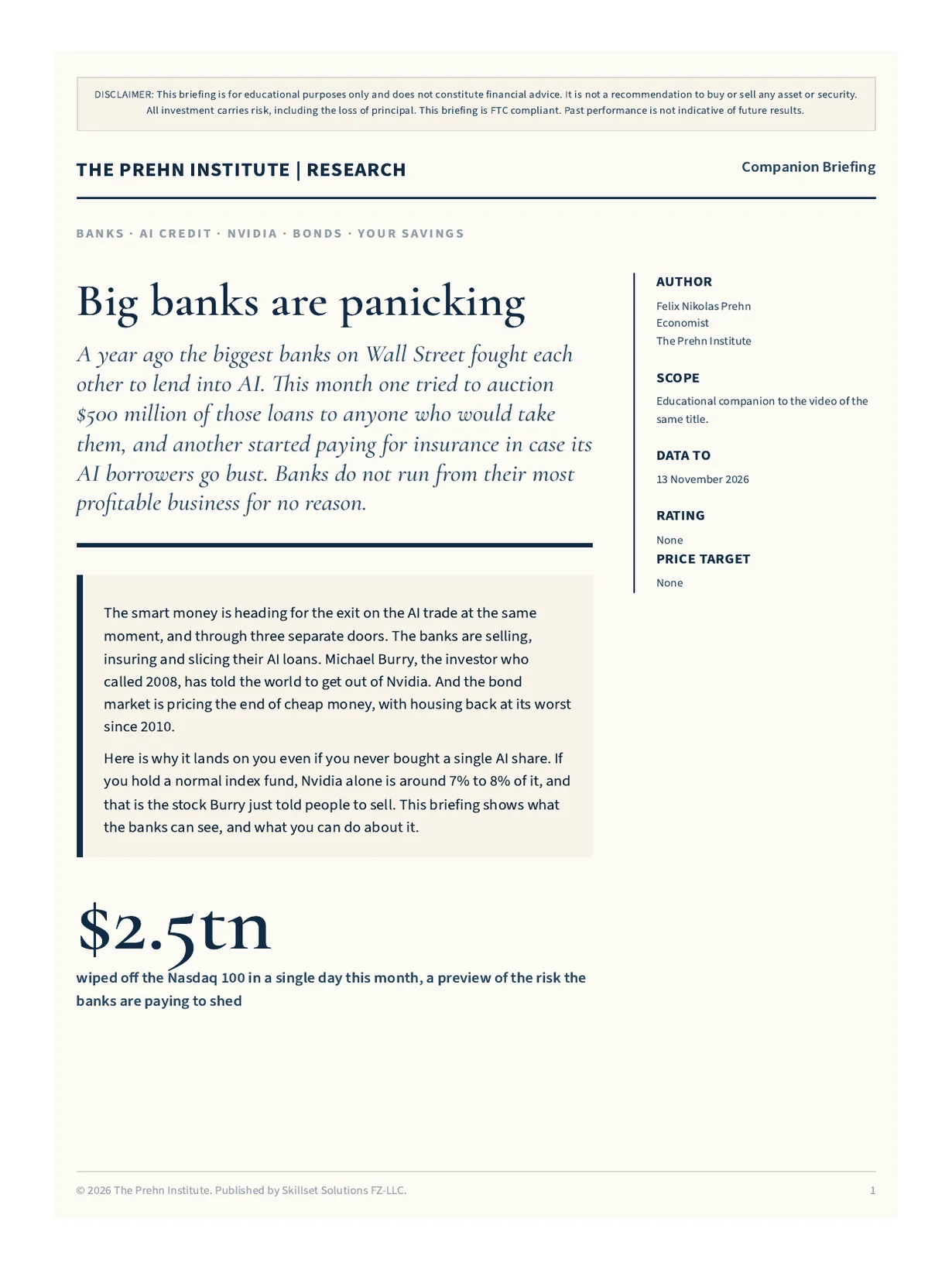
Big banks are panicking
A year ago the biggest banks on Wall Street fought each other to lend into AI. This month one tried to auction $500 million of those loans to anyone who would take them, and another started paying for insurance in case its AI borrowers go bust. Banks do not run from their most profitable business for no reason.
Felix Nikolas Prehn · 13 November 2026 · 13 pages
Bottom line
The smart money is heading for the exit on the AI trade at the same moment, and through three separate doors. The banks are selling, insuring and slicing their AI loans. Michael Burry, the investor who called 2008, has told the world to get out of Nvidia. And the bond market is pricing the end of cheap money, with housing back at its worst since 2010. Here is why it lands on you even if you never bought a single AI share. If you hold a normal index fund, Nvidia alone is around 7% to 8% of it, and that is the stock Burry just told people to sell. This briefing shows what the banks can see, and what you can do about it.
$2.5tnwiped off the Nasdaq 100 in a single day this month, a preview of the risk the banks are paying to shed
The banks are running
Three exits, opened at once
What actually happened is worse than any headline. Start with ING, one of the biggest banks in Europe. A year ago it lent happily into the boom. Data centres, chips, the lot.
But this month it changed course. It put around $500 million of those loans up for auction, a public sale where it asks rival buyers to bid for the debt. The names are ones you know: OpenAI, SoftBank and Oracle.
So why would a bank sell off its own loans? You sell when you want the risk gone before something breaks.
Then there is Barclays, doing the same thing a different way. It is buying insurance on its own AI loans. Every month it pays a premium to firms like AIG and Chubb. If the borrowers cannot pay, somebody else eats the loss.
How much risk are they handing off? Between 20% and 50% of it. And banks do not insure a loan they believe in. They insure a loan that scares them.
- $500m
- of data-centre loans ING put up for auction
- 20-50%
- of AI exposure laid off through credit insurance
- $2.5tn
- off the Nasdaq 100 in a single day
While they did all this, the market gave a preview. In a single day, $2.5 trillion was wiped off the Nasdaq 100, the index of America's biggest tech companies. That is more than the whole economy of most countries. Gone before lunch.
Now here is why it lands on you, even if you never bought a single AI share. Own an index fund, an S&P 500 tracker, a normal pension? Then you already own this.
Nvidia on its own is now around 7% to 8% of the entire S&P 500. One company.
So close to a tenth of your money rides on one stock. It is the very stock Michael Burry just told people to sell. And the other big tech names push that share higher still.

How deep the bank problem goes
How banks slice a loan and hand off the risk
Come under the bonnet. The bank story runs deeper than two or three loans.
There is a thing banks do called a structured risk transfer. It sounds technical. It is simple, and it tells you everything.
Picture one enormous loan to a single data centre, too big to sit on comfortably. So the bank slices it up. It keeps the safe-looking top slice.
Then it pushes the riskiest bottom slice out to private credit funds and insurers. The most dangerous part of the boom gets posted to someone else, in a hurry. And that tells you exactly how the bank rates it.
So where does that risk actually go? This is the part nobody mentions. It does not vanish.
It moves to private credit funds, to insurers, to pension funds hunting a little more yield. So even if your bank gets out clean, the risk can land in the pension paying for your retirement. The hot potato gets passed around a small room. And a lot of ordinary people are sitting in that room without knowing it.
- $29bn
- of data-centre loans at JPMorgan, 12% of its commercial property book
- ~16%
- yield on CoreWeave 2031 notes, the market pricing in real distress
- €200bn
- of euro-area AI loans the ECB is now weighing a review of
This is not a corner of the market. JPMorgan, the biggest bank in America, sits on around $29 billion of data-centre-linked loans. That is now its second-largest slice of commercial property lending, about 12% of the whole book.
One theme. One bet. On a technology that did not exist at this scale three years ago.
Then look at the price the market puts on it. CoreWeave, one of the big AI infrastructure players, has bonds trading at a yield near 16%.
So what does a 16% yield tell you? Lenders are not treating that borrower as safe. They are treating it as something that might not pay them back. And that is distress pricing, in the open, on a company at the centre of the story.
Underneath all of it is something more fragile than any single loan. A lot of the boom is money going round in a circle.
One AI company invests billions in another. That second firm spends it on chips and cloud computing from the first, and from a third. The third signs a giant supply contract back with the first.
On paper every one of them books record revenue. But in reality it is the same pile of money doing laps between a small group of firms. They all depend on each other to survive. And the banks can see that web more clearly than anyone, because they helped build it. So that is exactly why they are trying to climb out.
- One giant invests in another
- That firm buys chips and cloud from the first
- A third signs a supply deal back to the first
- Everyone books record revenue; it is the same money doing laps
The regulators have noticed too. The European Central Bank is weighing a formal review of how much its banks have lent into AI. Across the euro area it already runs to around 200 billion euros. The Bank of England is asking its own banks hard questions about speculative data-centre loans.
So why do central banks suddenly start counting? They are checking the fire exits.
Auctioning the loans. Insuring them. Slicing them. Counting them. Every one of those is the behaviour of people who think the music is about to stop.
Burry says get out of Nvidia
Burry's two reasons to sell Nvidia
Which brings us back to Michael Burry, and the stock you almost certainly own. Burry ran a fund called Scion. In the mid-2000s everyone was convinced house prices only ever went up.
He went through the mortgage loans line by line, saw they were rotten, and bet against the American housing market. People laughed at him. Then he was right, and he made a fortune.
So this is not a man who posts for attention. When he breaks cover and says something plainly, it is worth stopping to listen.
And what he said was blunt. Get out of Nvidia before it is too late. He gave two reasons, and both matter to you.
The first is a single human being. Jensen Huang, the boss of Nvidia. Burry's point is that much of Nvidia's power sits inside one man's relationships. The deals, the loyalty, the ability to keep customers paying top price and waiting in the queue.
So take him out of the picture, for any reason at all. Those customers are suddenly free. They can slow their orders, push back on price, or walk across the road to a competitor. And for a company priced as though nothing can go wrong, that is a frightening amount riding on one person's shoulders.
The second reason should stop you. Burry points out that Nvidia has been helping to finance its own customers' purchases. Read that again. Nvidia sells the chips. And Nvidia also helps provide the money to buy those chips.
So what does that do to the revenue? Some of it is, in effect, Nvidia's own money going out the front door and strolling back in as a sale. It looks like insatiable demand. But underneath, a slice of it is a company lending to itself in a circle and calling the result growth.
- Nvidia sells the chips
- Nvidia helps finance the customer's purchase
- The customer buys the chips with that money
- It books as record demand; some of it is a loop
To be clear, this is not a recommendation to sell anything. That is your decision and your money. But the point is narrower and harder to dismiss.
The one man famous for calling the last crash is heading for the door. His target is the single stock tucked inside nearly every portfolio on the planet, including yours. And he has given his reasons out in the open. So the least you can do is understand them before the rest of the crowd does.
The debt side
The bond market ends the era of cheap money
There is one more door closing, away from the AI story altogether. It is over in the bond market, where the really big money lives. This week America sold $25 billion of 30-year government bonds. The rate it had to pay was 5.441%.
So why should a dry number like that matter to you? The 30-year bond is the benchmark for long-term borrowing across the whole economy. It sets the tone for mortgage rates, for business loans, for the cost of money over the long run. And when that rate stays high, the cheap-money era really is over. The most powerful borrower on Earth now has to pay up like everyone else.
- 5.441%
- rate on the new $25bn, 30-year US government bonds
- 2010
- the last time the US housing market was this weak
- $25bn
- of 30-year debt sold in a single auction this week
You can already see the damage where it hits families first. Housing. The American housing market is now at its worst level since 2010, the wreckage right after the last financial crisis. High borrowing costs freeze the whole thing solid.
Nobody can afford to buy at these rates. Nobody with a cheap mortgage wants to sell and give it up. So the market seizes. And when housing goes, it drags a lot behind it, because so much of ordinary wealth is tied up in the home.
Then you have the Treasury Secretary, Scott Bessent, admitting the bind out loud. He says America can bend its debt problem back under control with growth and spending restraint. That is the confident version.
But what does it really mean? The only clean way out of a debt this size, without a crisis, is a long stretch of restraint that looks and feels a lot like a recession.
So that is the needle they are trying to thread. Grow fast enough to outrun the debt. Do it without triggering the slowdown that servicing the debt is already causing. It is a tightrope. And they are telling you, in careful language, that there is a drop on both sides.
So stand back and look at all of it at once. The banks are backing out of AI.
The government is paying 5.441% to borrow for 30 years. Housing is as bad as it has been in over a decade. And the man in charge of the money is hinting the road out runs through pain.
They belong together. It is the same tide going out, all at once. And a great many people are about to discover they were swimming without a plan.
Returns are lumpy
The 10% a year that almost never happens
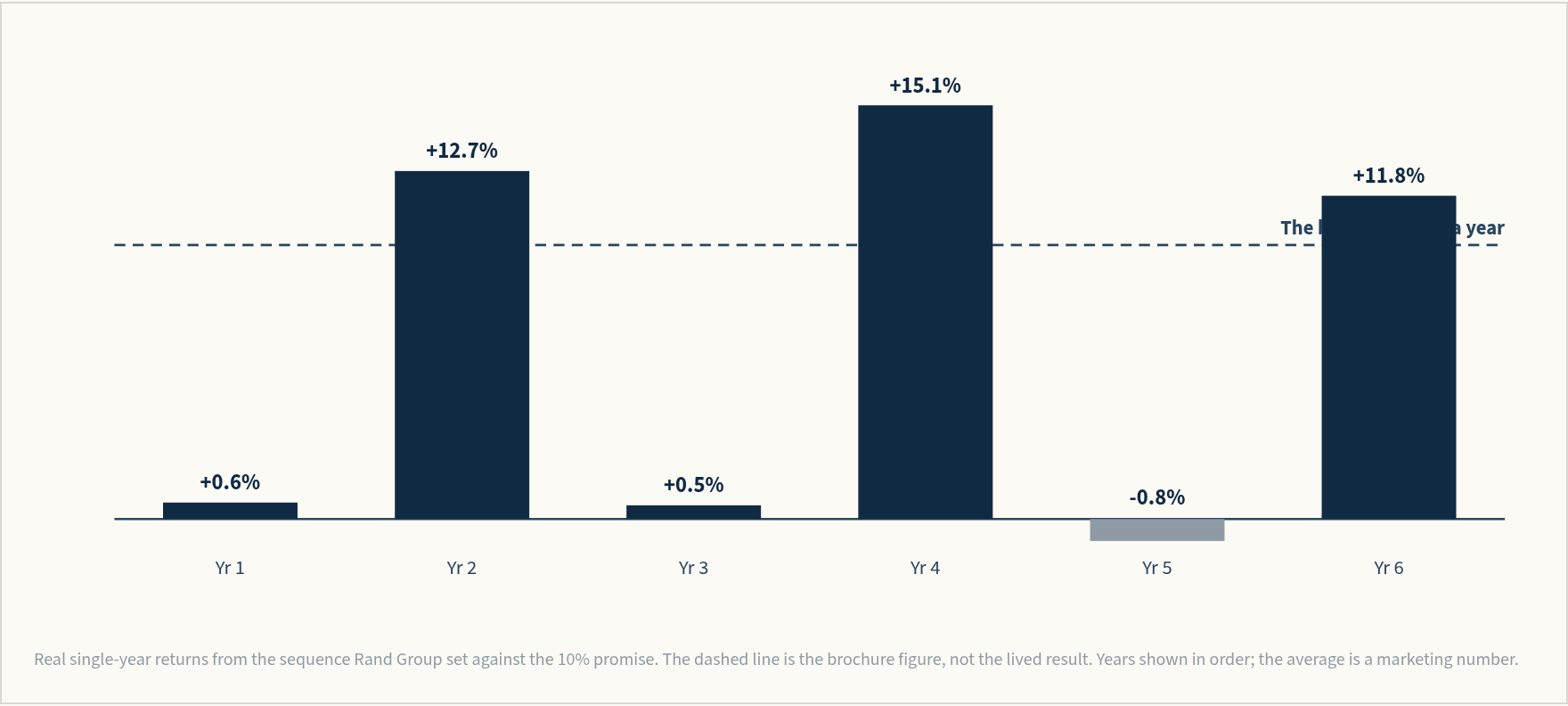
This is the part most people get badly wrong. You have been told your whole life that the stock market returns about 10% a year. It is on every pension form. It is the number every adviser leans on.
But here is the trouble. That 10% almost never happens in any given year.
So look at what real returns can look like over a stretch of years. This sequence comes from the Rand Group, set against that promise. Not the brochure, the reality: 0.6%, then 12.7%, then 0.5%, then 15.1%, then minus 0.8%, then 11.8%. Some of them are brilliant. Some are a decade where your money went nowhere.
And an average can come out near the brochure figure. But you do not live in the average. You live in the actual years, in order. And the order is what decides your retirement.
So what if you retired at the start of one of those flat stretches? You did not get the brochure. You got a lost decade.
Ten years of putting money in and watching it stand still, while the clock on your retirement kept running. And the average is not a promise. It is certainly not a plan.
What a lost decade costs you
What a flat decade does to a $300,000 pension
So picture what that phrase really means. Someone who did everything right. They are 60.
They have saved hard and built up $300,000. They are about to retire. And they are told, as everyone is told, that the market does about 10% a year, so they will be fine.
But then the market hands them one of those flat decades. Not a crash. Just ten years of going nowhere. The 0.6%, the 0.5%, the minus 0.8% years strung together.
Here is the trap. They are not adding money any more. They are drawing it out to live.
So every year they take some out to pay the bills, and the market gives nothing back to refill it. The pot does not stand still. It drains.
By the time the good years finally show up, there is far less money left to enjoy them with. The chart below is an illustration, not a forecast, on simple assumptions. A $300,000 pot, drawing $18,000 a year to live, through a decade that averages about 1% a year.
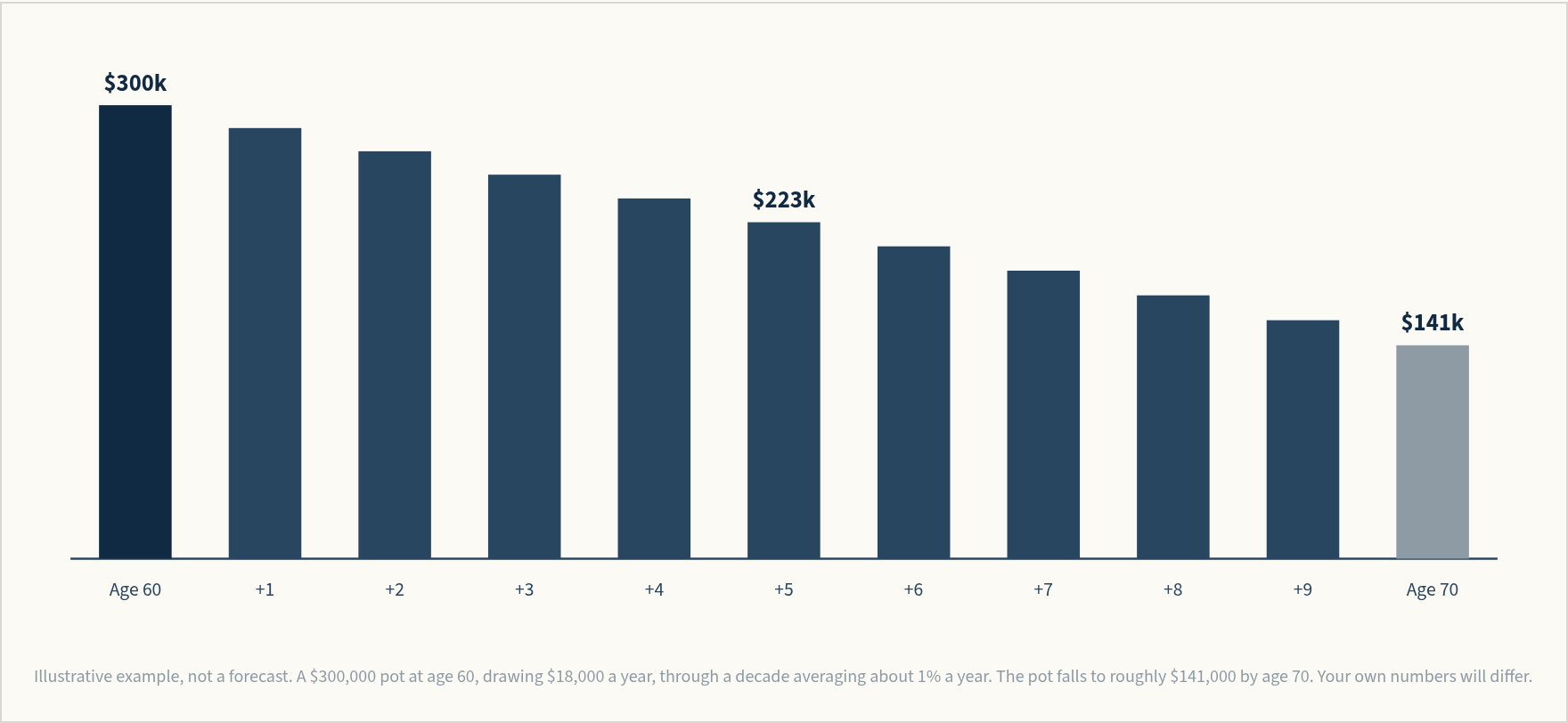
That is how a person who did everything right still runs low in their seventies. Not because they were reckless. They retired into the wrong decade, and nobody taught them what to do about it.
And a flat decade is survivable, genuinely survivable. But only if you position your money before it arrives, not while it is happening to you. So that is the whole reason the smart money, the banks, an investor like Burry, protects itself before the storm instead of after.
| What could change this picture | Window | What it would do |
|---|---|---|
| Banks stop selling and insuring AI loans | Weeks | Removes the clearest tell that insiders rate the risk highly |
| 30-year rate falls back well below 5% | Months | Eases the pressure on housing and on every long-term borrower |
| Nvidia demand proves durable, not financed in a loop | Quarters | Weakens the circular-financing worry Burry is pointing at |
| Money supply growth cools sharply | Quarters | Takes the fuel out of the crowded, top-heavy market |
The data room
Method
Every figure in this briefing is taken from the source listed on the next page, with nothing estimated unless it is labelled as an illustration. Bank and market figures are from primary reporting in November 2026. The single-year return sequence and the market and bond figures posted on X are reproduced as stated by the account named, and the post is linked so you can read the original. The lost-decade chart on page 9 is an illustration on stated assumptions, not a forecast.
The raw numbers
| Figure | Value | Source call |
|---|---|---|
| ING data-centre loan auction | ~$500m | CNBC, 6 Nov 2026 |
| AI exposure laid off via credit insurance | 20-50% | FT, 11 Nov 2026 (AIG, Chubb, AXA) |
| Nasdaq 100, one-day fall | $2.5tn | Investing.com, 9 Nov 2026 |
| Nvidia share of the S&P 500 | ~7-8% | Index weighting; chart uses 7.5% midpoint |
| JPMorgan data-centre loans | ~$29bn | Investing.com, 9 Nov 2026 (12% of CRE) |
| CoreWeave 2031 notes yield | ~16% | Investing.com, 20 Oct 2026 |
| Euro-area AI loans, ECB review | ~€200bn | roic.ai, 6 Nov 2026 (BoE questioning too) |
| US 30-year bond auction rate | 5.441% | @DeFi_Machine, 13 Nov 2026 ($25bn sold) |
| US housing market | Worst since 2010 | @DeFi_Machine, 13 Nov 2026 |
| Single-year return sequence | 0.6 / 12.7 / 0.5 / 15.1 / -0.8 / 11.8% | @randgroup |
| Lost-decade pot (illustration) | $300k → ~$141k | Example: $18k a year drawn, ~1% average |
The Bessent remarks on page 7 (bending the debt curve with growth and spending restraint) are reported comments; the primary wire is being confirmed and the aggregated post is linked on the next page for reference only.
Disclaimer
This briefing is for educational purposes only and does not constitute financial advice. It is not a recommendation to buy or sell any asset or security, including Nvidia or any company named here. All investment carries risk, including the loss of principal. Past performance is not indicative of future results. The lost-decade figures on page 9 are an illustration on stated assumptions, not a forecast. The Prehn Institute takes no sponsorships or endorsements.