
3 million accounts frozen overnight
In 11 days the plumbing of money broke in 7 countries. Here is what happened, how to keep access to your own money, and why the companies paid to stop all this fell about 17% in a single week.
Felix Nikolas Prehn · 9 November 2026 · 15 pages
Bottom line
Paraguay froze about 3 million accounts. Japan watched 128 banks go dark in one afternoon. France lost about 100 million euros to fraud. All inside a fortnight. Nobody in this wave lost much money for long. What they lost was access. So this briefing is about access first, and the sold-off cyber sector second.
7countries where people lost access to their own money in 11 days, late October to early November 2026
The Money Is There. You Cannot Touch It.
Safe on paper, out of reach on the day
- 128
- Japanese banks dark in one afternoon, 6 November
- 3m
- Paraguayans frozen out, about 6 in 10 adults
- $38,200
- Paraguay's deposit guarantee ceiling
Start with Japan. It shows the problem better than anywhere.
Japan has small local banks called shinkin banks. Hundreds of them share one computer system. That system is the master ledger, the single book that knows what sits in every account, and when it stops, every one of those banks stops with it.
On 6 November that shared system failed. Not a hack. A piece of communications kit broke.
And in one afternoon 128 banks went dark together. 3,430 branches. Cash machines dead, including the ones in convenience stores. Apps down. Transfers stopped.
So hold on to the lesson. When many banks share the same plumbing, one fault does not hit one bank. It hits all of them at once.
You might be thinking you do not bank in Japan. So why does this matter? Because the same week, on the other side of the world, people lost access a completely different way.
Paraguay had a bank called Ueno. It had lent far too much to firms linked to its own owners. That breaks the rules, for good reason.
So the central bank shut it down. The moment it did, almost 3 million customers were frozen out. Accounts, cards, the app, the cash machines. All dead.
That is roughly 6 in 10 adults in the whole country.
The state guarantee paid people back. But only up to a ceiling, about $38,200. And for a lot of savers that was a fraction of what they had in there.
Now look at the two side by side. Japan: the plumbing broke. Paraguay: a regulator shut the door.
Different causes. Same result for the ordinary person. So the money was there on paper, and they could not touch it.
And that is the thing almost nobody plans for. There are three ways to lose access to money that is yours. The plumbing breaks. Someone steals it. Or a regulator shuts the bank. Most people have planned for none of them.
11 Days, 7 Countries
A fortnight of broken plumbing
I will run the fortnight quickly. The pattern matters more than any single story.
| Date, 2026 | What happened | Verified figure |
|---|---|---|
| 29 Oct | Binance hacked; the FBI blames North Korea | $6.3bn stolen, the largest crypto theft on record; users made whole within days |
| 3 Nov | Paraguay puts Ueno Bank into resolution (a solvency failure, not a hack) | about 3m customers frozen, about 6 in 10 adults; guarantee up to about $38,200 |
| 3 Nov | Bank SinoPac (Taiwan), a supplier's settings exploited | NT$41.76m from 419 accounts, all refunded the same day; new app pulled offline |
| 4 Nov | Crédit Mutuel Arkéa (France), through an outside provider | about €100m from the bank's own accounts; 5.8m customers warned of fraud to follow |
| 5 Nov | South Korea's regulator reports a run of attacks | 37 financial firms, about 473,000 records, about ₩1bn stolen |
| 6 Nov | Japan: 128 of 236 shinkin banks on one shared system go dark | 3,430 branches; ATMs, counters, apps and transfers down; cause was equipment, not a hack |
| 6 Nov | GOPAX (Korean crypto exchange) freezes deposits, withdrawals and trading | after a hack threat; no restart date given |
Dates are when each event was reported. Figures are from primary or major news sources; see the sources page. French supermarket fridges were also turned up towards 50°C across about 700 stores in mid-October.
So notice two things. They are where the use is.
First, look at who actually lost money. In most cases it was the institution. The customers were made whole. What the customer lost was access.
The app was down. Withdrawals frozen. Transfers suspended. So for a few hours or a few days your money was there and you could not use it.
Second, look at how they got in. Again and again it was not the bank's own front door. It was an outside supplier, or a shared system between firms.
And the weak point is the plumbing you never see and can never check.
Rehearsing Behind Closed Doors
The people in charge are preparing for worse
Once or twice a year the International Monetary Fund publishes a report on what could break the world's financial system. So when the IMF names a threat, people listen.
This time, for the first time, it put cyberattacks at the top. As a risk to the whole system, not one unlucky bank. The reasoning is what we just watched.
Everyone leans on the same digital plumbing. A handful of tech suppliers sit underneath all of it. And the attackers now have artificial intelligence making them faster.
She grew up behind the Iron Curtain, so the warning is not idle. And the head of the Bank of England has said much the same.
And here is how seriously they take it. The finance chiefs of the G7 have agreed to run a drill. A rehearsal of an AI attack on the banking system, to see if it holds. Governments do not rehearse for things they think cannot happen.
One more piece of background, and I will be straight about it. America has a new law for digital dollars, the GENIUS Act. It is not new. It passed last year.
But its rules switch on in January, about 70 days out. And one detail is worth knowing. The firms that issue these digital dollars must be able to freeze them, to switch them off, on a lawful order.
The money of the future is being built with an off switch inside it.
So put it together. The people who run the system are rehearsing in private for the day it fails. The message to the public is that everything is secure. When those two do not match, you do not panic. You prepare.
Your Access Plan
Five steps I use myself
This is what I do myself. None of it is complicated or expensive. Five steps. Write them down.
- A cash buffer you can reach without any bank: I keep about a month of essential spending in cash, somewhere safe, and never let it drop below two weeks. Not a hoard. Not an investment. Just enough to keep the lights on and food in the house if your cards stop for a few days.
- A second bank on a different system: Remember Japan: 128 banks fell together because they shared one set of plumbing. Two accounts on the same supplier give you no backup. Fund the second one for your essentials.
- Check your deposit insurance: In America it covers $250,000 per person, per bank, per type of account. Britain and the European Union have their own limits. Paraguay's savers learned the ceiling the hard way. Five minutes now saves a nasty surprise later.
- A paper copy of what you would need if the apps were dead: Your bank's real phone numbers, your account details, a couple of emergency contacts. Somewhere safe. It sounds old-fashioned until the day the app will not load.
- Assume a scam wave after any big hack: That is exactly what the French bank warned its customers about. Never act on a call or text that says it is your bank. Hang up, and ring the number on the back of your own card.
Someone always says cash loses value. True, a little. But that misses the point. This is not about growing the money, it is about being able to reach it on the worst possible day, the day the app is down and the branch is dark and everyone around you is working out what to do. So access first, growth second. You do both. You just do access first, because it is the part that bites.
The one-month buffer is my own rule of thumb, not a target for you. Pick a number that fits your own spending.
The Market Got It Backwards
The defenders got sold off mid-attack
There is an old rule I live by. For every disaster, there is a win buried in it, if you are calm enough to look.
You would expect the companies that sell protection against hacking to boom during the biggest hacking wave on record. The opposite happened. And in the same week, the biggest names in cybersecurity fell about 17% each. The defenders got sold off in the middle of the attack.
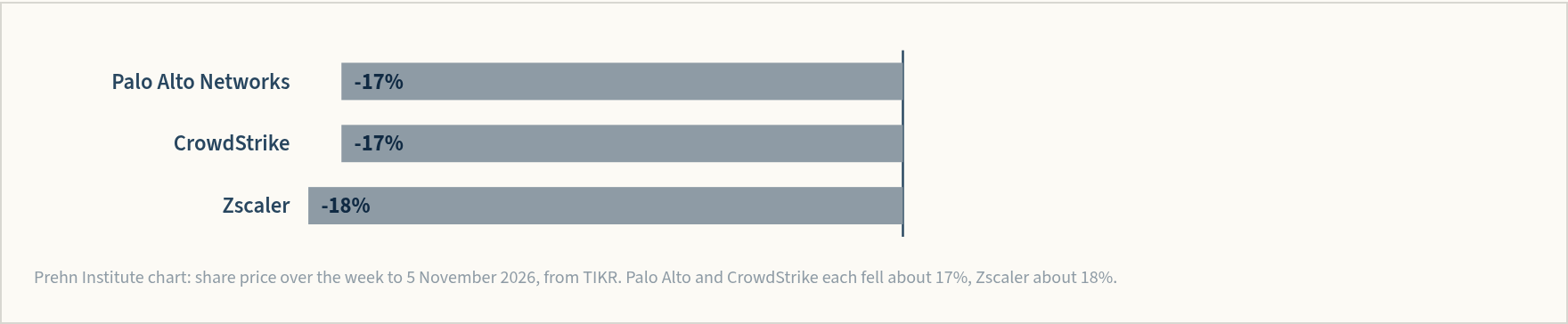
So why did they fall? Not because anyone stopped needing them. Two reasons, and neither is about demand. A rival reported slowing growth, and the whole sector got tarred with it. And it fell inside a wider tech sell-off after the US elections. The shares were expensive to begin with, priced for perfection, so they had far to fall.
But banks and governments will spend more on security after this fortnight, not less. The market overreacted, the way it almost always does to a scare.
Here is the same mistake in miniature. On the day Japan's banks went dark, the shares of Japan's big banks fell about 6%. Social media shouted that Japanese banks were collapsing. They were not.
That fall was about interest rates and nerves after the US vote rather than the outage, which is exactly the kind of story that spreads fast and turns out to be wrong. So do not trade the headline. The headline is almost always wrong.
Cyber Funds In The Winston App
A sharp scare, not a broken trend
This is how I look at the sector myself, in the Winston app, the research tool my team and I built.
So start with the funds. For most people a fund is the sensible way in, because you own a slice of lots of these firms at once instead of staking everything on the one name that happens to stumble. And here they are, sorted by their Winston score, our own rating out of 100.
| Fund | Winston score | Size ($bn) | Fee (%) | Off 52-wk high | vs 200-day |
|---|---|---|---|---|---|
| IHAK iShares Cybersecurity and Tech | 71 | 1.26 | 0.47 | −14.6% | +17.4% |
| HACK Amplify Cybersecurity | 69 | 3.55 | 0.60 | −17.4% | +13.1% |
| WCBR WisdomTree Cybersecurity | 69 | 0.23 | 0.45 | −20.3% | +21.2% |
| BUG Global X Cybersecurity | 66 | 2.27 | 0.50 | −17.7% | +22.7% |
| CIBR First Trust Nasdaq Cyber (largest) | 66 | 15.78 | 0.58 | −17.7% | +8.7% |
| LOCK.L iShares Digital Security (UK/EU) | 76 | 2.30 | 0.40 | −12.8% | +6.8% |
| ISPY.L L&G Cyber Security (UK/EU) | 67 | 3.12 | 0.69 | −15.5% | +13.5% |
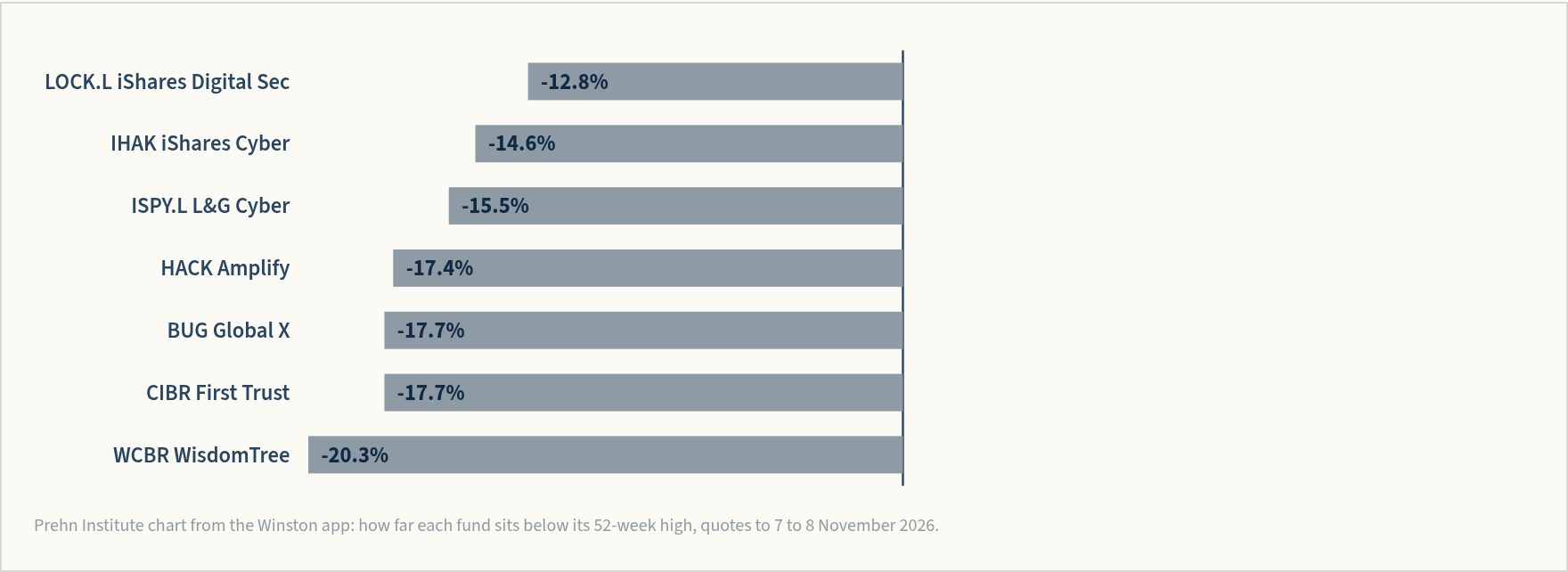
So notice the shape. And almost all of them sit well below their highs for the year. But still above their longer-term trend line. A sharp scare, yes. A broken trend, not yet.
Cyber Shares, And The Watch List
Cheap and steady, or priced for perfection
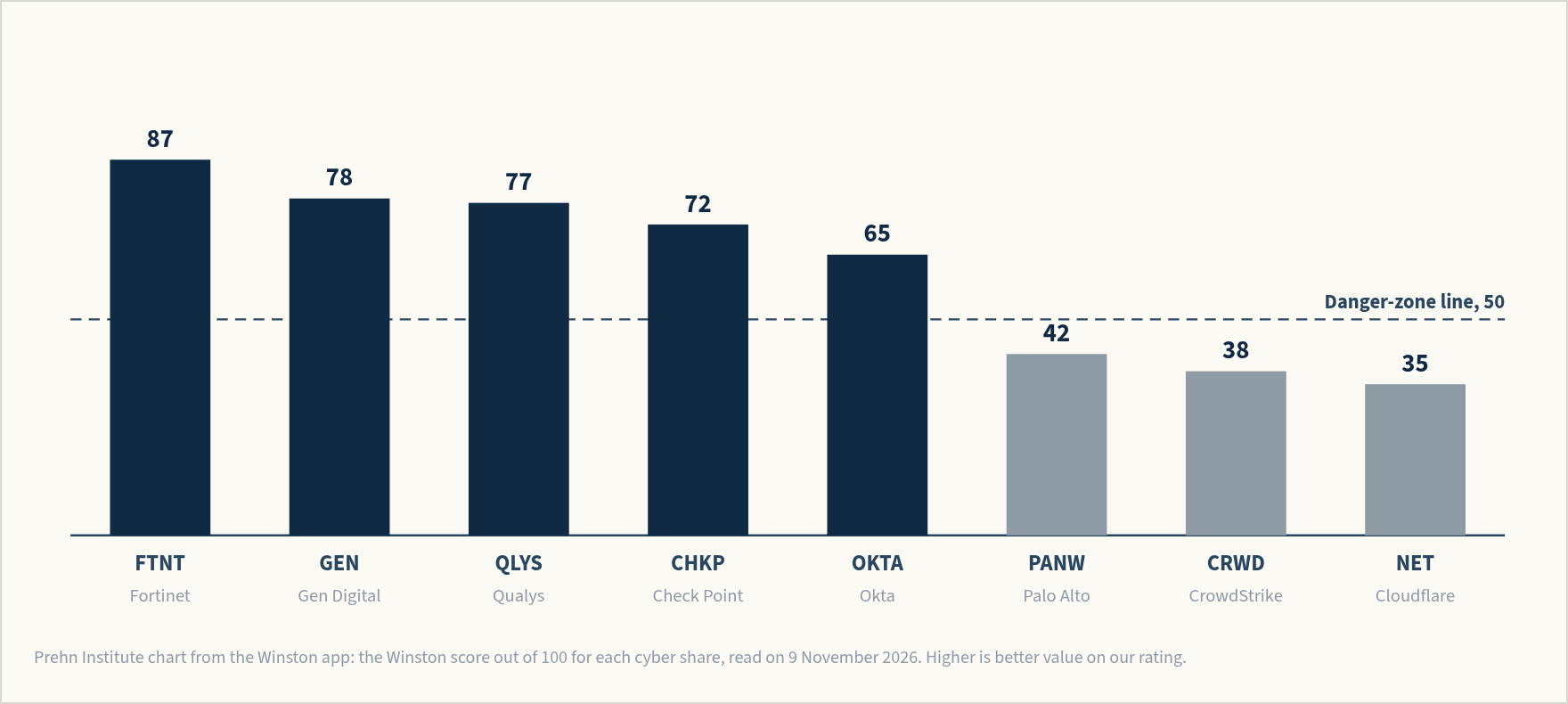
Now the individual companies. So this is where it gets interesting.
The one our system rates highest is Fortinet, in the high 80s. Why? It is profitable. It is growing at a healthy clip.
And you are not paying a silly price for it. Gen Digital and Qualys score in the high 70s for the same reasons.
Then the famous ones. Palo Alto in the low 40s. CrowdStrike in the high 30s. Cloudflare in the mid 30s. Brilliant firms, growing fast.
But look at the price. You pay so much for that growth that there is no room for a single disappointment. That is not a flaw in the company. It is a warning about the price you pay to own it.
| Share | Winston score | Fwd P/E | Revenue growth | Score date |
|---|---|---|---|---|
| Fortinet FTNT | 87 | 32 | +20.5% | 30 Oct |
| Gen Digital GEN | 78 | 8 | +12.2% | 7 Nov |
| Qualys QLYS | 77 | 25 | +11.0% | 4 Nov |
| Check Point CHKP | 72 | 14 | −1.1% | 4 Nov |
| Okta OKTA | 65 | 38 | +10.6% | 3 Nov |
| Palo Alto PANW | 42 | 65 | +34.4% | 1 Nov |
| CrowdStrike CRWD | 38 | 120 | +25.8% | 24 Sep |
| Cloudflare NET | 35 | 116 | +39.2% | 6 Nov |
So what do you do with that? Nothing hasty. This is a watch list, not a buy list. A buy list says act now. A watch list says here is what I am waiting for.
| What I am watching | When | What it would tell us |
|---|---|---|
| Japan megabank results | 13 Nov | whether the 6% one-day fall in bank shares was overdone |
| Palo Alto earnings | 18 Nov | whether the growth slowdown is sector-wide, or just one rival |
| CrowdStrike and Zscaler earnings | 1 to 2 Dec | the same test for the two most expensive names |
| GENIUS Act takes effect | 18 Jan 2027 | digital-dollar rules start; issuers need the tech to freeze tokens |
| The 200-day line | Ongoing | a fund that closes below it cancels the overreaction read |
Triggers, not feelings. You decide what matters before any money is on the line.
What If I Am Wrong?
Where this could be wrong
Let me argue against myself. You should be suspicious of a man who only tells you one side.
What if I am overcooking the danger? Fair. Most of these outages were fixed within hours or a day. Most victims got their money back.
The great majority of people never lost a penny. And overpreparing has a cost of its own. So do not turn your house into a bunker. A buffer, not a hoard.
And the shares? I could be wrong there too. Cybersecurity shares can fall further if growth really is slowing across the whole sector rather than at one firm, and the price you pay today leaves almost no room for that. Palo Alto's results are the first real test. And if those funds break below their long-term trend line, I will say so and stand aside.
| What could spoil it | Window | What it would do | Nearest analogue |
|---|---|---|---|
| The slowdown is real | PANW 18 Nov, CRWD 1 Dec | the scare was right and the defenders fall further | Fortinet's product growth slipped from 52% to 37% and dragged the group down |
| The funds break the trend | Any week, watch the close | a close below the 200-day average kills the overreaction read | the cyber funds already sit 13% to 20% below their year highs |
| Overpreparing | Ongoing | cash at home can be stolen and loses value to inflation | a buffer that grows into a hoard costs you every year |
| A fresh access shock | Any week | another outage or seizure freezes accounts again | Japan's 128 banks and Paraguay's 3 million, 11 days apart |
So decide what would change your mind before you have money on the line, not after. And here is the comfort in all of it.
If you have an access plan and a watch list with clear triggers, it almost does not matter which way this goes. Nothing happens, you have lost nothing but a little time. Something does, and you are the calm one. Plan for that, and you come out ahead either way.
Which Decade Are You Standing In?
Same market, very different decades
One last thing. It matters more than any single hack.
People trust another number they never check. The idea that the market just grows about 10% a year, forever, like clockwork.
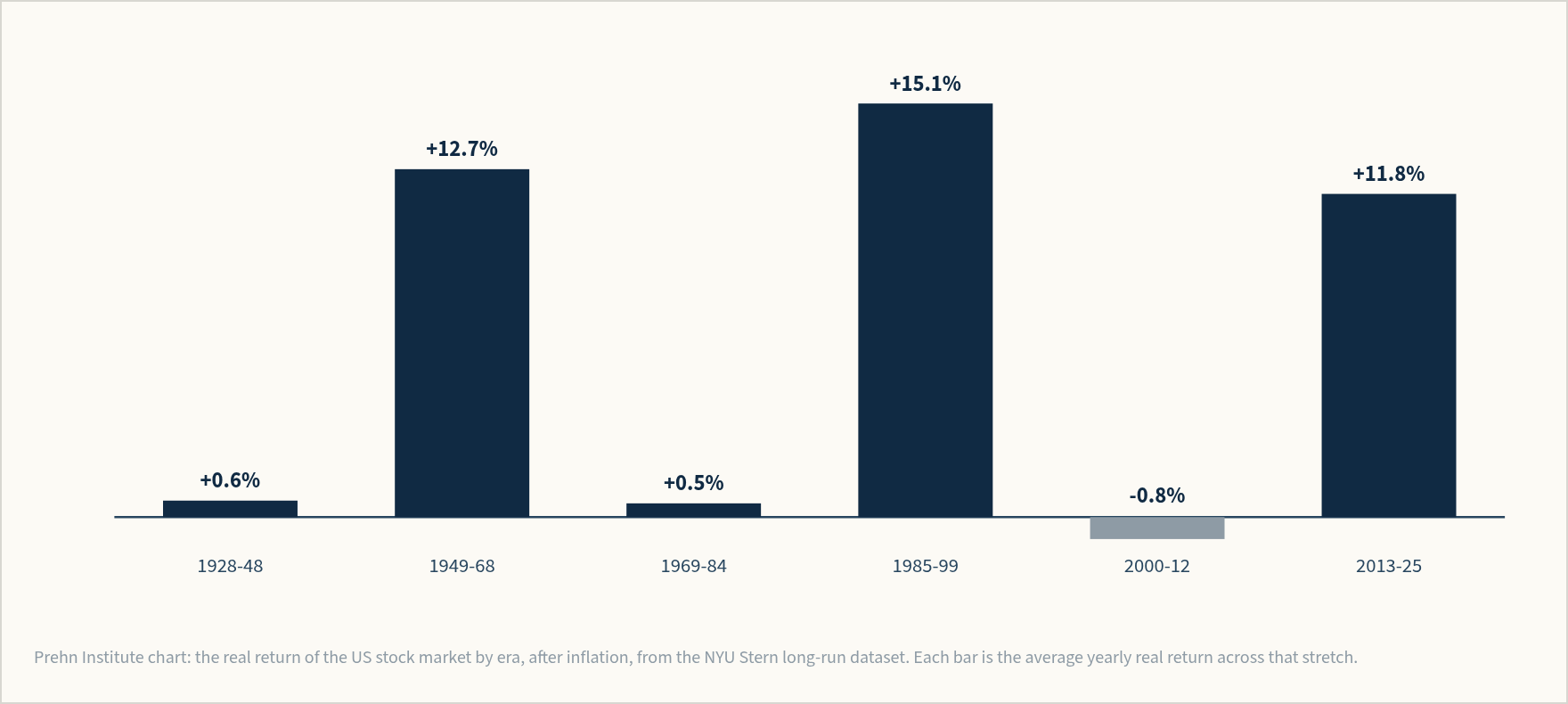
Here is the real return of the American market, by era, after inflation. The chunks could not be more different. There are long stretches, 15 years at a time, where after inflation you made almost nothing. And then stretches where you made a fortune.
So the honest question is not what the market returns. It is which decade you are standing in. Retire at the wrong moment and your so-called 10% was close to zero for 15 years. And no amount of hoping fixed it.
If you are 55 today, you may only get one or two more of these stretches. One. Maybe two.
So which one are you in right now? That is not a rhetorical question. It is the single most important thing for your money. And almost nobody can answer it.
Data and method
Data room
This page gives the method and the raw figures behind every chart, so you can rebuild them yourself rather than take our word for it.
Method
The incident figures Each one is drawn from a primary source (a bank or regulator release) or a major news report, listed on the sources page. Where a figure is an estimate or an order of magnitude, it is marked “about”.
Winston scores The Winston score is our own rating out of 100, read from the Winston database on 9 November 2026 (ETFData.winstonScore for funds, StockData.cachedGoatScore for shares). Each share's score date is shown in the table on page 10, because scores refresh on a rolling basis. CrowdStrike's score dates from 24 September, so treat it as the oldest reading here.
The weekly share falls The about 17% and 18% falls over the week to 5 November are TIKR's figures for Palo Alto, CrowdStrike and Zscaler. Our own price feed is used for the Winston scores and fund distances.
Real returns by era Average yearly real return of the US stock market, after inflation, from the NYU Stern long-run dataset.
Cyber defenders, week to 5 November 2026
| Share | Week |
|---|---|
| Palo Alto Networks | −17% |
| CrowdStrike | −17% |
| Zscaler | −18% |
Real US stock returns by era, after inflation
| Era | Real return a year | Era | Real return a year |
|---|---|---|---|
| 1928 to 1948 | +0.6% | 1985 to 1999 | +15.1% |
| 1949 to 1968 | +12.7% | 2000 to 2012 | −0.8% |
| 1969 to 1984 | +0.5% | 2013 to 2025 | +11.8% |
Where the figures come from
Fund scores and distances were read from the Winston database on 9 November 2026, with daily closes from financialmodelingprep.com/stable/historical-price-eod/light . The incident figures were gathered from the releases and reports on the sources page.
Disclaimer
This briefing is for educational purposes only and does not constitute financial advice. It is not a recommendation to buy or sell any asset or security. All investment carries risk, including the loss of principal. Past performance is not indicative of future results. The Prehn Institute takes no sponsorships or endorsements.