
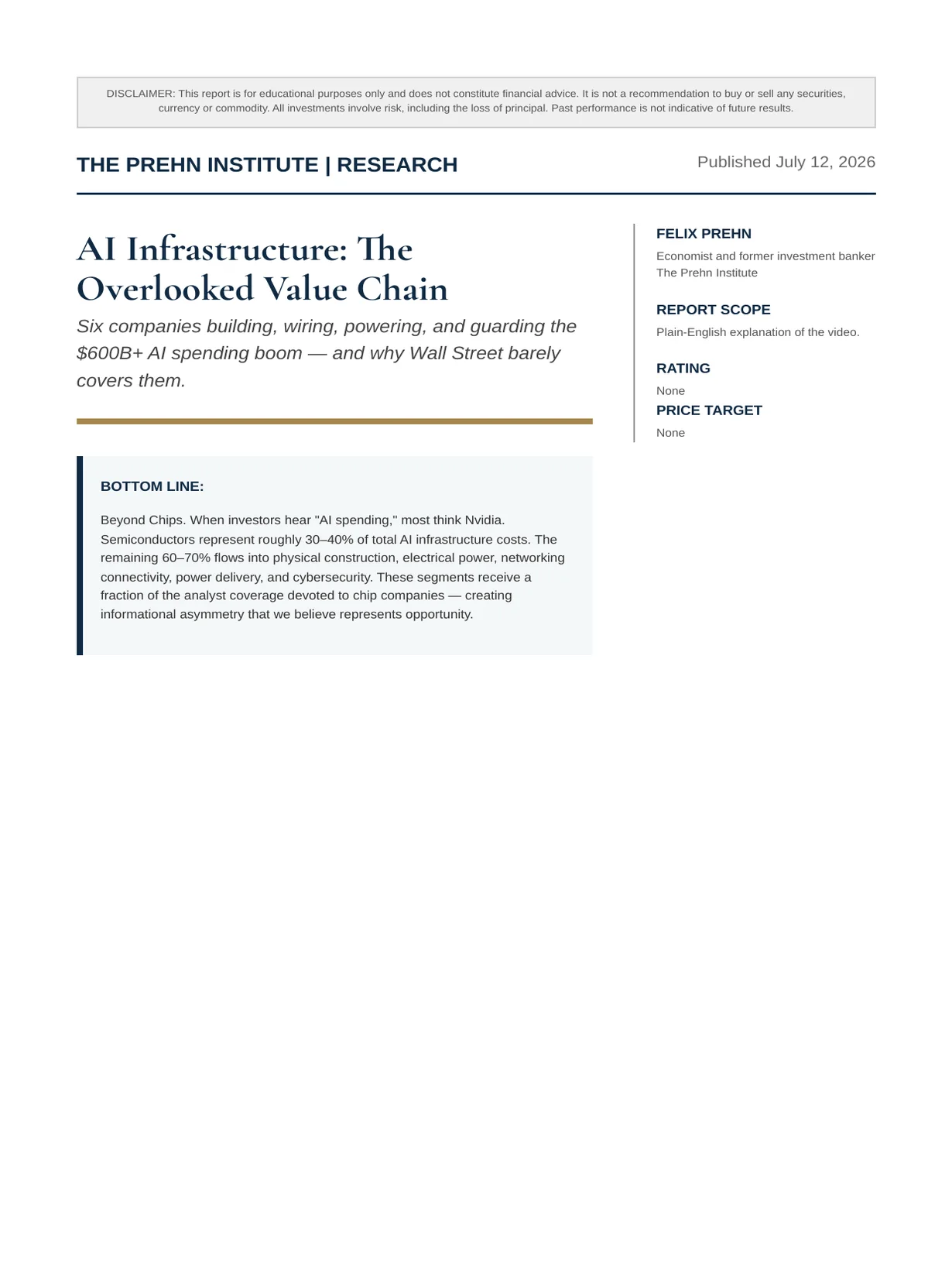
AI Infrastructure: The Overlooked Value Chain
Six companies building, wiring, powering, and guarding the $600B+ AI spending boom — and why Wall Street barely covers them.
Felix Nikolas Prehn · 12 July 2026 · 20 pages
Bottom line
Beyond Chips. When investors hear "AI spending," most think Nvidia. Semiconductors represent roughly 30–40% of total AI infrastructure costs. The remaining 60–70% flows into physical construction, electrical power, networking connectivity, power delivery, and cybersecurity. These segments receive a fraction of the analyst coverage devoted to chip companies — creating informational asymmetry that we believe represents opportunity.
Overview
Sources & Citations
Global TechnoloGy · InfrasTrucTure · cybersecurITy
AI Infrastructure: The
Overlooked Value Chain
Six companies building, wiring, powering, and guarding the $600B+ AI
spending boom
BOTTOM LINE:
THE INVESTMENT LANDSCAPE
The Spending War. Every major technology company — Microsoft, Google, Amazon, Meta, Apple
- has committed to an unprecedented AI infrastructure build-out. Total AI-related capital spending exceeds $600 billion in 2026, with AI- specific investment estimated at $450–500 billion. To contextualize this: the figure surpasses the GDP of Sweden and Argentina. In one year. On one technology.
Beyond Chips. When investors hear "AI spending," most think Nvidia. Semiconductors represent roughly 30–40% of total AI infrastructure costs. The remaining 60–70% flows into physical construction, electrical power, networking connectivity, power delivery, and cybersecurity. These segments receive a fraction of the analyst coverage devoted to chip companies — creating informational asymmetry that we believe represents opportunity.
The Bottleneck Shift. The primary constraint on AI deployment has shifted from chip supply to physical infrastructure. Over 140 large-scale data center projects (each exceeding 50 megawatts) are under construction or in planning across the United States alone, representing approximately 5 gigawatts of computing capacity. Industry analysts project over $3 trillion in cumulative data center spending by 2030. The number one bottleneck is no longer semiconductors — it is electrical power.
MAPPING THE AI INFRASTRUCTURE
VALUE CHAIN
We divide the AI infrastructure value chain into three layers, each representing a distinct investment thesis:
Layer 1: Build Construction & Power STRL · AGX Layer 2: Connect Data & Power Delivery CRDO · VICR Layer 3: Guard Security & Identity OKTA · CLBT
Layer 1 — Build. Data center construction and power plant development. These companies build the physical shells that house AI computing and the electrical generation capacity to power them. Revenue is largely contracted through multi-year backlogs, providing unusual earnings visibility for the construction sector.
Layer 2 — Connect. Semiconductor enablers that solve the two critical bottlenecks inside the data center: data connectivity between chips and precision power delivery to GPU racks. These are high-margin, technology-driven businesses with strong moats.
Layer 3 — Guard. As AI systems access sensitive enterprise data and autonomous AI agents perform actions without human intervention, identity management and digital forensics become critical infrastructure. This is the security layer of the AI revolution.
THE THREE-CHECKBOX QUALITY FRAMEWORK
HOW WE EVALUATE:
Before we present any stock, we apply a three-checkbox framework designed to filter for quality. This is not a timing tool — it is a quality filter. All three boxes must be checked for a name to earn our attention. When any checkbox stops being true, that is the signal to reassess.
Checkbox 1: Is the Industry Climbing? Not "is it in the news" — is real money flowing into this industry? Are revenues accelerating across the sector? Are companies receiving more orders, not fewer? We look for industries where aggregate demand is growing, not where headlines are loudest.
Checkbox 2: Is This the Best Company in Its Space? Highest gross margins. Fastest revenue growth. Strongest backlog. Best return on invested capital. We want the company that is winning — not merely participating. This aligns directly with Felix's quality-stock rules: we look for moats, profitability, and cash generation.
Checkbox 3: Is the Stock Already Moving? We do not attempt to call bottoms. We require evidence that the market has begun to recognize what we see in the fundamentals. This could be an established uptrend or a consolidation pattern (a "base") following a significant advance.
FELIX'S
QUALITY
STOCK
FRAMEWORK
| Felix's "How to Pick Great Stocks" — Quality Checklist | |
|---|---|
| Metric | What It Tells Us |
| Gross Margin | Size of the moat. Core efficiency and ability to absorb shocks. |
| Operating Margin | Profitability after all operational costs. Measures cost control. |
| ROCE / ROIC | Return to all stakeholders. Measures management effectiveness. |
| Free Cash Flow Margin | What portion of sales ends up as cash. Measures real-world efficiency. |
| Leverage / Debt | Financial risk. Tells a story about volatility of returns. |
| Interest Coverage | Degree of financial comfort regarding debt. High = stability. |
| P/E Ratio + Fwd P/E | Short-term valuation snapshot. The least important of our metrics. |
| Consistent EPS Growth | Whether shareholder value is increasing or being diluted. |
| Moat (Competitive Advantage) | |
| Cost advantage, scale, high switching costs, patents, brand, or government | |
| licenses. |
INDUSTRY 1: WHO BUILDS THE DATA CENTERS?
Data Center Construction & Power Generation
The Biggest Building Boom Since the Interstate Highway System. If AI is a factory, somebody has to build the factory. And somebody has to make sure the factory has electricity. That is this industry.
Right now, data center construction represents the largest infrastructure build-out in a generation. Companies are spending hundreds of billions and cannot build fast enough. The constraint is not demand — it is physical capacity to construct and power these facilities.
The Power Problem. Every data center requires massive electrical capacity. A single large-scale AI data center can consume 100+ megawatts — enough to power a small city. There are not enough power plants being built to keep up with the computing demand. This bottleneck creates pricing power and revenue visibility for the companies that build these facilities.
Competitive Landscape. The data center construction space includes large general contractors (Quanta Services, MasTec, AECOM) and specialized players. The companies we highlight below have differentiated themselves through specialized AI infrastructure capabilities and exceptional financial metrics that separate them from the broader contractor universe.
Industry Data. Over 140 large-scale data center projects (>50MW each) are under construction or in active planning across the United States. Total capacity under construction approaches 5 gigawatts. Industry analysts project cumulative data center spending will exceed $3 trillion by 2030. Power remains the number one bottleneck cited across industry reports and company earnings calls.
Sterling Infrastructure, Inc.
STRL
$20.9B
- +92%
- 22%
$5.15B
FWD P/E
- 25x
- WINSTON SCORE
Business Overview. Sterling Infrastructure is widely perceived as a road-paving and civil construction company. That perception is outdated. Through its E- Infrastructure Solutions segment, Sterling builds the foundations, electrical systems, and site work for data centers. This segment is the fastest-growing part of the business and now drives the company's financial performance.
Why This Company Matters. Sterling's most recent quarter delivered revenue growth of 92% year over year — an extraordinary figure for a construction company. The company's backlog stands at over $5.15 billion, representing work already contracted and scheduled. Management has guided for $3.7–3.8 billion in full-year 2026 revenue.
Quality Assessment. Return on invested capital sits at 22% — a figure that exceeds most technology companies and is remarkably high for the construction sector. The backlog business model provides unusual revenue visibility. Contracts are signed, work is scheduled, and revenue is largely pre-determined quarters in advance.
The Moat. Sterling's competitive advantage is specialization. Building data center electrical infrastructure requires expertise that general contractors lack. The company has built deep relationships with hyperscale cloud customers and developed proprietary processes for this specific type of construction. High switching costs and specialized labor create a durable competitive position.
Competitors. Quanta Services (PWR, ~$100B market cap) operates in electrical infrastructure but is far larger and more diversified. MasTec (MTZ, ~$15B) also competes but with lower margins. Neither has the same concentration of AI data center exposure as Sterling's E-Infrastructure segment.
STRL — FINANCIAL SUMMARY
| Metric | Value | Assessment |
|---|---|---|
| Revenue Growth (Q1 2026, YoY) +92% Exceptional — driven by E-Infrastructure | ||
| Backlog | $5.15B | Multi-year revenue visibility |
| 2026 Revenue Guidance | $3.7–3.8B | Strong guidance, backlog-supported |
| ROIC | 22% | Elite — exceeds most tech companies |
| Forward P/E | 25x | Reasonable given growth trajectory |
| Winston Score | Above-average quality | |
| Pattern | BASE | Consolidating after advance — setting up |
Three-Checkbox Assessment: ☑ Industry climbing (AI construction spending at all-time highs) · ☑ Best-in- class (92% growth, 22% ROIC, $5B+ backlog) · ☑ Stock in motion (base pattern, setting up). Result: 3 of 3 checked.
Argan, Inc.
AGX
$8.8B
- 47%
- 28%
~$3.0B
DEBT
- $0
- WINSTON SCORE
Business Overview. If Sterling builds the data center, Argan builds the power plant that feeds it. Through its subsidiary Gemma Power Systems, Argan constructs natural gas power plants — and right now, it is building massive plants specifically to power data center customers.
Why This Company Matters. Argan has secured a contract to build a 1.4-gigawatt gas-fired power plant in Texas — enough electricity to power a small city, built specifically for data center clients. This contract exemplifies the "picks and shovels" thesis: every new data center needs dedicated power, and somebody has to build it.
Quality Assessment. The financial profile is exceptional by any standard. Free cash flow margin of 47% means that for every dollar of revenue, 47 cents becomes free cash. Return on invested capital is 28% — even higher than Sterling. The backlog stands at approximately $3 billion. And the balance sheet is a fortress: $895 million in cash and zero debt.
Financial Stability. In a capital-intensive construction business, having zero debt is almost unheard of. The $895 million cash position provides a massive cushion against any cyclical downturn and gives management the flexibility to pursue additional contracts without external financing. Interest coverage is effectively infinite with zero debt.
The Moat. Power plant construction requires specialized engineering expertise, regulatory licensing, and multi-year project management capabilities. Gemma Power Systems has a decades- long track record in this space. The high switching costs and regulatory barriers create a meaningful competitive advantage.
Market Cap Opportunity. At $8.8 billion, Argan is small relative to the opportunity it is addressing. The AI power bottleneck is not a one-year phenomenon
- it is a structural shift that will require massive power plant construction for the remainder of this decade.
Competitors. Fluor Corporation (FLR, ~$10B) and Bechtel (private) build power infrastructure but are far more diversified. Argan's pure-play focus on gas power plants, combined with its balance sheet strength and margins, makes it unique in the publicly traded universe.
| Metric | Value | Assessment |
|---|---|---|
| Free Cash Flow Margin 47% Exceptional — approaching software-tier FCF | ||
| ROIC | 28% | Best-in-class for construction sector |
| Backlog | ~$3.0B | Multi-year visibility |
| Cash Position | $895M | Fortress balance sheet |
| Total Debt | $0 | Zero leverage — extraordinary |
| Winston Score | Strong quality | |
| Pattern | BASE | Consolidating — setting up |
Three-Checkbox Assessment: ☑ Industry climbing (power plant construction = #1 AI bottleneck) · ☑ Best- in-class (47% FCF, 28% ROIC, debt-free) · ☑ Stock in motion (base pattern after strong advance). Result: 3 of 3 checked.
INDUSTRY 2: THE SILICON PLUMBERS
High-Speed Connectivity & Precision Power Delivery for AI Data Centers
The Bottleneck Inside the Data Center. AI runs on massive GPU chips working in clusters — thousands of processors wired together, communicating at extraordinary speeds. But the chip is only as fast as the connection between the chips. If the wiring is slow, the whole system is slow. And if the power delivery is imprecise, the chips cannot operate at full capacity.
Think of It Like Plumbing. You can have the most expensive kitchen in the world, but if the pipes are clogged, nothing works. The companies in this section are the "silicon plumbers" — they make the data connections and the power delivery systems that allow AI chips to function at their theoretical performance levels.
Two Bottlenecks, Two Companies. We identify one company solving the data connectivity problem (Credo Technology) and one solving the power delivery problem (Vicor). Both address bottlenecks that AI companies are desperate to resolve, and both possess proprietary technology with high barriers to entry.
Competitive Landscape. In high-speed connectivity, Broadcom (AVGO, ~$1T) and Marvell Technology (MRVL, ~$100B) compete but are vastly larger and more diversified. In power delivery, Texas Instruments (TXN) and Monolithic Power Systems (MPWR) participate in the broader power management space, but neither has Vicor's specialized factorized architecture for GPU rack power.
Credo Technology Group Holding Ltd.
CRDO
$48.1B
- +202%
- 68%
- 35%
- FWD P/E
- 26x
- WINSTON SCORE
Business Overview. Credo Technology designs and manufactures high-speed connectivity chips — specifically SerDes (serializer/deserializer) chips — that allow AI processors to communicate with each other inside data centers. Every single AI data center requires these components. Credo's designs are among the highest-performing in the world.
Why This Company Matters. Credo's fiscal year 2026 revenue tripled — from $436.8 million to $1.3 billion in one year. That is 202% growth. The most recent quarter alone delivered $437 million in revenue, up 157% year over year. Management has guided for another 80%-plus revenue growth in fiscal year 2027. This is not slowing down.
Quality Assessment. Gross margins of 68% indicate substantial pricing power — no competitor is undercutting Credo because nobody has equivalent technology. Net margins of 35% mean more than a third of every dollar becomes pure profit. The Winston Score of 78 is the highest on this list, reflecting exceptional business quality across multiple dimensions.
The Moat. Credo's moat is technological. High-speed SerDes design at the performance levels required for AI data centers is extraordinarily difficult — only a handful of companies globally can do it. The technology requires years of R&D investment and deep customer relationships with hyperscale cloud providers. Once designed into a system, switching costs are very high.
Market Cap Consideration. At $48.1 billion, Credo is the largest company on our list. The arithmetic for a 10x return is more challenging from this base. However, we include it because the business quality is arguably the strongest on the list. Revenue tripling with 68% margins in a market growing faster than early cloud computing represents a rare combination.
Competitors. Broadcom (AVGO) is the dominant player in networking semiconductors, but at over $1 trillion in market cap, it is a diversified giant. Marvell Technology (MRVL) competes in networking silicon. Credo's advantage is its pure-play focus on AI connectivity and its performance leadership in next- generation SerDes.
| Metric | Value | Assessment |
|---|---|---|
| FY2026 Revenue $1.3B (from $436.8M) Tripled in one year — extraordinary | ||
| Q4 FY2026 Revenue | $437M (+157% YoY) | Acceleration continuing |
| Gross Margin | 68% | Strong pricing power — deep moat |
| Net Margin | 35% | Highly profitable at scale |
| FY2027 Guidance | 80%+ growth | Growth not decelerating |
| Forward P/E | 26x | Reasonable given triple-digit growth |
| Winston Score | Highest quality on this list | |
| ROIC | 21% | Capital-efficient growth |
| Pattern | CLIMBING | Active uptrend — momentum confirmed |
Three-Checkbox Assessment: ☑ Industry climbing (AI connectivity spending exploding) · ☑ Best-in-class (revenue tripled, 68% GM, 35% NM, nobody close) · ☑ Stock in motion (active uptrend). Result: 3 of 3 checked.
Vicor Corporation
VICR
$12.3B
- 59%
- 29%
- $300.6M
- CAPACITY TARGET
$1.5B Rev
WINSTON SCORE
Business Overview. If Credo is the data plumber, Vicor is the power plumber. Vicor designs and manufactures specialized power modules that deliver precision electricity to GPU racks in data centers. AI chips are extraordinarily power-hungry — you cannot simply plug them into a standard power supply. You need the right voltage, the right current, at the right time, delivered to thousands of chips simultaneously.
The Technology. Vicor's competitive advantage is its proprietary Factorized Power Architecture (FPA). This approach breaks power conversion into stages, with each stage handled by a tiny, hyper-efficient module. The company's next-generation Vertical Power Delivery (VPD) modules can deliver 3 amps per square millimeter — representing 40 times the current multiplication of previous designs. These specifications are industry-leading and extremely difficult to replicate.
Quality Assessment. Revenue has reached record levels. The backlog stands at $300.6 million — the highest in company history. Gross margins of 59% are exceptional for a power component company and indicate strong pricing power. Net margins of 29% confirm the business is generating substantial profit. The company is actively building capacity to support $1.5 billion in annual revenue.
Financial Stability. Vicor operates with manageable leverage, and its record backlog provides revenue visibility over the coming quarters. The capacity expansion to $1.5 billion signals management confidence in sustained demand growth.
The Moat. Vicor's competitive advantage is its proprietary architecture. Factorized power conversion is patented, and the VPD module specifications represent years of R&D investment. Competing designs from companies like Monolithic Power Systems (MPWR) exist in the broader power management space, but Vicor's architecture is specifically optimized for the extreme density and efficiency requirements of AI GPU racks.
Competitors. Monolithic Power Systems (MPWR, ~$45B) is a high-quality analog semiconductor company competing in power management. Texas Instruments (TXN, ~$200B) is the dominant broad- line analog player. Neither has Vicor's specialized architecture for GPU rack power delivery.
| Metric | Value | Assessment |
|---|---|---|
| Revenue Record (Q1 2026) Strong demand trajectory | ||
| Backlog | $300.6M (all-time high) | Record visibility |
| Gross Margin | 59% | Exceptional for power components |
| Net Margin | 29% | Highly profitable |
| Capacity Target | $1.5B annual revenue | 5x current run-rate build-out |
| VPD Specs | 3A/mm², 40x current multiplication | Industry-leading — no equivalent competitor |
| Winston Score | Strong quality | |
| Pattern | BASE | Consolidating — potential breakout setup |
Three-Checkbox Assessment: ☑ Industry climbing (power delivery = critical AI bottleneck) · ☑ Best-in- class (59% GM, record backlog, proprietary architecture) · ☑ Stock in motion (base pattern, setting up). Result: 3 of 3 checked.
INDUSTRY 3: AI NEEDS GUARDS
AI Security, Digital Identity & Investigative Analytics
The Security Imperative. Hundreds of billions of dollars of AI infrastructure. Every company on the planet connecting its most sensitive data to AI systems. AI agents — software robots — logging into systems, accessing data, and taking actions without a human pressing a button. Who makes sure the right agent accesses the right data? Who investigates when something goes wrong?
AI Does Not Just Need to Be Built. It Needs to Be Guarded. This is a massive, growing market that receives disproportionately little investor attention relative to chips and infrastructure. We identify two companies addressing different segments of the AI security problem: identity management (Okta) and digital forensics (Cellebrite).
Competitive Landscape. In identity management, CrowdStrike (CRWD, ~$100B) and Palo Alto Networks (PANW, ~$130B) are cybersecurity leaders, but identity is not their primary focus. Microsoft Entra competes directly with Okta. In digital forensics, there is no publicly traded company with comparable scale and margin profile to Cellebrite — the company effectively operates in a category of one.
Okta, Inc.
OKTA
$23.0B
$2.9B
- 77%
- 30%
- FWD P/E
- 29x
- WINSTON SCORE
Business Overview. Most investors think of Okta as a boring single sign-on company — the thing that lets you log into work apps. That is like saying Amazon is a bookstore. It was true once. It is not the whole story anymore.
The AI Agent Identity Play. Okta has positioned itself as the identity layer for AI. The company launched "Okta for AI Agents" — a product that lets enterprises control which AI agents can access which systems, what data they can see, and what actions they can take. Think of it as the bouncer for AI.
Why This Matters Now. As every company deploys AI agents, they all need a way to manage permissions and identity. Traditional cybersecurity products protect perimeters — Okta controls who (and what) gets through the front door. This is a fundamentally different capability, and Okta is the first mover.
Quality Assessment. Revenue stands at $2.919 billion, growing 12% year over year. That growth rate is not as explosive as the other names in this report
- but the quality metrics are exceptional. Gross margins are 77%. Free cash flow margin is 30%. The company has reached GAAP profitability, reporting $235 million in net income. And EPS acceleration is running at +177%, meaning the business is becoming dramatically more profitable quarter over quarter.
Forward Visibility. Management has guided for $3.17–3.19 billion in revenue for the next fiscal year. The AI agent security product is still brand new — if enterprise adoption accelerates, the revenue growth rate could re-accelerate from the current 12%.
Financial Stability. With 77% gross margins, 30% FCF, and newly achieved GAAP profitability, Okta's financial profile is that of a mature, cash-generating software platform. This is not a speculative growth story — it is a profitable business with an emerging high-growth catalyst in AI agent identity.
The Moat. Okta's moat is network effects and switching costs. Once an enterprise deploys Okta for identity management across thousands of employees and applications, the switching costs are extraordinarily high. The AI agent identity product extends this advantage into a new domain that competitors have not yet addressed.
Competitors. Microsoft Entra (bundled with Azure) is the most significant competitive threat. CyberArk (CYBR, ~$17B) competes in privileged access management. SailPoint (SAIL, ~$7B) focuses on identity governance. None have launched an equivalent "identity for AI agents" product.
| Metric | Value | Assessment |
|---|---|---|
| FY2026 Revenue $2.919B (+12% YoY) Stable growth, could re-accelerate via AI agents | ||
| Gross Margin | 77% | Software-tier — strong moat indicator |
| Free Cash Flow Margin | 30% | Cash-generating machine |
| GAAP Net Income | $235M | Newly profitable on a GAAP basis |
| EPS Acceleration | +177% | Profitability inflecting rapidly |
| FY2027 Guidance | $3.17–3.19B | Solid forward visibility |
| Winston Score | Solid quality | |
| Pattern | CLIMBING | Active uptrend |
Three-Checkbox Assessment: ☑ Industry climbing (AI security spending accelerating, AI agent identity is new category) · ☑ Best-in-class (77% GM, GAAP profitable, first-mover in AI agent identity) · ☑ Stock in motion (climbing — active uptrend). Result: 3 of 3 checked.
Cellebrite DI Ltd.
CLBT
$4.0B
- 84%
- 31%
$565–571M
FWD P/E
- 28x
- WINSTON SCORE
Business Overview. Cellebrite is the company that might surprise you the most on this list. At a $4 billion market cap, most investors have never heard of it. Yet it does something fascinating — and increasingly essential.
What Cellebrite Does. Cellebrite makes the tools that law enforcement and intelligence agencies worldwide use to extract data from phones, computers, and digital devices during investigations. Think FBI, think Interpol, think military intelligence. When there is a criminal case and investigators need to pull data from a suspect's phone — Cellebrite's technology is what they use.
The AI Angle. As AI gets embedded into everything
- phones, apps, communications, encrypted messaging — digital investigations become exponentially more complex. Investigators need AI- powered tools to analyze AI-generated data. Cellebrite is building exactly that capability. The company is evolving from a data extraction vendor into an AI-powered investigative analytics platform.
Quality Assessment. The numbers are remarkable. Gross margins are 84% — the highest on this entire list. This is software-level profitability on a company that many investors still misperceive as a hardware vendor. Free cash flow margin is 31%. Revenue guidance for fiscal year 2026 is $565–571 million, representing roughly 19–20% growth over the prior year's $475.7 million.
The Moat. Cellebrite's competitive advantage is a combination of government contracts (recurring, sticky revenue), security clearances (extremely high barriers to entry), and proprietary technology refined over decades. Law enforcement and intelligence agencies do not casually switch their forensic technology vendors. The switching costs are enormous — operationally, contractually, and from a security-clearance perspective.
Market Cap Opportunity. At $4 billion, this is the smallest company on our list by a significant margin. This is precisely where the arithmetic for significant returns becomes most compelling. A company generating 84% gross margins, 31% free cash flow, and growing at 19–20% annually — from a $4 billion base — has substantial room for market cap expansion if execution continues.
Competitors. There is effectively no publicly traded competitor of comparable scale in digital forensics. Magnet Forensics was acquired by Thoma Bravo in 2023. OpenText and AccessData operate in adjacent spaces but lack Cellebrite's margin profile and government penetration. This is, for practical purposes, a category of one among public companies.
| Metric | Value | Assessment |
|---|---|---|
| FY2025 Revenue $475.7M (+18% YoY) Consistent double-digit growth | ||
| FY2026 Revenue Guidance | $565–571M (+19-20%) | Accelerating growth rate |
| Gross Margin | 84.2% | Highest on this list — indicates massive moat |
| Free Cash Flow Margin | 31% | Strong cash generation |
| Market Cap | $4.0B | Smallest on list — most room to run |
| Forward P/E | 28x | Reasonable given margins and growth |
| Winston Score | Above-average quality | |
| Pattern | CLIMBING | Active uptrend |
Three-Checkbox Assessment: ☑ Industry climbing (digital forensics and AI-era investigation = essential government spending) · ☑ Best-in-class (84% GM — best on list, government contracts, category of one) · ☑ Stock in motion (climbing — active uptrend). Result: 3 of 3 checked.
COMPARATIVE ANALYSIS: ALL SIX STOCKS — SIDE BY SIDE
| Company | Ticker | Market Cap | Rev Growth | Gross Margin | FCF / ROIC | Fwd P/E | Winston | Pattern |
|---|---|---|---|---|---|---|---|---|
| Sterling STRL $20.9B +92% — ROIC 22% 25x 61 BASE Infra. | ||||||||
| Argan | AGX | $8.8B | — | — | ||||
| FCF 47% / | ||||||||
| ROIC 28% | ||||||||
| — | BASE | |||||||
| Credo | ||||||||
| Tech. | ||||||||
| CRDO | $48.1B | +202% | 68% | ROIC 21% | 26x | CLIMBING | ||
| Vicor | VICR | $12.3B | Record | 59% | NM 29% | — | BASE | |
| Okta | OKTA | $23.0B | +12% | 77% | FCF 30% | 29x | CLIMBING | |
| Cellebrite | CLBT | $4.0B | +19% | 84% | FCF 31% | 28x | CLIMBING |
STRONGEST BUSINESS QUALITY
Credo Technology (CRDO). The highest Winston Score (78), triple-digit revenue growth, and 68% gross margins make this the standout quality name. Revenue tripled in a single year. We struggle to find a comparable growth profile with this margin structure among publicly traded companies.
Argan (AGX). The combination of 47% free cash flow margin, 28% ROIC, zero debt, and $895 million in cash makes Argan arguably the most financially robust company on this list. The fortress balance sheet provides downside protection that the other names lack.
MOST ROOM TO GROW (BY MARKET
CAP)
Cellebrite (CLBT) — $4.0B. The smallest company on the list, with the highest gross margins (84%) and a near-monopoly position in digital forensics. The path from $4 billion to significantly larger market capitalizations is most arithmetically plausible here.
Argan (AGX) — $8.8B. A debt-free, high-FCF construction company in the hottest infrastructure market in decades — still under $10 billion.
Vicor (VICR) — $12.3B. Record backlog, proprietary technology, and active capacity expansion to $1.5 billion in annual revenue — still under $15 billion in market cap.
QUALITY FRAMEWORK SCORECARD
| Felix's Quality Criteria | STRL | AGX | CRDO | VICR | OKTA | CLBT |
|---|---|---|---|---|---|---|
| Is it profitable? ✓ ✓ ✓ ✓ ✓ ✓ | ||||||
| Cash generation strong? | ✓ | ✓✓ | ✓ | ✓ | ✓✓ | ✓✓ |
| Financially stable? | ✓ | ✓✓✓ | ✓ | ✓ | ✓ | ✓ |
| Reasonable valuation? | ✓ | ✓ | ✓ | ✓ | ✓ | ✓ |
| Identifiable moat? | Specialist | Licensing + Scale | Tech IP | Patents | Switching costs | Gov. contracts |

July 2026
Street Does Instead
Finding great stocks is only half the battle. Knowing when to sell — before a 70% drawdown erases your gains — is the skill most investors never learn.
Live this coming weekend. Get your free seat at
ETF ALTERNATIVES FOR LOWER-RISK EXPOSURE
For investors who prefer diversified exposure to the AI infrastructure theme rather than individual stock selection, we identify the following sector and industry ETFs. These provide exposure to the same tailwinds discussed in this report while spreading risk across multiple companies.
| ETF | Ticker | Theme Exposure | Why It's Relevant |
|---|---|---|---|
| Broad exposure to companies building and operating Global X Data Center & Data Centers / VPN data center infrastructure. Covers Layer 1 of our value Digital Infrastructure Infrastructure chain. | |||
| iShares Semiconductor ETF | SOXX | Semiconductors | |
| Diversified semiconductor exposure including | |||
| connectivity and power management companies. | |||
| Covers Layer 2. | |||
| First Trust NASDAQ | |||
| Cybersecurity ETF | |||
| CIBR | |||
| Cybersecurity / | |||
| Identity | |||
| Broad cybersecurity exposure including identity | |||
| management companies. Covers Layer 3. Includes | |||
| Okta. | |||
| SPDR S&P Homebuilders | |||
| ETF | |||
| XHB | Construction | ||
| Broader construction and building exposure. Includes | |||
| infrastructure construction companies. | |||
| VanEck Semiconductor ETF | SMH | Semiconductors | |
| Market-cap-weighted semiconductor exposure. | |||
| Heavier toward large-cap chip companies. | |||
| Global X Artificial | |||
| Intelligence & Technology | |||
| ETF | |||
| AIQ | Broad AI | ||
| Diversified AI theme exposure across software, | |||
| hardware, and infrastructure. |
A Note on ETFs vs. Individual Stocks. ETFs provide diversification and reduce company-specific risk. However, they also dilute exposure to the specific companies we believe are best-positioned. The six stocks in this report were selected precisely because they exhibit characteristics — high margins, strong moats, focused exposure — that are diluted when held inside a broader basket. For investors comfortable with individual stock analysis, the names in this report offer more concentrated exposure to the thesis. For those who prefer lower volatility, the ETFs above provide a reasonable alternative.
RISK FACTORS
Every investment carries risk. We believe the following represent the most material risks to the AI infrastructure thesis and to the specific companies covered in this report.
AI Spending Pullback. The single largest risk to every company in this report is a reduction in AI-related capital expenditure by the major technology companies. If Microsoft, Google, Amazon, and Meta decide they have spent too much, too fast — and pull back — every company on this list faces revenue pressure. The backlog-heavy business models of STRL and AGX provide some buffer, but a sustained pullback would eventually impact new contract awards.
Valuation Compression. Several of these companies are priced for strong continued growth. If revenue growth disappoints — even modestly — stock prices could decline significantly. This dynamic played out with quantum computing stocks in 2025: the businesses were fine, but stocks dropped 70% because expectations were too high. The same pattern could repeat in any high-growth sector.
Competition. These are real businesses operating in competitive markets. Larger, better-capitalized competitors could enter these niches or existing competitors could develop superior products. Broadcom could invest more aggressively in SerDes. Monolithic Power could develop competing architectures for GPU rack power. Microsoft Entra could erode Okta's identity position. No competitive advantage is permanent.
Concentration Risk. Several of these companies derive significant revenue from a small number of hyperscale customers (Microsoft, Google, Amazon, Meta). Customer concentration creates dependence — the loss of a single major contract could materially impact financial results.
Regulatory and Geopolitical Risk. Government regulation of AI, export controls on semiconductor technology, and geopolitical tensions could all impact demand patterns. Companies with international exposure (particularly to China) face additional risks from trade restrictions.
Execution Risk. High-growth companies must continuously execute on product development, manufacturing capacity expansion, and customer acquisition. Any misstep in execution — a product delay, a manufacturing bottleneck, a lost contract — can disproportionately impact smaller companies with limited product lines.
How the Framework Protects You. This is precisely why we emphasize the three-checkbox framework. The framework is not just a tool for finding stocks — it is a system for protecting capital when the story changes. When a checkbox fails — when the industry stops climbing, when the company is no longer best- in-class, or when the stock breaks its trend — that is the signal to reassess, reduce position size, or exit entirely.
July 2026
Street Does Instead
The quantum computing stocks went up 1,000% — and most investors still lost money.
The stock pick was right. The system was missing. buying index funds.
Live this coming weekend. Get your free seat at
About Felix Prehn and The Prehn Institute
Felix Prehn is a former investment banker. He gained deep insights into the strategies and principles that professional investors use to build and protect wealth.
The Prehn Institute Felix Prehn is the founder of The Prehn Institute, an educational platform that has taught over 20,000 students the fundamentals of investing and stock market analysis. The Prehn Institute focuses on demystifying Wall Street's investment strategies and making them accessible to regular investors. The academy provides comprehensive training on fundamental analysis, technical analysis, risk management, and portfolio construction—empowering individual investors to make informed decisions about their financial futures.
Tradevision.io Felix Prehn is also the co-founder of Tradevision.io, a platform dedicated to providing news and data specifically tailored for retail investors. Tradevision.io helps individual investors access the information and tools they need to compete effectively in modern financial markets.
Mission and Dedication Felix Prehn has dedicated his retirement to teaching regular investors how to protect their wealth and navigate the complexities of the stock market. His approach emphasizes understanding the fundamental principles that drive long-term investment success, rather than chasing short-term trends or speculation. By bridging the knowledge gap between Wall Street professionals and individual investors, Felix works to level the playing field and help people take control of their financial destinies.
Connect with Felix Prehn on YouTube youtube.com/felixfriends