
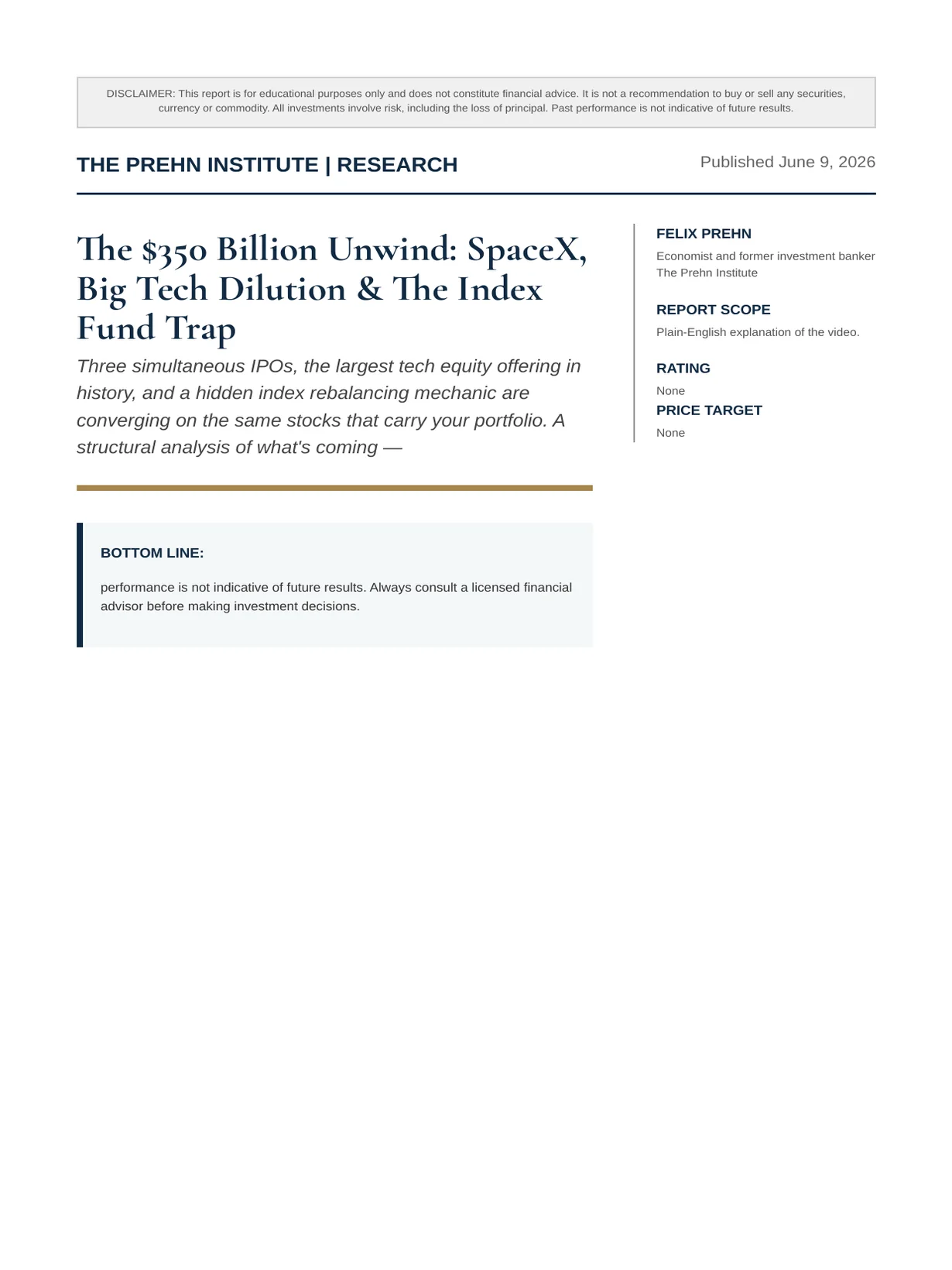
The $350 Billion Unwind: SpaceX, Big Tech Dilution & The Index Fund Trap
Three simultaneous IPOs, the largest tech equity offering in history, and a hidden index rebalancing mechanic are converging on the same stocks that carry your portfolio. A structural analysis of what's coming —
Felix Nikolas Prehn · 9 June 2026 · 12 pages
Bottom line
performance is not indicative of future results. Always consult a licensed financial advisor before making investment decisions.
Goat Academy Research
Overview
performance is not indicative of future results. Always consult a licensed financial advisor before making investment decisions.
June 2026 | Page 2
The $350 Billion Capital Drain
Two forces are about to hit the stock market at the same time — and both are aimed at the exact same stocks.
Force #1: The Triple IPO Collision
Three of the largest private companies on Earth are racing to go public nearly simultaneously, creating an un‐ precedented capital demand:
Exhibit 1: The Triple IPO — Capital Requirements & Valuations
COMPANY
RAISE AMOUNT
TARGET VALUATION
KEY DETAIL
SpaceX $75B $1.75T
Largest IPO in stock market history; ~2.5× Saudi Aramco ($29B in 2019)
OpenAI $60B $1.0T S-1 filed confidentially; currently losing $14B per year
Anthropic $60B ~$965B S-1 filed; Claude AI competes directly with ChatGPT
TOTAL
~$200B
Sources: Reuters, AIToolsRecap, Fortune, Forbes — See Sources section for full citations
To put SpaceX's $75 billion raise in perspective: the previous record-holder, Saudi Aramco's 2019 IPO, raised ap‐ proximately $29 billion. SpaceX is doing nearly three times that.
THE SHOPPING MALL ANALOGY Imagine three brand-new mega-malls all opening on the same street, in the same month. Every existing shop in town is going to lose customers — because shoppers (investors) only have so much money to spend. That is what is happening to existing stock holdings.
Force #2: Big Tech Is Printing New Shares
While $200 billion is being drawn out for IPOs, the companies investors already own are simultaneously asking for more money through unprecedented equity issuances:
Alphabet (Google)largest tech stock offering ever Alphabet (Google) — Announced $85 billion in new shares, the largest tech stock offering ever
Meta — Reportedly exploring "tens of billions" in stock sales; stock dropped 5–9% on the rumor alone
Microsoft — Spending $190B on AI in 2026
Amazon — Spending $200B on AI in 2026 ready own.
Why Not Borrow? The debt market is choking on tech paper. In the first five months of 2026, AI-related companies have issued $110 billion in bonds — representing 15% of all investment-grade bonds issued this year. Borrowing costs have risen. Spreads have widened. The debt channel can no longer absorb this volume — so companies are turning to equity markets instead.
June 2026 | Page 3
The Total Damage
Exhibit 2: Total Capital Drain — 2026 Estimate
Triple IPO
Share Offerings
TOTAL
Source: Author analysis based on IPO filings, SEC filings, and reported equity offering sizes
Every dollar of the $350 billion must come from somewhere. Fund managers sell the stocks that are easiest to
sell — the most liquid, most widely held names: Nvidia, Microsoft, Apple, Google. These are the exact stocks cur‐ rently carrying investor portfolios.
S E C T I O N 0 3
Your "Safe" Index Fund Is a Trap
The S&P 500 is supposed to be 500 stocks. But right now, the top 10 make up over 40% of the entire index — more concentrated than at the peak of the dot-com bubble.
The Concentration Problem
Exhibit 3: S&P 500 Concentration — Historical Comparison
METRIC 2000 (DOT-COM PEAK) 2026 (CURRENT) DIFFERENCE
Top 10 Weight in S&P 500 ~29% 40%+ +11 percentage points
Top 3 (NVDA, AAPL, MSFT) — ~18.7% Nearly 1 in 5 dollars
Magnificent 7 Weight — ~35% Over ⅓ of the index
S&P 500 P/E Ratio ~28× ~30× Above dot-com levels
Sources: PionLine, Commonfund, SlickCharts, Motley Fool
The Magnificent Seven — Apple, Nvidia, Microsoft, Amazon, Google, Meta, and Tesla — make up roughly 35% of the index. When someone says "I'm diversified, I own the S&P 500," they are effectively saying: "35% of my money is in seven tech stocks, and I didn't even choose them."
The Two-Sided Attack
$200B
$150B+
$350B+ Minimum
Large funds sell these stocks to free up cash for $200B in IPOs. When SpaceX goes public, hedge funds don't buy with money under a mat‐ tress — they sell Microsoft, Nvidia, and Apple.
The companies themselves are printing new shares. Alphabet is selling $85B in new stock. Meta may follow. Every new share dilutes the ones investors already own.
Selling pressure from the outside. Dilution from the inside. Both hitting the same stocks at the same time. This is not a normal pullback — it is a structural event.
THE PREHN INSTITUTE RESEARCH June 2026 | Page 5
Even the Biggest Bull Is Scared
The warning signals are not coming from perennial pessimists. They are coming from two of the most respected — and divergent — voices in investing.
The Value Investor: Mohnish Pabrai
Mohnish Pabrai is one of the greatest living investors — a close personal friend of the legendary Charlie Munger (Warren Buffett's partner for 60 years). Pabrai famously turned $1 million into $30 million investing in Turkey while the Turkish lira was collapsing 90%.
- Mohnish Pabrai, on the S&P 500 (October 2025)
Pabrai points out that the S&P 500 is trading at a P/E of 30 — the long-term average is 16. Stocks are nearly
twice as expensive as normal , and above where they were at the peak of the dot-com era. His personal fund is trading at a P/E of just 11, concentrated in coal and energy companies. He has zero exposure to mega-cap tech.
Meanwhile, Warren Buffett — through Berkshire Hathaway — has sold his S&P 500 index fund holdings entirely, while simultaneously deploying $10 billion into Alphabet at depressed prices. Buffett didn't invest because he loves chatbots — he saw the dilution coming and positioned himself to buy when others were selling.
The Perma-Bull: Tom Lee
Tom Lee , head of research at Fundstrat Global Advisors, is the most consistently bullish voice on Wall Street. He correctly called the 2023 rally, the 2024 rally, and the 2025 recovery when consensus was bearish.
TOM LEE'S WARNING The perma-bull is now warning of a 15–20% correction in 2026.
His three reasons:
New Federal Reserve leadership creating uncertainty around interest rate policy
AI valuations are getting repriced — the market is realizing these stocks may not be worth current prices
Policy fragmentation and trade wars creating headwinds that slow corporate earnings
Lee projects 2026 will follow a pattern of "joy, depression, and rally" — a painful drop in the middle of the year, fol‐ lowed by a year-end recovery.
CRITICAL INSIGHT Even if Lee is correct that markets recover by December, a 15–20% mid-year drop wipes out everyone
who panics . Those who sell during the drawdown lock in permanent losses and miss the recovery. Conversely, those with a plan see a 20% drop as the buying opportunity of a decade.
Mohnish Pabrai Value Zero mega-cap tech; P/E 11 portfolio Coal, energy, materials
Warren Buffett Value Sold S&P 500 index holdings $10B into Google at dip
Tom Lee Growth / Bull Warning of 15–20% correction Top picks: energy, basic materials
THE PREHN INSTITUTE RESEARCH June 2026 | Page 6
The 2021 Playbook — This Has Happened Before
The pattern is always the same: hype → IPO flood → liquidity drain → crash. We are seeing the exact same pattern now — but at 10× the scale.
The 2021 IPO Boom — And What Followed
In 2021, the market was euphoric. Money was cheap. Massive IPOs flooded the market — Rivian, Coinbase, Robinhood — all at what turned out to be absurd valuations. Then the Federal Reserve tightened. Liquidity vanished.
Exhibit 5: Post-IPO Crash — 2021 Cohort Peak-to-Trough Declines
Robinhood (HOOD)
Rivian (RIVN)
Coinbase (COIN)
IPO Market (2022)
Source: Author analysis based on public market data
In 2022, total IPO proceeds collapsed by 94% compared to 2021. The market effectively shut down. The current cycle is repeating this pattern — but SpaceX alone is raising more than the top five IPOs of 2021 combined.
The AI Spending Trap
Big Tech is collectively spending over $725 billion on AI infrastructure in 2026. The Federal Reserve has flagged AI infrastructure spending as a top systemic financial risk.
Exhibit 6: 2026 AI Capital Expenditure by Major Tech Company
COMPANY 2026 AI CAPEX FUNDING SOURCE RISK
Amazon $200B Potential equity issuance
Microsoft $190B Potential equity issuance
Alphabet (Google) $190B Already issuing $85B in shares
| Meta | $145B | Reportedly exploring stock sale |
|---|---|---|
| TOTAL | $725B | 95% of enterprise AI projects show no measurable ROI |
-85%
-85%
-75%+
-94% total proceeds vs. 2021
Google's breakthrough "TurboQuant" technology reduces the memory needed to run AI by 6×. If compa‐ nies need dramatically less hardware to achieve the same results, the demand story propping up hardware stocks — and the justification for $725B in spending — begins to crack. The companies spending the most will fall the hardest when the market recognizes this.
June 2026 | Page 7
The 3-Step Framework — What To Do Now
The people who get wealthy in markets like this are not the people who panic. They are the people who have a plan before the storm hits.
Audit Your Concentration Pull up your 401k or brokerage account and answer: how concentrated am I?
Quick estimate: Take the total amount in index funds. Multiply by 0.40. That is roughly how much sits in just 10 stocks. For a $100,000 S&P 500 position, approximately $40,000 is in 10 companies
- $35,000 in just seven.
Gut check: If a 20% drop in your index fund would cause you to panic sell, you are too concen‐ trated. Full stop.
Understand Where the Money Is Going When big money leaves tech stocks, it does not disappear — it rotates. The smart money is telling you exactly where:
Pabrai: Coal and energy companies
Tom Lee: Energy and basic materials
Buffett: Bought $10B of Google at the dip; positioned for dilution-driven dislocations
Institutional investors call this the "HALO shift" — High-Asset, Low-Obsolescence. Businesses that own real, physical assets: utilities, pipelines, defense contractors, energy companies. They pay dividends, generate real cash flow, and don't need $85 billion in share offerings to fund speculative AI bets.
Build Your Watchlist Before the Dip
Do NOT panic sell. That is how regular people destroy their retirement.
Do NOT try to time the exact bottom. Nobody can. Not even Buffett.
What you DO: Make a list of 10–15 high-quality companies you would love to own at the right price. Write down the price you would pay for each one. Then wait.
"Have your list. Know your prices. When blood is in the streets, you buy the
list."
- The entire strategy of the greatest investors who ever lived, in one sentence.

the opportunity appeared, he acted.
💡
First & Only LIVE Training on
"The Index Fund Trap: Why the S&P 500 Is Lying to You"
Learn how to audit your portfolio, identify rotation plays, and build the buy list that turns a crash into an opportunity.
THE PREHN INSTITUTE RESEARCH June 2026 | Page 9
The Big Picture
Every great bull market has a shakeout. Every single one. The 1990s had one. The 2010s had one. This one will too.
The AI revolution is real. This report is not an argument that AI is a fraud. It is an argument that the stocks pricing
it in are ahead of themselves — and the companies behind them are printing shares to pay for bets that may not produce returns for years.
The people who build wealth from this environment are not the ones who bought the hype at the top. They are the ones who bought the hangover.
The Final Word
This is not 2008. The economy is not collapsing. This is a $350 billion game of musical chairs — and you have just been told the music is about to stop.
Have your list. Know your prices. Buy the hangover.
S O U R C E S & D I S C L O S U R E S
Selected Sources
OpenAI IPO: AIToolsRecap; Forbes
Anthropic IPO: Reuters (June 1, 2026); Fortune (June 2, 2026)
Alphabet $85B Offering: SEC Filing; CNBC (June 1, 2026); Yahoo Finance
Meta Equity Exploration: Reuters (June 5, 2026); CryptoBriefing
AI Capex Totals: Tom's Hardware; Yahoo Finance
Debt Market Stress: Reuters; MarketMinute; CNBC
S&P 500 Concentration: PionLine; Commonfund; SlickCharts; Motley Fool
Mohnish Pabrai: AcquirersMultiple (Oct 2025); ButterflyMarketInsider; PortfoliosLab
Tom Lee / Fundstrat: Yahoo Finance; Medium; CryptoRank
2021 IPO Crash Data: Public market data; Motley Fool (Biggest IPOs)
Nasdaq Fast-Entry Rule: Nasdaq regulatory filings
AI ROI Data: Fidelity AI Bubble Analysis
Federal Reserve AI Risk Flag: Federal Reserve Financial Stability Report
Important Disclosures: This report is published by The Prehn Institute for informational and educational purposes only. It does not constitute investment advice, a recommendation, or an offer to buy or sell any securities. The author may hold positions in securities discussed in this report. All data is sourced from publicly available information believed to be reliable but not independently verified. Past performance is not indicative of future results. Investing involves risk, including the potential loss of principal. Always consult with a qualified financial advisor before making any investment decisions. The views expressed represent the opinions of the author as of the date of publication and are subject to change without notice.
Mohnish Pabrai sees it. Tom Lee sees it. Buffett sees it. The question is — do you? And what are you going to do about it?