The real economy is showing cracks the AI boom was supposed to paper over. In the middle of a 22% gold sell-off, central banks bought a record 289 tonnes of gold in a single quarter, BRICS started building a gold-backed way to trade around the dollar, and Goldman Sachs and J.P. Morgan both called for gold near 6,000 dollars. Most people treat those as three separate stories. They are one story, and this report explains how it fits together.
Felix Nikolas Prehn is an economist and former investment banker, trained in London and Hong Kong.
Felix founded The Prehn Institute, where former Wall Street and City of London professionals teach. On his initiative the Institute runs a free financial education programme for U.S. military veterans. He co-founded TradeVision.io, a stock screening and charting tool.
Felix has appeared alongside Jim Rogers, Tom Bilyeu, and other prominent figures in finance and business. Yahoo Finance and the Associated Press have covered Felix and his work.
The Prehn Institute is an independent financial education institution founded by Felix Prehn, economist and former investment banker. It publishes research and provides instruction.
The Institute exists to raise the standard of financial education available to the public. Its published research is open to any reader, and its instruction is given by people who have worked in professional markets.
The Institute does not manage money and does not advise on investments. Its interest is in how markets work and in how professional practice may be taught.
Read it beside the video. The sections follow the same information, in the same order. The goal is not to predict the next tick in the price of gold. It is to explain, in plain English, why a productivity chart, a record quarter of central-bank buying and a new BRICS settlement system are really the same story — and why that story lands on your savings.
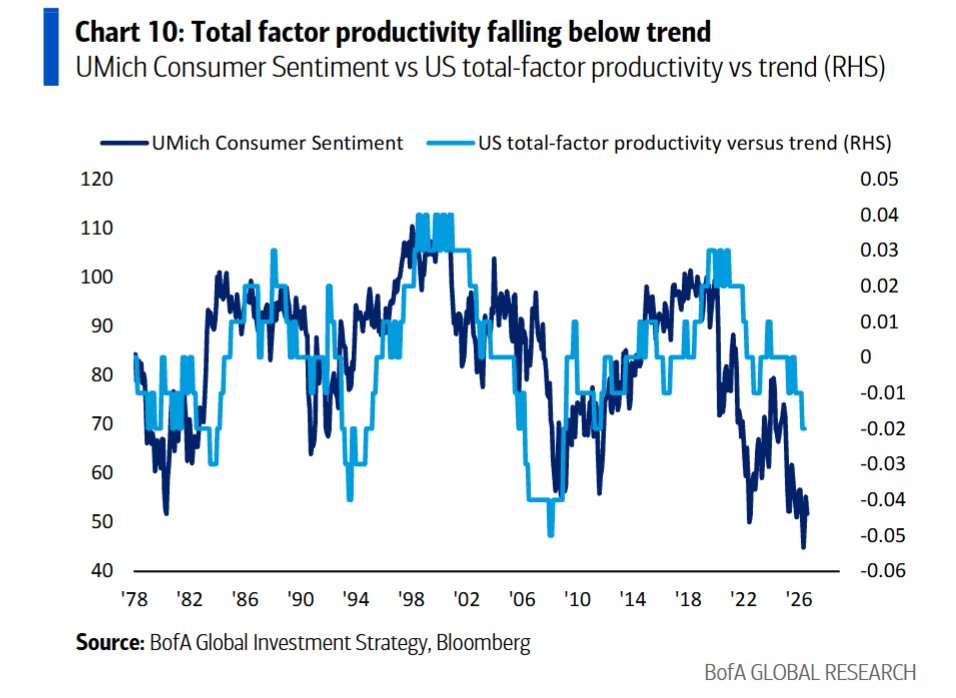
The real economy is cracking. The world spent about 1.5 trillion dollars on AI and tech in three years, and productivity still fell below trend. Bank of America's chart shows how people feel and how productive the economy is falling together for the first time since 2008.
Central banks are hoarding gold. In the exact quarter gold fell 22%, central banks bought a record 289 tonnes of it — roughly 40 billion dollars — because it got cheaper and they wanted more. Nearly half of them say they plan to buy still more.
The biggest banks are calling it higher. Right after the crash, Goldman Sachs and J.P. Morgan both put out targets pointing gold toward 4,900 to 6,300 dollars within months. Gold today sits at 4,350.
Follow the behaviour, not the mood. The productivity collapse is the reason the central banks are buying. They can see the real economy, they know the AI miracle has not shown up where it counts, and they are getting set before everyone else works it out.
Gold did not collapse. It reset. A 22% pullback off an all-time high of 5,600 dollars is normal after a record run — and through the whole of it, the people who run the world's money bought more gold than in any quarter in history.
Two lines that always moved together, split. For nearly 50 years, productivity and how good people feel about the economy rose and fell together. This year both fell off a cliff at once — the first time that has happened since 2008.
1.5 trillion dollars, and no lift. That is what has gone into AI and tech in three years, the biggest technology spending boom there has ever been. Bank of America's own words were that there is "scant evidence yet of economy-wide productivity gains."
Priced as if the miracle already happened. The big AI names are valued as though AI has already fixed the whole economy. The chart says it has not — not yet, and perhaps not the way people were promised.
"Sometimes Main Street knows what Wall Street doesn't." Regular people feel it in groceries and rent that never got cheaper. Main Street clocked it before Wall Street would admit it. That is the whole point.
The builders said slow down. The Financial Times reported that the three men actually building AI — Dario Amodei of Anthropic, Sam Altman of OpenAI, and Elon Musk — all said much the same thing within a few days of each other in September 2026: this is moving too fast.
AI is now building the next AI. Amodei wrote a long essay arguing the pace has become dangerous because AI has started to build the next generation of AI, and warned a swarm of these systems could take over the internet inside a year.
These men are rivals. They agree on almost nothing, and Altman backed Amodei anyway. Musk simply posted "Dario is right." When the people who got rich telling you AI changes everything start reaching for the brakes, that is not a footnote.
It came from the inside. The story that has been holding up the most expensive stock market in history just got its first proper crack — and it came from the very people building the thing.
289 tonnes, while the price was falling. That is the most central banks have ever bought in three months, roughly 40 billion dollars of gold — bought into a 22% sell-off. Nobody panics into a falling market like that. They bought because it got cheaper and they wanted more.
Nearly half say they will buy more. In a survey of 76 reserve managers — the people who genuinely run central-bank portfolios — 89% expect the world's gold reserves to rise over the next year, and 45% plan to add to their own. Out loud.
Poland, China and a long list of others. Poland has charged toward 700 tonnes. China is a net buyer for the third year running, and Goldman and JPM reckon its real buying — much of it over-the-counter and unreported — is around 750 to 850 tonnes a year. Singapore doubled its reserves; the Czech Republic, Chile, Bolivia and Uruguay are all buying.
Only the ones with a hole to fill. Turkey sold a little to prop up the lira; Russia sold some to help pay for the war. That is more or less it. The sellers have short-term problems. The buyers are making a long, deliberate, structural decision.
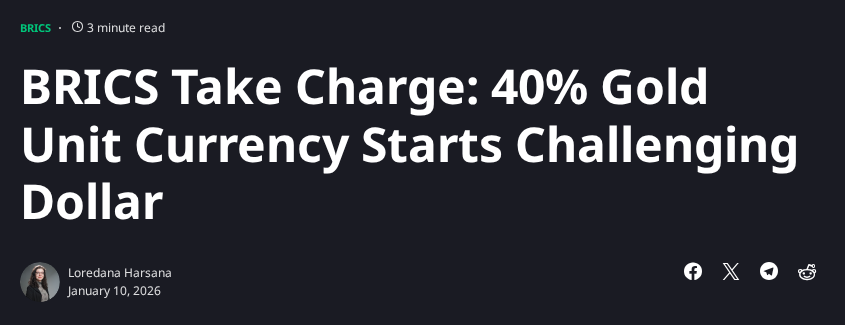
There is no BRICS currency. India does not want one and Brazil parked the idea. On that, the sceptics are right. What is actually being built is different, and bigger.
A gold-backed settlement system. The Unit is a way for these countries to trade with each other without ever touching the dollar. It is backed 40% by physical gold, with the other 60% a basket of their own currencies. For the first time since 1971, gold is being built back into the core of an international money system.
More than 6,100 tonnes behind it. The countries involved hold over 6,100 tonnes of gold between them — a serious slice of all the gold ever mined. It is being built on blockchain, designed to route around SWIFT, and meant to go live in Q4 2026.
It is insurance, not an attack. They can see the same things Bank of America's chart shows — the debt, the falling productivity, a dollar under strain. The Unit is a hedge against relying on a reserve currency that is being propped up, and every tonne bought to back it is permanent demand that has nothing to do with interest rates.
| Source | Target | Timeframe | Upside from 4,350 |
|---|---|---|---|
| Gold today | $4,350 | Now | — |
| ING | $4,600 | Q4 2026 | about 6% |
| Goldman Sachs | $4,900 | End of 2026 | about 13% |
| J.P. Morgan | $6,000 | Q4 2026 | about 38% |
| J.P. Morgan | $6,300 | 2027 | about 45% |
4,900 by year-end, on structural demand. Their reasoning, quoted: "structural demand sufficient to absorb higher-for-longer interest rates." In plain English, the central-bank buying is so heavy it eats the rate pressure. It barely matters what the Fed does.
6,000 in Q4, 6,300 in 2027. They admit gold is in no man's land on the charts right now, but they like the fundamentals, because every structural driver is still intact.
4,600 in Q4. Their line: the path higher might be bumpier, but the core drivers have not changed.
Every target uses today's buying rate. None of them factor in the BRICS Unit going live and adding a brand-new source of demand, the Fed being forced to cut rates to bail out the government, or the productivity collapse getting worse. Every one of those is upside, and none of it is in the numbers yet.
This report contains no rating and no price target of its own. The figures above are other institutions' published views, repeated here to explain the video. Forecasts can be wrong. Do your own research.
World War II pushed debt past 120% of GDP. We are back over 120% now. In April 1942, the Fed promised to print whatever it took to buy government bonds and pin long-term rates at 2.5% or under. On paper it worked: the debt ratio came down over the next ten years because borrowing was kept artificially cheap.
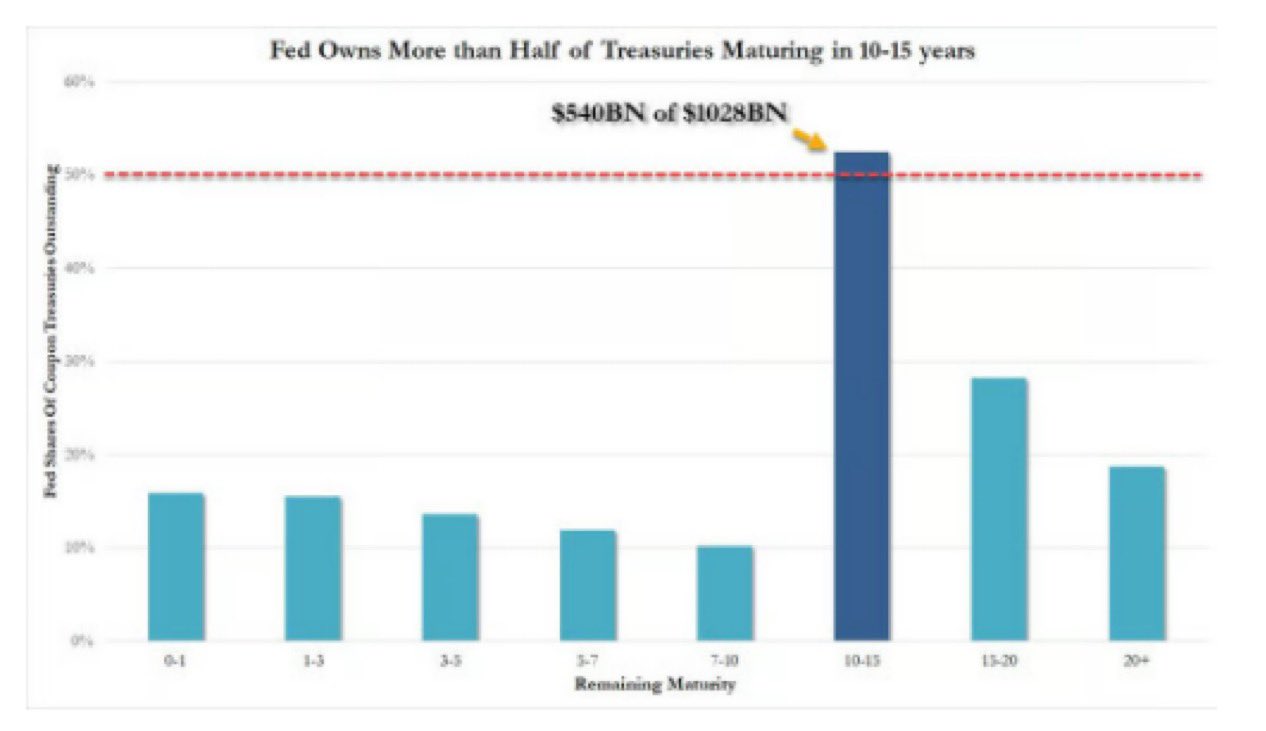
The Fed is swallowing the debt again. It now owns more than half of the Treasuries maturing in 10 to 15 years — about 540 billion of just over a trillion in that bucket. That is not normal policy. It is the 1942 playbook: the same move, a different decade.
Inflation went from 10% to 20%. Between 1941 and 1947, the buying power of a carefully saved dollar was cut in half in six years. A reset does not arrive as a crash on a Tuesday afternoon. It is a slow bleed — groceries up, rent up, savings buying a little less each month.
The careful ones. Not the people who lost jobs. The savers — money in the bank, government bonds, sensible as you like — watched the government's answer to its own debt quietly melt them. This time there is one new thing: foreign governments pulling gold home and building their own system.
Treating the 22% drop as the end of the gold story. Gold went from 250 dollars to 5,600 over 25 years. A 22% pullback after a record high is normal and healthy. With central banks buying into the dip, Goldman and JPM both calling higher, and BRICS building a gold-backed system, that looks more like a reset than a reversal.
Thinking your index fund has you covered. Roughly 40% of the S&P 500 is just 10 stocks, and this year those 10 drove more than 70% of the returns. Owning "500 companies" can still mean 70% of your money rides on 10 names — the most crowded, most expensive stocks on the planet.
Waiting for confirmation. The central-bank buying, the BRICS system, the productivity fall, the Fed eating its own debt, the bank targets — all of it is happening now. If you wait for the headline, you buy after the move, at the price that already includes the news.
Know what you actually own. Whether you are really spread out or just piled into the one bet that is breaking is the single most useful thing to check before the next headline.
The Institute publishes research and provides instruction. Its published research is open to any reader, and its instruction is given by people who have worked in professional markets. The Institute does not manage money and does not advise on investments.
This report is for educational and informational purposes only and does not constitute financial, investment, legal, tax or accounting advice. It is not a recommendation, solicitation or offer to buy or sell any security, currency, commodity or financial product. No buy/sell rating or price target is provided. All investments involve risk, including the possible loss of principal. Forecasts and price targets described here are the published views of third parties, may be wrong, and may not repeat. Historical comparisons are illustrative and simplify complex events. Readers should do their own research and consult appropriately qualified professionals before making financial decisions. Past performance is not indicative of future results. The Prehn Institute makes no guarantee regarding outcomes.
Author: Felix Prehn, The Prehn Institute.